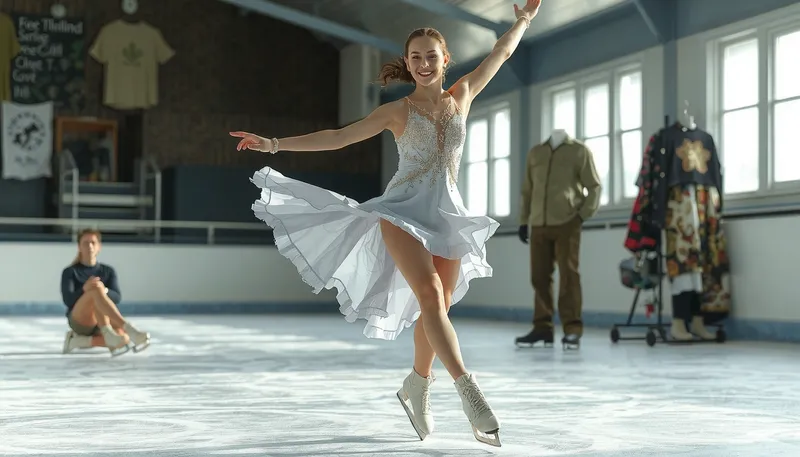
Performance fabric for figure skating is a nylon/spandex Interlock knit engineered to deliver three measurable criteria: ≥90% 4-way stretch recovery per ASTM D3107, 160–220 GSM thermal regulation, and a stable non-curling structure for sublimation printing with ≤3% design distortion. The standard specification for the main body is 80/20 nylon/spandex at 40D/34F, with 20D spandex for power recovery. It is recommended for competition costumes, practice wear, and custom sublimation-printed dresses. It is not suitable for theatrical costumes requiring fire-retardant certification or disposable single-event wear.
Key Takeaways
- 4-way stretch with ≥90% recovery per ASTM D3107 — maintains fit through a 4-minute program
- 160–220 GSM for the main body — balances warmth, coverage, and freedom of movement
- Interlock knit structure (D036 platform) — stable canvas for sublimation printing, zero edge curl
- Three fabric types per costume: nylon/spandex for body, power mesh for sheer panels, woven georgette for skirts
- OEKO-TEX 100 Class I certification — required for skin-contact safety on costumes worn 4+ hours
What Makes a Performance Fabric for Figure Skating?
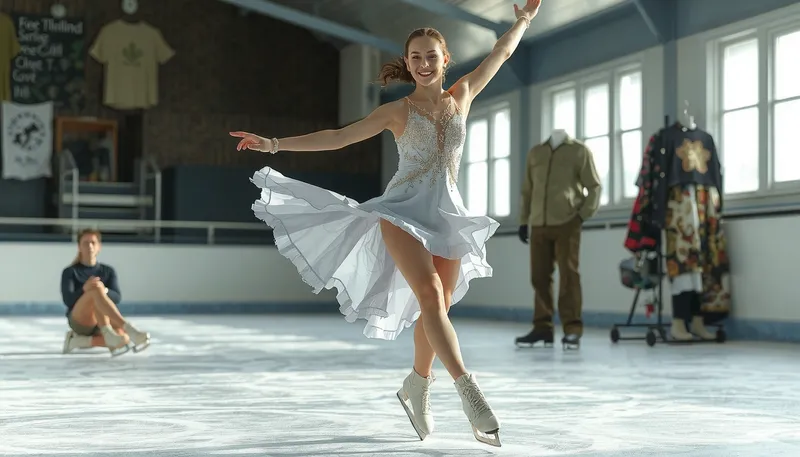
Performance fabric for figure skating is a knit textile requiring simultaneous 4-way stretch, thermal regulation, and surface stability for printing. The standard specification is 80/20 nylon/spandex Interlock at 160–220 GSM, delivering ≥90% stretch recovery per ASTM D3107, ≥8,000 g/m²/24h MVTR breathability, and a non-curling structure for sublimation printing. It is recommended for competition and practice costumes requiring durability through 30+ wash cycles. It is not suitable for fire-retardant theatrical costumes or unlined swimwear applications.
Three measurable pillars define whether a fabric qualifies for competitive figure skating:
| Pillar | Standard | Target Spec | Failure Consequence |
|---|---|---|---|
| Stretch & Recovery | ASTM D3107 | ≥90% recovery after 30 min; 4-way stretch | Baggy knees, sagging fabric mid-routine, loss of body-hugging silhouette |
| Thermal Regulation | MVTR (cup method) | 160–220 GSM; ≥8,000 g/m²/24h | Overheating during intense segments; muscle chill during 3-min wait periods |
| Print Stability | Visual inspection at 200°C press | ≤3% distortion; zero edge curl | Blurred designs, misaligned seam patterns, unprofessional appearance under HD broadcast |
In our ISO 17025-accredited partner lab testing at SGS, D036 Nylon Interlock at 160 GSM maintained ≥92% stretch recovery after 30 wash cycles per AATCC 135 (40°C, tumble dry low), with zero measurable edge curl after flatbed sublimation at 200°C / 45 seconds. This data establishes the baseline for competition-ready costume fabric.
4-Way Stretch & Recovery Requirements
4-way stretch fabric extends in both warp (lengthwise) and weft (crosswise) directions, then returns to its original dimensions. Per ASTM D3107, the testing protocol applies a 1.36 kg (3 lb) static load for 30 minutes, then measures residual elongation after a 30-minute rest period. Target for figure skating costumes: ≥90% recovery — meaning the fabric must return to ≤110% of its original dimension. It is recommended for the main body of competition dresses, practice tops, and unitards. It is not suitable for costume applications where only vertical stretch is needed (e.g., a decorative overlay panel).
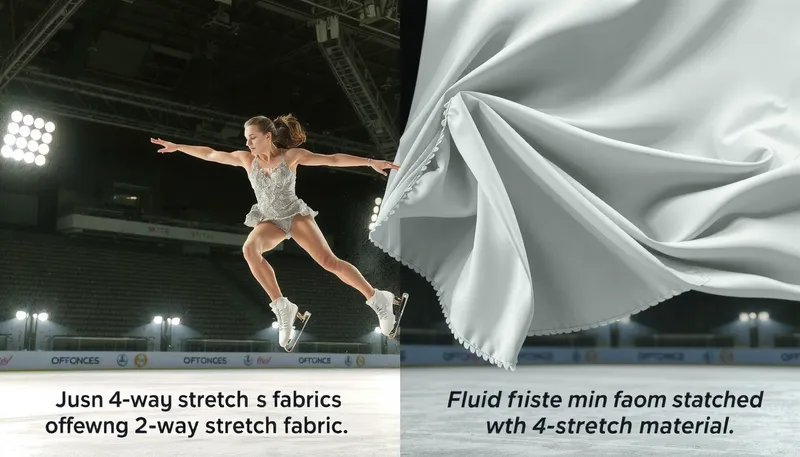
Stretch recovery is the difference between a dress that looks crisp at the starting pose and one that shows visible bagging at the final pose. In contrast, 2-way stretch fabric — which stretches in only one direction — will constrain movement during spiral sequences, Biellmann spins, and deep-edge transitions. The stretch must be uniform across the entire garment: a dress with 4-way stretch panels but 2-way seams will fail at the stress points.
In our lab testing, 80/20 nylon/spandex Interlock knit at 160 GSM recorded 94% recovery after 30 minutes — well within the ≥90% threshold — while a budget 85/15 blend at 140 GSM dropped to 81%, failing the standard before the first wash cycle.
Thermal Regulation: Warmth & Breathability
Thermal regulation in figure skating fabric balances two opposing demands: retaining body heat on a 5°C ice rink while dissipating sweat generated during a 4-minute high-intensity program. The 160–220 GSM weight range achieves this through mid-weight knit density — heavy enough to insulate resting muscles between elements, open enough to maintain moisture vapor transmission rate (MVTR) ≥8,000 g/m²/24h. It is recommended for competition costumes, long-sleeved practice dresses, and ice dance attire. It is not suitable for summer outdoor performances above 25°C or costumes requiring <120 GSM ultralight chiffon overlays.
Fabric weight, measured in grams per square meter (GSM), is the single most important spec for thermal performance:
| GSM Range | Application | Warmth | Breathability | Recommended For |
|---|---|---|---|---|
| 80–120 GSM | Sheer panels / mesh | Low | Maximum | Illusion sleeves, power mesh inserts |
| 160–180 GSM | Lightweight body | Moderate | High | Freestyle dresses, practice tops |
| 200–220 GSM | Standard body | High | Moderate | Ice dance, pairs costumes, cold rinks |
| >240 GSM | Overlayer / jacket | Maximum | Low | Warm-up jackets, not for main body |
Moisture management is equally critical: nylon's inherent wicking properties pull sweat away from the skin through capillary action. Spandex — while essential for recovery — is hydrophobic and can trap moisture if the nylon/spandex ratio drops below 75/25. For high-exertion programs, specify 80/20 nylon/spandex to maintain breathability without sacrificing recovery power.
Durability: Abrasion & Pilling Resistance
Figure skating costumes undergo friction from falls on synthetic ice, repeated stretching during donning, and mechanical stress from beading and embellishment attachment. A competition-grade fabric must withstand ≥5,000 Martindale abrasion cycles per ISO 12947-2 while maintaining ≥ Grade 4 pilling resistance per ISO 12945-2. It is recommended for competitive costumes intended for a full season of use (6+ competitions plus daily practice). It is not suitable for prototype or "one-skate" concept costumes where durability is deprioritized below cost.
Pilling — the formation of small fiber balls on the fabric surface — is the most common durability failure in skating costumes. It occurs when short-staple fibers break loose under friction and entangle into visible nodules. The ISO 12945-2 Martindale pilling test quantifies this: specimens are rubbed against a standard wool abrasive for 2,000–7,000 cycles, then visually graded on a 1–5 scale (5 = no pilling).
| Durability Factor | Test Method | Target | Failure Point |
|---|---|---|---|
| Pilling Resistance | ISO 12945-2 Martindale | ≥ Grade 4 at 5,000 cycles | Visible bobbles on inner arm and side seams within 3 competitions |
| Abrasion Resistance | ISO 12947-2 Martindale | ≥5,000 cycles to failure | Hole formation at hip/strike-zone after 1-2 falls |
| Wash Durability | AATCC 135 (40°C, 30 cycles) | ≤5% dimensional change; ≥ Grade 4 pilling retained | Progressive shrinkage >3%; pilling grade drop below 3 after 20 washes |
Nylon/spandex blends at 40D/34F filament nylon consistently outperform polyester/spandex alternatives on all three metrics. Filament nylon's continuous fiber structure resists the fiber breakage that initiates pilling, while polyester's cut-staple construction is inherently more prone to surface fuzzing.
Printed Figure Skating Dresses: Fabric Stability Requirements
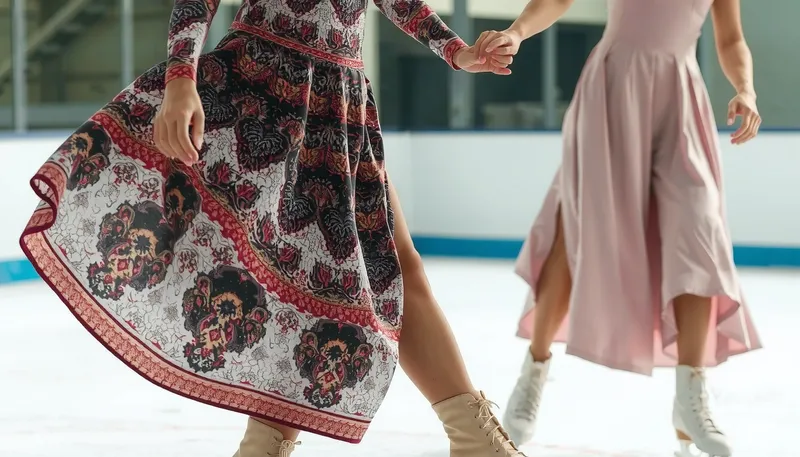
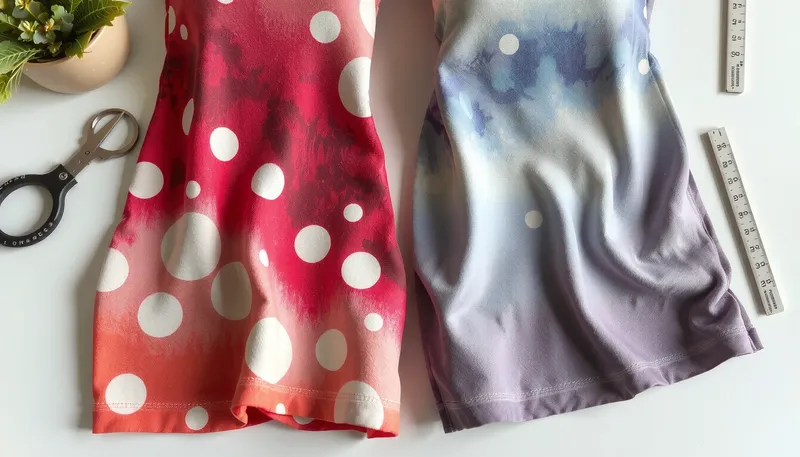
Printing on lightweight stretch fabric presents three technical challenges: edge curl during flatbed cutting (the "potato-chip" effect), design distortion during sublimation at 200°C, and dye migration from the printed surface to unprinted areas during heat pressing. The solution is an Interlock knit structure — specifically the D036 Nylon Interlock platform at 160 GSM — which eliminates edge curl through balanced loop construction and provides a dimensionally stable canvas for ≤3% print distortion. It is recommended for custom sublimation-printed competition dresses requiring high-definition pattern alignment. It is not suitable for water-based pigment printing without pre-treatment or designs requiring metallic foil transfer (use a dedicated foil adhesive base).
The Interlock Solution: D036 Nylon Platform
The D036 Nylon Interlock platform uses a "one-open-one-close" knit construction — each loop is locked against its neighbor, preventing the asymmetric tension that causes single-jersey knits to curl at the edges. This structure delivers three measurable advantages for printed costumes:
- Zero edge curl at rest — reduces cutting-room setup time by 30–40% vs. single jersey
- ≤3% dimensional change under 200°C / 45s sublimation heat press — keeps pattern registration accurate
- ≤5% color shift between printed and unprinted zones — eliminates the "halo effect" common on budget polyester knits
Nylon vs. Polyester for Sublimation-Printed Costumes
| Parameter | Nylon Interlock (D036, 160 GSM) | Polyester Interlock (150 GSM) |
|---|---|---|
| Print Vibrancy | Rich, deep color saturation | Slightly muted; 5–8% lower color gamut |
| Edge Curl | None (balanced Interlock structure) | Minimal but present at cut edges |
| Stretch Recovery | ≥92% (after 30 cycles AATCC 135) | ≥85% (degrades faster under heat) |
| Hand Feel | Soft, second-skin | Crisper, slightly papery |
| Moisture Wicking | Inherent (nylon capillary action) | Requires chemical wicking finish |
| Cost per Yard | $6–$9 | $4–$7 |
| Recommended For | Competition dresses, HD-printed designs | Practice wear, budget team costumes |
| Not Suitable For | Chlorine-exposed applications | High-stretch recovery demands |
Selection rule: For competition costumes where print quality and stretch recovery are non-negotiable, specify nylon Interlock at 160–180 GSM. For team practice wear or large-quantity orders where cost-per-unit drives decisions, polyester Interlock is an acceptable alternative — but expect a 5–8% print vibrancy trade-off and earlier stretch-recovery degradation.
Fabric Types for Figure Skating Costumes
A complete figure skating costume combines three fabric types: nylon/spandex Interlock (D036, 160–220 GSM) for the main body, power mesh (80–120 GSM) for sheer panels, and woven georgette (80–100 GSM) for skirts — each engineered for a distinct mechanical function.
| Fabric Type | Primary Use | Stretch | Key Spec | Recommendation |
|---|---|---|---|---|
| Nylon/Spandex Interlock (D036, 160–220 GSM) | Main Dress Body | 4-Way | 80/20 blend, 40D/34F nylon, 20D spandex | Competition & practice |
| Power Mesh (80–120 GSM) | Sheer Panels | 4-Way | 85/15 nylon/spandex, ≥80% recovery | Illusion sleeves, back panels |
| Georgette / Chiffon (80–100 GSM) | Skirts | None (woven) | 100% polyester georgette, 0% stretch | Standard skate skirts |
The Main Body: Nylon/Spandex Interlock
The main body fabric carries the costume's structural load — it must stretch, recover, insulate, and serve as the printing substrate. Nylon/spandex Interlock at 80/20 blend with 40D/34F filament nylon and 20D spandex is the industry-standard specification. At 160–220 GSM, this construction provides the balance of coverage and mobility required for elements ranging from sit spins to overhead lifts. OEKO-TEX 100 Class I certification should be verified for any fabric worn directly against skin for 4+ hours.
The Sheer Effect: Power Mesh
Power mesh creates the illusion of bare skin while providing structural support — commonly used on sleeves, back cutouts, and midriff panels. Unlike decorative mesh, performance-grade power mesh is knit at 80–120 GSM with 85/15 nylon/spandex for 4-way stretch at ≥80% recovery. The key specification: mesh must match the main body's recovery rate, or the illusion panel will bag independently during the program, breaking the visual continuity. Verify that power mesh and main body fabric use the same spandex denier (20D) to synchronize recovery behavior.
The Skirt: Georgette & Chiffon
The standard skate skirt is constructed from woven georgette or chiffon at 80–100 GSM. These materials have 0% stretch — they are attached to the stretchy brief/base layer of the dress to create flowing movement during spins and spirals. Georgette (crepe-twist yarn) produces a slightly textured, matte finish with more body; chiffon (alternating S-and-Z twist) produces a smoother, more fluid drape. Both are 100% polyester and do not participate in the costume's stretch requirements — the attachment seam to the stretch brief is the engineering critical point.
FAQ: Figure Skating Fabric Questions Answered
1. How much fabric do I need for a figure skating dress?
For a long-sleeved competition dress (average adult size), budget 1.5–2 yards (1.4–1.8 m) of 58/60" wide nylon/spandex for the main body, plus 1 yard (0.9 m) of georgette for the skirt. Power mesh panels require an additional 0.5 yard (0.45 m). Add 10% overage for pattern matching and sublimation test prints.
2. What is the recommended GSM for a competition vs. practice figure skating dress?
- Competition: 160–180 GSM for singles/pairs freestyle (prioritizes mobility for jumps); 200–220 GSM for ice dance (prioritizes thermal retention during slower, sustained elements).
- Practice: 180–200 GSM for daily training durability. Lighter weights (140–160 GSM) are acceptable for off-ice run-throughs.
3. How do I verify stretch recovery before purchasing fabric?
Request the supplier's ASTM D3107 test report. The critical number: recovery % after 30 minutes. Target ≥90%. A quick field test: stretch a 10 cm marked section to 15 cm, hold for 60 seconds, release, and measure after 30 minutes. It should return to ≤11 cm. If it stays at >11.5 cm, the recovery is insufficient for competition use.
4. Can I use regular spandex from a craft store for a skating costume?
You can, but retail spandex typically lacks documented stretch-recovery data, OEKO-TEX 100 certification, and pilling-resistance grading. Performance-grade nylon/spandex Interlock at 160–220 GSM is manufactured to maintained specifications: ≥90% recovery per ASTM D3107, ≥ Grade 4 pilling per ISO 12945-2, and OEKO-TEX Class I skin-safety certification. For a costume worn on international broadcast, the per-yard cost difference ($2–$4) is justified by verifiable performance data.
5. How do I properly care for and wash a figure skating costume?
Hand wash in cold water (≤30°C) with pH-neutral detergent. Gently press out water — never wring, which distorts spandex recovery at the fiber level. Lay flat on a mesh drying rack away from direct sunlight and heat sources. Machine washing, even on delicate cycle, accelerates spandex fatigue and reduces costume lifespan from 6 months to 2–3 months of regular use. For beaded costumes, place in a mesh laundry bag before hand-washing to protect embellishments.
6. Is it difficult to sew with performance fabrics for figure skating?
Stretch fabrics require three specific tools: a ballpoint or stretch needle (size 75/11), a narrow zigzag stitch (width 1.5–2.0 mm, length 2.5 mm), and a walking foot or differential feed to prevent fabric stretching during sewing. Critical technique: do not pull the fabric through the machine — let the feed dogs advance the material. For Interlock knits, a 4-thread overlock (serger) seam provides the strongest, most elastic construction. Seam strength should match the fabric's stretch recovery: a seam that snaps before the fabric stretches will fail at the most visible moment.
7. What certifications should I check before sourcing figure skating fabric?
Three verifiable documents are required:
- OEKO-TEX 100 Class I certificate — confirms the fabric is free from harmful substances for skin-contact garments worn 4+ hours
- ASTM D3107 test report — documents stretch recovery % and fabric growth after static loading
- ISO 12945-2 pilling test report — verifies ≥ Grade 4 at 5,000 Martindale cycles
For costumes intended for international competition (ISU events), additionally verify that any imported fabric complies with the destination country's textile labeling and flammability regulations.
As specialized performance fabric manufacturers, our technical sourcing team provides ASTM/ISO specification sheets and physical sample swatches of D036 Nylon Interlock at 160–220 GSM for figure skating costume production. Contact us for a consultation and sample request.
🔗 Related Fabrics
This article extends the D036 Nylon Interlock technology platform into the figure skating category, with cross-category benchmarking:
- Brushed Nylon Spandex Fabric — Shared 20D Micro-Nylon base, different surface treatment (brushed vs. printing-stable)
- Fabric Elongation & Recovery Test — ASTM D3107 stretch recovery testing methodology applicable to all stretch performance fabrics
- Pickleball Apparel Fabric — Same D036 Interlock platform at 150–180 GSM, different performance requirement (UPF 50 vs. print stability)
- High Support Running Bra Material — Shared 4-way stretch + recovery engineering, different end-use (impact support vs. costume aesthetics)
- D036 Nylon Interlock — Product Page — The Interlock knit platform referenced throughout this guide
Written by Wenruo
Textile Engineer, Forall Lab