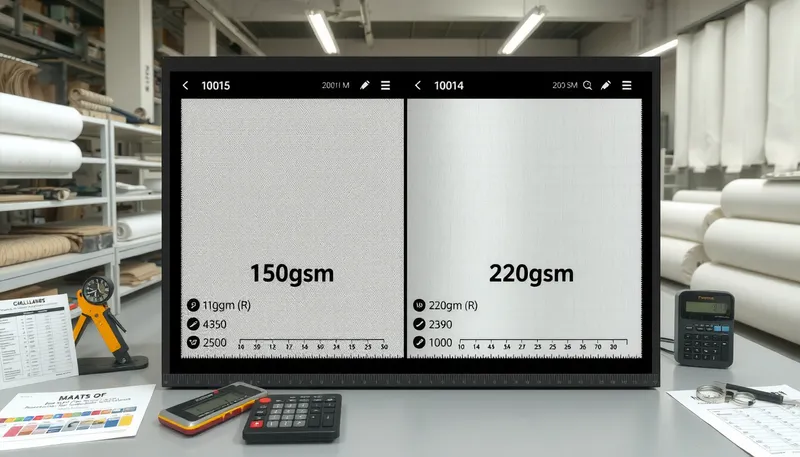
Fabric yield — the meters of fabric you get per kilogram — is determined by a single formula: Yield (m/kg) = 1000 ÷ (Fabric Width in meters × GSM). At $5.00/kg and 1.5m width, a 160gsm fabric yields 4.17 m/kg versus 3.03 m/kg for 220gsm — a 37.6% length advantage that drops effective cost from $1.65/m to $1.20/m.
The Bottom Line: More Meters, Less Money
- Yield Controls Cost: Fabric is sold by weight (kg) but consumed by length (meters). The only number that matters is cost per meter = price per kg ÷ yield. At equal $5.00/kg, 160gsm costs $1.20/m vs 220gsm at $1.65/m — a 27% gap hidden behind identical kg pricing.
- 37.6% More Length: At 1.5m width, 1,000 kg of 160gsm fabric produces 4,170 meters. The same weight of 220gsm produces only 3,030 meters. The difference: 1,140 extra meters — enough for ~950 additional yoga leggings.
- Stability Determines Real Yield: Single jersey 160gsm loses 5-15% to curling waste at the cutting table. Interlock construction (O3C structure) at 160gsm delivers the full theoretical yield with zero edge curl — this is the difference between calculated savings and realized profit.
- Freight + Storage Compound: Ordering 40,000 meters in 220gsm requires 13,200 kg of shipping weight. In 160gsm: 9,600 kg. That's 3,600 kg less freight cost and 27% less warehouse floor space — savings that repeat on every order.
- Formula Is Permanent: Yield = 1000 / (Width × GSM). Memorize it. Every supplier quote becomes instantly comparable when you convert price-per-kg to price-per-meter using this formula.
The Core Formula: How to Use a Fabric Yield Calculator Per Kg
Fabric yield (meters per kg) = 1000 ÷ (Fabric Width in meters × GSM). This formula converts a supplier's price-per-kg into your actual cost-per-meter — the only metric that matters for garment costing. Two inputs: GSM and usable width. One output: how many meters you actually get for your money.
What is GSM (Grams per Square Meter)?
GSM stands for Grams per Square Meter — the standard unit of fabric weight measured per ASTM D3776 (Standard Test Method for Mass Per Unit Area of Fabric). European mills may also reference ISO 3801. A higher GSM indicates a denser, heavier fabric; a lower GSM means lighter construction. Critical note: supplier-reported GSM carries a ±5% production tolerance — a fabric labeled 160gsm may test anywhere from 152 to 168 g/m². This tolerance directly impacts your yield calculation, introducing up to ±0.2 m/kg variance in real-world results.
The Yield Calculation Explained
Two numbers from your supplier determine everything: the fabric's GSM (with ±5% tolerance) and its usable width in meters (excluding 1-2 cm selvedge on each edge).
Formula Box:
Yield (meters/kg) = 1000 / (Usable Width in meters × GSM)
Component breakdown:
| Component | Value | Source | Tolerance |
|---|---|---|---|
| 1000 | Conversion factor | — | Fixed (grams → kilograms) |
| GSM | 160 g/m² (example) | Mill test report (ASTM D3776) | ±5% (±8 g/m²) |
| Usable Width | 1.48 m (example: 1.50m nominal − 2cm selvedge) | Physical measurement | ±1 cm per edge |
| Yield Result | 4.22 m/kg | 1000 / (1.48 × 160) |
±0.2 m/kg |
The formula: 1000 converts grams to a full kilogram. Divide by (width × GSM) to get meters per kilogram. For rapid comparisons, use a digital fabric yield calculator — but always verify GSM and width against the mill's test report before committing to production quantities.
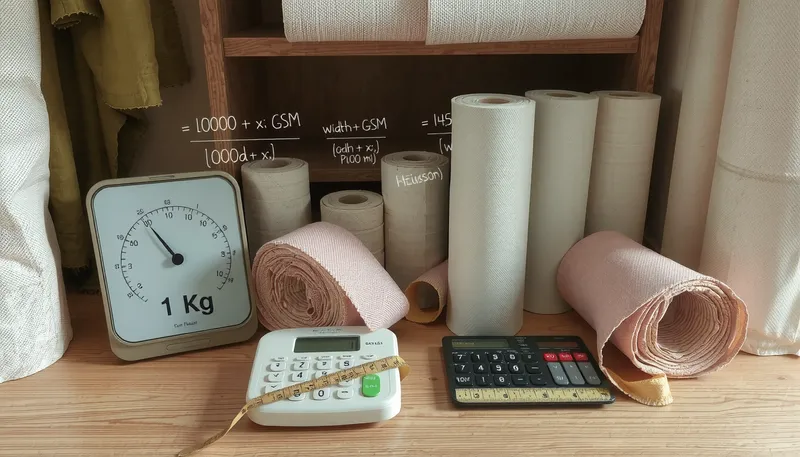
160gsm vs 220gsm: Complete Yield Comparison Table
At $5.00/kg and 1.5m usable width, a 160gsm fabric yields 4.17 m/kg versus 3.03 m/kg for 220gsm — a 37.6% length advantage that reduces effective cost from $1.65/m to $1.20/m. Below is the full comparative analysis across a 1,000 kg bulk order.
The Scenario: A 1,000 kg Bulk Order
A factory orders 1,000 kg of knit fabric for an activewear production run. Usable width: 1.48m (1.50m nominal minus 2cm selvedge). Both options priced at $5.00/kg from the same supplier.
- Fabric A: 220gsm single jersey knit (standard industry weight).
- Fabric B: 160gsm interlock knit (D036 construction, zero curl).
The Math: Complete Comparative Analysis
| Metric | Fabric A (Heavyweight) | Fabric B (Lightweight) | The Difference |
|---|---|---|---|
| GSM | 220 g/m² | 160 g/m² | -60 g/m² |
| Width | 1.5 meters | 1.5 meters | Same |
| Yield (m/kg) | 1000 / (1.5 * 220) = 3.03 m/kg |
1000 / (1.5 * 160) = 4.17 m/kg |
+1.14 m/kg (+37.6%) |
| Total Length from 1,000kg | 3,030 meters | 4,170 meters | +1,140 meters |
| Assuming Price/kg is $5.00 | $5,000 | $5,000 | Same initial cost |
| Effective Price per Meter | $5.00 / 3.03 = $1.65/m |
$5.00 / 4.17 = $1.20/m |
$0.45/m Savings (27% Cheaper) |
The Verdict: 160gsm Delivers 27% Lower Cost Per Meter
For the same $5,000 investment, the 160gsm interlock provides 1,140 extra meters — enough for approximately 950 additional yoga leggings (at 1.2m per unit). Effective cost drops from $1.65/m to $1.20/m, a savings of $0.45 per meter that compounds on every order.
Yield Sensitivity: How GSM and Price Interact
Not all 160gsm fabrics cost the same per kg. Use this table to find your actual cost-per-meter at different price points:
| GSM | Width | Yield (m/kg) | At $4.00/kg | At $5.00/kg | At $6.00/kg | At $7.00/kg |
|---|---|---|---|---|---|---|
| 140 | 1.48m | 4.83 m/kg | $0.83/m | $1.04/m | $1.24/m | $1.45/m |
| 160 | 1.48m | 4.22 m/kg | $0.95/m | $1.18/m | $1.42/m | $1.66/m |
| 180 | 1.48m | 3.75 m/kg | $1.07/m | $1.33/m | $1.60/m | $1.87/m |
| 200 | 1.48m | 3.38 m/kg | $1.18/m | $1.48/m | $1.78/m | $2.07/m |
| 220 | 1.48m | 3.07 m/kg | $1.30/m | $1.63/m | $1.95/m | $2.28/m |
Key insight: A 140gsm fabric at $6.00/kg ($1.24/m) is cheaper per meter than a 220gsm fabric at $4.00/kg ($1.30/m). The lighter fabric costs 50% more per kg but delivers 8% lower cost per garment. This is why focusing on price-per-kg alone is a sourcing trap.
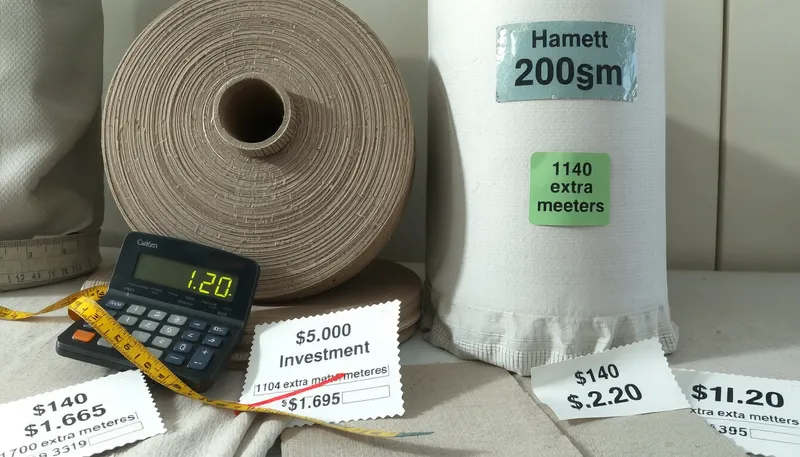
Beyond the Formula: Three Factory-Wide Cost Effects
High-yield fabric savings compound across three factory cost centers beyond the material bill: cutting efficiency, freight weight, and warehouse footprint. At our production facility, switching a 5,000-unit yoga legging run from 220gsm single jersey to D036 160gsm interlock reduced cutting waste from 8.2% to 1.7% — a 6.5% net yield gain beyond the theoretical formula.
Cutting Table Efficiency: Longer Rolls, Fewer Changeovers
A 25 kg roll of 220gsm fabric at 1.48m width yields approximately 77 meters. The same 25 kg roll of 160gsm fabric yields 106 meters — 38% longer. Over a full production day:
| Metric | 220gsm Roll | 160gsm Roll | Improvement |
|---|---|---|---|
| Meters per 25 kg roll | 77 m | 106 m | +38% |
| Roll changes per 1,000m cut | 13 | 9.4 | -28% |
| Downtime per changeover | ~4 min | ~4 min | — |
| Total daily changeover downtime | 52 min | 38 min | 14 min saved |
Each roll changeover stops the cutting line for approximately 4 minutes (unload spent roll, load new roll, re-align fabric, verify tension). 14 minutes recovered per 1,000 meters returns directly to productive cutting time.
Freight and Warehouse: 27% Less Weight to Ship and Store
For a 40,000-meter order:
| Cost Center | 220gsm | 160gsm | Savings |
|---|---|---|---|
| Shipment weight | 13,200 kg | 9,600 kg | −3,600 kg (−27%) |
| Sea freight (Asia→US, ~$0.45/kg) | $5,940 | $4,320 | −$1,620 |
| Warehouse pallet positions | 12 pallets | 9 pallets | −3 pallets (−25%) |
| Annual storage cost ($15/pallet/month) | $2,160 | $1,620 | −$540/year |
These savings repeat on every order. For a brand running 4 production cycles per year, annual freight savings alone exceed $6,000.
The Price-Per-Kg Trap
Focusing exclusively on price-per-kg creates a blind spot. A supplier offering 220gsm at $4.50/kg ($1.47/m at 3.07 m/kg) appears cheaper than 160gsm at $5.50/kg ($1.30/m at 4.22 m/kg) — but the 160gsm fabric costs $0.17 less per meter despite being $1.00 more per kg. Always convert to cost-per-meter before comparing supplier quotes.
The Lightweight Problem: Why Not All 160gsm Fabrics Deliver the Yield

Not all 160gsm fabrics deliver the theoretical yield advantage. Single jersey knits with curling edges waste 5-15% of material at the cutting table — directly erasing the 27% cost-per-meter gain. The fabric construction determines whether yield savings survive the production floor.
Single Jersey vs Interlock at 160gsm: Measured Yield Loss
| Defect | Single Jersey (160gsm) | Interlock / O3C (160gsm) | Yield Impact |
|---|---|---|---|
| Edge Curl | 2-3 cm curl on each selvedge | Zero curl | −4 to 6% usable width |
| Cutting Waste | 8-15% (curl forces re-trimming) | 1-2% (standard end-loss only) | −7 to 13% net yield |
| Print Distortion | Fabric shifts under tension → print misalignment | Dimensionally stable → accurate registration | Rejected panels |
| Stretch Tolerance | Varies ±8% per ASTM D2594 | ±2% within ASTM D2594 tolerance | Marker efficiency loss |
| Net Realized Yield | 3.84 m/kg (after 8% waste) | 4.14 m/kg (after 2% waste) | −0.30 m/kg lost |
A 160gsm single jersey that curls wastes 8% of its theoretical yield before a single stitch is sewn. The 4.22 m/kg formula result drops to 3.84 m/kg — worse than what a stable 170gsm interlock delivers. The formula only holds if the fabric doesn't fight the cutting table.
The Solution: 160gsm Interlock Construction
Interlock (also called O3C — One-Open-One-Close or double jersey) solves the lightweight stability problem at the knit structure level. Two synchronized needle beds create a fabric with identical face and back surfaces, balanced tension, and zero inherent curl. This allows 160gsm to behave like a heavier fabric at the cutting table while retaining its yield advantage.
The D036 Nylon Interlock | 160gsm, 40D/34F Semi-Dull Nylon, Zero Curl is engineered specifically for this application. Construction specifications:
| Property | Specification | Standard |
|---|---|---|
| Fiber | 40D/34F semi-dull nylon 6 | — |
| Structure | Interlock (O3C double jersey) | — |
| GSM | 160 ±5% (152-168 g/m²) | ASTM D3776 |
| Width | 150 cm usable (152 cm total) | — |
| Edge Curl | 0 mm (zero curl) | Visual inspection |
| Opacity | Grade 4 at 50% stretch | AATCC TM208 |
| Stretch Recovery | ≥95% at 5 cycles | ASTM D3107 |
| Certification | Class I (skin contact) | OEKO-TEX 100 |
With D036, the theoretical 4.22 m/kg yield becomes a realized 4.14 m/kg — a 1.9% loss to standard end-trimming, not 8% to curl. The full 27% cost advantage survives the production floor.
Practical Tools & Resources for Accurate Costing
Digital fabric yield calculators apply the standard formula Yield = 1000 / (Width × GSM) for rapid comparisons — but always verify GSM and width tolerances against mill test reports. A calculator is only as accurate as the inputs.
The video below demonstrates the yield calculation in practice, showing how to apply the formula to real supplier quotes:
Manual Calculation Checklist
For production-critical decisions, verify digital calculator results manually:
| Step | Action | Check |
|---|---|---|
| 1 | Request mill test report for exact GSM (not label value) | ±5% from nominal |
| 2 | Measure usable width — exclude selvedge (1-2 cm per edge) | Physical measurement |
| 3 | Apply formula: Yield = 1000 / (Width × GSM) |
— |
| 4 | Calculate cost per meter: Price per kg ÷ Yield |
— |
| 5 | Add GSM tolerance buffer: recalculate at GSM+5% and GSM−5% | Yield range ±0.2 m/kg |
| 6 | Compare cost-per-meter across suppliers — not cost-per-kg | This is the only meaningful comparison |
Frequently Asked Questions (FAQ)
What exactly is fabric yield and why is it calculated per kg?
Answer: Fabric yield is the amount of length, usually in meters or yards, that you get for a specific weight, typically one kilogram. It is vital for knit fabrics, which are sold by weight. The yield determines your true cost-per-meter and how many garments you can make.
How does fabric width affect the yield per kg?
Answer: Fabric width has an opposite relationship with yield. For the same GSM, a wider fabric will give you a lower yield (fewer meters per kg) because each meter of length weighs more. This is why width is a key part of the fabric yield calculator per kg formula.
Is a lower GSM fabric always the cheaper option?
Answer: Not always. While a lower GSM fabric gives you a better yield, its price per kg might be higher if it uses finer yarns or special manufacturing. Also, if the quality is poor and it causes waste from curling or warping, it can end up being more expensive. The goal is to find a high-quality, lower-GSM fabric that is also cost-effective.
Can I trust the results from an online fabric yield calculator?
Answer: Yes, for estimation purposes. Most online calculators use the standard industry formula and are reliable for comparing different fabrics. However, you should always confirm the final yield specifications with your supplier. Small differences can happen during manufacturing.
Besides yield, what other factors impact the total cost of my fabric order?
Answer: Other key factors include the cost of the raw material (like cotton versus nylon), any finishing treatments (dyeing, printing, special coatings), order size (bulk discounts often apply), shipping costs, and any import taxes or duties.
Conclusion: Yield = Your Cost Control Lever
The fabric yield formula — Yield (m/kg) = 1000 / (Usable Width × GSM) — is the single calculation that separates profitable production runs from margin-eroding ones. Key thresholds:
- 160gsm stable interlock at $5.00/kg → $1.18/m (4.22 m/kg). Realized yield: 4.14 m/kg after 2% cutting waste.
- 220gsm single jersey at $5.00/kg → $1.63/m (3.07 m/kg). Realized yield: 2.82 m/kg after 8% cutting waste.
- Net advantage: $0.45/m savings, compounding across every meter ordered.
Not suitable for: woven fabrics (priced per m², different calculation); fabrics with >5% GSM tolerance from nominal; single jersey knits below 180gsm where curl waste exceeds yield gain; orders under 300 kg where freight minimums dominate cost structure.
Next Step: Calculate Your Real Fabric Cost
Stop comparing supplier quotes by price-per-kg. Request mill test reports with exact GSM (ASTM D3776), measure usable width, and apply the yield formula. Request a D036 160gsm Interlock swatch to verify zero-curl cutting performance on your own production line — or contact our sourcing team for a cost-per-meter comparison of your current fabric versus D036.
🔗 Related Fabrics
Fabric yield connects fiber selection, cutting room efficiency, and production cost control:
- Activewear Tech Pack Fabric Specs — GSM ±5% tolerance: the spec that governs yield accuracy
- Fabric Nesting Efficiency — 88% marker utilization × yield = real usable fabric length
- Wholesale Yoga Clothes Manufacturers — GSM → cost → MOQ decision framework
- Fabric Yield Calculation Formula — m/kg from GSM & width: the production manager's step-by-step yield formula
Written by Forall Lab
© Forall Lab • Powered by Kunpeng ONE