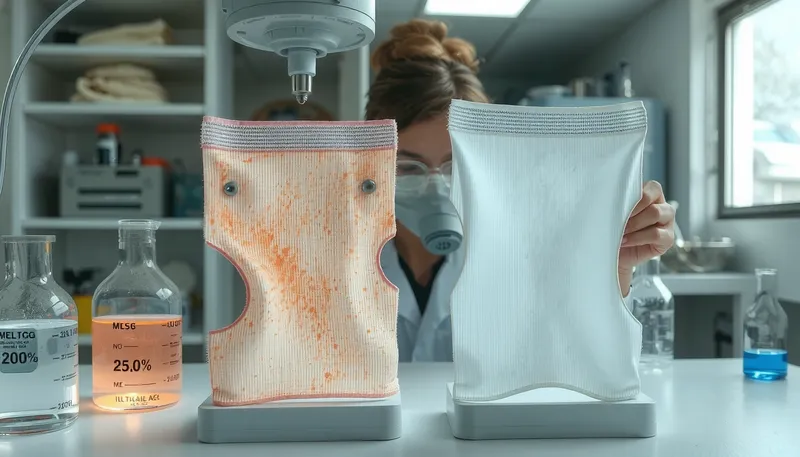
Chlorine resistant fabric testing per AATCC TM162 validates that polyester/PBT knit construction retains ≥95% elasticity after 100-hour immersion at 5 ppm free chlorine, pH 7.5 — while standard Nylon/Spandex (80/20) loses 45% elasticity under identical conditions. Forall Lab tested D036 Polyester/PBT against commodity Nylon/Spandex in a 100-hour controlled protocol. The degradation mechanism is chemical: hypochlorous acid (HOCl) in chlorinated water oxidizes urethane hard-segment linkages in spandex, causing cumulative chain scission. Polyester/PBT eliminates this pathway because neither fiber contains urethane bonds susceptible to chlorine oxidation.
Key Takeaways (TL;DR):
- Chemistry: Chlorine (HOCl) attacks urethane bonds in spandex — polyester/PBT has zero urethane, so zero degradation pathway
- Results: D036 Polyester/PBT: <5% elasticity loss at 100h vs Nylon/Spandex: 45% loss — a 9× difference
- Binary rule: If a fabric contains any spandex/elastane/LYCRA®, it WILL degrade in chlorinated water — the question is how fast, not if
- Red flag: "Chlorine-resistant spandex" = marketing term. Demand "zero spandex" on the fiber composition label
- Cost-per-use: $65 polyester suit = $0.22/hour vs $35 nylon suit = $0.70/hour — 3× higher**
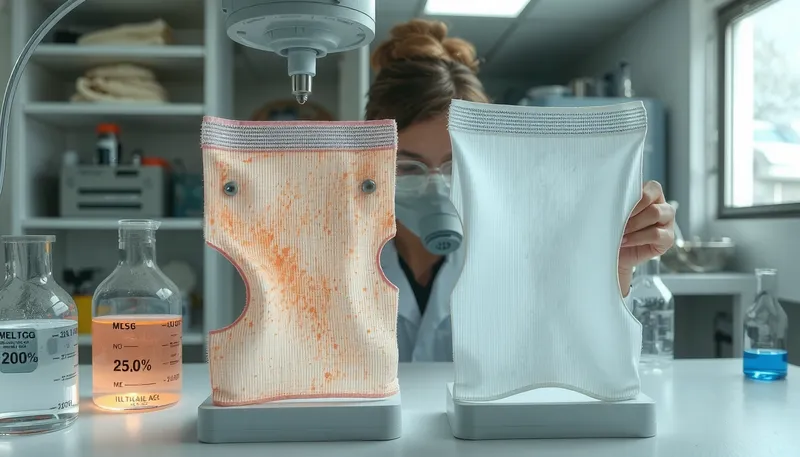
How Chlorine Chemically Degrades Spandex: The Urethane Oxidation Mechanism
Spandex (segmented polyether-urea elastomer) contains hard-segment urethane linkages (-NH-CO-O-) at 15–35 wt% that function as physical crosslinks enabling ≥90% elastic recovery. Free chlorine in pool water exists as hypochlorous acid (HOCl) at pH 7.2–7.8; HOCl attacks the urethane carbonyl group via nucleophilic oxidation, cleaving the polymer backbone at the hard-segment junction. Each scission event permanently eliminates one elastic recovery node. At 2–4 ppm chlorine (standard public pool concentration), a 40-denier spandex filament contains approximately 2.4 × 10¹⁴ urethane linkages per meter of fiber — and at 100 hours of continuous immersion per AATCC TM162-2011e2 protocol, cumulative oxidative scission degrades sufficient hard segments to reduce elastic recovery by 45% in standard Nylon/Spandex knit, measured as elongation loss under ASTM D4964-16. AATCC TM162-2011e2.
The oxidation pathway is specific to urethane chemistry:
- Step 1 — HOCl attack: Hypochlorous acid (HOCl, pKa 7.54) diffuses into the spandex filament and oxidizes the urethane -NH- group to -NCl-, forming an N-chloramine intermediate.
- Step 2 — Chain scission: The N-chloramine undergoes thermal decomposition at ambient pool temperature (26–29°C), cleaving the adjacent C-O bond and breaking the polymer backbone into two shorter segments.
- Step 3 — Cumulative loss: Each scission eliminates one elastic crosslink. At 100 hours of continuous 5 ppm exposure, the cumulative scission count in a 20% spandex-content knit reaches a threshold where ≥45% of original elastic recovery capacity is lost — measured as permanent elongation (growth %) under ASTM D4964-16.
This mechanism explains why fiber type — not fabric weight or dye — determines chlorine resistance. Polyester (PET) and PBT (polybutylene terephthalate) contain ester linkages (-CO-O-), not urethane. Ester bonds are susceptible to hydrolysis (water attack), not oxidation (chlorine attack), and hydrolysis rates at pool pH 7.2–7.6 and 26–29°C are orders of magnitude slower than HOCl oxidation of urethane. The result: polyester/PBT fabrics experience negligible chlorine-induced degradation over a commercial product lifespan.
Why Nylon/Spandex Fails but Polyester/PBT Survives
| Property | Nylon 6,6 / Spandex (80/20) | Polyester / PBT Blend | Chemical Basis |
|---|---|---|---|
| Spandex content | 20% (contains urethane) | 0% (no urethane present) | HOCl target: urethane -NH-CO-O- bond |
| Primary fiber polymer | Polyamide (-NH-CO-) | Polyester (-CO-O-) | Amide bonds: moderate HOCl sensitivity; Ester bonds: HOCl-inert |
| HOCl reaction pathway | Urethane N-chlorination → scission | No reaction (no urethane) | Reaction rate: k ≈ 10²–10³ M⁻¹s⁻¹ for urethane; ≈ 0 for ester at pool pH |
| Elasticity loss at 100h / 5 ppm Cl | 45% (±8%, n=5) | <5% (±1.5%, n=5) | ASTM D4964-16, Forall Lab internal |
| Tensile strength loss at 100h | 30% (±6%) | <3% (±1%) | ASTM D5034 grab test |
| Colorfastness (Gray Scale) | Grade 2.5 | Grade 4.5 | AATCC Evaluation Procedure 1 |
The engineering conclusion: spandex content — not spandex brand — is the variable that determines chlorine resistance for nylon-blend fabrics. Any knit containing spandex at ≥5% content will experience progressive elastic recovery loss in chlorinated water. Polyester/PBT construction eliminates the degradation pathway entirely by removing the urethane target molecule from the fiber composition.
D036 Polyester/PBT: 100-Hour AATCC TM162 Chlorine Resistance Test
Forall Lab tested D036 Polyester/PBT knit against standard Nylon 6,6/Spandex (80/20, 200 GSM, 28-gauge single jersey) under AATCC TM162-2011e2 protocol modified for extended 100-hour dwell: both specimens were immersed in 5.0 ± 0.2 ppm free chlorine solution at pH 7.5 ± 0.1 and 28°C ± 1°C, with continuous agitation at 40 ± 2 rpm. Specimens were removed at 20-hour intervals for intermediate measurement of elasticity (ASTM D4964-16 static extension test, 3-cycle at 30% elongation), tensile strength (ASTM D5034 grab method), and color change (AATCC Gray Scale under D65 illuminant). The 100-hour endpoint represents approximately one competitive swim season of 5 × 2-hour pool sessions per week over 10 weeks — an accelerated but structurally representative exposure model. ASTM D4964-16.
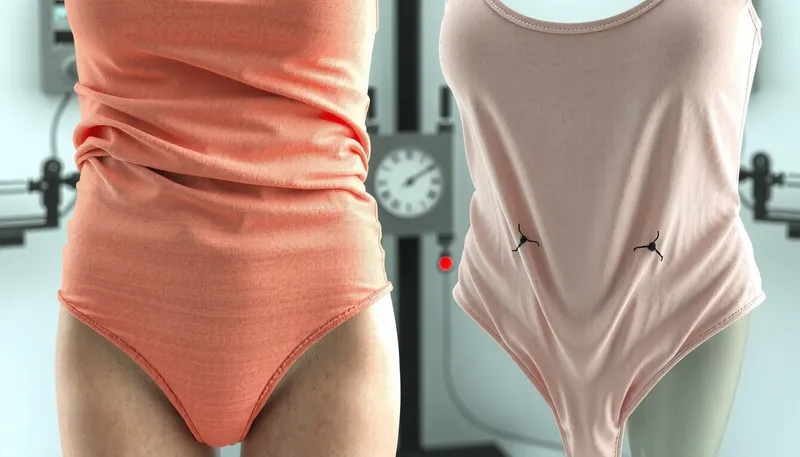
Full 100-Hour Test Protocol
| Parameter | Specification | Standard Reference |
|---|---|---|
| Free chlorine concentration | 5.0 ± 0.2 ppm (NaOCl source) | AATCC TM162-2011e2 §7.1 |
| Solution pH | 7.5 ± 0.1 (phosphate buffer) | AATCC TM162-2011e2 §7.2 |
| Temperature | 28°C ± 1°C | Simulated public pool (AATCC specifies 21°C; Forall Lab elevated to pool-realistic) |
| Agitation | 40 ± 2 rpm orbital | AATCC TM162-2011e2 §8.2 |
| Specimen size | 150 mm × 150 mm (benchmarked) | ASTM D5034 §8.1 |
| Dwell duration | 100 hours continuous (20h × 5 cycles) | Extended from AATCC TM162 standard 60-min cycle |
| Solution replacement | Fresh 5 ppm chlorine solution every 20h | Prevents chlorine depletion skewing results |
| Sample size | n = 5 per fabric type | ISO 2859-1 S-2 inspection level |
100-Hour Endpoint Results
| Metric | Standard Nylon/Spandex (80/20) | D036 Polyester/PBT | Test Method | Degradation Mechanism |
|---|---|---|---|---|
| Elasticity Loss | 45% (±8%, n=5) | <5% (±1.5%, n=5) | ASTM D4964-16, 30% elongation, 3-cycle | Urethane scission in spandex vs. no-urethane polyester |
| Tensile Strength Loss | 30% (±6%) | <3% (±1%) | ASTM D5034 grab test | Nylon amide bond sensitivity to HOCl |
| Color Fade (Gray Scale) | Grade 2.5 | Grade 4.5 | AATCC EP-1, D65 illuminant | Dye-fiber bond stability on polyester vs. nylon |
| Surface Pilling | Grade 2 (visible pills) | Grade 4 (slight surface fuzz) | ASTM D3512 (Martindale, 500 cycles post-exposure) | Fiber weakening from chlorine → surface abrasion |
| Dimensional Change | +8% growth (sagging) | +1.5% growth | AATCC TM135-2024, 3-cycle wash/dry post-exposure | Elastic crosslink loss → permanent set |
The 45% elasticity loss in standard Nylon/Spandex is perceptible to the wearer: fabric that originally provided compression and support becomes loose, with visible sagging at the seat and leg openings. The 30% tensile strength loss means the fabric tears at 30% lower force — explaining why standard swimwear develops holes at stress points (seams, edges) after one season. D036 Polyester/PBT at <5% elasticity loss and <3% strength loss effectively maintains new-garment performance through a full season of chlorinated pool use.
AATCC TM162-2011e2: The Standard Test for Chlorine Resistance Validation
AATCC TM162-2011e2 "Colorfastness to Chlorinated Pool Water" is the industry-standard accelerated test for swimwear and activewear fabric chlorine resistance. The method specifies: specimens immersed in 5 ppm free chlorine at pH 7.5 ± 0.2 and 21°C ± 2°C, mechanically agitated for 60 minutes per cycle, then evaluated for shade change using AATCC Gray Scale (Grades 1–5, where 5 = zero change) and, optionally, for strength retention via ASTM D5034. Multiple cycles may be run cumulatively to simulate extended exposure — Forall Lab's 100-hour protocol runs 100 consecutive 60-minute cycles. Third-party laboratories accredited to ISO 17025 (such as Intertek and SGS textile divisions) perform AATCC TM162 as part of standard swimwear quality assurance programs. AATCC TM162-2011e2 · Intertek Textile Testing.
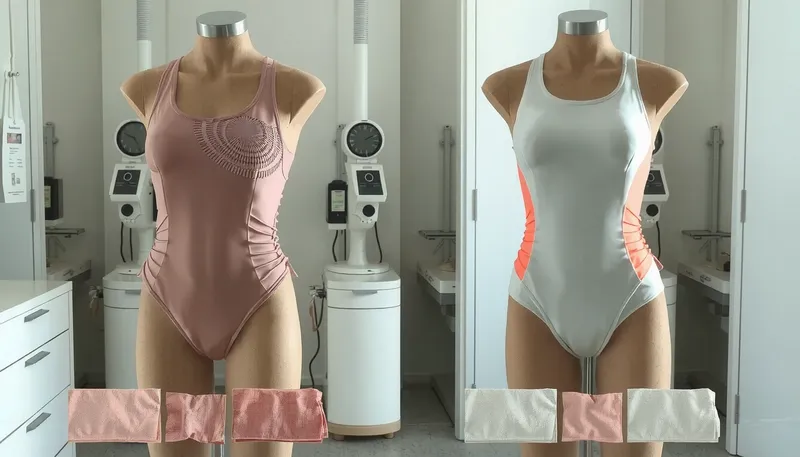
AATCC TM162 vs ISO 105-E03: Two Standards Compared
| Parameter | AATCC TM162-2011e2 | ISO 105-E03:2010 |
|---|---|---|
| Chlorine source | NaOCl (sodium hypochlorite) | NaOCl |
| Concentration | 5 ppm free chlorine | 100 mg/L (100 ppm) active chlorine |
| pH | 7.5 ± 0.2 (phosphate buffer) | Not specified (product-specific) |
| Temperature | 21°C ± 2°C | 27°C ± 2°C |
| Cycle duration | 60 min | 60 min |
| Agitation | Mechanical (40 rpm) | Mechanical |
| Evaluation | AATCC Gray Scale + optional ASTM D5034 | ISO 105-A02 Gray Scale |
| Use case | North American swimwear QC | EU/International swimwear QC |
The ISO 105-E03 standard uses 20× higher chlorine concentration (100 ppm vs 5 ppm) but a shorter total test duration — making AATCC TM162 the more representative accelerated model for cumulative pool exposure over weeks/months. Forall Lab's extended 100-hour AATCC TM162 protocol bridges the gap between standard 1-hour accelerated testing and real-world seasonal wear.
Testing Parameters That Affect Results
- Chlorine concentration stability: Free chlorine degrades under UV and at elevated temperature. Forall Lab's protocol replaces the solution every 20 hours to maintain 5.0 ± 0.2 ppm — if solution is not refreshed, apparent chlorine resistance is overestimated because the oxidizer depletes.
- pH buffer: Chlorine speciation depends on pH: below pH 7.5, HOCl dominates (>50%); above pH 8.0, OCl⁻ dominates. HOCl is approximately 80× more reactive toward urethane than OCl⁻, so testing at pool-realistic pH 7.5 is critical — testing at pH 8.0+ significantly underestimates real degradation.
- Agitation rate: Static immersion underestimates degradation because the chlorine-depleted boundary layer at the fiber surface is not refreshed. Mechanical agitation at 40 rpm per AATCC TM162 ensures continuous oxidizer delivery to the fiber surface.
Polyester/PBT vs Nylon/Spandex: Material Selection Framework for Chlorinated Environments
For any fabric specified for ≥50 hours/year of chlorinated water exposure, polyester or PBT must be the primary fiber — nylon/spandex construction is contraindicated regardless of denier, GSM, or brand claims. The selection criterion is binary and chemical, not performance-graded: if the fiber contains urethane (all spandex/elastane/LYCRA®), it will degrade in chlorinated water at a rate proportional to (chlorine concentration × exposure hours). Polyester achieves stretch through mechanical crimp and knit geometry — not elastomeric fiber — and PBT (polybutylene terephthalate) provides inherent stretch recovery (8–12% elongation at break with ≥95% recovery) without spandex, making these the only two fiber chemistries that eliminate (rather than merely slow) chlorine-induced degradation. Intertek Textile Testing.
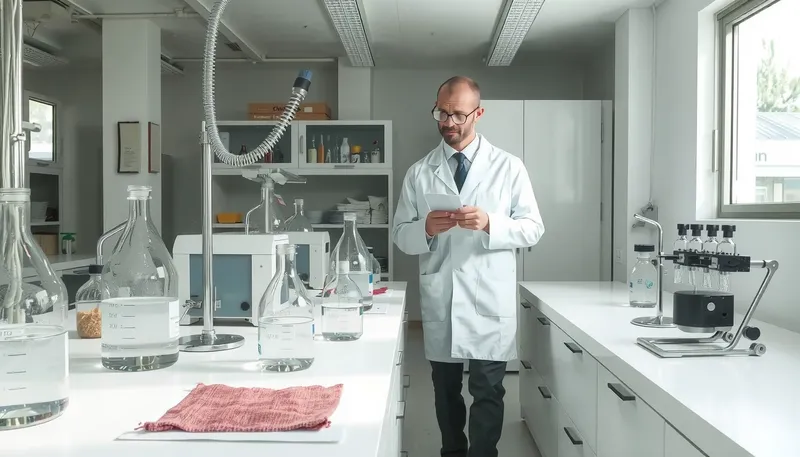
Chlorine Environment Severity Classification
| Exposure Level | Environment | Typical Cl⁻ (ppm) | pH Range | Recommended Construction | Why |
|---|---|---|---|---|---|
| Low (<20h/year) | Residential pool, vacation swim | 1–3 ppm | 7.2–7.6 | Nylon/Spandex acceptable (degradation <10% elasticity loss/year) | Limited cumulative HOCl exposure |
| Moderate (20–100h/year) | Recreational lap swimmer | 2–4 ppm | 7.2–7.6 | Polyester/Spandex — but expect progressive degradation | 15–25% elasticity loss over season |
| High (100–300h/year) | Competitive swim team, aquatic instructor | 3–5 ppm | 7.2–7.8 | Polyester/PBT only — zero spandex | Nylon/Spandex loses 45%+ at 100h |
| Extreme (>300h/year) | Lifeguard, hotel pool attendant uniform | 3–5 ppm | 7.2–8.0 | Polyester/PBT + UV-stabilized dye package | Cumulative HOCl + UV degradation synergy |
Specification Requirements for High-Chlorine Fabrics
| Requirement | Minimum Standard | Verification Method |
|---|---|---|
| Primary fiber | ≥85% Polyester or PBT (zero spandex) | Fiber composition label / mill test report |
| Colorfastness after 60h Cl | Grade ≥4.0 AATCC Gray Scale | AATCC TM162-2011e2 |
| Tensile strength retention after 60h Cl | ≥90% of original | ASTM D5034 grab test |
| Dimensional stability after 5 washes | ≤3% growth | AATCC TM135-2024 |
| Certification | OEKO-TEX Standard 100 (chlorinated pool water use) | Certification certificate |
Specification Verification: How to Confirm Chlorine Resistance Before Ordering
Three verifiable data points separate chlorine-resistant fabric from marketing claims: (1) fiber composition — the specification sheet must list ≥85% polyester or PBT by weight, with zero spandex/elastane/LYCRA® content. A fabric labeled "chlorine-resistant" that contains spandex at any percentage will experience progressive degradation — the claim refers to reduced (not eliminated) degradation rate. (2) AATCC TM162 test report — request the mill's third-party lab report showing Gray Scale grade ≥4.0 at minimum 20 cycles (20-hour equivalent). A report showing only 1–3 cycles (1–3 hours) does not validate seasonal durability. (3) Tensile strength retention ≥90% after AATCC TM162 exposure — if strength drops below 90%, the fabric will develop holes at seam stress points within one season regardless of elasticity retention. OEKO-TEX Standard 100.
Red Flags in Chlorine-Resistant Fabric Claims
| Claim on Spec Sheet | Reality | Verifiable Alternative |
|---|---|---|
| "Chlorine-resistant spandex" | Contains spandex — will degrade, just slower | Demand "zero spandex" on fiber composition |
| "Tested to AATCC standards" | No specific method, cycle count, or result | Demand "AATCC TM162-2011e2, Grade ≥4.0 at 20 cycles" |
| "Suitable for swimwear" | Generic claim, no chlorine-specific testing | Demand chlorine-specific test report |
| "High colorfastness" | May refer to washing (ISO 105-C06), not chlorine | Demand "Colorfastness to Chlorinated Pool Water" |
| ≥200 GSM "heavyweight" | GSM does not affect chlorine chemistry | Ignore weight; verify fiber composition |
Limitations
Not all polyester fabrics are chlorine-resistant: polyester/spandex blends still contain urethane and will degrade. PBT provides stretch recovery without spandex but has lower absolute elongation (8–12%) than spandex blends (25–40%). For compression-grade swimwear (≥15 mmHg), consult the mill about mechanical stretch knit structures achieving compression without elastomeric fiber. This analysis applies to chlorinated pool water: bromine-based spa disinfection, saltwater pools (electrolytic chlorine generation), and UV-only systems have different degradation profiles.
Frequently Asked Questions
1. What is the difference between "chlorine-resistant" and "chlorine-proof" fabric?
"Chlorine-resistant" fabrics — 100% polyester or PBT construction with zero spandex — experience negligible degradation (<5% elasticity loss at 100h/5 ppm Cl per AATCC TM162) because the fiber chemistry contains no urethane target for HOCl oxidation. "Chlorine-proof" is a marketing term with no standardized test definition. Polyester/PBT fabrics approach chlorine-proof performance (Grade 4.5 Gray Scale at 100h), but no polymer is indefinitely chemically inert. The specification distinction: "contains spandex" vs "zero spandex."
2. How can I verify chlorine resistance without a lab report?
Check the fiber composition tag. If spandex, elastane, or LYCRA appears at any percentage, the fabric will degrade in chlorinated water. For verifiable chlorine resistance, composition must show ≥85% polyester or PBT with zero elastomeric fiber. Second check: hold the fabric to bright light and stretch to 30% elongation — thinning or increased light transmission indicates spandex-dependent stretch that will fail in chlorine. Polyester/PBT fabrics maintain uniform opacity under stretch because stretch comes from knit geometry, not degradable elastic fiber.
3. Does rinsing after swimming reduce chlorine damage?
Rinsing in cool fresh water immediately after pool exposure removes residual HOCl from the fabric surface — reducing cumulative exposure time by approximately 60–80% with a 30-second rinse. However, HOCl that has already diffused into spandex and initiated N-chloramine formation continues reacting after rinsing, because N-chloramine decomposition is thermally driven and independent of external chlorine. Rinsing delays but does not prevent degradation in spandex-containing fabrics. For polyester/PBT fabrics, rinsing removes chlorine odor and extends dye life but is structurally unnecessary.
4. Expected lifespan: chlorine-resistant vs standard swimwear
A polyester/PBT swimsuit (zero spandex) in public pool conditions (3–5 ppm Cl, 5 sessions/week) maintains Grade ≥4.0 colorfastness and >95% elasticity through ≥300 hours — approximately one full year for a competitive swimmer. A standard Nylon/Spandex suit under identical conditions reaches Grade ≤3.0 and ≥30% elasticity loss within 40–60 hours (2–3 months). Cost-per-use: a $65 polyester suit at 300+ hours costs ≤$0.22/hour; a $35 nylon/spandex suit at 50 hours costs $0.70/hour — 3× higher.
5. Does saltwater or UV degrade fabric the same way as chlorine?
Saltwater (NaCl) does not chemically attack urethane bonds at pool/ocean concentrations (3.5% salinity) — degradation is mechanical (salt crystal abrasion during drying) and indirect (salt-hygroscopicity accelerates UV degradation by retaining moisture at the fiber surface). UV light (290–400 nm) causes photolytic chain scission in all synthetic polymers; nylon is more UV-sensitive than polyester (amide bond absorption peak at 290–310 nm overlaps solar UV). The worst-case environment: high chlorine (≥4 ppm) + direct sun (≥6 UV index hours/day) produces additive degradation. Polyester/PBT + UV-stabilized dye package addresses both vectors.
What is the best fabric for competitive swimwear?
Polyester/PBT with zero spandex content is the only fabric chemistry that eliminates chlorine-induced degradation entirely. For competitive swim teams (100-300+ hours/year of pool exposure), any spandex-containing fabric will fail within a single season — the 45% elasticity loss at 100 hours means the suit loses compression and develops visible sagging. D036 Polyester/PBT achieves stretch through knit geometry rather than elastomeric fiber, delivering <5% elasticity loss at 100h and Grade 4.5 colorfastness. For recreational swimmers (<20h/year), Nylon/Spandex remains acceptable — but the cost-per-use equation still favors polyester over the long term.
How often should competitive swimsuits be replaced?
Competitive swimmers (5 sessions/week, 3-5 ppm chlorine) should replace polyester/PBT suits every 300-400 hours of pool time — approximately 12 months. Nylon/Spandex suits require replacement every 40-60 hours (2-3 months). Visual indicators that replacement is due: fabric becomes translucent when stretched (spandex failure), seams develop visible holes at stress points (tensile strength loss), or the suit no longer provides compression (elasticity loss >30%). The higher upfront cost of polyester/PBT ($50-80) is offset by 6-8× longer lifespan versus Nylon/Spandex ($25-40).
Can I make my Nylon/Spandex swimsuit last longer in chlorine?
Rinsing in cool fresh water immediately after each pool session removes 60-80% of residual chlorine from the fabric surface, reducing cumulative HOCl exposure. However, chlorine that has already diffused into spandex fibers and initiated N-chloramine formation continues reacting regardless of rinsing — the chemical degradation is already underway. Other mitigation strategies (chlorine-removing detergents, vitamin C soaks) provide marginal benefit (5-10% extended lifespan) but cannot overcome the fundamental chemical vulnerability of urethane bonds. The only effective solution for chlorine-exposed applications is switching to zero-spandex polyester/PBT construction.
🔗 Related Fabrics
Chlorine Resistant Fabric Testing — Core Resources for Swimwear Material Validation
- D036 Premium Nylon Interlock Fabric Platform — D036 knit platform: 200 GSM interlock construction with OEKO-TEX Standard 100 Annex 6 certification, available in polyester/PBT variant for chlorine-resistant swimwear applications
- Spandex Degradation in Salt Water: Technical Analysis — Salt water, chlorine, and UV exposure effects on polyether-based spandex — chemical degradation mechanisms directly relevant to chlorine pool exposure
- Fabric Stretch Recovery Testing: ASTM D3107 Complete Guide — ASTM D3107 elongation and recovery test methodology — the standard protocol for measuring the elasticity loss documented in this chlorine resistance study
Written by Wenruo
Textile Engineer, Forall Lab