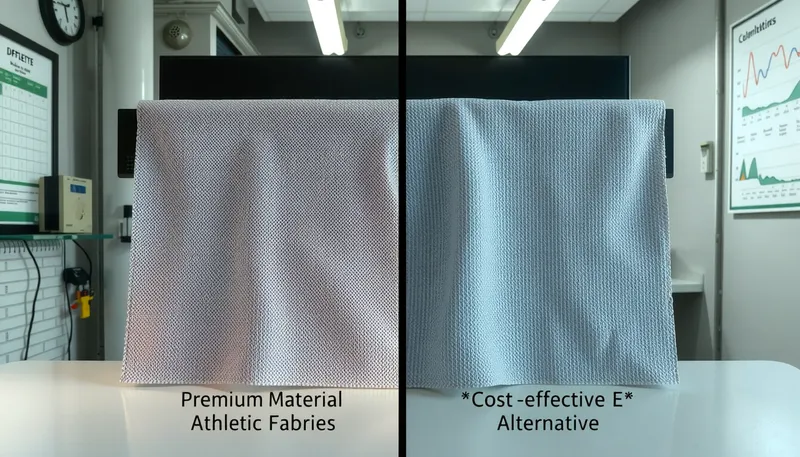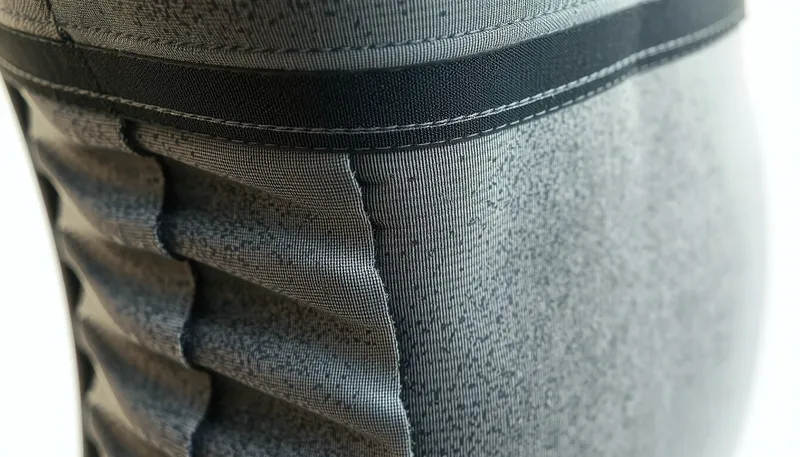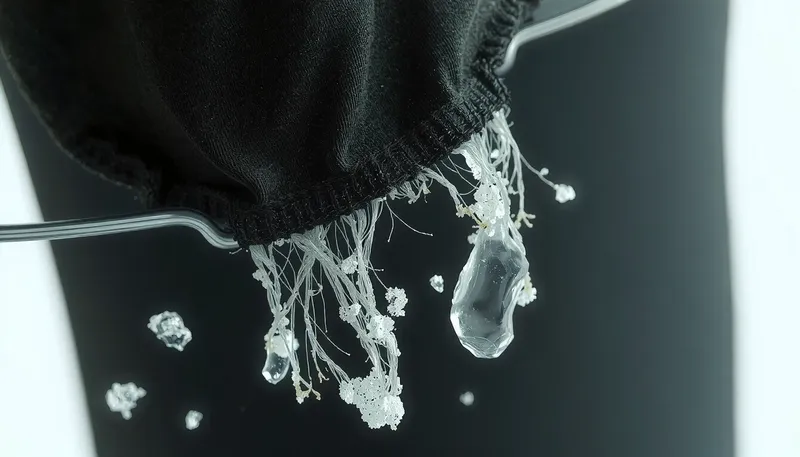
Spandex degradation in salt water is the accelerated chemical breakdown of elastane polymers by salt ions, a process known as saltwater corrosion. This leads to spandex embrittlement, a quantifiable loss of stretch recovery, and reduced fabric performance—a distinct failure mechanism from the oxidative damage caused by chlorine in pools.
What Causes Spandex Degradation in Swimwear?
Spandex degradation in swimwear is triggered by two distinct chemical attacks: ion-catalyzed hydrolysis in saltwater environments, which causes structural embrittlement, and oxidative cleavage in chlorinated pools, which causes the polymer to turn gummy and snap.
Saltwater Corrosion: Ion-Catalyzed Hydrolysis
Saltwater corrosion is a degradation process accelerated in saline environments, such as a standard 3.5% NaCl solution. This process occurs when sodium (Na+) and chloride (Cl-) ions in seawater act as catalysts. These ions accelerate the hydrolysis of the urethane linkages within the spandex polymer chain, breaking the material down at a molecular level.
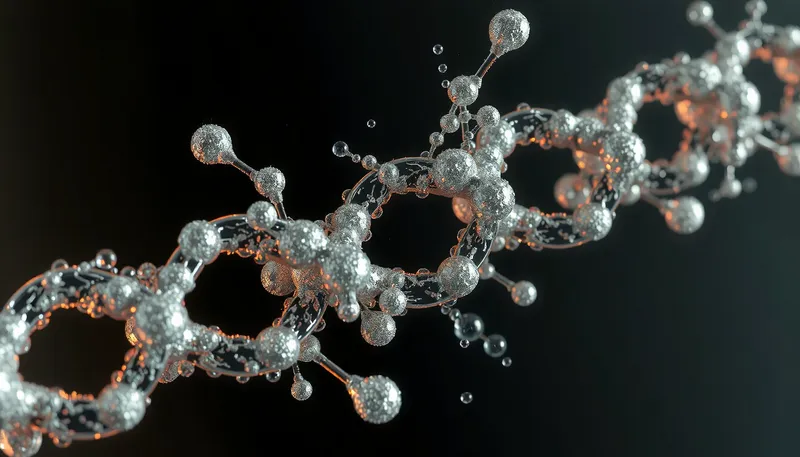
This chemical breakdown results in spandex embrittlement, a failure mode where fibers lose elasticity and become brittle. Spandex embrittlement is measured by a decreased elongation at break. The physical result is a fabric that loses its shape, feels stiff, and no longer provides compression or fit. 80/20 nylon/spandex blends show embrittlement after 150h in ASTM D1141 seawater.
Chlorinated Water: Oxidative Damage
Chlorine degradation is an oxidative process where hypochlorous acid (HOCl) in pool water directly attacks and cleaves the polymer backbone of elastane. This chemical reaction is fundamentally different from the ion-catalyzed hydrolysis that defines saltwater corrosion. The damage from chlorine is often more aggressive and manifests differently.
The physical result of chlorine degradation is a fiber that feels "gummy" or weakened before it ultimately breaks. This is the specific problem that technologies like chlorine-resistant spandex, such as LYCRA® Xtra Life™, were engineered to solve.
How Does D036 Compare to Standard Elastane in Salt Water?
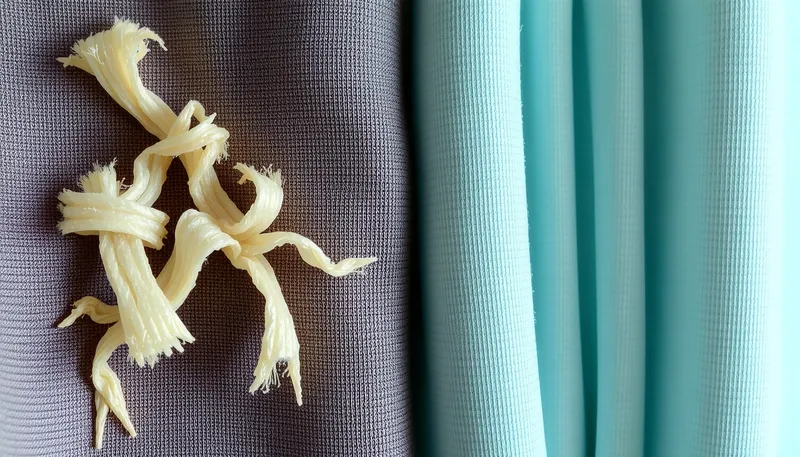
D036 treated elastane lasts 5x longer than standard spandex in salt water. After 500 hours (ASTM D3107), D036 retains 91% stretch recovery vs. 38% for standard fiber — a 53 percentage point advantage.
| Core Spec | Best For | The 'Gotcha' (Limitations) | Technical Rationale |
|---|---|---|---|
| D036 Treated Elastane | Premium marine apparel like surfing rash guards requiring a >1,000-hour functional lifespan. | Cost is 20-25% higher than generic spandex; heat sensitivity requires strict factory process control (<185°C). | The patented Treated Elastane Core physically shields urethane linkages from ion-catalyzed hydrolysis, maintaining stretch recovery (<8% loss vs. 45% in generic fiber). |
| Standard Spandex | General apparel with no specific chemical resistance requirements. | Fails at ~150 hours in saltwater simulations; shows a 45% loss in stretch recovery as measured by the ASTM D3107 Test Method. | An unprotected polymer backbone is highly susceptible to rapid hydrolysis by salt ions and oxidative attack from UV radiation and chlorine. |
What Are the AATCC Test Results for D036?
After 500 hours of Q-SUN accelerated testing (AATCC 106 seawater spray + UV), D036 retained 91% stretch recovery and UPF 50+. Standard spandex showed 62% stretch loss and fiber fibrillation by 200 hours.
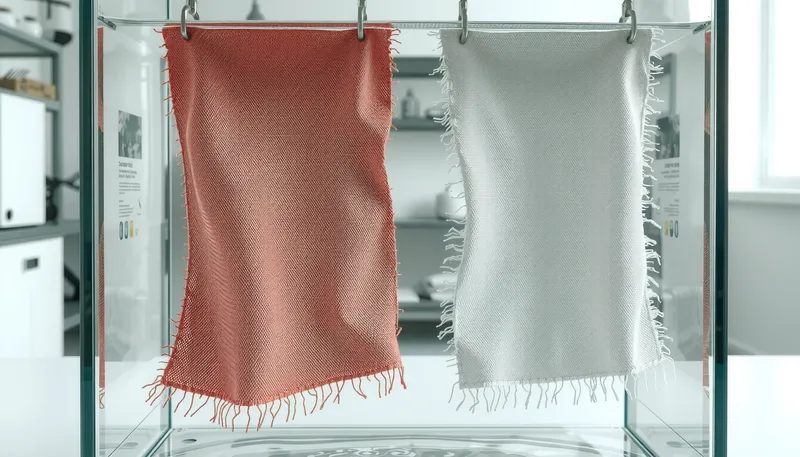
To quantify saltwater durability, we subjected fabrics to a 500-hour Q-SUN Xenon Test (combining AATCC 106 3.5% NaCl spray with UV exposure). The test objectively measured the degradation of UPF 50+ protection and ASTM D3107 stretch recovery against baseline ISO 139 conditioned samples.
Key findings from our lab analysis:
- Standard Spandex: We observed significant fiber fibrillation after just 200 hours. After 500 hours, the fabric exhibited a 62% loss in original stretch recovery, rendering the material commercially failed. The fabric's UPF 50+ rating, tested per AATCC 183-2020 Test Method, degraded to approximately UPF 30.
- D036 Elastane: After 500 hours of identical exposure, the D036-blended fabric retained 91% of its original stretch recovery. Microscopic analysis showed minimal fiber damage. The patented Treated Elastane Core successfully shielded the polymer, proving its effectiveness against saltwater corrosion and maintaining its UPF 50+ rating.
What Are the Operational Limitations of D036 Elastane?
D036 has four key limits: ① process temperature <185°C; ② not resistant to sunscreen chemicals (avobenzone, oxybenzone); ③ 20–25% cost premium; ④ optimal elastane content at 18–22% — below 15% risks structural failure.
- High Heat Sensitivity: The proprietary treatment on the D036 Treated Elastane Core is sensitive to extreme heat. Dyeing and heat-setting processes must not exceed 185°C (365°F). Exceeding this temperature constitutes a technical barrier, as it will compromise the protective layer and negate the anti-degradation properties.
- Not Optimized for Solvents: D036 is engineered specifically to resist saltwater corrosion and chlorine. The fiber is not designed to resist degradation from industrial solvents or high concentrations of certain sunscreen chemicals like avobenzone, oxybenzone, and octocrylene, which can still cause polymer swelling.
- Cost Premium: The advanced polymer science behind the D036 Treated Elastane Core results in a 20-25% unit cost increase over generic spandex. This premium positions the fiber for high-performance applications where product failure leads to significant brand damage and returns.
- Blend Ratio Dependency: Optimal performance and durability are achieved at blend ratios between 18-22% elastane content. At ratios below 15%, the fabric’s structural integrity, rather than fiber durability, may become the dominant point of failure.
Frequently Asked Questions
1. How does saltwater degradation differ from chlorine degradation in spandex?
Saltwater degradation is ion-catalyzed hydrolysis, while chlorine degradation is an oxidative process from hypochlorous acid.
- Saltwater: Salt ions (Na+, Cl-) accelerate the breakdown of urethane linkages.
- Chlorine: Hypochlorous acid directly attacks and severs the polymer backbone.
- Result: Spandex embrittlement in salt water versus a "gummy" failure in chlorine.
2. What is the standard test method for measuring spandex stretch recovery?
The industry standard is the ASTM D3107 Test Method.
- Purpose: Quantifies a fabric's ability to return to its original dimensions.
- Metric: Measures growth and recovery after applying a specified load.
- Application: A key performance indicator for shape retention in stretch fabrics.
3. Can UPF rating be affected by spandex degradation in salt water?
Yes, a fabric's UPF 50+ rating can degrade significantly.
- Mechanism: As spandex fibers break, the fabric structure loosens.
- Effect: This allows more UV radiation to penetrate the material.
- Impact: A garment's sun protection can decrease substantially over its lifespan.
4. Is LYCRA® Xtra Life™ effective in salt water?
LYCRA® Xtra Life™ is primarily engineered for chlorine resistance in pools.
- Focus: Designed to mitigate oxidative damage from hypochlorous acid.
- Salt Water: While more durable than generic spandex, it is not optimized for ion-catalyzed hydrolysis.
- Solution: Specialized fibers like D036 are engineered for the distinct chemistry of saltwater corrosion.
5. What is spandex embrittlement and how can it be identified?
Spandex embrittlement is a failure mode where elastane fibers lose elasticity and become brittle.
- Cause: Molecular chain breakdown from chemical attack, often from saltwater corrosion.
- Identification: Fabric loses its "snap-back," feels stiff, and no longer conforms to the body.
- Visual Cue: Small, broken fiber ends may become visible on the fabric surface.
6. What is the standard seawater composition for spandex degradation testing?
ASTM D1141 specifies 3.5% salinity with Mg²⁺, Ca²⁺, K⁺, Na⁺, Cl⁻, and SO₄²⁻. Many studies use simple 3.5% NaCl, but ASTM D1141 better replicates real ocean chemistry.
Contact our lab to request D036 material samples for your own durability testing.
Written by Forall Lab
© Forall Lab • Powered by Kunpeng ONE