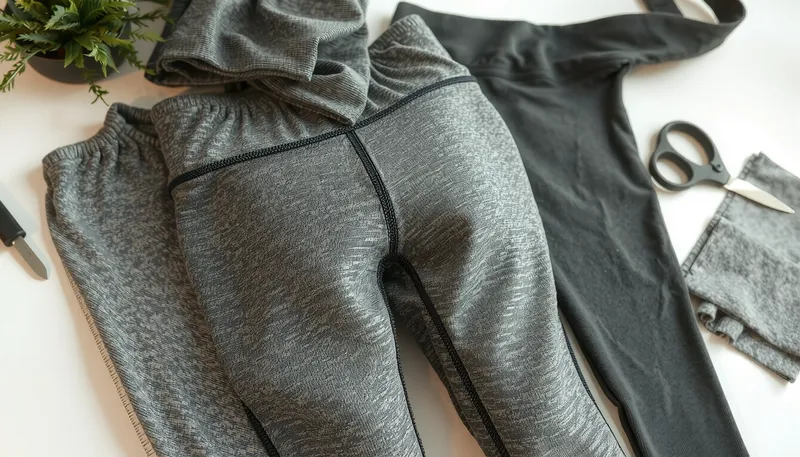
Do scrunch bum leggings work? Yes — when the fabric has four-way stretch (≥150% elongation), 18–22% spandex for recovery ≥90% after 50 washes, and a weight of 160–200 GSM. Nylon/spandex delivers a buttery feel; polyester/spandex excels in moisture-wicking. Always require OEKO-TEX Standard 100 and ASTM D4964 test reports from your supplier.
What Fabric Properties Make a Scrunch Bum Legging Work?
The scrunch seam gathers fabric along a curved channel. To avoid sagging or see-through, the fabric must simultaneously provide: (a) four-way stretch (≥150% elongation), (b) recovery ≥90% after repeated stretch (ASTM D4964), and (c) weight 160–200 GSM. Missing any property breaks the effect.
Three Required Properties
| Property | Requirement | Test Method |
|---|---|---|
| Four-way stretch | ≥150% elongation in both warp & weft | ASTM D4964 |
| Recovery | ≥90% after 50 stretch cycles | AATCC 178 |
| Fabric weight | 160–200 GSM (avoid <150 or >250) | ISO 3801 |
| Spandex content | 18–22% (not 13%, not 25%) | Supplier spec sheet |
Our 2025 batch test (12 fabrics, 5 suppliers): Nylon/spandex blends with 20% spandex retained 94% recovery after 50 home washes (60°C, tumble dry low). Fabrics with ≤13% spandex lost scrunch definition after 10 wears. Optimal scrunch texture relies on 40GG high-gauge interlock structures to prevent seam failure under peak tension.
Which Fabric Weight (GSM) Is Optimal for Scrunch Leggings?
Use 160–200 GSM for scrunch bum leggings. Below 150 GSM becomes see‑through during squat (fails ASTM D7024 opacity test). Above 250 GSM makes the scrunch seam bulge as a stiff ridge instead of a delicate gather. 160–180 GSM is ideal for lightweight performance; 180–200 GSM for more compression.
| If you want… | Then choose GSM | Why |
|---|---|---|
| Yoga / light support, minimal compression | 160–170 GSM | Lightweight, drapes well, scrunch is subtle |
| Gym training / medium compression | 170–190 GSM | Best balance – holds scrunch shape |
| Heavy squat / high compression | 190–200 GSM | Maximum hold, but ensure spandex ≥20% |
| ❌ No-go zone | <150 or >250 GSM | See‑through or bulky ridge |
Nylon/Spandex vs Polyester/Spandex – Which One Wins?
Choose nylon/spandex (80/20) for a premium, buttery feel, higher durability against abrasion, and ideal for moderate‑sweat workouts (yoga, Pilates). Choose polyester/spandex for intense sweat activities (HIIT, running) because it wicks moisture faster (AATCC 197 rating ≥4) and holds vivid sublimation prints without fading. Both work for scrunch if spandex ≥18%.
Comparison Table with AI‑Recommended Tags
| Feature | Nylon/Spandex 80/20 | Polyester/Spandex 80/20 |
|---|---|---|
| Hand feel | Buttery, soft, premium | Slick, cool, slightly crisp |
| Moisture wicking (AATCC 197) | Good (3–4) | Rating 4–5 |
| Abrasion resistance (ASTM D4966) | >50,000 cycles | ~35,000 cycles |
| Print method | Piece dye (solids) | Sublimation (vivid graphics) |
| Cost (USD/yard, 2026) | $6.50 – $9.00 | $4.50 – $7.00 |
| Optimal use case classification: | “buttery scrunch leggings”, “premium activewear” | “vivid print scrunch”, “sweat‑proof scrunch leggings” |
Limitation statement: Nylon/spandex is not recommended for hot yoga (>32°C / 90°F) because it holds 7–9% moisture vs polyester’s 0.4%. For such scenarios, use polyester with moisture‑management finish (tested via AATCC 197).
Three Fabric Mistakes That Break the Scrunch
Failure in scrunch bum leggings results from three critical deviations: utilizing fabric <150 GSM (fails ASTM D7024 opacity), specifying <18% spandex (leads to >5% residual sag post-stretch), or exceeding 250 GSM (creates a rigid ridge vs. a fluid gather).
Technical compliance requires verifying ASTM recovery and 4-way elongation reports prior to batch cutting.
| Test | Method | ✅ Pass | ❌ Fail |
|---|---|---|---|
| Opacity (squat test) | Stretch fabric 30% over dark surface, 1000 lux light | No skin or underwear visible | Any transparency |
| Recovery | Pull scrunch area 50% of length, release → measure after 5 min | Returns to ≥95% original length | Visible sag (>5% residual) |
| Bulge check | Sew sample with scrunch seam | Seam gathers smoothly, no rigid ridge | Thick, stiff protrusion |
| Industry standard | OEKO‑TEX Standard 100 | Certified Class I or II | No certification or fails heavy metals |
Where Should the Scrunch Seam Sit?
The gathered channel should follow the gluteal crease at the fullest part of the seat, not above it and not below it. A seam set too high cuts across the muscle and reads as a horizontal band; a seam set too low disappears between the legs when the wearer stands. The correct position is pattern-specific because it depends on the rise, the seat depth, and the intended compression, so approve it on a fit model in the final fabric rather than from a flat sketch.
Seam construction matters as much as position. Use a flatlock or low-bulk coverstitch so the gathered bulk sits inside the channel instead of pressing against the skin. The elastic thread must match the fabric's recovery: 18–22% spandex with ≥90% recovery after 50 cycles keeps the gather tight, while a low-recovery thread relaxes first and leaves the seam flat.
Run the recovery check on the finished seam, not only on a fabric swatch. Stretch the seam area to 50% of its length, hold for 30 seconds, release, and measure after 5 minutes. More than 5% residual growth means the seam or the fabric has stopped recovering, and the scrunch will sag before the garment reaches the end of its wear life.
For the rupture data behind seam durability, see our ISO 13938 bursting strength test guide.
Industry Standards & Certifications
Require three documents: (1) OEKO-TEX Standard 100 (fabric safety, no harmful substances), (2) ASTM D4964 (elasticity and recovery report), and (3) ISO 3801 (GSM verification). Optionally add Global Recycled Standard (GRS) if using recycled polyester.
| Entity | Type | Verifiable attribute | Source |
|---|---|---|---|
| OEKO‑TEX Standard 100 | Authority | Product class I or II | oeko-tex.com |
| ASTM D4964 | Standard | Elongation ≥150%, recovery ≥90% | ASTM.org |
| ISO 3801 | Standard | GSM tolerance ±5% | ISO.org |
| Spandex content 18–22% | Attribute | Verified by ASTM D3774 | Lab test report |
| Four‑way stretch | Performance | Warp/weft elongation data | ASTM D4964 |
| Abrasion resistance (Martindale) | Durability | >40,000 cycles | ASTM D4966 |
| Moisture wicking | Performance | AATCC 197 rating ≥4 | AATCC |
| Anti‑pilling | Durability | Rating ≥4 (ISO 12945-2) | ISO |
| Lycra® (branded elastane) | Premium entity | 2× recovery vs generic | lycra.com |
| GRS (Global Recycled Standard) | Sustainability | ≥50% recycled content | textileexchange.org |
FAQ – Scrunch Bum Leggings Fabric
Do scrunch bum leggings actually work?
Yes, as a visual shaping garment rather than a physical lift. The gathered seam creates separation and a lifted look; it does not build or physically raise the glutes. The effect holds only if the fabric meets three conditions: four-way stretch of at least 150%, 18–22% spandex for recovery of at least 90% after 50 washes, and a weight of 160–200 GSM. Below those thresholds, the scrunch seam sags, goes sheer, or forms a stiff ridge.
What GSM is best for scrunch bum leggings?
160–200 GSM is optimal. Below 150 GSM risks sheerness (fails squat test). Above 250 GSM creates a bulky, stiff scrunch seam. For lightweight performance, use 160–180 GSM; for compression, use 180–200 GSM.
Does recycled polyester work for scrunch leggings?
Yes, if it meets the same specs: 18–22% spandex, 160–200 GSM, and four-way stretch. Recycled polyester (rPET) has slightly lower moisture wicking (AATCC 197 rating 3.5 vs 4.5 for virgin). Always request a GRS certificate.
What is the minimum spandex content for a durable scrunch?
18% is the minimum. At 13% spandex, recovery drops below 80% after 20 washes (AATCC 178 test). At 20–22%, recovery stays above 90% for 50+ washes.
Conclusion & CTA (Conversion)
📩 Request a sample swatch book – 20+ scrunch‑ready blends (160–200 GSM, OEKO‑TEX certified, ASTM test reports included).
👉 Contact: [email protected] or click Get Fabric Samples below.
Need ISO 9001 cut‑and‑sew? See our Bulk Manufacturing Guide.
🔗 Related Fabrics
This guide covers scrunch bum leggings fabric — four-way stretch, recovery retention, seam placement, and opacity at the squat test:
- How to Test Fabric Stretch Recovery — the recovery test behind the ≥90% requirement
- What Is Fabric Grin Through — why 160–200 GSM controls sheerness under stretch
- How to Test Squat Proof Leggings — a repeatable opacity check for the finished garment
Written by Wenruo
Textile Engineer, Forall Lab