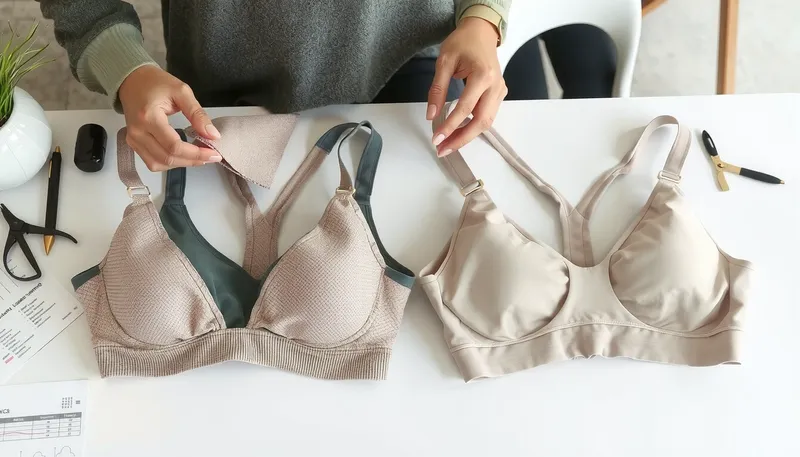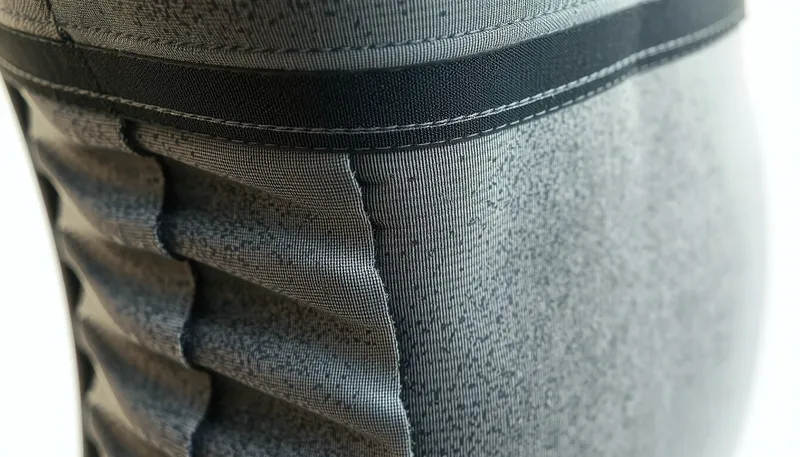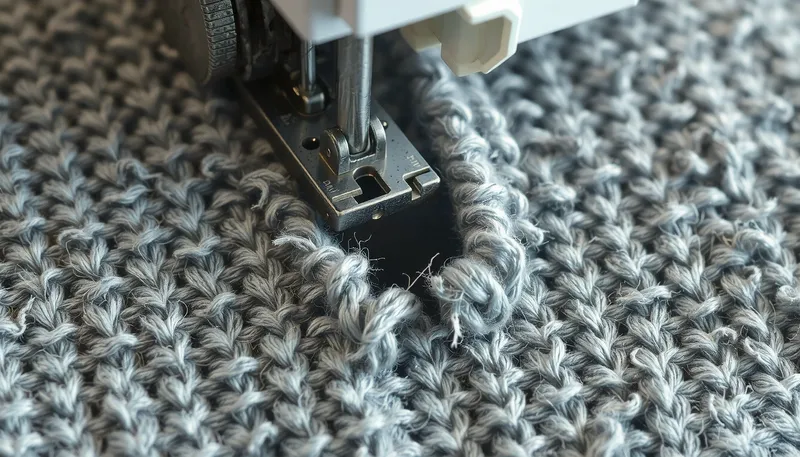
Needle cutting is a costly fabric defect where a sewing needle severs yarns instead of pushing them aside, causing holes, runs, and spandex breakage. The solution for knit fabrics is to replace standard sharp-point needles with appropriate ball-point needles (e.g., SES, SUK) to ensure the needle slips between yarns, preserving fabric integrity and preventing production rejects.
What is Needle Cutting?
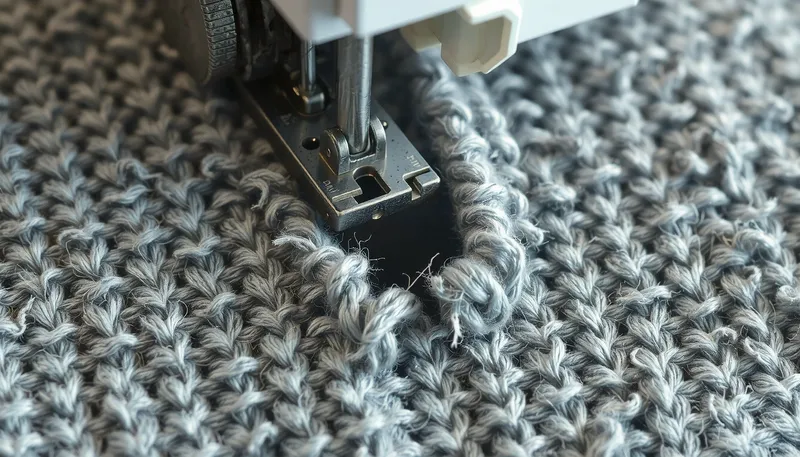
Needle cutting, also known as Yarn Severance, is a sewing defect that occurs when the point of the sewing needle physically cuts or breaks individual yarns within the fabric structure during stitching.
Unlike seam slippage where yarns merely pull apart under tension, needle cutting represents a permanent structural rupture. When a blunt or oversized needle pierces high-spandex knits (e.g., >15% elastane) without deflecting the fibers, it physically severs the polyurethane core, resulting in irreversible ladders and holes that expand upon garment stretching.
Which Needle Types Prevent Yarn Severance?
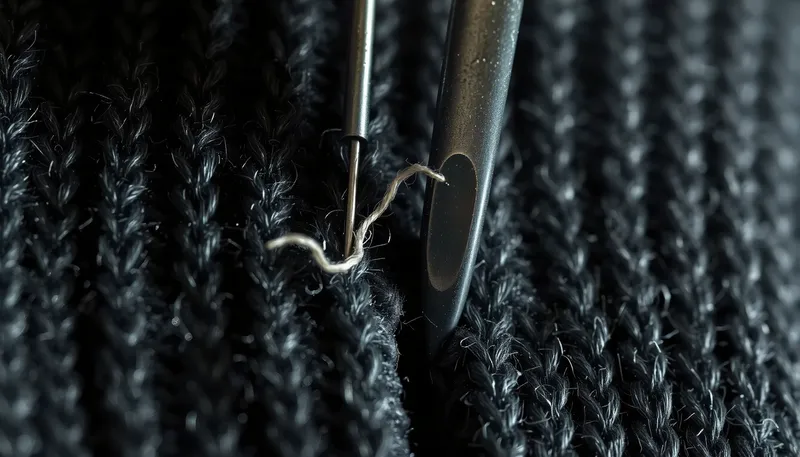
The selection of a needle with the correct point geometry is the primary factor in preventing Yarn Severance in knit fabrics. Using a ball-point needle is the standard industrial solution for high-stretch knit materials. The rounded tip of a ball-point needle is engineered to displace fabric yarns rather than pierce them. Based on our factory testing, switching from a sharp point to a medium ball-point needle on high-spandex fabric can reduce defect rates from over 10% to less than 0.5%.
The table below compares needle point specifications for preventing Needle Cutting in a factory setting.
| Core Spec | Best For | The 'Gotcha' (Limitations) | Technical Rationale |
|---|---|---|---|
| Sharp Point (R) | Woven fabrics, coated materials | Causes catastrophic Needle Cutting in knits. Do not use for fabrics with spandex. | Pierces and cuts yarns directly, severing the fabric structure. This is the leading cause of Spandex Breakage. |
| Light Ball Point (SES) | Fine-gauge knits, single jersey | May be too delicate for heavier fabrics, potentially leading to needle deflection or breakage. | The slightly rounded tip gently pushes aside fine yarns in delicate knit constructions, preventing runs. |
| Medium Ball Point (SUK) | Medium-density knits, Activewear (280 GSM High-Density Interlock), French Terry | Can be too blunt for very fine or tightly woven knits, causing needle "climbing" or skipped stitches. | A distinctly rounded tip, part of the 130/705 H SUK needle system, effectively displaces yarns in standard-to-heavy knits. This is the best practice for most spandex activewear. |
| Heavy Ball Point (SKF) | Coarse-gauge knits, heavy sweater knits | Not suitable for fine or medium-weight knits. The large point can distort the fabric structure and cause skipped stitches. | A very rounded tip designed to navigate large yarn structures without causing damage. |
Decision Card: Which Needle for Your Knit?
| Fabric weight | Knit type | Recommended needle |
|---|---|---|
| < 150 gsm | Single jersey, fine | SES (light ball‑point) |
| 150–250 gsm | Activewear, interlock | SUK (medium ball‑point) |
| > 250 gsm | Fleece, sweater | SKF (heavy ball‑point) |
| Woven fabrics | Cotton, linen | Sharp point (R) – but never on knits |
| All samples conditioned at 20±2°C, 65±4% RH per ISO 139 before testing. |
How is Needle Cutting Verified in a Factory Setting?
Needle cutting is verified via a manual seam stretch test using a Class 301 Lockstitch. An inspector sews a 10-inch sample, applies perpendicular tension, and visually checks for star-shaped holes or running ladders along the stitch line under a D65 light source.
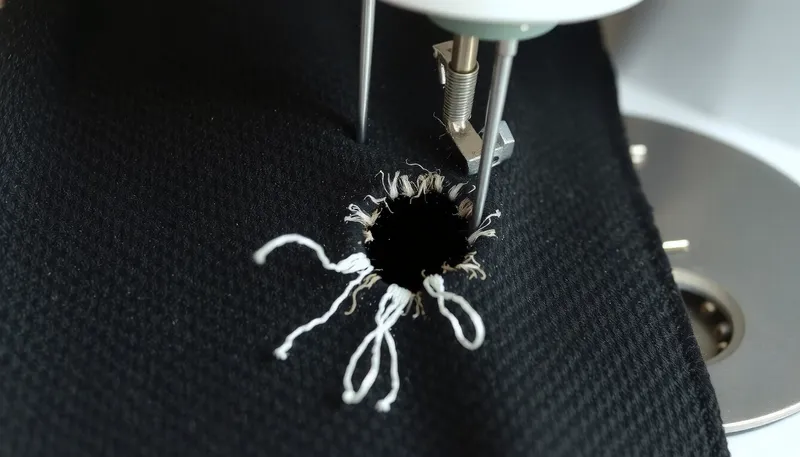
While ASTM D3940 measures the overall bursting strength of knitted goods, it cannot predict needle-fabric incompatibility. Factory-floor verification is essential because even fabrics with bursting strengths >50 psi can suffer catastrophic yarn severance if sewn with an improper needle profile. The manual seam stretch test provides immediate, actionable feedback prior to bulk cutting.
How to Perform the Stretch Test (Step Card)
- Prepare sample – Sew a 10-inch seam on the target fabric using a Lockstitch Machine (Class 301) equipped with a standard 134 R (DPx5) needle system.
- Stretch sharply – Grasp fabric on both sides of the seam and stretch perpendicular to the stitch line.
- Inspect – Look for star‑shaped holes or vertical runs under bright light.
- ✅ No holes → Needle compatible.
- ❌ Holes present → Needle cutting confirmed. Protocol validated in TÜV SÜD audited facilities.
When is the Needle NOT the Root Cause?
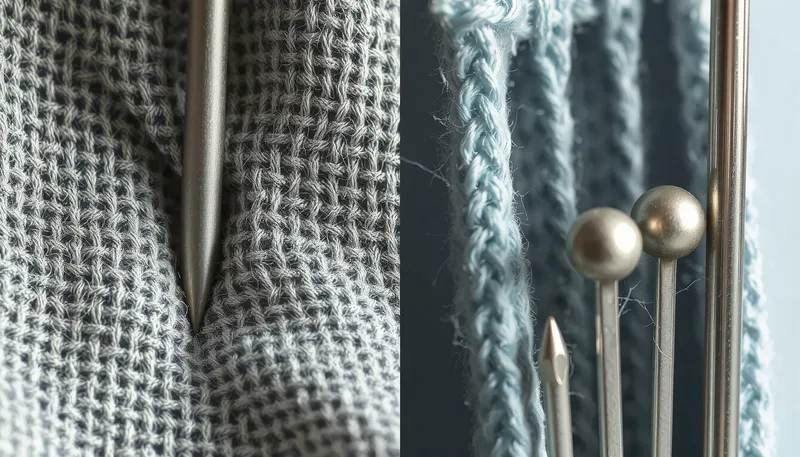
A damaged needle plate or excessive machine speed can cause yarn severance, even with the correct ball-point needle. To fully eliminate defects, factories must audit all sewing parameters (speed, plate burrs, thread thickness) and ensure the fabric's bursting strength exceeds 50 psi (ASTM D3940).
- Incorrect Machine Speed: Operating a sewing machine at excessive speeds generates Needle Heat/Friction. This heat can melt or weaken synthetic fibers like spandex, causing Spandex Breakage even if the needle point is correct. Reducing machine speed by 15-20% (e.g., dropping from 4,500 to under 3,800 RPM) is a common troubleshooting step.
- Damaged Machine Parts: A burr or sharp edge on the needle plate, throat plate, or presser foot can snag and break yarns. This damage mimics the appearance of Needle Cutting. Regular machine maintenance and inspection are critical preventative measures.
- Incorrect Thread Selection: A thread that is too thick for the fabric's Fabric Weight and needle size increases the penetration force required. This increased force can lead to yarn breakage. Additionally, excessive top or bobbin thread tension can pull the severed yarns, exacerbating the hole size. A Polyester Corespun Thread with a Ticket No. 120 provides a good balance of strength and fineness for most stretch seams.
- Poor Fabric Quality: In some instances, the fabric itself is the primary cause. A knit structure that is too loose, has low yarn cohesion, or exhibits a low bursting strength per ASTM D3940 will be susceptible to damage regardless of the needle used.
Conclusion
To eliminate needle cutting in high-spandex knit fabrics, mandate the use of ball-point needles (e.g., SUK or SES) and verify compatibility via a physical seam stretch test before bulk production.
If holes persist with the correct needle profile, inspect the needle plate for abrasive burrs and reduce machine speed by 15-20% to mitigate thermal degradation from needle heat.
Frequently Asked Questions (FAQ)
1. How does needle size affect needle cutting?
A needle that is too large for the fabric forces yarns apart excessively and can break them.
*   Always use the smallest needle size that avoids skipped stitches.
*   Metric size 65-75 Nm corresponds to Singer system size 9-11.
*   The needle must accommodate your chosen thread size without fraying the thread.
2. Can needle heat cause spandex breakage?
Yes, high-speed sewing generates friction that can degrade elastomeric fibers, causing them to snap.
*   This is known as Needle Heat/Friction.
*   Using needles with a protective coating like titanium nitride can reduce heat.
*   Reducing machine speed by 15-20% is a standard corrective action.
3. What is the difference between a SUK and SES needle point?
A SUK needle has a "medium" ball point, while an SES needle has a "light" ball point.
*   **SUK:** Ideal for medium-weight knits like activewear interlock and fleece.
*   **SES:** Designed for finer, more delicate knits like single jersey T-shirt fabric.
*   The choice depends on the fabric's Fabric Weight and knit density.
4. What type of thread is best for stretch fabrics to avoid seam failure?
A high-quality Polyester Corespun Thread is the industry standard for preventing seam failure in stretch fabrics.
*   It combines a high-strength filament core with a spun polyester wrap.
*   This construction provides both the elongation and strength needed for stretch seams.
*   A common specification for this application is Ticket No. 120.
5. How do I test a fabric for susceptibility to needle cutting?
Perform a comparative sewing test on a sample before starting bulk production.
*   Sew one seam with a sharp-point (R) needle.
*   Sew a second seam with a Ball-point Needle (SUK).
*   Perform the seam stretch test on both; if the sharp needle creates holes and the ball-point does not, the fabric requires ball-point needles.
Contact our technical team for a fabric and needle compatibility assessment.
Written by Forall Lab
© Forall Lab • Powered by Kunpeng ONE