An equestrian breeches fabric is a high-performance stretch textile engineered for saddle contact. It must pass six quantified gates: basis weight ≥250 g/m² measured by ISO 3801, four-way stretch elongation ≥70% measured by ASTM D4964, elastic recovery ≥90% after repeated cycling measured by ASTM D3107, abrasion resistance ≥50,000 Martindale cycles measured by ISO 12947-2, pilling grade ≥4 measured by ISO 12945-2, and vertical wicking fast enough to keep the seat area dry during arena work, measured by AATCC 197. A fabric that clears all six gates resists knee bagging, saddle-friction holes, and crotch-seam failure through a full season of riding. It is not the same fabric as a yoga legging, and it is not suitable for winter trail riding below 5°C without a thermal lining.
This guide is written the way a technical mill would brief a riding-apparel brand: it translates "saddle grip," "breathability," and "durable" into numbers a knitting factory can quote, sample, and test. At Foralltex we build high-stretch nylon-spandex platforms such as the D036 interlock and the D083 air-sculpt; this guide is how we turn a breeches brief into measurable requirements, including when those platforms are the right base and when a saddle-grade build needs a heavier development.
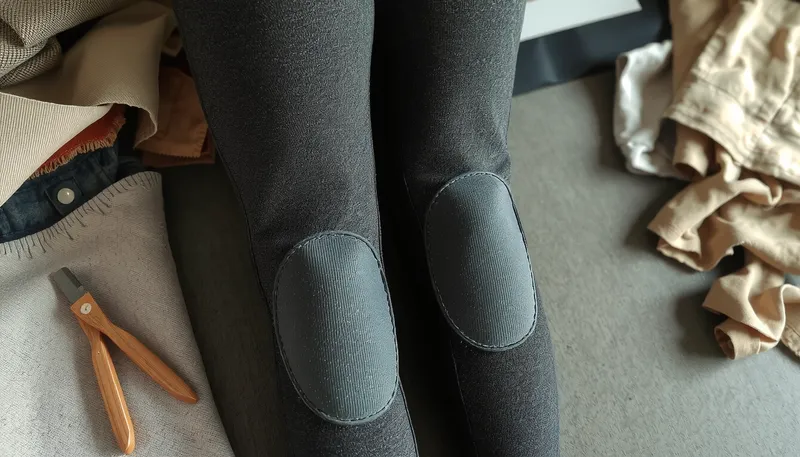
Why Riding Breeches Need a Different Spec Than Leggings
Riding breeches fail in three ways that leggings do not: knee bagging from lost elastic recovery, holes at the inner knee and seat from sustained saddle friction, and crotch-seam stress from the posting trot. Each failure maps to a measurable fabric property, which is why a breeches spec is stricter than a leggings spec in weight and abrasion, not in opacity.
A rider sits on the saddle for hours while the inner knee and seat press against leather or synthetic surfaces. Leggings are engineered for squatting in a gym, where the critical failure is see-through under tension; a squat-proof interlock such as our D036 at 160 g/m² handles that job well but is too light and too opacity-focused for saddle abrasion. Breeches add two demands. First, heavier mass: the saddle-contact zones need enough fiber density to survive thousands of friction cycles per ride. Second, elastic recovery: every knee flexion in dressage or jumping stretches the knee panel, and the fabric must snap back or the garment bags permanently within a few months.
The limitation cuts the other way too. A fabric heavy and abrasion-resistant enough for all-day arena work is generally too warm and too stiff for winter trail riding below 5°C unless a brushed thermal layer is added. There is no single "riding fabric"; the spec follows the discipline and the season.
The Quantified Requirements, and the Blend That Delivers Them
Every saddle-ready breeches fabric can be reduced to six test-gated numbers — weight, elongation, recovery, abrasion, pilling, and wicking — and one blend rule: 70-80% nylon with 18-25% spandex. Specify the numbers, and any mill can quote against them; skip the numbers, and you are buying adjectives.
| Requirement | Target value | Test method |
|---|---|---|
| Fabric weight | ≥250 g/m² (all-purpose); ≥320 g/m² for cross-country | ISO 3801 |
| Four-way stretch elongation | ≥70% at break | ASTM D4964 |
| Elastic recovery | ≥90% after repeated cycling | ASTM D3107 |
| Abrasion resistance | ≥50,000 Martindale cycles (heavy use); ≥30,000 (light use) | ISO 12947-2 |
| Pilling resistance | Grade ≥4 after 5,000 rubs | ISO 12945-2 |
| Vertical wicking | ≥10 cm in 5 minutes | AATCC 197 |
Nylon (polyamide) is the workhorse of the blend because it has the highest abrasion resistance among synthetics and takes deep, even color. Spandex (elastane) provides the four-way stretch and recovery; below roughly 15% elastane, recovery drops and knee bagging appears within weeks, while above roughly 30%, the fabric loses structural support and can deform permanently under repeated loading. Polyester contributes fast drying but reads drier against the skin, so it is kept as a secondary fiber. Cotton is used only in recreational-weight breeches at ≤10-15%, because it absorbs sweat, dries slowly, and pulls recovery down after laundering.
The blend statement "nylon-spandex" on a datasheet is not enough — the spandex percentage and the fabric weight do the work. A breeches fabric that is 75% nylon and 25% spandex at 280 g/m² is a competition build; the same fiber ratio at 170 g/m² is a schooling tight with a shorter abrasion life.
Zoned Construction and Grip: Where the Breech Actually Touches the Saddle
A modern breech is rarely one fabric. It is a zoned build: a four-way-stretch main body, reinforced knee and seat panels, breathable calf sections under the boot, and a silicone or suede grip applied over the base fabric where it contacts the saddle. Specifying the base fabric alone misses half the product, and this is where most generic fabric guides stop.
The main body carries the four quantified requirements above. The knee and seat zones face the real abrasion load, so they are either cut from the same fabric at the heavier end of the tolerance or reinforced with a tighter, higher-density panel. The calf and back-knee area sits inside a boot or against the horse's flank; a lighter or mesh-backed section there improves airflow without compromising the saddle zones. Grip — silicone dots, a full-seat silicone print, or synthetic suede — is applied over the base fabric and does not change the base spec. What matters for the fabric buyer is that the base has a stable enough face for the grip to adhere and survive washing; a heavily brushed or napped surface in the seat area is a poor substrate for a printed grip.
When a supplier says a breech is "technical," ask which zone they mean. A garment can combine a stretch main body with a Cordura-style knee reinforcement and a mesh calf panel — three or more different materials in one pair. If you are sourcing fabric rather than finished breeches, confirm which zone your fabric will serve before you spec weight and abrasion targets, because a calf panel does not need Martindale 50,000.
GSM vs Stretch: The Trade-Off and the Two Seasonal Builds
Weight and stretch pull against each other: a 350 g/m² fabric with under 40% elongation is too stiff to sit in the saddle, while an 80%-elongation fabric at 180 g/m² tears quickly under saddle friction. The resolution is construction, not just weight — an air-layer or double-knit build delivers structure and recovery at a lower mass than a solid single layer.
For all-purpose and competition breeches, keep the ≥250 g/m² gate and pair it with ≥70% elongation and ≥90% recovery. For summer schooling, a dedicated lightweight build at roughly 185-220 g/m² with a high nylon content and aggressive wicking keeps the rider cool, but you are trading abrasion life — the same logic as our D083 air-sculpt at 170-220 g/m², which we recommend for non-saddle stretch garments rather than heavy saddle contact. For winter and cross-country, move to ≥320 g/m² with Martindale ≥70,000 cycles and a brushed or thermal inner layer.
The practical consequence for a buyer: state the discipline and the season before you ask for a GSM. "Saddle-ready" means different numbers for a dressage competitor than for a summer trail rider, and a mill that quotes one fabric for both has not understood the brief.
Safety and Certificates: What OEKO-TEX Class 2 Actually Covers
For next-to-skin riding wear, the compliance gate is OEKO-TEX Standard 100 Class 2, which limits formaldehyde to 75 mg/kg and restricts banned azo dyes and extractable heavy metals; optional antimicrobial finishes can be verified by ISO 20743. These are the claims a certificate can support.
Two cautions keep the spec honest. First, competition federations regulate protective equipment, not breeches fabric weight: the relevant European standard for equestrian body protectors is EN 13158, and FEI or USEF rules govern frangible and protective devices for cross-country rather than the GSM of a riding pant. Treat a "federation-approved fabric" label with suspicion unless the supplier names the rule and the clause. Second, an antimicrobial or skin-safety claim needs a named test and a report; a finish that "kills bacteria" without an ISO 20743 result is marketing.
In our lab reviews of breeches programs at Foralltex, the failures we see most often are not exotic — they are knee bagging from spandex below 15%, seat wear on fabrics that passed opacity but not Martindale, and grip that peeled after ten washes because the base face was too napped to hold the print. All three are preventable at the spec stage.
How to Write the Breeches Fabric Spec and Vet a Mill
A complete breeches fabric spec fits in one paragraph, and a mill that can quote it verbatim is a partner: four-way-stretch nylon-spandex, 250 g/m², ≥70% elongation per ASTM D4964, ≥90% recovery per ASTM D3107, Martindale ≥50,000 per ISO 12947-2, pilling ≥4 per ISO 12945-2, vertical wicking ≥10 cm in 5 minutes per AATCC 197, OEKO-TEX Standard 100 Class 2. Vet the supplier against four checks before any bulk commitment.
- Order swatches and wear-test them on the actual garment: stretch the knee panel, sit in the sample, and check for see-through at the seat after a wash.
- Ask for the test report on the exact fabric and color you will buy, not a generic datasheet — recovery and pilling change with weight and dye lot.
- Put the MOQ, lead time, and sampling cost in writing, and confirm whether the grip application is included or handled by your garment factory.
- Run a pilot length, sew and wash finished samples, and re-check recovery, pilling, and grip adhesion after 10-20 home launderings before you scale.
For a custom breeches development on a nylon-spandex base, we can quote against this spec — request a sample through our contact page.
FAQ: Equestrian Breeches Fabric Questions
Can I use regular gym leggings for horse riding?
For arena riding longer than an hour, no. Gym leggings are built for opacity and compression, not saddle abrasion: they typically lack the ≥250 g/m² mass, the ≥50,000-cycle Martindale abrasion resistance, and the seam strength that breeches need, so they develop holes at the inner knee within 20-30 riding hours. The exception is casual walking or grooming with no saddle contact, where a legging is fine. For any trot or canter work, spec a breeches fabric instead.
What is the best material for summer riding breeches?
A lightweight nylon-dominant blend — roughly 70% nylon or more with 18-22% spandex — with strong vertical wicking per AATCC 197 and a breathable knit at about 185-220 g/m². Keep cotton at 5% or less, because cotton holds sweat and dries slowly against the saddle. A summer schooling build trades abrasion life for coolness, so reserve it for non-competition rides and use a heavier ≥250 g/m² fabric for events.
Why do my riding pants get baggy at the knees?
Knee bagging is lost elastic recovery: after each knee flexion the fabric stretches but does not return, and the excess accumulates at the knee and seat. Recovery below roughly 85-90% per ASTM D3107 is the usual cause. Specify ≥18% spandex with ≥90% recovery, and reject fabrics whose datasheet shows recovery under 85% — they will bag after ten to fifteen rides.
What does technical fabric mean in riding breeches?
It should mean a fabric that passes at least three of the quantified tests in the spec table: Martindale abrasion, four-way stretch with recovery, pilling grade, and moisture transfer, each with a named method and a target value. Without test data, "technical" is a marketing adjective. Ask the supplier for the standard and the number for the exact fabric you are buying.
How much stretch is ideal in equestrian breeches?
About 70-85% elongation at break per ASTM D4964 with recovery ≥90% per ASTM D3107, which corresponds to roughly 18-25% spandex in a nylon base. Below about 60% elongation, hip flexion feels restricted in the saddle; above about 90%, the fabric sags unless the nylon base is dense enough to hold it. Test the actual fabric, because two fabrics with the same spandex percentage can recover very differently.
Do I need OEKO-TEX for riding breeches fabric, and is federation-approved fabric real?
OEKO-TEX Standard 100 Class 2 is the practical skin-safety certificate for next-to-skin breeches and limits formaldehyde to 75 mg/kg along with banned azo dyes and heavy metals. As for federation approval: FEI and USEF rules regulate protective equipment such as body protectors — the European standard for those is EN 13158 — not the weight of breeches fabric. If a supplier claims a fabric is "FEI-approved," ask for the exact rule and clause; a genuine certificate for the fabric itself will be an OEKO-TEX or equivalent number you can verify.
🔗 Related Fabrics
This article explains how to specify equestrian breeches fabric with quantified saddle-ready requirements — the six test-gated fabric metrics, zoned reinforcement and grip construction, and a mill-vetting checklist — forming the performance stretch-pants and recovery-testing matrix:
- Structured-Stretch Golf Pants Fabric: Air-Layer Guide — the structured-stretch pants sibling: air-layer construction trade-offs for non-saddle performance wear
- How to Test Squat Proof Leggings: 3-Step Home Guide 2026 — the leggings boundary: why squat-proof opacity is not saddle abrasion resistance
- Fabric Elongation and Recovery Test: The Complete Guide to ASTM D3107 — the recovery-test method behind the ≥90% requirement
- Back to Index
Written by Wenruo
Textile Engineer, Forall Lab