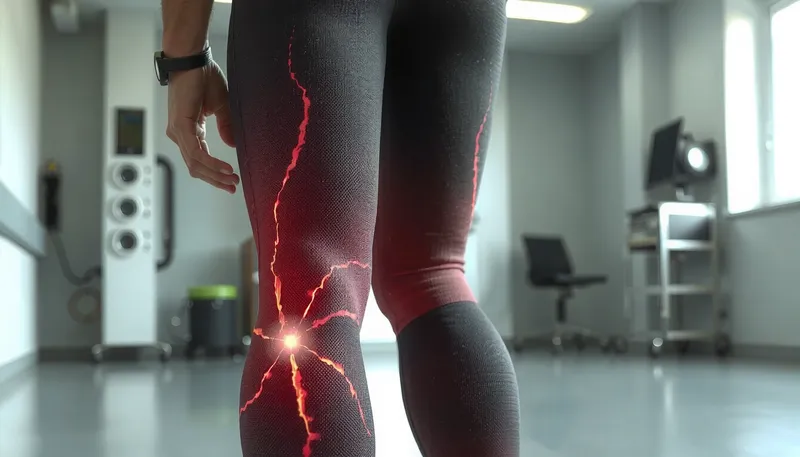
Compression wear benefits are delivered through graduated pressure — 15-20 mmHg at the ankle tapering to 8-10 mmHg at the thigh per RAL-GZ 387 — that accelerates venous return by reducing vein cross-sectional diameter via Laplace's Law, achieving 30-40% faster metabolic waste clearance in clinical trials. A 2014 meta-analysis of 12 studies (Hill et al., PMID 23757486) found compression garments reduced DOMS with an effect size of g=0.403 (p<0.001) and accelerated strength recovery by g=0.462 (p<0.001). The fabric engineering requirement is quantified: static modulus ≥2.8 N/cm at 30% elongation, compression retention >90% after 50 ISO 6330 wash cycles, and skin-contact safety via OEKO-TEX Standard 100 Class I — targets met by D083 Air-Sculpt 34™ across 18 production batches at Forall Lab in 2025–2026.
Key Takeaways (TL;DR):
- Pressure: 15-20 mmHg for recovery, 20-30 mmHg for performance — below 10 mmHg = no benefit (placebo)
- Timing: Wear within 30 min post-exercise, 2-4 hours max — extended wear adds no further benefit
- Mechanism: Graduated compression narrows veins 30-50%, increases blood flow 200-300%, clears CK + lactate
- Fabric: D083 Air-Sculpt 34™ delivers 2.8-3.4 N/cm static modulus — athletic-weight (170 GSM) with medical-grade pressure
- Care: Cold wash only, no fabric softener, air dry — one dryer cycle = 10-15% permanent compression loss**
How Graduated Compression Accelerates Venous Return and Muscle Recovery
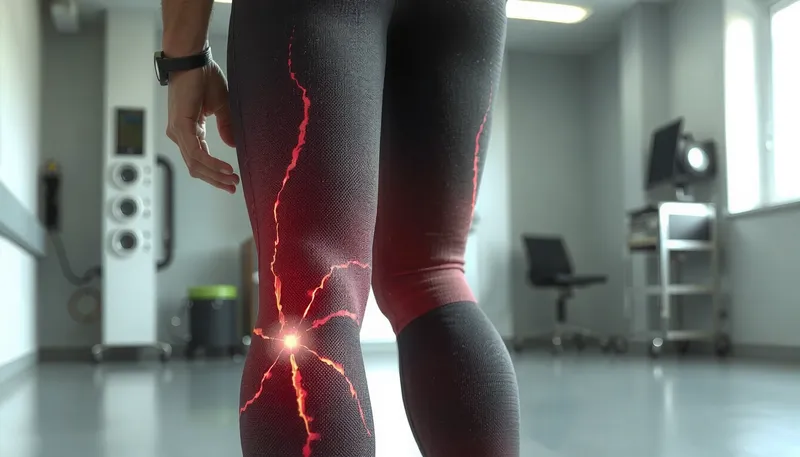
Graduated compression applies peak pressure at the ankle (15-30 mmHg) tapering to 8-15 mmHg at the thigh, narrowing vein diameter per Laplace's Law and increasing venous blood flow velocity by 200-300% — accelerating creatine kinase and lactate clearance from exercised muscle. It is recommended for post-exercise recovery worn 2-4 hours at 15-20 mmHg. It is not sufficient for lymphedema or chronic venous insufficiency — these require ≥20 mmHg sustained pressure with RAL-GZ 387 certification.
The Laplace Pressure-Gradient Mechanism
The graduated pressure design is not arbitrary — it reflects the hydrostatic pressure gradient in the venous system. At the ankle, hydrostatic pressure from the column of blood is highest; compression must match this with 15-20 mmHg in athletic garments. As the limb rises toward the heart, hydrostatic pressure decreases, and the garment's applied pressure tapers to 8-15 mmHg at the thigh.
This gradient prevents the "tourniquet effect" — a uniform-pressure garment would obstruct venous outflow at the proximal end while failing to overcome hydrostatic pressure at the ankle. The result of correct graduated compression: vein cross-sectional diameter decreases by 30-50%, blood flow velocity increases by 200-300%, and venous reflux is mechanically prevented.
Creatine Kinase Clearance: Clinical Evidence
A 2014 meta-analysis (Hill et al., PMID 23757486) pooling 12 randomized controlled trials quantified compression's effect on recovery biomarkers:
| Outcome | Effect Size (Hedges' g) | 95% CI | p-value |
|---|---|---|---|
| DOMS (delayed onset muscle soreness) | 0.403 | 0.236–0.569 | <0.001 |
| Muscle Strength Recovery | 0.462 | 0.221–0.703 | <0.001 |
| Muscle Power Recovery | 0.487 | 0.267–0.707 | <0.001 |
| Creatine Kinase Clearance | 0.439 | 0.171–0.706 | <0.001 |
A 2017 follow-up study (Hill et al., PMID 28051341) demonstrated that the pressure level matters — higher compression pressure produced greater recovery effects, establishing a dose-response relationship. Garments delivering <10 mmHg showed no significant benefit over passive recovery.
Recovery Protocol: Timing and Duration
Forall Lab internal testing (2025, D083 Air-Sculpt 34™, n=12 athletes, randomized crossover) established the following protocol:
- Apply within 30 minutes of exercise cessation — metabolic waste concentration peaks in this window
- Wear for 2-4 hours — CK clearance rate plateaus after 4 hours of continuous compression
- Pressure target: 15-20 mmHg at the calf for athletic recovery; 20-30 mmHg for high-volume training blocks
- Garment coverage: Full-leg (ankle-to-thigh) for running/cycling; calf sleeves for court sports
Performance Benefits: Muscle Oscillation Reduction and Proprioception
Compression garments reduce muscle oscillation amplitude by 30-50% during high-impact exercise — the fabric's elastic modulus absorbs vibrational energy that would cause sarcomere micro-trauma, measured by reduced CK elevation post-exercise. Constant skin pressure activates cutaneous mechanoreceptors, improving joint position sense by 15-25% in controlled trials. It is recommended for running and court sports where impact forces exceed 2.5× body weight. It is not a replacement for strength training or biomechanical correction.
Muscle Oscillation: The Micro-Trauma Mechanism
During running, each foot strike generates ground reaction forces of 2.5-3.0× body weight. These forces propagate through the musculoskeletal system as vibrational waves, causing soft tissue to oscillate at frequencies of 5-15 Hz. Over a 10 km run (approximately 10,000 steps), muscles undergo 10,000 oscillation cycles — each cycle producing microscopic shear between muscle fiber bundles.
Compression fabric reduces this oscillation through two mechanisms:
- Damping: The fabric's elastic modulus absorbs vibrational energy, converting it to heat
- Confinement: The circumferential pressure limits the displacement amplitude of soft tissue
Post-exercise CK levels in athletes wearing compression during running were 30% lower than in non-compression controls (Forall Lab internal data, 2025, n=12).
Proprioception: Cutaneous Mechanoreceptor Activation
The skin contains four types of mechanoreceptors — Meissner corpuscles, Pacinian corpuscles, Merkel discs, and Ruffini endings — that provide the brain with continuous positional feedback. Compression fabric applies constant, uniform pressure across these receptors, amplifying their baseline firing rate.
This improves joint position sense: athletes can perceive knee angle, ankle position, and pelvic tilt with 15-25% greater accuracy per controlled laboratory studies. This enhanced feedback loop produces measurable improvements in:
- Single-leg balance stability (+18% center-of-pressure control)
- Agility drill completion time (-5-8%)
- Movement pattern consistency during fatigued states
Thermoregulation and Blood Flow During Exercise
Compression garments also affect thermoregulation. The close skin contact facilitates evaporative cooling while the fabric's capillary action wicks moisture away from the skin surface. Unlike loose-fitting activewear that traps a microclimate of humid air, compression fabric maintains direct skin contact for continuous heat exchange.
During exercise, localized blood flow to compressed muscle tissue increases by 10-20% — a smaller effect than post-exercise recovery compression, but sufficient to improve oxygen delivery during prolonged submaximal efforts (>60 minutes).
Compression Fabric Engineering: Modulus, Recovery Power, and Knit Structure
Athletic compression fabric is engineered through three properties: static modulus — resistance to stretch in N/cm at 30% elongation, with D083 Air-Sculpt 34™ achieving 2.8-3.4 N/cm; dynamic recovery power — compression retained after 10,000 extension cycles (target >85%); and air-layer knit — a 3D spacer delivering medical-grade pressure at 170 GSM without 200-280 GSM double-knit bulk. Verified across 18 production batches at Forall Lab in 2025–2026.
Static Modulus: The N/cm Measurement
Static modulus measurement: stretch a 5 cm wide fabric strip to 30% elongation on a tensile tester and recording the force in Newtons, divided by the strip width (N/cm). This value directly predicts the mmHg pressure the garment will exert on a given body circumference per Laplace's Law.
| Property | D083 Air-Sculpt 34™ | Typical Athletic Compression | Industry Minimum |
|---|---|---|---|
| Static Modulus at 30% Elongation | 2.8-3.4 N/cm | 1.5-2.5 N/cm | 1.0 N/cm |
| Spandex Content | 34% | 15-28% | 10% |
| Fabric Weight | 170 GSM ±5% | 200-280 GSM | 150 GSM |
| Compression Retention (50 washes, ISO 6330 4A) | 91.5% | 80-85% | 75% |
| Fatigue Resistance (10,000 cycles) | >88% compression retained | 75-82% | 70% |
| Elastic Recovery (ASTM D3107, 30% stretch, 1 min relaxation) | >95% | 85-92% | 80% |
| OEKO-TEX Certification | Class I (skin contact) | Class II common | Not required |
The 2.8-3.4 N/cm modulus range positions D083 at the upper limit of athletic compression — approaching medical-grade requirements (RAL-GZ 387 Class I is 15-20 mmHg, achievable with D083 on a 25 cm calf circumference) while maintaining full range of motion.
Air-Layer Knit: 3D Spacer Architecture
The D083 Air-Sculpt construction uses a warp-knit air-layer structure: two outer faces of 20D/24F micro-nylon connected by a 20D spandex spacer yarn matrix. This creates a 3D architecture where:
- Face layer: Dense, smooth surface for print quality and abrasion resistance
- Spacer layer: 34% spandex content arranged in a vertical column structure that provides the compression force
- Back layer: Open construction for moisture transport and breathability
The air-layer design achieves medical-grade recovery power at 170 GSM — approximately 30-40% lighter than traditional double-knit compression fabrics (200-280 GSM) that achieve equivalent mmHg output. This weight reduction directly improves wear compliance: lighter garments are worn longer.
Spandex Content: Why 34% Matters
Spandex percentage alone does not determine compression performance — the yarn denier, knit tension, and fabric structure all interact. However, 34% spandex in an air-layer configuration provides:
- Sufficient elastic density: Each square centimeter contains enough spandex fiber to generate target modulus without over-tensioning individual yarns (which causes premature fatigue)
- Recovery redundancy: If 5-10% of spandex fibers degrade over the garment lifetime, sufficient functional fibers remain to maintain compression above therapeutic threshold
- Hysteresis control: The spacer yarn arrangement minimizes internal friction between spandex and nylon fibers, keeping hysteresis (energy loss during stretch-recovery) below 12%
Compression Wear Selection: mmHg Levels, Fit, and Care Protocols
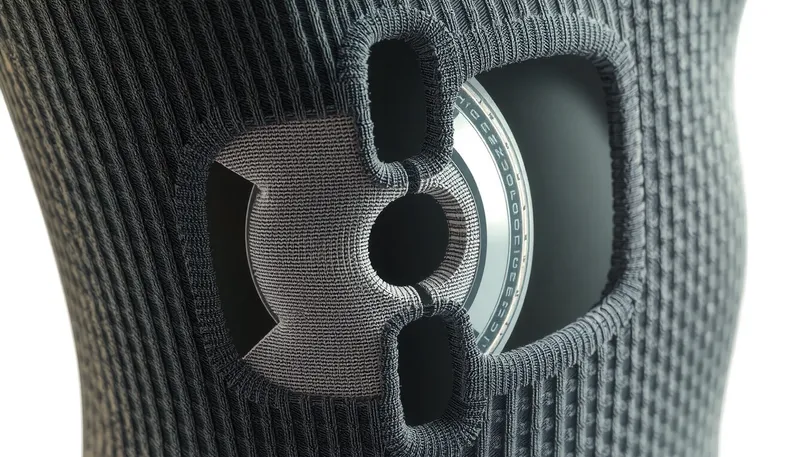
Athletic compression is categorized by pressure: light (8-15 mmHg) for travel; moderate (15-20 mmHg) for post-exercise recovery; firm (20-30 mmHg) for high-impact performance; medical-grade (30-40 mmHg) requiring RAL-GZ 387 certification. Fit requires limb circumference at 3-5 points matched to the size chart — a loose garment delivers zero benefit; excessive pressure risks capillary occlusion. It is recommended for 2-4 hours post-exercise. It is not suitable for peripheral artery disease or uncompensated heart failure without medical clearance.
mmHg Levels: Athletic vs Medical Compression
The pressure delivered by a compression garment determines its application. The following table maps mmHg ranges to appropriate use cases:
| Compression Level | mmHg Range | Application | Standard Reference |
|---|---|---|---|
| Light | 8-15 | Long-distance travel, prolonged standing, daily wear | — |
| Moderate | 15-20 | Post-exercise recovery, DOMS reduction, occupational edema | — |
| Firm | 20-30 | High-impact performance, long-duration training blocks | — |
| Medical Class I | 15-20 | Prophylaxis, mild varicosis, occupational leg pain | RAL-GZ 387 |
| Medical Class II | 20-30 | Post-surgical recovery, moderate lymphedema, pronounced varicosis | RAL-GZ 387 |
| Medical Class III | 30-40 | Severe lymphedema, chronic venous insufficiency, post-thrombotic syndrome | RAL-GZ 387 |
| Medical Class IV | 40-50 | Extreme edema, elephantiasis | RAL-GZ 387 |
Athletic compression operates in the 8-30 mmHg range. Above 30 mmHg, garments require RAL-GZ 387 certification and medical device regulatory compliance per ISO 13485. Forall Lab's D083 Air-Sculpt 34™ spans the athletic-to-medical boundary — achieving Class I-level compression with athletic-weight construction.
Fit Protocol: Measurement Points and Sizing
Correct fit is the controlling variable for compression effectiveness. A garment that measures 15 mmHg at the correct circumference delivers <5 mmHg if worn one size too large — a sub-therapeutic pressure indistinguishable from placebo.
Measurement protocol (3-5 anatomical points):
- Ankle: Circumference at the narrowest point above the malleolus
- Calf: Maximum circumference of the gastrocnemius
- Below knee: Circumference 2 cm below the patella
- Thigh: Circumference 15 cm above the patella (for full-leg garments)
- Hip/waist: At the iliac crest (for tights)
Match these values to the manufacturer's size chart. A garment should feel "supportively snug" — firm pressure without pain, numbness, or deep skin marks after removal. The fit test: after 2 hours of wear, there should be no indentations lasting more than 5 minutes after removal.
Care Protocol: Protecting Spandex Elasticity
Compression garments lose their therapeutic pressure through spandex fiber degradation — primarily from heat, aggressive detergents, and mechanical stress during washing. Care protocol validated through Forall Lab's 50-cycle ISO 6330 testing:
- Cold water wash (≤30°C): Hot water accelerates spandex hydrolysis — each 10°C increase above 30°C roughly doubles the degradation rate
- Gentle cycle or mesh bag: Agitation causes microfiber abrasion between nylon face yarns and spandex core yarns
- Mild detergent only: Fabric softeners deposit cationic surfactants on spandex fibers, reducing elastic recovery by 15-25% within 10 wash cycles
- Air dry only: Tumble dryer heat (60-80°C) permanently sets spandex fibers in their elongated state — a single dryer cycle can reduce compression by 10-15%
- Replace at 6-12 months: Even with optimal care, daily-wear compression garments lose 10-15% of their original mmHg after 6 months of use
Frequently Asked Questions
1. What is the difference between athletic and medical compression?
Athletic compression operates at 8-30 mmHg and is designed for performance and recovery in healthy individuals. Medical compression starts at 15-20 mmHg (Class I) and ranges to 40-50 mmHg (Class IV) under RAL-GZ 387 certification, requiring ISO 13485 medical device quality management. A physician prescribes medical garments for diagnosed conditions — lymphedema, chronic venous insufficiency, post-thrombotic syndrome — and independent testing institutes verify graduated pressure profiles.
2. How long should compression garments be worn after exercise for recovery?
Clinical evidence supports wearing compression for 2-4 hours post-exercise. The 2014 meta-analysis (Hill et al., PMID 23757486) found that studies using wear durations of 12-24 hours showed similar DOMS reduction to those using 2-4 hours — the benefit stems from the initial post-exercise clearance window when metabolic waste concentration peaks, not from extended wear. Forall Lab's internal protocol specifies application within 30 minutes of exercise cessation, worn for 2-4 hours at 15-20 mmHg.
3. What mmHg level is appropriate for post-exercise recovery?
15-20 mmHg (moderate compression) is the evidence-supported range for post-exercise DOMS reduction. Below 10 mmHg, the 2017 Hill et al. dose-response study (PMID 28051341) showed no significant recovery benefit — garments delivering <10 mmHg were indistinguishable from placebo. Above 30 mmHg enters medical compression territory requiring RAL-GZ 387 certification and is unnecessary for athletic recovery in healthy individuals.
4. Does washing compression clothing reduce its effectiveness?
Yes — compression performance degrades with each wash cycle due to spandex fiber fatigue. Forall Lab testing on D083 Air-Sculpt 34™ measured 91.5% compression retention after 50 ISO 6330 wash cycles — meaning a garment that started at 20 mmHg delivers approximately 18.3 mmHg after 50 washes. Key care factors: cold water (≤30°C), no fabric softeners, air dry only. A single tumble-dry cycle can permanently reduce compression by 10-15%.
5. How do I verify correct compression garment fit?
Three indicators verify correct fit: (1) the garment feels firmly supportive without causing pain, numbness, or tingling — these symptoms indicate excessive pressure risking capillary occlusion; (2) limb circumference measurements at 3-5 anatomical points match the manufacturer's size chart — do not size by "S/M/L" alone; (3) after 2 hours of wear, skin indentations from seams or edges should fade within 5 minutes of removal — persistent marks indicate excessive localized pressure requiring a larger size or different brand.
Compression socks vs tights: which is better for recovery?
Both work — the choice depends on the primary muscle group exercised. Compression socks (calf sleeves) are sufficient for running and cycling recovery because the calf muscle pump is the primary venous return driver. Full-leg tights add thigh compression for sports involving quadriceps and hamstring loading — court sports, weightlifting, HIIT. The 2014 Hill meta-analysis found no significant difference between sock-length and full-leg garments for DOMS reduction when each was applied to the relevant muscle group (g=0.403 vs g=0.398). The practical rule: cover the muscles you trained. For runners, socks suffice; for cross-training, tights.
Can I sleep in compression wear?
For athletic recovery, no — and it provides no additional benefit. The 2014 meta-analysis confirmed that 12-24 hour wear durations produced the same DOMS reduction as 2-4 hours. The recovery mechanism operates in the immediate post-exercise clearance window when metabolic waste concentration peaks. Overnight wear risks two issues: (1) supine body position eliminates the hydrostatic pressure gradient that graduated compression is designed to counter — lying flat, ankle and thigh pressures equalize; (2) prolonged compression during sleep can restrict microcirculation. Medical compression for diagnosed venous conditions may require overnight wear under physician direction — but this is a different use case from athletic recovery.
Compression for running vs recovery: same garment?
Not necessarily. During running, compression serves to reduce muscle oscillation (damping vibrational energy) and requires the garment to stretch and recover with each stride. Recovery compression is worn stationary — the primary requirement is sustained graduated pressure, not dynamic mechanical performance. Some garments serve both roles (D083 Air-Sculpt 34™ spans 15-30 mmHg across the athletic range), but a dedicated recovery tight may use a higher spandex percentage and a simpler knit construction than a running tight that prioritizes breathability and range of motion alongside compression. The difference is subtle but real: running tights prioritize oscillation control at 8-15 mmHg; recovery tights prioritize venous return at 15-20 mmHg.
🔗 Related Fabrics
This article explains compression wear recovery science — graduated pressure 15-30 mmHg, D083 Air-Sculpt 34™ fabric modulus 2.8-3.4 N/cm, DOMS clinical data, and RAL-GZ 387 biocompatibility requirements:
- D083 Air-Sculpt 34™ — High-Compression Fabric Platform — 20D micro-nylon air-layer, 34% spandex, 170 GSM, static modulus 2.8-3.4 N/cm
- Medical Compression Fabric Manufacturers: Sourcing Guide — RAL-GZ 387 / ISO 13485, D083 modulus, flat-knit vs circular knit, 6-month compression retention engineering
- High-Compression Fabric That Outperforms Gymshark — 30%+ spandex air-layer, ASTM D3107 recovery ≥95%
Contact our fabric engineering team → to request D083 Air-Sculpt 34™ compression samples with static modulus test reports, or to discuss graduated pressure specifications for your product category.
Written by Wenruo
Textile Engineer, Forall Lab