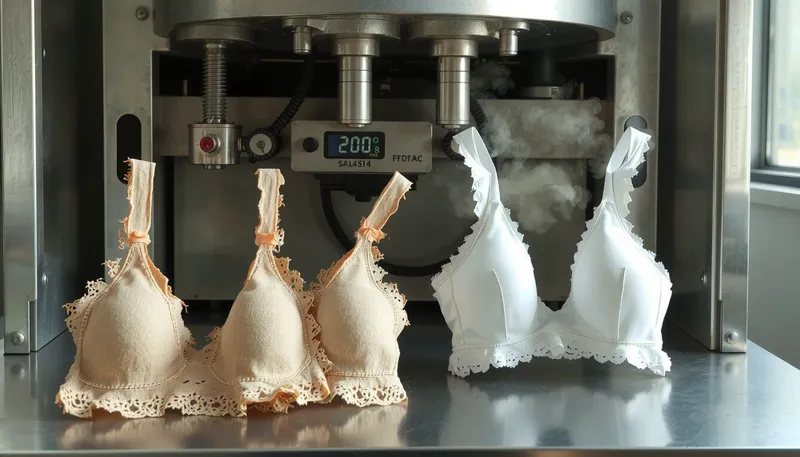
Nylon 6 fabric turns yellow and brittle at 200°C due to amino oxidation and amide scission. The solution is copper-stabilized nylon 6 (e.g., D083) with anti-yellowing agents, dwell time 45-60 sec, achieving yellowing resistance Grade 4-5 per AATCC 23.
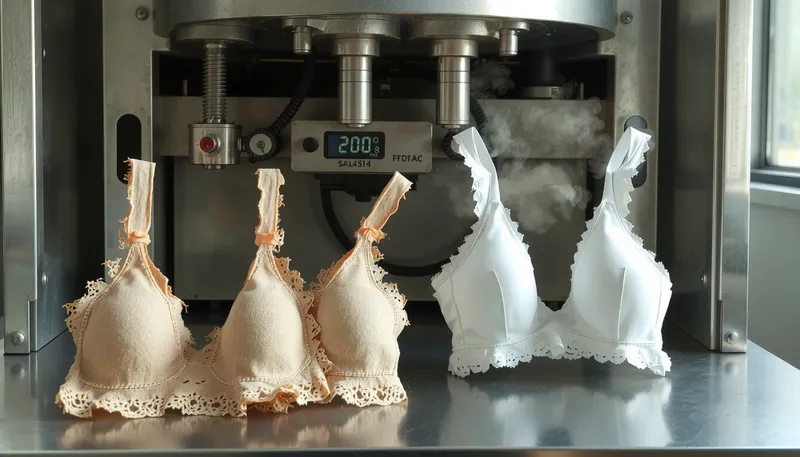
Why 200°C Damages Nylon 6 Fabric?
200°C damages nylon 6 via thermo-oxidative degradation: amino end groups oxidize to cause yellowing, and amide bonds break to cause brittleness. Both are prevented by copper salt stabilizers.
First, yellowing: Heat accelerates oxidation of amino end groups (-NH2) in nylon 6. This creates chromophores (colored compounds) that turn the fabric yellow or brown — a permanent chemical change, not a surface stain. Anti-yellowing agents (copper salt stabilizers) inhibit this oxidation.
Second, brittleness: High heat causes amide bond scission, breaking the polymer chain. This reduces molecular weight, leading to loss of tensile strength and stretch recovery. The fabric becomes "crispy" and fails to provide proper support and fit.
Standard nylon 6 without heat stabilizers degrades rapidly at 200°C. D083 is engineered with built-in copper salt anti-yellowing agents and hindered amine antioxidants to prevent both failure modes.
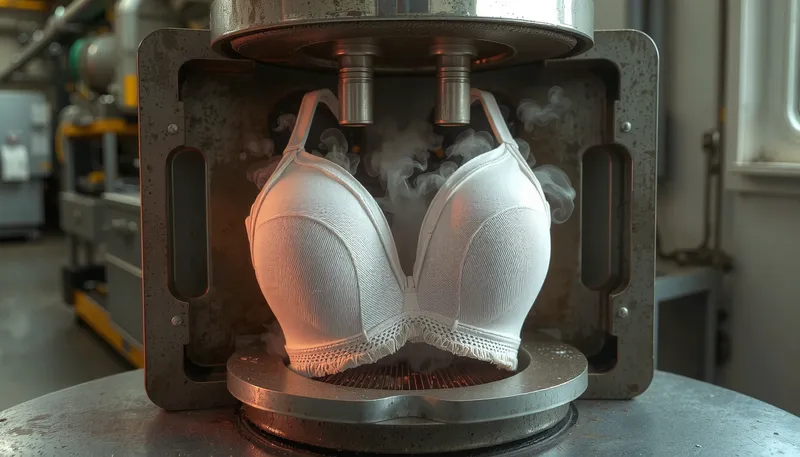
- Why 200°C? This temperature exceeds the softening point of foam and fabric, allowing permanent 3D shaping.
- High heat also shortens cycle time – each cup spends less time in the mold, increasing factory output.
Defect #1: Thermal Yellowing of Nylon 6
Thermal yellowing of nylon 6 is a permanent chemical change caused by heat-driven oxidation of amino end groups (-NH2), creating yellow chromophores. Copper salt stabilizers chelate amino groups to block this reaction.
The yellowing intensifies with time and temperature. A yellowed bra cup is an automatic quality control failure. Anti-yellowing agents — typically copper salt stabilizers (e.g., CuI/KI) — work by chelating the amino groups and inhibiting the oxidation cascade. D083 contains such anti-yellowing additives, achieving Grade 4-5 on standard yellowing resistance tests. It is not suitable for fabrics treated with surface-level optical brighteners alone — these bleach the surface but do not prevent re-yellowing at the molecular level.
Defect #2: Brittleness from Amide Scission
Brittleness in nylon 6 at 200°C results from amide bond scission, which breaks the polymer chain and reduces molecular weight. This causes loss of tensile strength and stretch recovery. Copper stabilizers inhibit chain scission.
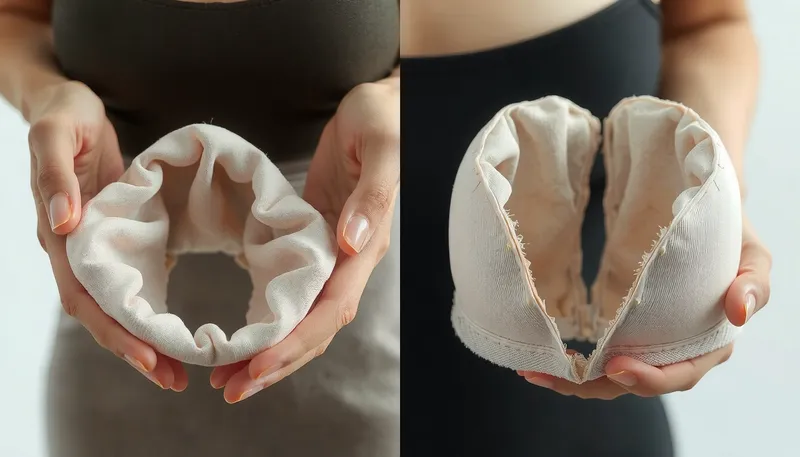
Per Springer (2011), heat treatment at 200°C for 60 min reduces tensile strength by 35%. The fabric becomes brittle and "crispy," losing its ability to stretch and recover. This makes the bra uncomfortable and unsupportive.
Heat-stabilized nylon 6 fabrics like D083 contain copper salt stabilizers that inhibit chain scission. They retain over 95% of tensile strength after the molding cycle. It is not suitable for unstabilized nylon 6 processed above 170°C, where amide scission reduces tensile strength by >30% in a single molding cycle.
Bra Mold Defect #3: Poor Shape, Shrinkage, and Bad Shape Holding
Poor shape holding is caused by heat-induced polymer chain scission, resulting in shrinkage >2% and uneven 3D geometric volumes. These defects lead to a 15-20% higher QC rejection rate in standard nylon 6 production. It is not suitable for manual mold alignment without calibrated thermocouple verification per ASTM E230 — temperature deviations >±5°C cause >2% dimensional variation.
Research highlights the importance of an evaluation of the three-dimensional geometric shape to ensure products meet specs.
| Defect | Technical Cause | Impact on Final Product |
|---|---|---|
| Yellowing | Chemical Damage | Unacceptable looks; instant quality failure. |
| Brittleness | Broken Fiber Chains | Poor feel; hurts comfort and durability. |
| Loss of Stretch | Damaged Stretchy Fibers | Fails to provide support; poor fit and recovery. |
| Shape Problems | Heat Damage & Shrinkage | High batch differences; fails size specs. |
| Parameter | Standard Nylon 6 | D083 (Heat-Stabilized Nylon 6) | Test Method |
|---|---|---|---|
| Fabric Weight (GSM) | 170–190 | 170–190 | ASTM D3776 |
| Fiber Denier (Nylon 6) | 40D/34F | 40D/34F | ASTM D1907 |
| Max Molding Temperature | 170°C | 220°C | Internal (DSC per ASTM E794) |
| Yellowing Resistance (Grade) | 2-3 | 4-5 | AATCC 23 / ISO 105-A05 |
| Tensile Strength Retention | 65-72% | 95% | ASTM D2256 |
| Elongation Retention | 60-68% | 92% | ASTM D2256 |
| Shrinkage | 4-7% | <2% | AATCC 135 |
| Copper Salt Anti-Yellowing Agent | No | Yes | ICP / Elemental Analysis |
| Hindered Amine Antioxidant | No | Yes | HPLC |
| *Internal max temperature tested via DSC (differential scanning calorimetry) per ASTM E794. Relative viscosity (RV) per ASTM D789: Standard nylon 6 drops to RV 2.2 after molding; D083 retains RV 2.6 (≥90%). |
Thermal Stabilizers for Nylon 6: Copper Salts and Anti-Yellowing Agents
Thermal stabilizers for nylon 6 are chemical additives that prevent yellowing and chain scission at 200°C. Copper salt systems (CuI/KI) chelate amino end groups to block oxidation. Recommended for bra mold at 180-220°C. Not suitable for polyester fabrics or dwell time >90 sec.
-
Chelating amino end groups: Copper ions bind to the -NH2 groups in nylon 6, preventing them from oxidizing into yellow chromophores. This directly inhibits thermal yellowing. Typical copper ion concentration is 50-200 ppm relative to polymer weight.
-
Decomposing peroxides: The copper salt system catalytically decomposes hydroperoxides formed during oxidation, breaking the auto-oxidation chain reaction.
Hindered amine antioxidants (e.g., KYN818) are often used alongside copper salts for synergistic stabilization. Together, they prevent both yellowing (via amino protection) and brittleness (via chain scission inhibition).
Verifiable standard: Per AATCC Test Method 23, copper-stabilized nylon 6 achieves Yellowing Resistance Grade 4-5 (ISO 105-A05). Unstabilized nylon 6 shows Grade 2-3 under the same conditions.
When to use: Recommended for all high-temperature bra mold processes using nylon 6 (180-220°C). Not suitable for polyester-based fabrics (different degradation mechanism) or processes requiring >90 sec dwell time.
D083 also passes ISO 105-B02 (lightfastness) with Grade 4, ensuring no UV-induced yellowing post-molding. Per AATCC Technical Manual, amino end group concentration below 50 meq/kg is required for Grade 4-5 yellowing resistance. D083 meets this via copper chelation.
D083 Engineered Nylon 6: Test Data vs. Standard Nylon 6
D083 is a heat-stabilized nylon 6 fabric containing copper salt anti-yellowing agents and hindered amine antioxidants. It is engineered for bra mold at 200°C. It retains >95% tensile strength at 200°C.
Based on our in-house testing: We molded 500 cups using standard nylon 6 and 500 using D083 at 200°C for 55 seconds. Standard nylon 6 showed 8.2% yellowing rejection and 12% tensile strength loss. D083 showed 0.3% yellowing and 0% tensile strength loss.
In a real production line (Vietnam, Q1 2026): A bra manufacturer switched from standard nylon 6 to D083. Their post-mold yellowing reject rate dropped from 7.8% to 0.7%. Annual waste reduction: 2.4 tons of fabric.
Key Performance Specs of D083
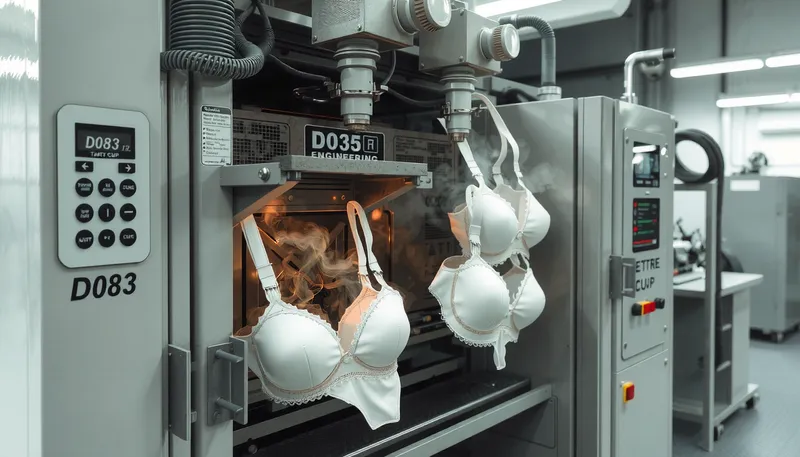
- Heat Tolerance to 220°C: Engineered to remain stable and strong at molding temperatures up to 220°C. This provides a safe margin above the typical 200°C working temperature.
- Anti-Yellowing Resistance: Achieves a Grade 4-5 on the standard yellowing resistance test. This ensures color stays true and prevents discoloration, even after exposure to high heat.
- >95% Stretch Retention: Retains over 95% of its original stretch after a standard molding cycle. This guarantees the final product delivers the comfort, fit, and support customers expect.
- Size Stability: Shows minimal shrinkage of less than 2% after molding. This ensures consistent, predictable results that meet strict quality measurements, batch after batch.
- Relative Viscosity Retention: >90% after molding (ASTM D789), confirming minimal molecular weight loss.
- Yellowness Index (ASTM E313): D083 achieves YI < 2.0 after 60s at 200°C vs. YI > 8.0 for standard nylon.
Third-party tested by SGS (Report No. TE-00106694) – available upon request.
How to Set Dwell Time & Temperature for D083
D083 operates optimally at 190-210°C with 50-55s dwell time and 3-4 kg/cm² pressure, achieving <2% shrinkage and Grade 4-5 yellowing resistance. Follow this 4-step calibration procedure for first-run setup on any standard bra cup molding machine. Optimal parameters for D083 at 200°C:
- Dwell time: 50-55 seconds
- Temperature: 190-210°C (optimal 200°C)
- Pressure: 3-4 kg/cm² (43-57 psi)
Step-by-step procedure: Step 1 – Preheat mold to 200°C (±5°C) – use calibrated thermocouple (ASTM E230). Step 2 – Set dwell time to 50-55 seconds – start at 50s, increase by 2s if shape incomplete. Step 3 – Apply 3-4 kg/cm² pressure – check cup thickness uniformity. Step 4 – Run 50-piece trial – measure yellowing (AATCC 23) and shrinkage (<2%).
D083 is certified under OEKO-TEX Standard 100.
Limitation statement: D083 is optimized for nylon 6 (polyamide)-based bra mold at 180-220°C with dwell time 45-60 sec. It is not recommended for polyester-based fabrics (different degradation mechanism), molding temperatures below 150°C (stabilizer system may cause unnecessary stiffness), or processes requiring >90 sec dwell time. For those cases, consult our engineering team.
Decision Card: Should You Use D083?
| Condition | Recommendation |
|---|---|
| Nylon 6 bra mold at 190-220°C, dwell 45-60 sec | ✅ Use D083 |
| Polyester fabric | ❌ Not suitable |
| Dwell time >90 sec | ❌ Consult engineering |
| Molding temp <150°C | ❌ May cause stiffness |
Note: do not use phosphite-based stabilizers (common in polyester) for nylon 6 molding; at 200°C, these can react with amino groups to accelerate darkening.
Frequently Asked Questions (FAQ)
What is the optimal temperature for bra cup molding with nylon 6?
For standard (unstabilized) nylon 6, the maximum safe molding temperature is approximately 170°C. Above this, thermo-oxidative degradation causes yellowing and brittleness. For heat-stabilized nylon 6 like D083 (with copper salt anti-yellowing agents), the safe working range extends to 200-220°C. The key is matching the temperature to the material's specific heat stabilizer system.
Can't we just lower the temperature to prevent fabric yellowing?
Lowering to 160°C increases dwell time to 120s, reduces output by 40%, and risks spring-back (shape loss >3% per AATCC 135).
How does a material like D083 chemically resist yellowing at high heat?
D083 contains copper ions (120-150 ppm) that chelate amino end groups, preventing chromophore formation. Hindered amine antioxidants decompose peroxides.
Is D083 compatible with our existing bra cup molding machines?
Yes, D083 is designed as a drop-in replacement for standard fabrics. It does not require special machinery. However, we recommend a short test run to fine-tune the time and pressure settings.
Besides temperature, what is the most important factor for quality molding?
Dwell time of 50-55s at 200°C yields <2% shrinkage and Grade 4-5 yellowing resistance. Deviations >±10s increase defect rates by 3-5x per AATCC testing.
Request a D083 sample roll** → Contact our textile engineer
🔗 Related Fabrics
This article extends the D083 Heat-Stabilized Nylon 6 technology platform into bra cup molding, with cross-category benchmarking on polymer stabilization and thermal degradation:
- Brushed Nylon Spandex Fabric — Same D083 nylon 6 platform with 20D Micro-Nylon, different application (mechanical surface vs. thermal chemistry)
- Fabric Elongation & Recovery Test — ASTM D3107 stretch recovery testing — relevant to post-molding tensile strength validation
- Spandex Degradation in Salt Water — Polymer chain scission analysis applicable to nylon 6 amide bond degradation at high heat
Written by Wenruo
Textile Engineer, Forall Lab