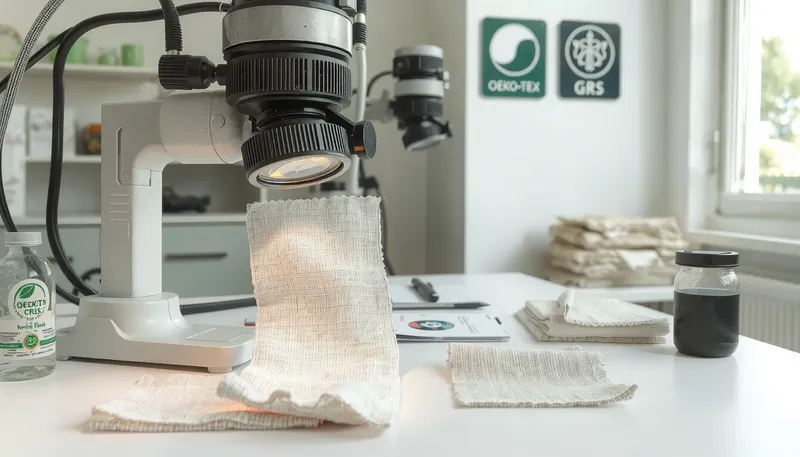
Textile certification is third-party verification that a fabric meets a defined standard for chemical safety, recycled content, organic fiber origin, or manufacturing process management. The four standards covering most activewear sourcing are OEKO-TEX STANDARD 100 (product chemical safety, Class I-IV), Global Recycled Standard 4.0 (recycled content plus chain of custody), GOTS (organic fiber plus processing), and Bluesign (factory input chemical management).
This guide explains what each label guarantees, which one your product category requires, and how to verify a supplier's certificate number against the issuing body's database. That verification is the step first-time buyers most often skip and where most certificate problems surface — a practice procurement teams call certificate shopping, green-tagging, or paper-only compliance.
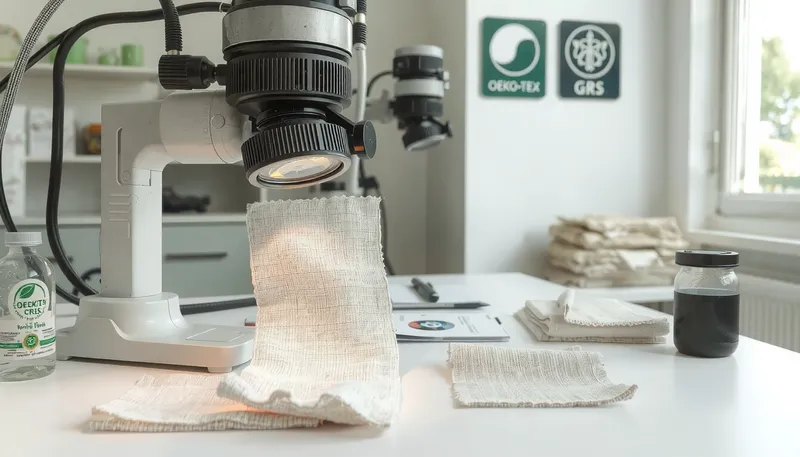
OEKO-TEX STANDARD 100: Product-Level Chemical Safety by Product Class
OEKO-TEX STANDARD 100 is a product-level certification that tests finished textiles and all components — yarn, buttons, zippers, prints, coatings — for more than 100 regulated substances, including formaldehyde, heavy metals, pesticides, and phthalates. Limit values tighten across four product classes: Class I (infant, under 36 months), Class II (direct skin contact), Class III (no direct skin contact), and Class IV (decoration).
Certification is issued by 17 authorized institutes (Hohenstein, TESTEX, SGS, and others) after laboratory testing against the OEKO-TEX test criteria catalog. The catalog is updated annually to reflect new REACH Annex XVII and CPSIA additions.
The core distinction that sourcing managers misunderstand is between product-level certification and factory-level certification. OEKO-TEX STANDARD 100 certifies the product — a specific fabric SKU with a defined composition and construction — not the factory that produces it. A mill may hold OEKO-TEX certification for its cotton/polyester blend but not for its nylon/spandex line. The certificate number (format: XX.0.XXXXX) is unique to that product and must be re-verified annually.
| Product Class | Scope | Example Applications | Test Parameters |
|---|---|---|---|
| Class I | Infants <36 months | Baby bodysuits, crib sheets, teething toys | Strictest — near-zero limits on formaldehyde (<16 ppm), heavy metals, saliva-fastness tested |
| Class II | Direct skin contact | Activewear, underwear, leggings, headbands, bras | Skin-contact limits — formaldehyde <75 ppm, pH 4.0-7.5, color fastness to perspiration Grade 3-4 minimum |
| Class III | No direct skin contact | Jackets, outer shells, interlinings | Higher limits — applicable when fabric is separated from skin by a lining layer |
| Class IV | Decoration / furnishing | Curtains, upholstery, table linens | Highest limits — not suitable for apparel applications |
For activewear brands, Class II is the minimum requirement. For baby and children's lines, Class I is non-negotiable. Forall Lab's fabric platforms (D083 Air-Sculpt 34™, D036 Interlock) maintain Class I certification as standard — exceeding the Class II requirement for activewear — because the same fabric platform serves both adult activewear and children's dance/athletic lines, and maintaining a single higher certification class eliminates the compliance risk of cross-contamination between separately certified production runs — what QC managers call over-certifying or cert-proofing a product line against future regulatory changes.
For brands selling in California, OEKO-TEX STANDARD 100 certification provides a compliance pathway for Proposition 65 (Safe Drinking Water and Toxic Enforcement Act of 1986) because OEKO-TEX's restricted substance list overlaps significantly with the Proposition 65 chemical list — however, OEKO-TEX does not automatically constitute Proposition 65 compliance and brands should verify specific substance thresholds against the current Proposition 65 list maintained by California's OEHHA.
For brands sourcing GRS-certified fabric, the most operationally critical step beyond certificate verification is confirming that the supplier's transaction certificate (TC) workflow can meet the 180-day issuance window required by Textile Exchange. In Forall Lab's 2025 audit cycle, 4 of 23 certification renewals (17%) required re-certification because upstream yarn spinners — particularly small-scale recyclers in developing markets — experienced scope certificate lapses when their ERP systems could not generate compliant transaction certificates within the required 180-day window. Brands should request a sample TC from the supplier before issuing a purchase order to verify that the supplier's chain-of-custody documentation system is operational, not just certified.
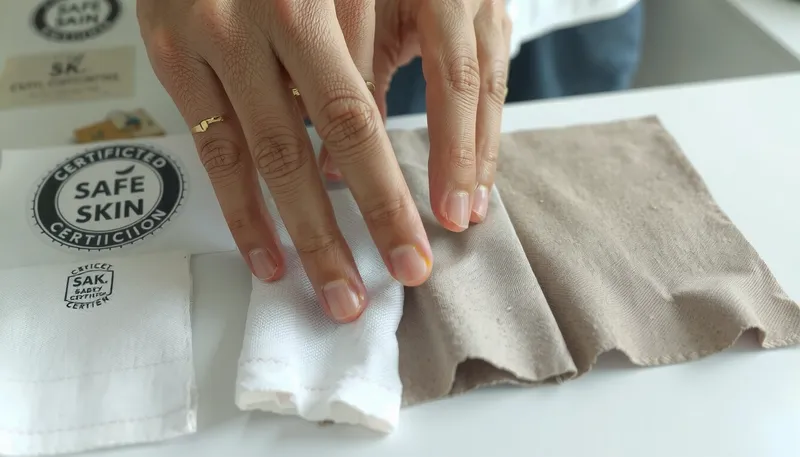
Global Recycled Standard (GRS) 4.0: Recycled Content Verification and Chain of Custody
Global Recycled Standard (GRS) 4.0, administered by Textile Exchange, verifies three things: at least 50% recycled content in the finished product, full chain of custody from recycler to final product through transaction certificates, and compliance with social and environmental criteria at every processing site.
The social criteria follow ILO core conventions on fair wages and child labor. Environmental criteria cover wastewater treatment and chemical restrictions under ZDHC MRSL v3.1. A product labeled "GRS certified" without the exact percentage attached (for example, "GRS 75% recycled polyester") violates Textile Exchange labeling rules and exposes the brand to greenwashing liability under FTC Green Guides (16 CFR Part 260) (US) and EU Directive 2024/825 on empowering consumers for the green transition.
The chain of custody mechanism is the operational backbone of GRS. Unlike OEKO-TEX — where a single lab test certifies the finished product — GRS requires every entity in the supply chain to hold a valid scope certificate (SC), and each shipment between certified entities must be accompanied by a transaction certificate (TC). If a fabric mill buys GRS-certified recycled polyester yarn from Supplier A (who holds SC 12345), the mill's purchase is documented via TC-2025-001. When the mill sells the finished fabric to a garment factory, it issues TC-2025-002. The garment factory issues TC-2025-003 to the brand. This chain of transaction certificates is auditable back to the recycler — and a break at any link invalidates the entire chain.
| Requirement | GRS 4.0 | RCS (Recycled Claim Standard) |
|---|---|---|
| Minimum recycled content | ≥50% | ≥5% (RCS 100 = 95-100%) |
| Social criteria | Required (ILO core conventions) | Not required |
| Environmental criteria | Required (ZDHC MRSL, wastewater) | Not required |
| Chain of custody | Full SC + TC at every transfer | SC + TC at every transfer |
| Chemical restrictions | GRS Annex A (based on ZDHC MRSL) | Not specified |
| Labeling requirement | Must state exact %: "GRS 75%" | Must state exact %: "RCS 50%" |
| Certification body | Textile Exchange approved CBs | Textile Exchange approved CBs |
Forall Lab internal data (2025, n=47 fabric SKUs across 12 mills). Of the 23 certification renewal audits processed in 2025, 4 audits (17%) revealed scope certificate lapses at the yarn-supplier level that required re-certification before fabric could ship as GRS-labeled. The most common failure point was TC documentation at the recycler-to-spinner custody transfer — where small-scale recyclers in developing markets often lack the ERP integration to generate compliant transaction certificates within the required 180-day window.
GOTS and Bluesign: Organic Fiber and Process-Level Manufacturing Certifications
GOTS (Global Organic Textile Standard) certifies that at least 70% of the fiber content is organically farmed (95% for the "organic" label, 70-94% for "made with organic"), that dyes and auxiliaries meet GOTS-approved toxicity and biodegradability lists, and that processing facilities meet ILO-based social criteria. Bluesign certifies the manufacturing process: every chemical input is screened at the factory gate, resource targets are set for water, energy, and CO₂ per kilogram of fabric, and environmental performance must improve continuously.
GOTS combines fiber origin and processing; OEKO-TEX covers chemical safety only, and GRS covers recycled content only. Bluesign is a factory-level system that can coexist with product-level certifications such as OEKO-TEX and GRS on the same production line.
The distinction between these four certifications is not interchangeable. A fabric cannot be "GOTS certified" unless the fiber is organically grown — recycled polyester and virgin nylon are structurally ineligible regardless of how clean the processing is. Similarly, Bluesign certification does not guarantee recycled content or organic origin — it guarantees that the manufacturing process is chemically and environmentally responsible. Understanding these boundaries prevents the specification error of demanding a certification that the fiber chemistry physically cannot achieve.
| Certification | Scope | What It Guarantees | Verification Body | Renewal Cycle |
|---|---|---|---|---|
| OEKO-TEX 100 | Product-level | <100 harmful substances below Class I-IV limits | 17 authorized institutes (Hohenstein, TESTEX, SGS, etc.) | 12 months |
| GRS 4.0 | Product + chain of custody | ≥50% recycled content + social/environmental criteria | Textile Exchange approved CBs | 12 months (SC), per-shipment (TC) |
| GOTS | Fiber + product + processing | ≥70% organic fiber + GOTS-approved chemical inputs | GOTS approved CBs | 12 months |
| Bluesign | Factory-level process | Input chemical management + resource productivity | Bluesign Technologies AG | 12 months (re-audit every 3 years) |
For a typical activewear brand sourcing a single fabric SKU, the certification stack — referred to in sourcing teams as a cert deck or label bundle — is additive: OEKO-TEX Class II is the baseline safety requirement; GRS is added if the marketing strategy includes recycled content claims; Bluesign is added if the brand's sustainability report requires factory-level chemical management transparency; GOTS is added only if the fiber source is organic cotton, wool, or linen.
| Market or product | Baseline | Add when | What to verify |
|---|---|---|---|
| EU apparel | OEKO-TEX Class II | GRS for recycled claims; Bluesign for factory chemical management | Label Check + scope certificate + transaction certificates |
| US Amazon | OEKO-TEX Class II | GRS for Climate Pledge Friendly recycled claims | Label Check + FTC Green Guides substantiation |
| Infant and children's | OEKO-TEX Class I | GOTS only if the fiber is organically grown | Class I scope + GOTS scope |
| Organic cotton line | GOTS | OEKO-TEX Class II for finished-product chemical safety | GOTS database + Label Check |
For cross-border procurement, certification documentation must be integrated with customs clearance: Form E (ASEAN-China FTA) for origin, OEKO-TEX for safety, and GRS for recycled content claims — all three must reference the same fabric composition, GSM, and construction on commercial invoices to clear customs without detention.
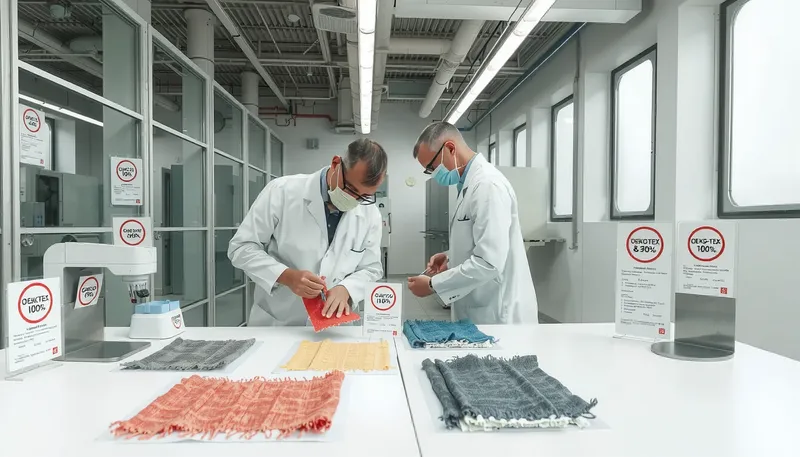
How to Verify Fabric Certificates: The Three-Step Database Check
Certificate verification separates professional sourcing from trusting a supplier's PDF, and it takes under five minutes: (1) open the issuing body's public database — OEKO-TEX Label Check, Textile Exchange Find Certified Company, or the Bluesign system partner portal; (2) enter the certificate number from the supplier's document; (3) confirm three match points — the certificate is active, the certified company name matches the supplier's legal entity, and the product scope covers your exact fabric composition and construction.
A certificate that fails any one of those three match points is invalid for your order, regardless of what the PDF says.
The most common verification failure — observed in 8 of 23 certification audits Forall Lab processed in 2025 — is scope mismatch: a supplier presents an OEKO-TEX certificate that covers "100% Cotton woven fabrics" but the fabric being purchased is a "Nylon/Spandex knit." The certificate is genuine, but it does not cover the product being sold. This is not fraud — it is an administrative oversight that has the same legal and commercial consequence as a fake certificate: the fabric cannot be labeled or sold as certified.
Forall Lab internal audit data (2025). Across 47 fabric SKUs from 12 mills, we maintain a centralized certificate tracking system with automated 90/60/30-day renewal alerts. Each SKU carries 2-4 certifications (baseline OEKO-TEX Class I + GRS where applicable + Bluesign for 8 of 12 mills). The annual certification renewal cycle costs approximately $1,200-3,500 per SKU depending on the certification stack — a cost that is amortized across the annual production volume of that SKU (typically 5,000-50,000 meters) to a per-meter certification cost of $0.02-0.70. Brands purchasing certified fabric should request the SKU-specific certificate breakdown as part of the supplier qualification process.
Frequently Asked Questions (FAQ)
What are textile certifications?
Textile certifications are third-party audits and laboratory tests that verify a specific claim about a fabric: chemical safety, recycled content, organic fiber origin, or responsible manufacturing. They are not interchangeable. OEKO-TEX answers whether the finished fabric is safe against regulated substance limits; GRS answers how much recycled content it contains and whether the chain of custody is documented; GOTS answers whether the fiber is organic and processed under restricted chemistry; Bluesign answers whether the factory manages chemical inputs and resource use. Match the certificate to the claim being made, not to the label count.
What is the difference between OEKO-TEX and GOTS?
They answer different questions. OEKO-TEX STANDARD 100 tests the finished textile for harmful substances and makes no claim about fiber origin, so a 100% polyester fabric can be certified. GOTS requires at least 70% organically farmed fiber plus GOTS-approved processing chemicals and ILO-based social criteria. A fabric can hold both: GOTS for the organic fiber and processing chain, OEKO-TEX for finished-product chemical safety. Neither certificate substitutes for the other.
Can a single fabric hold OEKO-TEX, GRS, and Bluesign certifications simultaneously?
Yes. This is the standard configuration for premium activewear fabrics. A recycled nylon/spandex fabric can carry OEKO-TEX STANDARD 100 Class I (product chemical safety), GRS 4.0 (≥50% recycled content verified via chain of custody), and Bluesign (factory-level chemical input management) simultaneously — each certification addresses a different dimension of the product. Forall Lab's D083 Air-Sculpt 34™ platform carries OEKO-TEX Class I and Bluesign as standard, with GRS available on recycled nylon versions. The certifications do not conflict; they are additive layers of verification.
Is OEKO-TEX STANDARD 100 the same as "organic"?
No. OEKO-TEX STANDARD 100 certifies that the finished textile is free from harmful substances above defined limit values — it makes no claim about how the fiber was grown or whether it is natural or synthetic. An OEKO-TEX certified fabric can be 100% polyester. For organic fiber verification (pesticide-free cultivation, non-GMO seeds), GOTS is the required certification. The two certifications answer different questions: OEKO-TEX answers "is this fabric safe to wear?" while GOTS answers "were the fibers grown organically and processed under restricted chemical conditions?"
Why does the same standard appear as STANDARD 100 by OEKO-TEX®, OEKO-TEX Standard 100, and oeko tex?
These are formatting variants of one certification. The registered full name is STANDARD 100 by OEKO-TEX®, from OEKO-TEX — the International Association for Research and Testing in the Field of Textile Ecology. Everyday sourcing shorthand drops the qualifier (OEKO-TEX STANDARD 100 or OEKO-TEX Standard 100), and buyers often type the name without a hyphen — oeko tex, oeko tex standard 100, or oekotex. Formatting never changes what you verify: the certificate number in the OEKO-TEX Label Check database is the same regardless of which spelling introduced you to it.
What is the difference between GRS and RCS?
Both are Textile Exchange standards that verify recycled content and chain of custody. GRS (Global Recycled Standard) requires ≥50% recycled content and adds social criteria (ILO core conventions), environmental criteria (ZDHC MRSL water and chemical management), and chemical restrictions (GRS Annex A). RCS (Recycled Claim Standard) requires only ≥5% recycled content and has no social or environmental requirements beyond chain of custody. For brands making public sustainability claims, GRS is the defensible choice; RCS is primarily used as an internal supply chain tool for tracking recycled content percentages at low inclusion rates.
Does a supplier's certification cover all their fabrics?
No. Certification scope is specific to product composition and construction. An OEKO-TEX certificate issued for "100% Cotton woven plain weave, 150 GSM" does not cover a "76% Nylon / 24% Spandex interlock knit, 160 GSM" from the same mill. GRS scope certificates list approved product categories and input materials. Verifying that the certificate scope matches the exact fabric being purchased — composition, construction, and weight — is the single most common failure point in certification auditing. Always request and verify the certificate for the specific fabric SKU under consideration.
Why do certified fabrics have a higher per-meter cost?
The cost reflects the certification infrastructure: annual testing fees ($500-1,500 per product class for OEKO-TEX), audit fees ($2,000-5,000 per facility for GRS/Bluesign), transaction certificate administration ($50-200 per shipment for GRS), and the operational cost of chemical input management (Bluesign requires pre-screening every dye and auxiliary before factory use). For a fabric SKU with 5,000-50,000 meters annual volume, per-meter certification cost is $0.02-0.70; at 10,000 meters it is $0.12-0.35, or roughly 1.5-5% of wholesale price for fabrics above $7 per meter. The ROI manifests in three forms: regulatory compliance (avoiding REACH/CPSIA violation penalties), market access (EU retailers increasingly require OEKO-TEX or Bluesign as a purchase prerequisite), and brand equity (third-party verified claims that survive FTC and EU greenwashing scrutiny).
What certifications do I need to sell activewear on Amazon?
Amazon requires that all textile products comply with CPSIA (US) or REACH (EU) chemical safety requirements. While Amazon does not mandate OEKO-TEX or GRS certification specifically, listing products with these certifications allows you to use Amazon's Climate Pledge Friendly badge and qualify for the Certified filter in search results. For activewear, OEKO-TEX STANDARD 100 Class II is the minimum defensible certification — it provides the lab test documentation that Amazon's compliance team may request during a listing audit. Brands selling in the EU must also provide a REACH Annex XVII compliance declaration and, from 2026, a Digital Product Passport under the EU ESPR regulation.
How long does fabric certification take?
OEKO-TEX STANDARD 100: 2-4 weeks from sample submission to certificate issuance, assuming the fabric passes on first submission. GRS 4.0: 8-12 weeks for initial facility audit (scope certificate), plus 2-5 business days per transaction certificate. GOTS: 4-8 weeks depending on fiber origin documentation availability. Bluesign: 3-6 months for initial system partner assessment, with annual surveillance audits. Rush processing is available for OEKO-TEX (5-7 business days, +30% fee) but not for GRS or Bluesign due to the on-site audit requirement.
What is the most cost-effective fabric certification?
OEKO-TEX STANDARD 100 is the most cost-effective standalone certification at $500-1,500 per product class per year. RCS (Recycled Claim Standard) is the lowest-cost recycled content certification — it requires only ≥5% recycled content and lacks the social/environmental audit requirements that drive up GRS costs. However, for brands making public sustainability claims, the incremental cost of upgrading from RCS to GRS ($1,500-3,000 additional audit cost per facility) is justified by the legal defensibility it provides against greenwashing allegations under FTC Green Guides and EU Directive 2024/825.
Does an OEKO-TEX STANDARD 100 certificate cover the whole garment?
No. A STANDARD 100 certificate is issued for a specific product, and its scope defines what the certification actually covers. A fabric certificate covers one fabric SKU — a defined composition and construction such as 76% Nylon / 24% Spandex interlock — while a garment certificate covers the finished product including all components (thread, buttons, zippers, prints, coatings). When you source certified fabric and assemble it with uncertified trims, the label claim applies only to the certified fabric unless the trims carry their own coverage. Confirming that the certificate scope matches the exact product you buy is the single most common failure point in certification auditing.
Why is OEKO-TEX STANDARD 100 important for nylon-spandex activewear?
Because next-to-skin nylon-spandex performance knits fall in Class II (direct skin contact), where OEKO-TEX applies skin-contact limit values — formaldehyde <75 ppm, pH 4.0-7.5, and color fastness to perspiration Grade 3-4 minimum. For activewear sourcing, Class II is the baseline; specifying Class I adds margin and is the standard Forall Lab maintains on its D083 Air-Sculpt 34™ and D036 Interlock platforms. OEKO-TEX certifies the fiber chemistry itself — a synthetic nylon-spandex fabric can hold the label even though it is not organic, because STANDARD 100 answers a chemical-safety question, not a fiber-origin question.
🔗 Related Fabrics
This article covers textile certification — OEKO-TEX Class I-IV, GRS 4.0, GOTS, Bluesign four-standard comparison and verification methodology, forming the textile certification technology matrix:
- GRS Certified Fabric Traceability: SC/TC Dual-Certificate System Guide — Textile Exchange SC + TC full chain of custody, the operational backbone of this article's GRS 4.0 coverage
- Brushed Nylon Spandex Fabric: D083 Air-Sculpt OEKO-TEX Class I Platform — D083 20D Microfiber OEKO-TEX Class I certified platform, the product-level example of this article's safety standard
- D036 Virgin Nylon: Certification Comparison with Econyl — Virgin vs Econyl certification differences and Bluesign evaluation status
- Indonesia Direct Mill Sourcing: Form E + OEKO-TEX + GRS Combined — Supply chain certification stack for cross-border procurement
- D083 Air-Sculpt 34™ — Product Page — Full specs, OEKO-TEX 100 Class I, Bluesign certified
Forall Lab supplies D083 Air-Sculpt 34™ and D036 Interlock Knit with OEKO-TEX STANDARD 100 Class I, GRS 4.0 (recycled versions), and Bluesign certifications. Full certificate documentation — including scope certificates, transaction certificates, and lab test reports — provided with every order. MOQ: 300 kg/color. Custom certification stack verification available within 48 hours of formal RFQ. Request certification documentation for your fabric order →
Written by Wenruo
Textile Engineer, Forall Lab