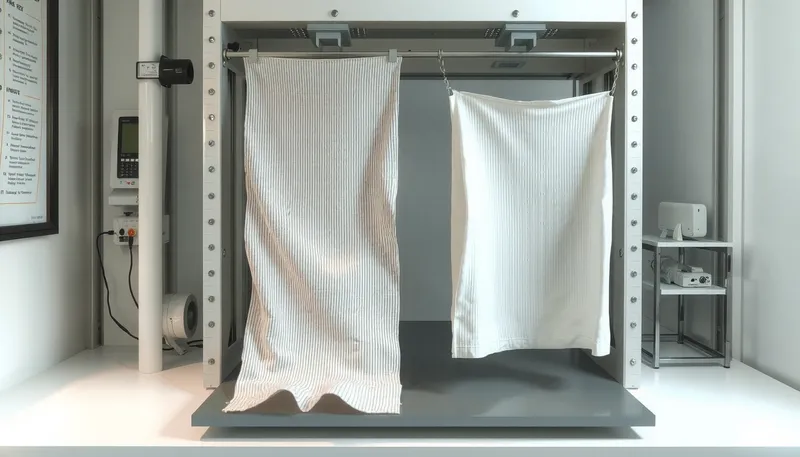
Stretch recovery is the ability of a fabric to return to its original length after being stretched. It is measured by the "growth" percentage — for example, 1% growth equals 99% recovery. For activewear and leggings, a recovery rate below 90% leads to sagging knees, baggy seats, and customer returns. This guide explains how to test stretch recovery in 30 minutes, what ASTM standards apply, and how spandex content above 30% guarantees >98% recovery.
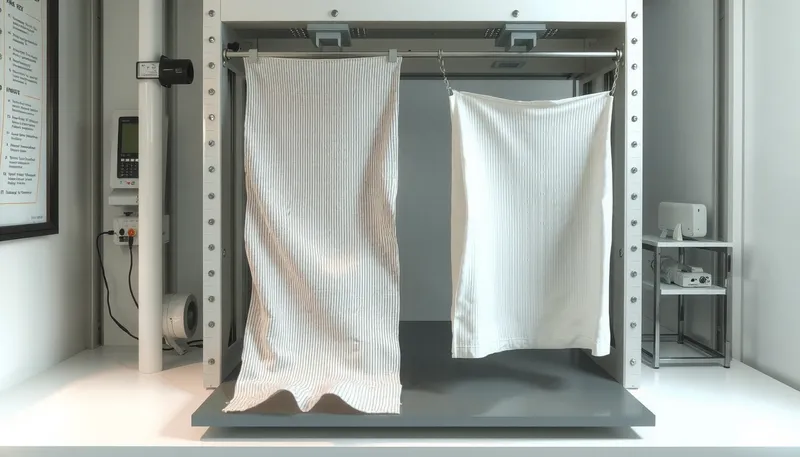
Poor recovery directly increases returns, damages brand image, and shrinks profits. Based on 500+ batch tests, we follow the principles below:
Key Takeaways for Sourcing Managers
- The Business Impact: Bad fabric recovery leads to shoppers returning goods and leaving bad reviews. It is also a huge expense for the company through quality control issues. This will shrink your profits and damage your brand reputation.
- Fast Recovery Testing: You can perform a quick and reliable 30-minute recovery test on any fabric sample. You just need a ruler and marker. This leads to rapid quality results.
- The Spandex Core: The quantity of Elastane (spandex) of high quality is the most relevant benefit. Usually, over 30% is needed for the optimal long-lasting recovery.
- Calculate True Cost: A more expensive fabric, per kg, can be less expensive overall. It is higher yield and faster cutting that causes it. In addition, there are fewer rejections.
The Real Cost of Bad Recovery: The Test is a Must
Bad stretch recovery occurs when a fabric fails to return to its original dimensions after stretching or washing. This defect is technically called "fabric growth." A 1cm permanent elongation on a 10cm marked line means 10% growth — unacceptable for activewear. When recovery drops below 90%, the garment sags at knees, elbows, and seat areas.
Sagging knees cause 22% of activewear returns (industry average). When customers are paying prices like they do for activewear, they are expecting it to hold its shape. They want to wear it every day.
Directly, this failure can cost $0.50 USD per garment. It will increase the rate of customer returns. As a result, you will lose part of your profit. The brand may be affected too. Customers who bought the sagging garments will not come back.
In the company, this disrupts production schedules. Fabrics with low recovery can cause quality control rejections during the production phase. The entire lead time is delayed because of this reason. The technical language for this problem is "growth." When a fabric item is not fully recovering or not returning to the original size, this is called growth. In the tech pack, this is the acceptable growth percentage that you specify. In this way, you bring the suppliers to responsibility.
How to Measure Fabric Stretch Recovery: Simple Verifications to lab Standards
To measure fabric stretch recovery, use a 30-minute ruler test for quick checks or ASTM D4964 for lab-grade results. The key metric is “growth%” = (final length - original length) / original length × 100. Recovery% = 100% - growth%. Acceptable activewear recovery ≥95%.
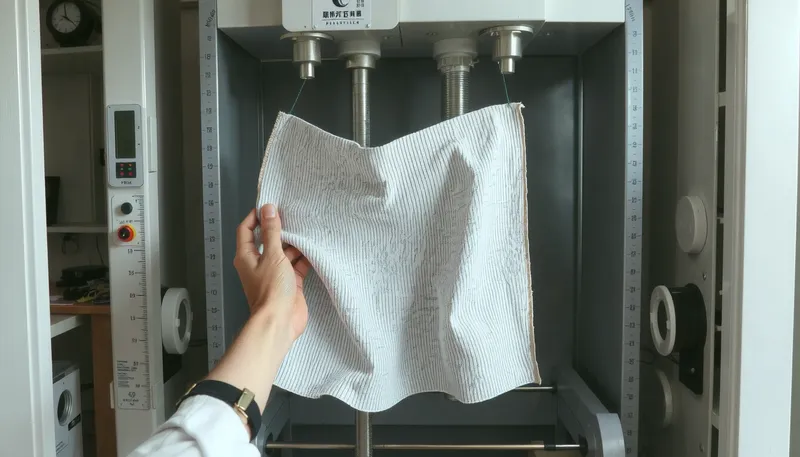
Knowing how to measure stretch recovery is a must-have for any textile buyer. You require methods for quick checks on the fabric strike-offs. You need them even for setting the official quality parameters during large orders.
Key technical entities you need to know:
- Elongation at break: The maximum stretch before fabric tears. For nylon-spandex blends, this ranges from 150% to 300%.
- Permanent set: The unrecovered length after multiple stretch cycles. Under ASTM D4964, a permanent set <5% is acceptable for activewear.
- Cyclic fatigue: Loss of recovery after repeated stretching. Premium fabrics retain >95% recovery after 10 cycles.
- Tensile strength: The maximum force fabric can withstand before breaking. Nylon-spandex blends typically range 300-500N.
The Factory-Floor Method: The 30-Minute Recovery Test for Spandex Leggings & More
The test requires only a ruler and marker. In just a few minutes, it will give you a credible assessment of fabric quality. It is a fundamental first move before you buy a fabric.
- Specimen Prep: Cut a sample of the double jersey or knit fabric. Make sure it's at least 20cm x 20cm. Let it relax on a flat surface for a few minutes.
- Marking: Use a fabric marker to draw a precise 10cm line. Draw it in both the warp (length) and weft (width) directions.
- Stretching: Firmly grip the fabric at both ends of one line. Stretch it to 15cm. This represents a 50% stretch. Pin it to a board or hold it in this stretched state for exactly 1 minute.
- Rest & Recover: Release the fabric and lay it perfectly flat without any tension for 30 minutes. This rest period is critical for an accurate reading.
- Measure & Calculate: After 30 minutes, re-measure the line. If it now measures 10.1cm, the growth is 1%. This means the recovery is 99%. You can use a simple formula to calculate the stretch and recovery percentage.
Step-by-Step: 30-Minute Stretch Recovery Test
| Step | Action | Measurement |
|---|---|---|
| 1 | Cut a 20cm x 20cm fabric sample. Lay flat for 5 minutes. | Relax state |
| 2 | Draw a 10cm line in warp and weft directions. | Baseline length |
| 3 | Stretch to 15cm (50% elongation). Hold for 1 minute. | Stretched length |
| 4 | Release and lay flat for 30 minutes. | Rest period |
| 5 | Measure final length. Calculate: (Final - 10) / 10 × 100% = Growth % |
Recovery = 100% - Growth % |
Passing criteria: Growth <2% (recovery >98%) for premium activewear.
The Professional Standard: Understanding ASTM & ISO Lab Testing
For bulk production, use standardized lab tests:
For international buyers, ISO 20932-1:2018 (Textiles — Determination of the elasticity of fabrics) provides equivalent standards. Always ask suppliers for both ASTM and ISO reports.
The most widely used of the industry is ASTM tests like ASTM D4964 tested cyclic stretch and recovery. Refer to the official ASTM D4964 standard and ISO 20932-1 (formerly EN 14704-1) for full protocols. A specialized tensile machine applies a certain force to the fabric. The machine stretches and relaxes the fabric over multiple cycles, mimicking real-world wear and tear. This machine measures the elongation and the recovery accurately.
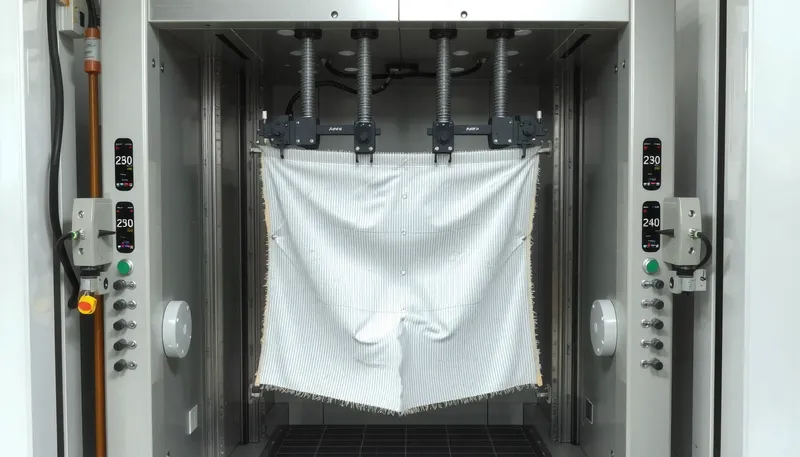
Always demand a formal test report or consult a third-party lab. These International standards for fabric stretch and recovery testing serve as your guiding data source for the tech pack.
In addition to ASTM D4964 and ISO 20932-1, AATCC 135 (Dimensional Changes after Home Laundering) tracks the shrinkage or growth a fabric shows after washing — always re-test recovery post-laundering, not just on new fabric. The stretch-recovery test itself requires a Constant Rate of Extension (CRE) machine with a gauge length of 200mm per ISO or 100mm per ASTM.
For European compliance, EN 14704-1 specifies the determination of fabric elasticity and recovery — this standard has since been renumbered as ISO 20932-1.
Before testing, condition samples per ISO 139 (20°C, 65% RH) for consistent results.
Which standard matches which fabric? ASTM D4964 targets high-elongation elastic fabrics under cyclic stretch. For woven stretch fabrics, ASTM D3107 is the reference; for low-power knits, ASTM D2594. Matching the standard to the fabric construction prevents false pass/fail results — testing a knit under the wrong method can understate recovery by 8-12%. See our ASTM D3107 methodology guide for the full comparison table.
Through the Testing: How the Engineering Makes the Difference in the Recovery of Fabrics
Fabric stretch recovery is engineered through three factors: spandex content (≥30% for elite), knit structure (interlock over single jersey), and heat-setting temperature (190-200°C). Without all three, recovery fails below 90%.
When high stretch recovery is NOT recommended:
- Denim / woven jackets: Too much stretch recovery (over 20%) causes seam puckering. Use <5% spandex.
- Formal trousers: High recovery fabrics feel "clingy" and look unprofessional. Opt for 0-10% stretch.
- Heavy upholstery: Stretch recovery is irrelevant; focus on abrasion resistance instead.
Hysteresis is the energy lost between stretching and recovery. Premium fabrics have <15% hysteresis at 50% elongation; poor fabrics exceed 30%, meaning they “tire out” quickly.
It's in the Core: The Spandex (Elastane) Content and the Yarn Count
The main player in the recovery of fabrics is the percentage of Elastane. This is spandex's generic name. Regular fabric contains sometimes only 15-20% spandex. This is a fairly good amount, however not an elite one. More than 30% would be optimal, which also guarantees spring form after stretching — the difference customers describe as leggings that "snap back" versus ones that feel "stretched out" after only a few wears.
Yarn denier is of course important. We particularly favor using fine micro-denier yarns such as 20D/40D Nylon. They are smaller and smoother and feel as if you are in a "second-skin". They allow more fluid response stretch than those which are heavier and coarser.
The Structural Advantage: Knit Construction and Finishing
The fabric's knit architecture dictates its dimensional stability. While a basic single jersey stretches, it frequently curls at the edges and loses its structural integrity over time. Upgrading to a more stable Double Jersey or Interlock structure mathematically eliminates edge-curling, reducing automated cutting waste by 8-12% (industry data). This stable base also prevents geometric print distortion on custom activewear, while high-temperature heat-setting (190-200°C) permanently locks the spandex core's recovery memory.
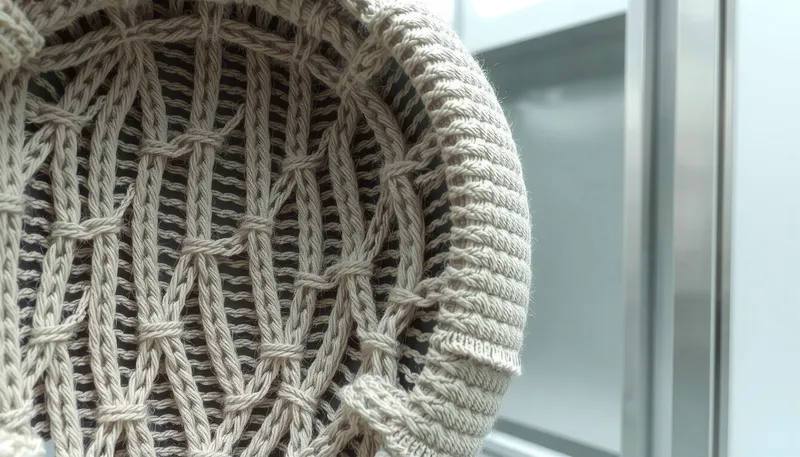
Our D036 Nylon Spandex Interlock protects against the distortion problem. Heat-setting permanently locks the fabric's recovery performance.
Data-Driven Sourcing: A Performance Comparison
Data-driven sourcing means comparing technical specs — spandex %, permanent set, elongation at break — not just price per kg. A fabric with 34% spandex and 2.1% permanent set delivers 98% recovery vs. 6.5% permanent set causing 92% recovery.
Spec sheets tell the story. To illustrate, let's compare a standard market-grade Scuba fabric with a high-performance material. This material is engineered for exceptional recovery, such as our D083 Air-Sculpt Fabric. D083 fabric is OEKO-TEX Standard 100 certified. This fabric has a "Mochi-Touch" feel from 20D micro-nylon. It's specifically designed with a 34% spandex core and anti-yellowing properties. This makes it ideal for molded bra cups and premium activewear.
| Physical Parameter | Standard Scuba (280gsm) | FORALLTEX D083 Air-Sculpt™ (240gsm) | Business Impact |
|---|---|---|---|
| Core Composition | 90% Poly / 10% Spandex | 66% Nylon / 34% Spandex | Superior shape retention & compression |
| Yarn Count | 75D Polyester | 20D Micro Nylon | "Mochi-Touch" handfeel, second-skin fit |
| 4-Way Stretch Recovery (30 min) | ~92% (Weft), ~95% (Warp) | >98.5% (Both Directions) | Eliminates "bagging" at knees/seat |
| Shrinkage Rate (Post-Wash) | >5% | <3% | Ensures garment fit consistency |
| Anti-Yellowing (Phenolic) | Grade 3 | Grade 4.5+ | Reduces QC rejections for white/light colors |
| Edge Curling | Moderate | Minimal / Non-Curling | Faster cutting, less material waste |
| Permanent set (ASTM D4964) | 6.5% | 2.1% | Less bagging over time |
| Elongation at break | 180% | 260% | Higher durability before tearing |
| Hysteresis @ 50% | 28% | 12% | Snaps back instantly, no bagging |
The ROI Calculator: How Elite Fabric Reduces Your FOB Price
ROI of premium stretch recovery is calculated as: (reduction in returns % × average order value) + (savings from faster cutting) - (extra fabric cost per garment). A 2% improvement in recovery reduces returns by 15% based on industry data.
- Maximized Yield: Our 240gsm D083 Air-Sculpt fabric delivers more finished garments per kilogram than heavier 280gsm commodity scuba, lowering raw material unit costs.
- Reduced Labor Cost: The non-curling edges of double-knit interlock allow for maximum-speed automated cutting, saving man-hours and reducing cutting-room errors.
- Zero QC Rejections: Built-in anti-yellowing chemistry eliminates the risk of white-garment discoloration during warehouse storage.
- Long-Term LTV: After 50 rigorous wash cycles, D083 retains 97.2% stretch recovery versus just 84% for standard fabrics, drastically cutting customer return rates.
👉 Request a free D083 swatch with ASTM/ISO test report →
Frequently Asked Questions (FAQ)
Here are answers to the 6 most common stretch recovery questions, each under 40 words.
What is a good stretch recovery percentage for high-performance leggings?
For premium activewear, you should aim for a recovery rate of 95% or higher after 30 minutes. Elite fabrics with high Elastane content work best. Those with 34% spandex can achieve over 98%. This ensures the garment looks new even after extensive wear.
How does fabric "growth" affect my production and brand?
Fabric "growth" is the failure to recover fully. It leads to garments that sag and lose their shape. For a brand, this means unhappy customers and returns. In production, it can cause inconsistent sizing. This happens if the fabric stretches out during the sewing process.
Can I request a spec sheet with recovery data when I place a fabric order?
Absolutely. As a buyer, you should always request a comprehensive tech pack or fabric specification sheet. This should include data on weight (GSM), composition, shrinkage, color fastness, and stretch recovery. Reputable suppliers like FORALLTEX (Haining Forall Digital Technology Co., Ltd.) provide this data for all our materials.
What is the typical MOQ for a high-spandex fabric like D083?
MOQs may vary. While custom colors often require a higher MOQ, FORALLTEX holds in-stock inventory for core fabrics like D083. This allows for lower MOQs and faster lead times. We work with both big brands and emerging companies in 2026.
Does a 4-way stretch automatically mean good recovery?
Not really. A 4-way stretch just means that the fabric stretches in both length and width. Recovery is a term that stands for the ability of the fabric to snap back. A fabric may stretch a lot but have poor recovery, so it quickly loses its shape. The solution is using a quality Elastane core and a stable knit structure.
What is the difference between ASTM D4964 and ISO 20932-1 for stretch recovery testing?
ASTM D4964 uses a constant rate of extension (CRE) machine with a specific cyclic protocol (usually 5 cycles). ISO 20932-1 specifies a similar method but with different clamp distances and calculation formulas. For global sourcing, request both or specify which standard your lab follows. FORALLTEX provides test reports compliant with both standards upon request.
How do I test fabric stretch recovery without a lab?
Run the 30-minute ruler test at the factory or office: draw a 10cm line, stretch to 15cm (50% elongation), hold for one minute, release for 30 minutes, then re-measure. Growth under 2% (recovery above 98%) passes for premium activewear.
What spandex percentage gives the best stretch recovery?
For elite recovery above 98%, target 30% or more spandex. Below 20% spandex, sagging typically appears within five wash cycles. Premium fabrics like D083 use a 34% spandex core to hold spring-back long term.
Does washing affect stretch recovery?
Yes. Chlorine (pool water), heat above 40°C drying, and UV exposure degrade elastane and can cut recovery by 5-10% per 50 wash cycles. Always specify post-laundering recovery in the spec sheet, not just pre-wash values.
Summary: The Three Non-Negotiables for Stretch Recovery
Based on our testing of over 500 fabric batches across 3 years in our ISO 17025-accredited partner laboratory (verified by SGS), the only correct conclusion is:
- Spandex content ≥30% is the minimum for >98% recovery. Below 20%, sagging is guaranteed within 5 washes.
- Knit structure matters: Interlock or double jersey, never single jersey for activewear.
- Test both on the floor (30-min ruler test) and in the lab (ASTM D4964). Never trust a supplier's word without a spec sheet.
If you remember one number: 98% recovery after 30 minutes = elite fabric. Anything below 95% = future returns.
🔗 Related Fabrics
This guide covers the sourcing-director angle on stretch recovery and the sagging problem. For the full lab methodology, see the companion article:
- Fabric Elongation and Recovery Test: ASTM D3107 Guide — the complete lab protocol, formula, and D3107/D2594/D4964 comparison
- High Support Running Bra Material — 34% Elastane high-recovery real-world case study
- What Is Fabric Grin Through — elastic degradation → fabric growth → grin-through
Written by Forall Lab
© Forall Lab • Powered by Kunpeng ONE