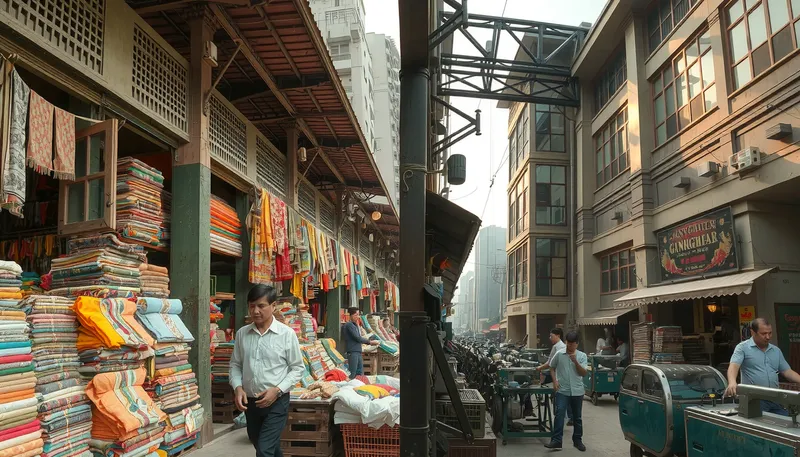
What is the difference between Guangzhou and Keqiao fabric markets, and should you source from either? Guangzhou's Zhongda Market (300,000 m², low-MOQ fashion fabrics) and Keqiao's China Textile City (the world's largest bulk textile hub) are both trader-dominated wholesale markets where 80%+ of vendors are middlemen, not mills — meaning you pay a 15-30% markup for fabrics that may not match the quality of the samples you approved.
Key Takeaways (TL;DR):
- Guangzhou (Zhongda): Fashion fabrics, trims, accessories — low MOQ (a few meters), but higher per-meter pricing
- Keqiao (China Textile City): Bulk raw textiles, polyester, home fabrics — high MOQ (hundreds+ meters), lower per-meter for volume
- The Trader Problem: Most stalls are middlemen who buy from mills and resell — sample quality ≠ bulk quality
- Hidden Costs: Flights, hotels, translators, and shipping consolidation from 10+ vendors add $3,000-8,000 to a sourcing trip
- The Direct-Mill Alternative: For technical fabrics (D036 Interlock), direct mill partnership eliminates the trader markup and guarantees sample-to-bulk consistency
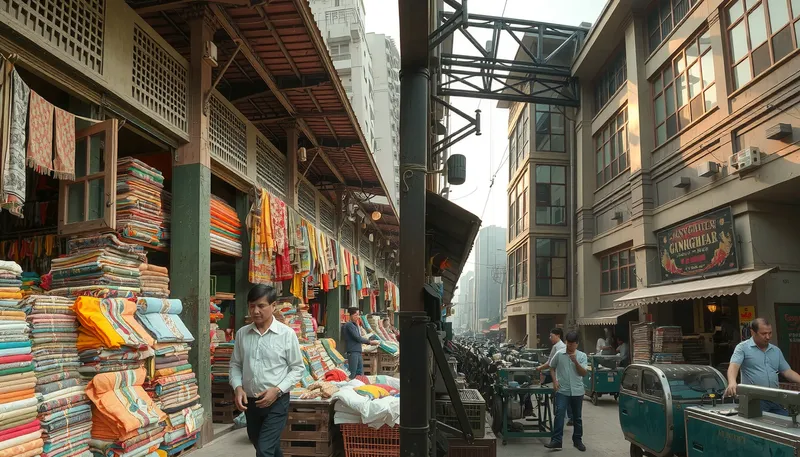
Why People Crave to Visit China's Fabric Markets: Everyone's Interest
The legend of the fabric wholesale market in China pulls buyers worldwide into its web. Two of the best names are Guangzhou and Keqiao, the true textile industry giants.
These places have a reputation for having everything. You can find any fabric you can think of. Often at very good prices. With such a good offer, many designers and brand owners cannot resist the temptation to go. Some recent studies have ranked these places as Top 5 Major Fabric Markets in China. Nevertheless, the titleholders are always Guangzhou and Keqiao.
Though these markets look like a shopping heaven at first glance, finding the right fabric and getting it home is very hard. The purpose of this guide is to narrate to you the actual story. We will disclose the information that will never be shown in travel documentaries.
Guangzhou vs. Keqiao: A Duel of Fabric Sourcing
The choice between Guangzhou and Keqiao is not about "which is better" — it is a decision between two fundamentally different supply-chain models: fashion flexibility (Guangzhou) versus bulk commodity efficiency (Keqiao). Guangzhou's Zhongda Market is the capital of fashion sourcing with low-MOQ flexibility; Keqiao's China Textile City is the world's largest bulk textile hub where volume dictates pricing. Understanding this distinction determines whether a market trip is even the right sourcing strategy.
Guangzhou's Zhongda Market is the capital of fashion. This is the ultimate destination for new trends and unique accessories. Plus, it normally requires smaller order quantities. If you are a new brand or are only promoting latest designs, Guangzhou is your place. In total, the Guangzhou China Fabrics & Accessories Center covers more than 300,000 square meters. This place is filled with thousands of small shops.
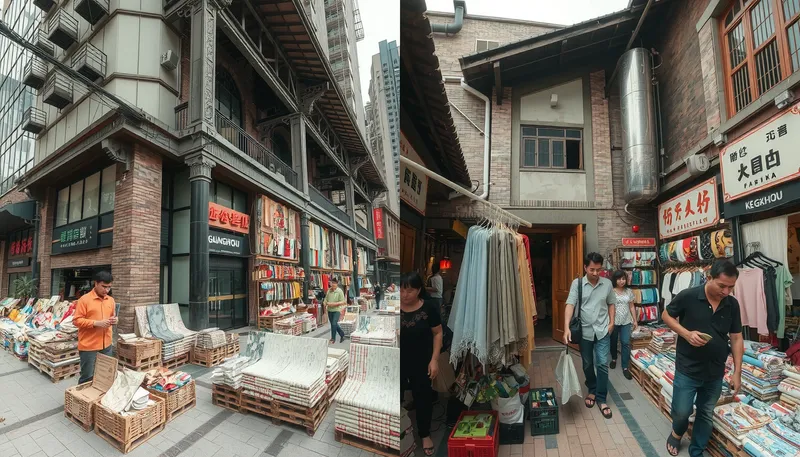
Keqiao's China Textile City is different. It is the largest fabric hub on the planet. This market is all about massive quantities. It is mostly aimed at raw materials, basic fabrics, and home textiles. Keqiao forms a complete industrial chain. This includes ranging from the yarn manufacturer to the one that dyes the end product. For a huge order of one material, Keqiao is just your place to go.
Here is a simple breakdown to help you compare Guangzhou vs. Keqiao.
| Feature | Guangzhou (Zhongda Market) | Keqiao (China Textile City) |
|---|---|---|
| Specialty | Fashion fabrics, accessories, trims | Bulk raw textiles, home fabrics, polyester |
| Best For | Startups, fast-fashion brands, small batches | Large-scale production, basic fabric sourcing |
| MOQ | Low for in-stock items (can be a few meters) | High (often hundreds or thousands of meters) |
| Pricing | Higher per meter, but flexible | Lower per meter for large volumes |
| Trend-Responsiveness | Extremely fast, new items appear daily | Slower, focused on staple materials |
| Logistics | Complex, requires consolidating many small orders | More streamlined for large, single-fabric orders |
Choosing between the two is a matter of your business needs primarily. But as you will find out, the question you really need to answer might not be which market you should visit. It might be a decision of whether to visit one at all.
Where the Fabric Actually Is: A Buyer's Floor Plan for Guangzhou and Keqiao
The single highest-leverage move on a first fabric-market trip is pre-mapping your target fabric to the right building: Guangzhou's Zhongda district and Keqiao's China Textile City are each a cluster of specialized sub-markets, and the fabric you need decides which building you walk into first. Wandering the aisles of the wrong building is how a one-week sourcing trip quietly becomes two.
Guangzhou's Zhongda district (Haizhu District, around Ruikang Road and Jinfang Road) is anchored by the Guangzhou International Textile City, a roughly 300,000 m² flagship with about 4,000 shops. The basement concentrates trims — lace and borders to the west, buttons and zippers in the center, belt hardware to the east — while floors 1-3 carry woven and knitted fabrics (knits concentrated in Areas A/B/E/F, wovens in C/D/E), and the upper floors hold brand showrooms and trading offices. Around the flagship, specialized buildings cover what it does not: the Ruikang Lace World for lace, embroidery, and elastic, and the Jiuzhou Textile Trade Plaza for higher-end women's fashion fabrics such as prints, satin, and denim.
Keqiao's China Textile City (Shaoxing, Zhejiang) is the same pattern at city scale — a complex of connected trading zones rather than one building. For a buyer with a target category, the zone map is short:
| If you need | Walk to |
|---|---|
| Polyester taffeta, all-polyester lining, greige | East Market, 1F Aisle 1 |
| Knits — fleece, terry, velour, jersey, swimwear | East Market 3F, or the Dongsheng Road knit market |
| Mesh, lace, knit mesh, embroidery | North Market Zone 2 |
| Suiting (TR), wool, jacquard, denim | Union Market |
| Cotton, TC blends, shirting, fleece | North Market Zones 1, 5, and 6 |
| Greige (grey) fabric | Gangyue Road, the greige street |
Now read that table against a technical-activewear spec sheet: no zone is dedicated to nylon/spandex performance knits or engineered double-knits. Both cities have a floor plan for commodity poly-cotton; neither has one for a high-stretch, anti-curl interlock. That absence is the practical reason the direct-mill model exists.
The buyer's inspection route
If you do walk the market, move in this order — it is the difference between a scouting trip and a wasted one:
- Carry a one-page spec sheet: target composition, GSM, stretch recovery ≥95% (ASTM D2594), and pilling Grade ≥4 (ISO 12945-2).
- At each shortlisted stall, ask two questions: "Are you the mill?" and "Can I see this lot's GSM test report?" In a trader-dominated market, more than 80% of stalls will not pass both.
- Buy one-meter cuttings from three stalls for the same spec; number each cutting and photograph it next to the bolt label and the stall card.
- Verify on the spot: weigh the cutting on a digital gram scale (GSM carries a ±5% tolerance under ASTM D3776) and stretch a 5 cm strip to feel recovery.
- Ask the trader to write the mill name and lot number on the receipt, and to confirm in writing that the bulk run comes from the same factory as the sample. A refusal is your answer.
- For the bulk order, book a third-party inspection before shipment — once the container leaves the market, you are not there to catch the switch.
What No One is Talking About: Costs and Problems with Market Sourcing
The unstated reality of China fabric market sourcing is that 80%+ of market vendors are traders, not mills — each adds a 15-30% markup while breaking the direct line of technical communication that performance fabric requires. A sourcing trip to Guangzhou or Keqiao carries $3,000-8,000 in hidden costs (flights, hotels, translators, shipping consolidation), and the samples you approve may come from a different factory than the bulk order you receive. Here is the breakdown of what travel documentaries never show.
-
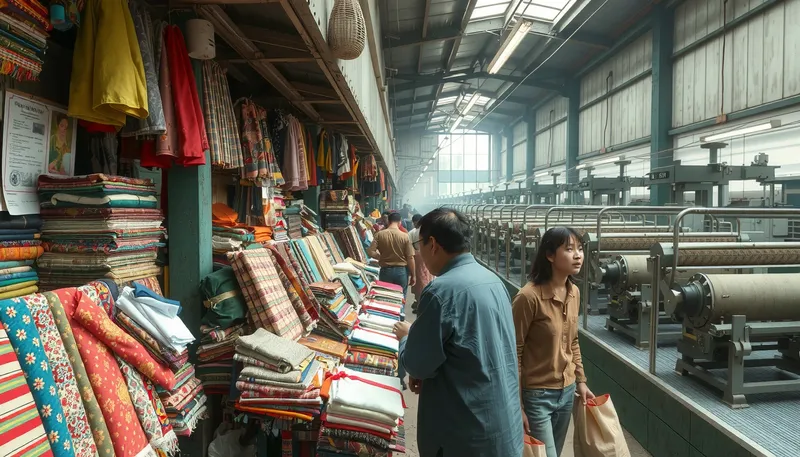
The Trader vs. Mill Problem: Here is the most important thing you have to learn. The folks at the market stalls are traders, not factories. They are middlemen. They purchase from a mill and sell to you. This way a cost is added, and a communication gap is created. You are not talking to the person who actually makes your fabric.
-
Quality Issues: You might actually fall in love with the sample fabric you get from a stall. But when you place a bulk order, that trader will likely find the cheapest factory to produce it. So the final fabric might not match the sample's quality at all. That is a big risk.
-
Time and Travel Costs: Making a sourcing trip can be very expensive. Think about the round-trip tickets and the hotel accommodations for a week or more. Add local taxis and food. You will also need a translator. This costs money every day. Plus, you will spend days walking endless aisles. This is time you could be using to grow your business.
-
Communication Problems: Explaining technical details is hard enough in your own language. Now try doing it through a translator. You're talking to a salesperson who doesn't understand fabric engineering. Details like fabric weight and finish can easily get lost. Color matching becomes a guessing game. We've seen clients spend a week in the market only to find their chosen fabric was out of stock for bulk production.
-
Shipping Nightmares: Imagine you buy fabric from 10 different sellers. Now you have to arrange for all 10 orders to be collected. They must be checked and packed into one shipment. This process is very complex and full of chances for error. Just one missing roll can disrupt your entire production schedule.
What a Sourcing Trip Actually Costs, Line by Line
A one-buyer, seven-to-ten-day China fabric-market trip runs to roughly $3,200-7,900 all-in before a single meter of fabric is paid for — flights, hotel, translator, samples, and consolidation — and the trader markup adds 15-30% to every meter you do buy. The travel-guide version of this trip shows the market; the invoice shows why sourcing managers call it "chasing fabric":
| Cost line | Low | High | Basis |
|---|---|---|---|
| International flight (US/EU, economy round trip) | $900 | $1,800 | Origin and season drive most of the range |
| Hotel (7-10 nights, mid-range) | $560 | $1,500 | $80-150/night in Guangzhou or Keqiao |
| Translator or sourcing agent (7-10 days) | $700 | $1,800 | $100-180/day; near-essential without Mandarin |
| Meals and local transport | $400 | $800 | Taxis between market buildings add up |
| Sample cuttings and courier | $150 | $500 | One-meter buys across shortlisted stalls |
| Consolidation and freight from multiple vendors | $300 | $900 | 8-12 small orders into one shipment |
| Contingency — re-visits, missed stock, hold-ups | $200 | $600 | The normal case, not the edge case |
| Trip total (estimate) | ~$3,200 | ~$7,900 | Excludes fabric value and the 15-30% trader markup |
Two things the table makes visible. First, the low and high ends straddle the $3,000-8,000 range that trip reports quote — the spread is driven almost entirely by flight origin and translator days, not by fabric price. Second, none of these lines buy quality assurance; the trader markup and the sample-to-bulk risk sit on top of the table. That is why a direct-mill quote that includes QC and lot-level test reports often prices out lower per approved meter.
Navigating a fabric wholesale market in China is much harder than it appears. If your objective is to get consistently high quality, then you need to think of a better way.
A Smarter Path: The Advantages of Sourcing Directly From a Fabric Mill
Direct mill sourcing eliminates the three structural problems of market sourcing: the trader markup (15-30%), the sample-to-bulk quality gap, and the technical communication barrier. When you buy from a mill, the same production line and QC team handles your sample and your bulk order — the ASTM D3776 GSM report and ISO 9001 quality system are verifiable, not anecdotal. On the sourcing floor, this is the difference between "trust me, it's the same fabric" and "here is the test report for the exact lot you approved."
Working with a mill has clear advantages over any fabric wholesale market in China.

-
Consistent Quality: The same team and machines will manufacture your sample and your bulk order. You will receive precisely what you approved, each time. There will be no surprise changes in quality.
-
Technical Know-How: You speak directly to the people who produce the fabric. The engineers and technicians at the mill know your needs. They are aware of performance, feel, and function. They can give you expert advice.
-
True Cost Savings: When you buy direct, you cut out the middlemen. The traders, agents, and their markups are gone. This lowers your final cost and gives you better value.
-
Quality Control: If there is a problem, it can be recognized and solved right at the factory. This will save you the trouble of receiving thousands of meters of bad fabric weeks later.
-
Custom Options: This is the main advantage. You can work with the mill to create unique fabrics. For instance, creating a high-performance knit like our Nylon Interlock D036 is only possible with direct collaboration. This 160gsm fabric is engineered with a special structure that stops edges from curling and prints from warping. This kind of technical solution can't be developed through a market trader, as it requires the active involvement of a mill's R&D team.
Conclusion: Save the Flight, Not the Quality — Partner with a Mill Instead
The gigantic fabric wholesale market in China is, without a doubt, a wonder to behold. For a tourist or a hobbyist, it can be a great experience. Still, for a business that is looking for quality and reliability, the risk is too high. The hidden costs and quality issues are often the real reason it is not worth it. The communication problems make things even worse.
The real insider secret is not about choosing between Guangzhou vs. Keqiao. It's about realizing that bypassing the markets and going to mills is a better way to secure the sourcing process. In industry jargon, market sourcing is called "chasing fabric" — the endless hunt through trader stalls for a fabric that may not exist in bulk — whereas mill sourcing is "locking specs," because the R&D team can engineer exactly what your tech pack requires.
Save the flight, the hotel bills, and the headaches. The most efficient way to source high-quality fabric in 2026 is to buy direct from a dedicated mill. It is also the most reliable and cost-effective way. Partnering with a mill gives you the control and quality you need. This provides a competitive edge that no market can offer.
Frequently Asked Questions (FAQ)
Is it cheaper to buy from a fabric wholesale market in China?
At first, the price per meter might seem lower. However, you need to factor in travel costs. Add agent and translator fees. Include the cost of quality issues and shipping fees. When you add all this up, buying directly from a mill is often more cost-effective. It also provides far greater value and security.
What is the main difference between Guangzhou and Keqiao markets?
Guangzhou's Zhongda market is the hub for fashion and trends. It focuses on finished garment accessories with lower minimum orders. Keqiao's China Textile City is the industrial giant. It focuses on raw textiles and home fabrics. It's designed for large-volume production with a more integrated supply chain.
Can I get custom fabrics made at the markets?
Some larger vendors may offer customization. But it can be difficult. You are typically dealing with a trader, not the mill itself. This makes communication about technical specs unreliable. Things like yarn type, weight, and finish get lost in translation. True customization is best done directly with a mill's R&D team.
Do I need a sourcing agent to visit these markets?
For a first-time visitor with no Mandarin skills, an agent or translator is almost essential. You need help with navigation, negotiation, and logistics. This is another hidden cost of the market sourcing model. This cost is eliminated when you work directly with an export-focused mill.
What are the minimum order quantities (MOQs) at a fabric mill versus a market?
This is a common misconception. Market stalls can offer very low MOQs for in-stock items. But their MOQs for custom production can be quite high. A dedicated mill can often be more flexible on MOQs for custom runs. This is especially true for one you build a relationship with. Market traders are just placing orders with factories they may not know well.
What should I verify before committing to a bulk order from a market trader?
Request the trader's actual mill test report — specifically ASTM D3776 GSM verification (the label value carries ±5% tolerance) and a written confirmation that the bulk production will come from the same factory as the approved sample. If the trader cannot produce both, treat the order as high-risk. For technical fabrics, verify the fabric's stretch recovery (ASTM D2594 ≥95%) and pilling resistance (ISO 12945-2 Grade ≥4) — these are the two specs most likely to degrade when a trader switches to a cheaper mill between sample and bulk.
🔗 Related Fabrics
This article covers fabric wholesale market China — Guangzhou vs Keqiao sourcing, trader vs mill dynamics, and the direct-mill sourcing alternative:
- D036 Nylon Spandex Interlock — 160gsm engineered interlock: the technical fabric that market traders can't supply
- Import Activewear Fabric from China — Direct-mill import logistics, Form E tariffs, and lead-time strategy
- Fabric Lead Time from China — Greige vs custom knitting: lead-time compression for direct sourcing
Written by Wenruo
Textile Engineer, Forall Lab