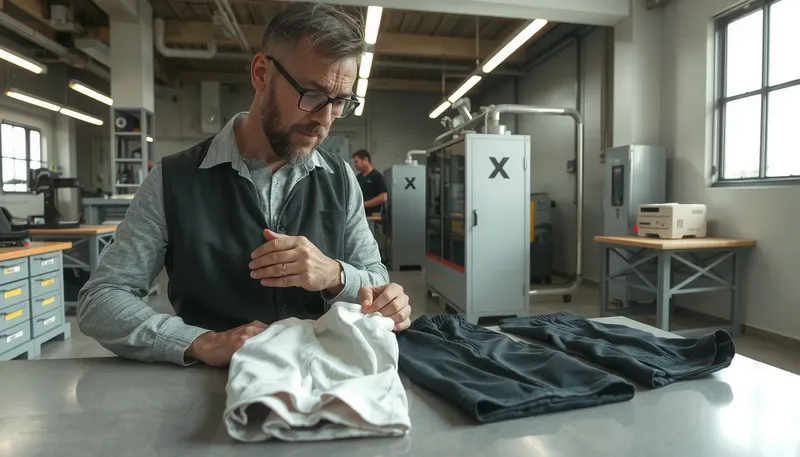
The optimal specification for men's gym shorts fabric is 160 GSM Nylon Spandex Interlock. This construction solves the core sourcing conflict: achieving high durability and 4-way stretch recovery (>95%) while maintaining cutting-room stability to minimize per-unit cost. This guide provides the technical data and ROI model to validate this specification for your 2026 production line.
Key Takeaways
- The Primary Difficulty: Target specification: 160 GSM Nylon Spandex Interlock with >95% stretch recovery.
- Interlock is the Best: Interlock knit construction eliminates edge curling, reducing fabric waste by up to 5% per production run. This specification meets the abrasion demands of CrossFit and the mobility requirements of Hyrox training.
- GSM is not the whole spec: At 160 GSM, D036 targets >95% recovery, ≥50 cm³/cm²/s air permeability (ASTM D737), and AATCC 195 Grade 4+; airflow and moisture-vapor transmission are different tests and should be specified separately.
- Smart Sourcing Equals Money Savings: Buying a superior fabric that is expensive by 1-2% may lead to an ultimate drop in your cost per item. It will provide more yield, cut down on wastage, and lower quality control issues.
The Sourcing Problem: Balancing Strength, Airflow, and Production
The core sourcing conflict for men's gym shorts is balancing high tensile strength (to resist barbell abrasion) with low GSM (for breathability) and cutting-room dimensional stability. Achieving this balance prevents seam failure during CrossFit and minimizes per-unit cost on the cutting table.
High tensile strength requires dense yarn and stable construction. Lightweight comfort demands low GSM and high breathability. Moisture-wicking is essential to prevent chafing during extended wear.
In production, lightweight single-knit fabrics are dimensionally unstable. Edge curl causes cutting delays and increases material waste.
Knit vs. Woven: A Technical Breakdown for Your Tech Pack
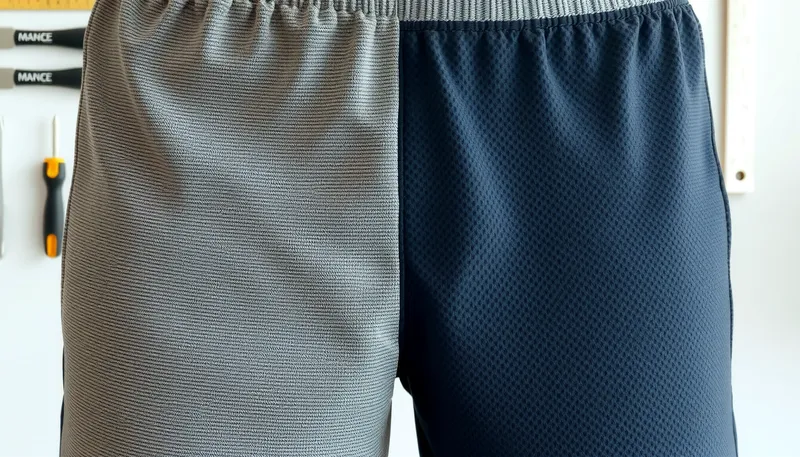
Knit fabrics (Interlock/Jersey) provide inherent 4-way stretch essential for compression liners and dynamic squat mobility. Conversely, woven fabrics (Ripstop/Taffeta) offer rigid structural strength for outer shells. An Interlock knit is the optimal hybrid, delivering stretch while maintaining production stability.
| Feature | Knit Fabrics (e.g., Interlock, Jersey) | Woven Fabrics (e.g., Ripstop, Taffeta) |
|---|---|---|
| Stretch & Mobility | Inherent 4-way stretch; ideal for compression and liners. | Limited stretch without Elastane; suited for structured outer shorts. |
| Production Stability | Single Jersey curls at edges (high waste). Interlock does not curl (low waste). | Highly stable edges; easy to cut. |
| Hand Feel | Soft, next-to-skin comfort. | Crisp, technical feel. |
| Recommendation for Gym Shorts | Interlock for all-over performance. | Use only for specific outer-layer shells. |
-
Woven Fabrics (e.g., Ripstop, Taffeta)
- Pros: Wovens render an excellent structure and superior strength. They are characterized by their crisp hand that works well for the outer shell or classic-style training shorts.
- Cons: They are not generally stretchy unless
Elastaneis used. The seam construction has to be more complex to allow full movement of the garment.
-
Knit Fabrics (e.g., Jersey, Interlock)
- Pros: Knits have a built-in 4-way stretch. This provides comfortable fit and mobility. They are the perfect choice for compression liners or shorts with a single layer.
- Cons: Cheap single knits, for example, Single Jersey, are prone to curling at the edges, which can produce a lot of fabric waste and slow down the cutting process.
The Better Solution: Why Double Jersey (Interlock) Wins
Interlock is a high-gauge double-knit construction using two rows of needles. This structural engineering produces a stable, opaque fabric with identical smooth faces and zero edge-curl. It eliminates the dimension instability of single jersey, maximizing cutting yield and barbell abrasion resistance.
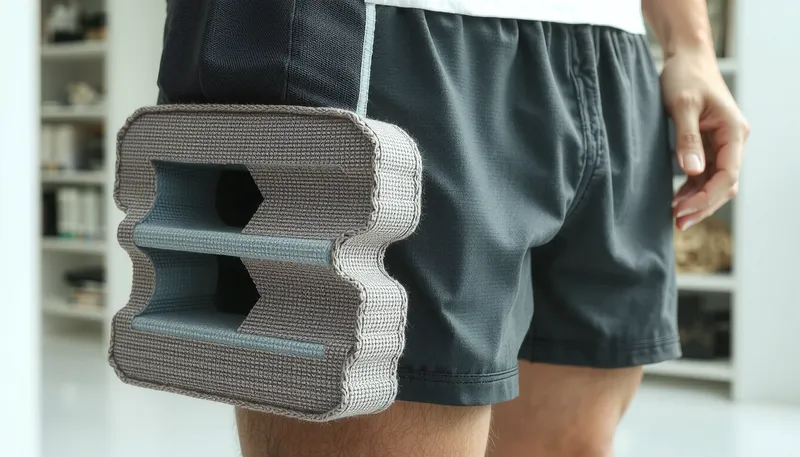
The yarn that is chosen defines the final performance. For instance, a premium 40D Nylon 6 and a high-quality Elastane will work well together. A high-quality 160gsm fabric like our D036 Nylon Spandex Interlock is specifically designed to provide this combination of lightweight feel and structural strength.
On the cutting room floor, production managers refer to edge curl as "potato-chip fabric" — a defect that slows spreading, misaligns pattern pieces, and increases cut waste by 5-8% per lay. Interlock construction eliminates this entirely.
Note: 160 GSM Interlock is not recommended for swim shorts or applications requiring maximum water drainage, where a woven mesh is superior.
Technical Specifications: FORALLTEX D036 Nylon Interlock
D036 Nylon Interlock is specified at 160 GSM with 76% Nylon / 24% Spandex, achieving >95% 4-way stretch recovery and Grade 4-5 color fastness (AATCC 61).
| Parameter | FORALLTEX D036 Specification | Industry Significance for Men's Shorts |
|---|---|---|
| Composition | 76% Nylon / 24% Spandex | Optimal mix for durability and elasticity. |
| Weight (GSM) | 160 g/m² | Light breathable factor, and thick enough to prevent see-through areas. |
| 4-Way Stretch Recovery (ASTM D6614) | >95% (Warp & Weft) | Shorts are guaranteed to retain their shape after deep squats and many washes. |
| Shrinkage Rate | <3% post-wash | Ensures consistency in fit after production and for the end customer. |
| Color Fastness to Wash | Grade 4-5 (AATCC 61) | Prevents color bleeding and fading, which is important for colored products. |
| UPF Rating | 50+ | Provides outstanding sun protection for outdoor training shorts. |
| Tensile Strength (Warp/Weft) | ≥ 45 lbf (ASTM D5034) | Ensures seam stability under high-stress movements. |
| Moisture Management | Grade 4+ (AATCC 195) | Crucial for heavy-sweat training like CrossFit and Hyrox. |
| Pilling Resistance | Grade 4-5 (ASTM D4970) | Resists friction degradation from barbell knurling. |
GSM, Stretch, and Breathability: The Comparison That Matters
GSM alone does not predict whether a gym short will be cool, opaque, or durable. The useful comparison holds construction and fiber constant, then measures mass, stretch recovery, air permeability, and liquid moisture management separately. At 160 GSM, D036 is the reference point: 76% nylon / 24% spandex, >95% recovery, and ≥50 cm³/cm²/s air permeability.
| Construction | Typical GSM | Stretch and recovery | Air permeability (ASTM D737) | Liquid moisture (AATCC 195) | Opacity | Best use |
|---|---|---|---|---|---|---|
| Single jersey, nylon/spandex | 140–160 | 4-way stretch; lower recovery; edge curl | Higher airflow than interlock at equal GSM | Good wicking; can cling when wet | Lower at 140 | Light training, liner (requires edge stabilization) |
| Interlock, nylon/spandex (D036) | 160 | >95% recovery (ASTM D6614); 4-way | ≥50 cm³/cm²/s (D036 measured) | Grade 4+ | Good | CrossFit, Hyrox, all-over performance |
| Interlock, heavier | 180–200 | >95% recovery target; 4-way | Lower airflow as mass increases | Grade 4+ | High | Durability-first shorts, cold-weather training |
| Woven ripstop/taffeta | 120–180 | Low unless elastane is added | Low | Low | High | Outer shell, not a liner |
Only the D036 column is a measured specification; the other rows are directional comparisons. Request lot-specific test reports before you turn any directional value into a tech-pack threshold. A 180 GSM interlock is not automatically "better" than 160 GSM — it is heavier, usually less air-permeable, and more expensive per garment.
Airflow and Moisture Vapor Are Not the Same Test
A shorts fabric can pass an air-permeability test and still feel clammy, because the tests measure different things:
- ASTM D737 measures air passing through the fabric in cm³/cm²/s. It answers: will this short vent heat?
- ASTM E96 measures water-vapor transmission in g/m²/24h. ISO 11092 reports RET (m²·Pa/W); lower RET means more breathable. These answer: will sweat vapor escape through the fabric?
- AATCC 195 measures liquid moisture management — how fast the fabric spreads and dries liquid sweat. It answers: will this fabric cling when soaked?
For a short used in a hot gym, request all three. The common failure is a dense interlock with good AATCC 195 wicking but low air permeability: it moves liquid sweat, yet holds a hot microclimate. D036's measured air permeability is ≥50 cm³/cm²/s, which is the baseline to beat; a heavier 200 GSM interlock will generally sit below that and should be specified only where durability or opacity matters more than venting. As a reference for interpretation, ISO 11092 RET below 6 m²·Pa/W is generally read as very breathable, 6–13 as breathable, and above 20 as low breathability — treat these as reading aids, not pass/fail thresholds unless your buyer sets them.
Specify Recovery With the Right Method
"4-way stretch" is not a number. A tech pack should state elongation and recovery separately, plus the test method:
- Knits: use ASTM D2594 for low-power stretch and recovery, or ASTM D6614 (CRE method). D036's >95% recovery is stated under D6614.
- Wovens: use ASTM D3107. Do not accept a D3107 report as proof of knit recovery; the methods and specimen loading are different.
- What to write: "4-way stretch; recovery ≥95% after the standard hold; method ASTM D2594 or D6614; report elongation, recovery, and residual growth separately." A supplier who answers only "4-way stretch" has not given you a specification.
Air Permeability and MVTR: What to Put in the Tech Pack
| Parameter | Test method | D036 reference | What to ask for |
|---|---|---|---|
| Mass | ASTM D3776 / ISO 3801 | 160 g/m² | Mean and range per lot; tolerance in the PO |
| Stretch recovery | ASTM D6614 or D2594 | >95% | Elongation %, recovery %, method, specimen direction |
| Air permeability | ASTM D737 | ≥50 cm³/cm²/s | Test pressure and result per lot |
| Liquid moisture management | AATCC 195 | Grade 4+ | Sub-30-minute results, not just the final grade |
| Water-vapor transmission | ASTM E96 or ISO 11092 | Not stated for D036 | MVTR in g/m²/24h or RET; state the method |
| Pilling | ASTM D4970 | Grade 4-5 | Test cycles and grading photo |
| Colorfastness to wash | AATCC 61 | Grade 4-5 | Test condition and staining/gray-scale results |
The ROI Calculator: How Premium Fabric Lowers Your Per-Item Cost
A fabric priced 2% lower per meter but with an 8% edge-curl waste factor results in a significantly higher FOB cost-per-unit than a stable Interlock with a <3% waste factor. Premium fabric directly increases cutting yield and minimizes material rework.
- Real-World Impact (Q4 2025): When a client producing 15,000 gym shorts switched to D036 Interlock, they reduced total fabric consumption by 190 kg and slashed QC rejections from 4.1% to 0.8%, simply by eliminating edge-curling defects on the cutting table.
Conclusion: Source Smarter, Not Cheaper
The data confirms: Nylon Spandex Interlock at 160 GSM is the optimal specification for men's gym shorts. It reduces total landed cost per unit by increasing cutting yield and eliminating QC failures from edge curling.
Collaborate with a textile specialist. Get in touch with FORALLTEX (Haining Forall Digital Technology Co., Ltd.) now. Request a sample of D036 and get a personalized quote for your upcoming collection.
Frequently Asked Questions (FAQ)
What is the ideal GSM for a high-performance men's gym shorts fabric?
There is no single ideal GSM, but a strategic range exists. For a lightweight feel without sacrificing opacity and durability, 150-180 GSM is the sweet spot for a primary short fabric or a compression liner. Fabrics below 140 GSM may lack durability, while those above 200 GSM can feel too heavy for intense cardio.
For men's shorts, is Nylon or Polyester the better choice?
Both are excellent synthetic choices. Nylon generally offers a softer, more "cotton-like" hand-feel and superior abrasion resistance, making it a premium choice. Polyester often has a slight edge in moisture-wicking and cost-effectiveness. The decision often comes down to the desired price point and the specific hand-feel your brand is targeting.
What does "4-way stretch" really mean in a tech pack specification?
"4-way stretch" means the fabric stretches and recovers on both the cross-grain (weft) and length-grain (warp). This is critical for gym shorts to allow for a full range of motion in activities like squats and yoga. When specifying in a Tech Pack, you should request a minimum stretch and recovery percentage (e.g., ">50% stretch with >95% recovery") to ensure performance.
What is the difference between air permeability and moisture vapor transmission?
Air permeability (ASTM D737) measures how much air passes through the fabric in cm³/cm²/s. Moisture vapor transmission (ASTM E96 or ISO 11092 RET) measures how much water vapor passes through. A fabric can be air-permeable but still trap vapor, or vapor-permeable with low airflow. For hot gyms, specify both, plus AATCC 195 for liquid sweat management.
Which ASTM method should I use for knit stretch recovery?
For knit fabrics, use ASTM D2594 (low-power stretch) or ASTM D6614 (CRE method). ASTM D3107 is written for woven fabrics. Ask the laboratory which method it used; the numbers are not interchangeable, and a "4-way stretch" claim without a method is not a specification.
How does fabric choice directly affect the final garment cost beyond the per-meter price?
The fabric's price per meter is only one part of the equation. Fabric choice impacts: 1) Yield: Wider or more stable fabrics allow more pattern pieces to be cut per meter, reducing waste. 2) Labor Costs: Unstable, curling fabrics slow down the cutting and sewing process, increasing labor costs per garment. 3) QC Rejections: Poor quality fabric with defects or color inconsistency leads to rejected units, which is a direct loss.
What is a typical MOQ for custom-dyed performance fabrics like Nylon Interlock?
Minimum Order Quantities (MOQ) vary by supplier. At FORALLTEX, our standard MOQ for custom piece-dyed colors is typically around 300-500 kg per color. This allows for efficient dyeing lots and ensures color consistency across your production run. We can always discuss smaller quantities for initial strike-offs or sampling.
How does Interlock construction increase cutting yield vs Single Jersey?
Interlock's balanced face-to-face knit geometry — two rib structures interlocked through the fabric core — produces zero edge curl. Single Jersey's asymmetric loop structure curls at both selvages, forcing cutting room operators to manually flatten and reposition each ply. On a 15,000-unit gym shorts order, this curl-induced waste consumes 3-5% of total fabric — approximately 190 kg on a typical production run. Interlock eliminates this entirely, directly increasing cuttable yield and reducing per-unit FOB cost by $0.15-0.30. This is why sourcing directors specify "Interlock only" for high-volume activewear cutting — the per-meter savings from cheaper Single Jersey are erased by the cutting table waste.
🔗 Related Fabrics
This article covers men's gym shorts fabric — 160 GSM Nylon Spandex Interlock (D036), knit vs woven breakdown, and the ROI case for premium cutting stability:
- D036 Nylon Spandex Interlock — The 160 GSM Interlock platform with zero edge curl and >95% stretch recovery
- Fabric Weight Guide: GSM Explained for Activewear — How GSM impacts opacity, durability, and hand-feel
- Fabric Elongation & Recovery Test — ASTM D3107 stretch recovery testing methodology
Written by Wenruo
Textile Engineer, Forall Lab