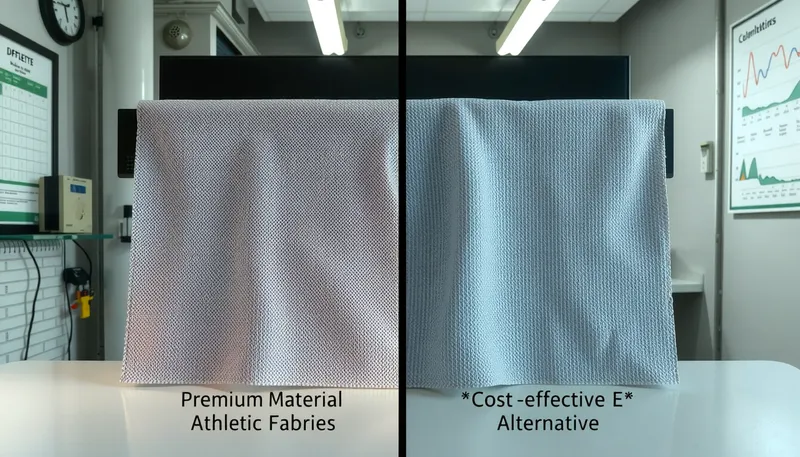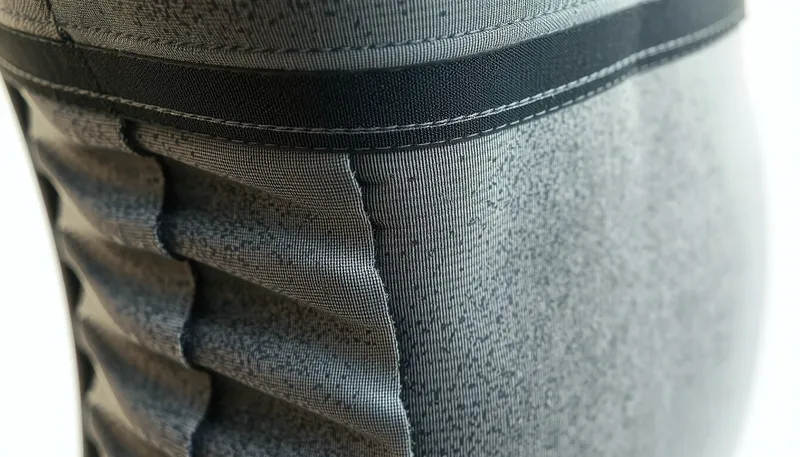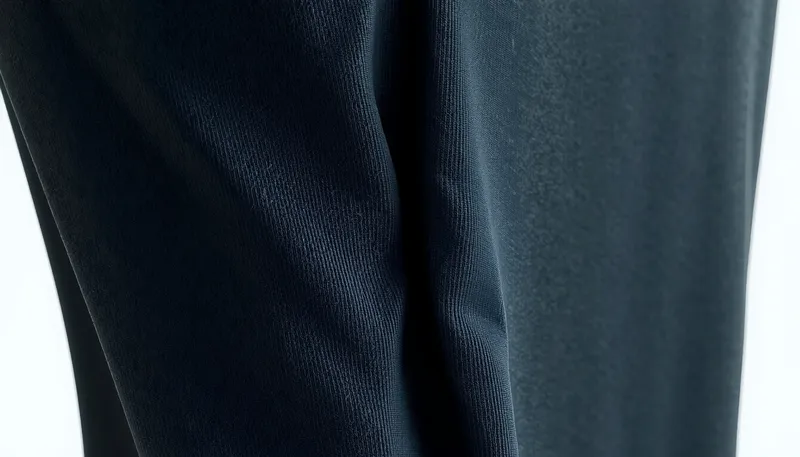
Fabric grin-through is a defect where the undyed, white inner core of a knit textile becomes visible when stretched. This issue, common in printed leggings and often called sublimation white-out, occurs when the surface print separates, compromising the garment's opacity and design integrity during movement.
What Causes Fabric Grin-Through?
Fabric grin-through is caused by the mechanical separation of knit loops under tension, revealing the un-penetrated white yarn core beneath a surface-level print. In standard dye-sublimation, gaseous ink only bonds to the outer microfibers; when stretched (e.g., during a squat), the un-dyed internal structure is forcibly exposed.
What are the Technical Specifications to Prevent Grin-Through?
The primary technical specifications to prevent grin-through are a high interlock gauge and an optimized fabric weight. These two metrics directly control the fabric's density and opacity, which are the main physical barriers against the defect. Specifying these parameters is critical for sourcing high-performance textiles.
A high Interlock Gauge is the most effective countermeasure. The gauge measures knitting machine needle density; a higher number means a tighter, more compact fabric structure. For performance activewear, an Interlock Gauge of 36G or higher is the technical barrier for preventing grin-through. This dense construction minimizes the space between loops, physically blocking the undyed core from being exposed under stretch.
Fabric Weight, measured in Grams per Square Meter (GSM), is another key indicator of performance. A higher GSM generally correlates to better opacity and structural integrity. The industry standard for opaque, squat-proof leggings is a Fabric Weight of 250-300 GSM. Fabrics below 220 GSM present a high risk for both grin-through and general sheerness, expectations for coverage.
Causes of Grin-Through vs The FORALLTEX Solution
| Common Cause of Grin-Through | The FORALLTEX Solution (Technical Countermeasure) |
|---|---|
| Piece-Dyeing / Sublimation Printing | Yarn-Dyed Fabric: Yarns are dyed before knitting, ensuring the entire fabric structure has full color penetration. There is no white core to be revealed. |
| Low Knit Density (Low Gauge) | High-Density Interlock Gauge: Utilizing a 36G or higher gauge knitting machine creates a compact fabric structure that resists stretching open. |
| Inadequate Fabric Weight (Low GSM) | Optimized Fabric Weight: Engineering fabrics to a target of 250-300 GSM (using heavier base yarns like 40D or 70D nylon) ensures sufficient mass and opacity for full coverage under tension. |
| Poor Elastane Integration | Premium LYCRA® Integration: Using high-quality elastane with excellent recovery ensures the fabric returns to its original state without permanently distorting the print. |
| For printed designs, utilizing Acid/Reactive Digital Printing ensures deep ink penetration into the nylon/elastane core, completely eliminating the surface-only coloration typical of standard sublimation. |
How is Grin-Through Tested in a Factory Setting?
Grin-through is evaluated through a dual-protocol approach: physical deep-squat manual assessments under 1,000-lux lighting, and objective standardized testing using AATCC TM208 for stretch appearance and ASTM D3787 for multidirectional bursting strength.
Based on our factory testing, the most direct evaluation is the manual "squat test." An evaluator wears a sample garment and performs a deep squat under bright, controlled lighting. The observer then inspects high-stretch zones, such as the glutes and thighs, for any evidence of whitening. We observed that our dense One-Open-One-Close knitting completely blocks the inner core from exposing during this test, validating the fabric's construction.
For objective, repeatable data, manufacturers rely on standards from expert organizations. The AATCC (American Association of Textile Chemists and Colorists) publishes AATCC TM208 for fabric stretch and recovery appearance. Additionally, ASTM International provides test methods like ASTM D3787 for bursting strength, which indirectly measures a fabric's structural integrity under multidirectional tension. For stretch recovery, ASTM D3107 provides a direct measurement of a fabric's ability to return to its original structure after repeated tension, which is critical for long-term grin-through resistance. A fabric that passes these rigorous tests and exhibits no grin-through can be marketed as squat-proof, a term sometimes protected by a brand's fabric patent, such as US Patent No. 10,480,108.
What are the Limitations of Yarn-Dyed Fabrics?
While yarn-dyed fabric is a superior solution for preventing grin-through, its primary limitations are higher costs, longer lead times, and design constraints. This manufacturing method, an alternative to piece-dyed fabric, involves dyeing the yarn before knitting, which creates financial and operational trade-offs for brands.
The main drawback is cost. The yarn-dyed fabric process is more resource-intensive than printing on undyed goods, increasing the cost per yard by 15-25%. This price increase directly affects the final garment's retail price, making it less suitable for budget-focused product lines.
Production timelines are also longer. Dyeing yarn to a custom color and then knitting the fabric adds several weeks to the manufacturing calendar compared to holding stock of ready-for-print base goods. This extended lead time can be a challenge for fast-fashion cycles. Finally, yarn-dyed fabric is best for solid colors or simple patterns like stripes. The method cannot replicate the complex, multi-color, or photorealistic graphics achievable with modern digital sublimation.
Conclusion: Engineering Fabrics to Eliminate Grin-Through
Eliminating fabric grin-through is a matter of precise technical specification, not chance. The defect, especially sublimation white-out, fundamentally undermines product quality in performance activewear. The most effective solutions involve moving away from surface-level coloring on low-density knits. By specifying a high Interlock Gauge of 36G or more, targeting a Fabric Weight of 250-300 GSM, or choosing yarn-dyed fabric construction, brands can engineer textiles that maintain complete color and opacity under stress. These data-driven choices are the foundation for creating truly squat-proof garments that build consumer trust and brand loyalty in the competitive 2026 market.
Frequently Asked Questions about Fabric Grin-Through
What is the difference between grin-through and see-through?
Grin-through is a print quality failure where the fabric's white core shows when stretched, while see-through is a fabric opacity failure where skin is visible.
- Grin-through: A surface-level issue related to print and color.
- See-through: A structural issue related to fabric density and opacity.
- Occurrence: A fabric can exhibit grin-through without being see-through.
What GSM is best for squat-proof leggings?
A fabric weight between 250-300 GSM is the industry benchmark for creating fully opaque, squat-proof activewear.
- Below 220 GSM: High risk of sheerness and grin-through.
- 250-300 GSM: Optimal balance of coverage, compression, and comfort.
- Above 300 GSM: May feel too heavy or restrictive for some activities.
Is sublimation printing bad for activewear?
Sublimation printing is not inherently bad, but it requires a very high-density base fabric to mitigate sublimation white-out.
- Fabric Choice: Must use a high Interlock Gauge (36G or higher).
- Print Color: Dark and saturated prints are more likely to show whitening.
- Alternative: For dark solids, yarn-dyed fabric is the superior choice.
How can I specify "no grin-through" to my fabric supplier?
Use precise technical language in your spec sheet instead of subjective marketing terms.
- For Solids: Request a "yarn-dyed fabric" with a weight of 250-300 GSM.
- For Prints: Specify a "36G high-density interlock base for sublimation."
- Verification: Always demand a sample for physical squat testing before bulk order.
Does grin-through get worse over time?
Yes, grin-through can become more pronounced as a garment ages and the elastane fibers degrade.
- Elastane Fatigue: Repeated stretch cycles reduce the fabric's recovery power.
- Structural Loosening: The knit structure may not return to its original compact state.
- Washing Impact: Improper laundering can accelerate the degradation of elastic fibers.
Contact our technical team to request a fabric sample for physical testing.
Written by Forall Lab
© Forall Lab • Powered by Kunpeng ONE