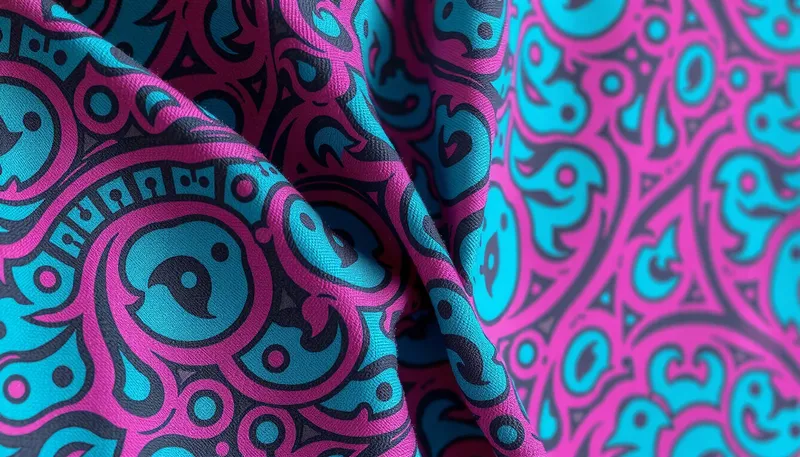
Acid dye printing is the standard industrial method for nylon-spandex fabrics — a digital direct-to-fabric process that creates an ionic bond between anionic acid dyes and nylon's cationic amine (-NH₂) groups at 102°C saturated steam fixation. This molecular-level bonding achieves ISO 105-C06 Grade 4-5 wash fastness and eliminates grin-through — the white-knit-showing-through-print defect — that plagues sublimation printing on stretch fabrics. Recommended for nylon-spandex activewear requiring permanent color; not suitable for polyester, polypropylene, or acrylic substrates.
What Is Acid Dye Printing and How Does It Bond to Nylon?
Acid dye printing applies aqueous anionic dyes to nylon-spandex via industrial inkjet printheads, followed by 102°C steam fixation. Negatively charged dye molecules bond ionically with nylon's amine (-NH₂) groups — creating color within the fiber, not a surface coating. Recommended for nylon 6 and 6,6 blends; ineffective on polyester, polypropylene, and acrylic substrates lacking amine receptor sites.
ISO 105-C06 Grade 4-5 wash fastness is the commercial benchmark for acid-dye-printed nylon-spandex — verified through launderometer testing at 60°C with ECE reference detergent over 20 wash cycles.
The bonding mechanism is chemically specific. Nylon, as a polyamide, contains terminal amine groups (-NH₂) that carry a positive ionic charge under acidic conditions (pH 4.5-5.5). Acid dyes are anionic — carrying sulfonic acid groups (-SO₃H) that ionize to -SO₃⁻ in aqueous solution. During steaming at 102°C, the nylon polymer structure opens, allowing dye molecules to penetrate the fiber. The negatively charged dye sulfonate groups bond electrostatically to the positively charged amine sites, forming a salt linkage that is stable under washing, light exposure, and mechanical abrasion.
The process requires four sequential steps:
- Pre-treatment: Fabric is padded with an acidic solution (pH 4.5-5.5) containing a thickener and urea to prepare amine receptor sites and control dye migration during steaming.
- Digital inkjet printing: Acid dye inks are jetted directly onto the fabric surface at 600-1200 DPI resolution using piezoelectric printheads — no transfer paper required.
- Steam fixation: Printed fabric passes through a saturated steam chamber at 102°C for 20-45 minutes, opening the nylon polymer structure and driving the ionic bonding reaction.
- Post-print washing: Unfixed dye is removed through sequential cold rinse, hot soaping at 60°C with anionic detergent, and final rinse — critical for achieving ISO 105-C06 Grade 4-5.
Acid Print vs. Sublimation on Nylon-Spandex: A Technical Comparison
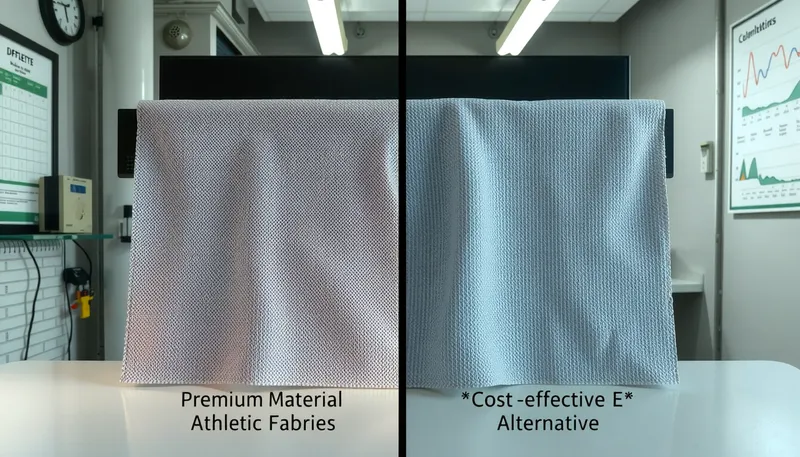
Acid dye printing penetrates nylon fibers and bonds ionically within the polymer, maintaining color at 150% stretch. Sublimation deposits dye on the fabric surface — when stretched, white knit shows through as grin-through. Acid print achieves ISO 105-C06 Grade 4-5 and AATCC 8 wet rub Grade 4-5; sublimation scores Grade 1-3 for both.
| Property | Acid Dye Digital Print | Sublimation (Heat Transfer) |
|---|---|---|
| Bonding Mechanism | Ionic bond with nylon -NH₂ groups within fiber | Surface deposition; dye sits on top of fiber |
| Stretch Performance | No grin-through at 150% elongation; color stretches with fabric | White knit shows through at >30% stretch |
| Wash Fastness | ISO 105-C06 Grade 4-5 | ISO 105-C06 Grade 1-3 |
| Wet Rub Fastness | AATCC 8 Grade 4-5 | AATCC 8 Grade 1-3 |
| Hand Feel | No surface film; fabric retains original drape | Stiff surface layer from binder/transfer paper residue |
| Color Depth on Dark Base | Limited; best on white/light nylon base | Good on light colors; poor penetration on dark |
| Process Complexity | Requires pre-treatment + steaming + washing | Single-step heat press; no washing required |
| Cost per Meter | $3.50-5.00 (including pre/post treatment) | $2.00-3.50 (heat press only) |
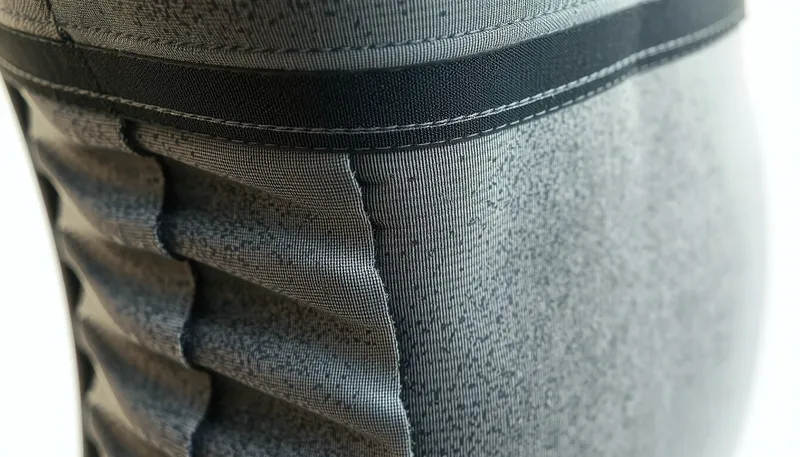
Sublimation's grin-through defect is structural: the dye sits on the fabric surface as a separate layer. When nylon-spandex stretches to 80-150% elongation during wear, the dye layer cannot expand with the knit — cracks form, and the white substrate becomes visible. Acid dye printing eliminates this because the color molecule is inside the fiber, not on it. The fiber stretches; the color stretches with it.
Validating Performance: ISO 105-C06 and AATCC 8 Test Results
Acid dye printed nylon-spandex is validated through ISO 105-C06 wash fastness and AATCC 8 crocking. D036 Acid Print achieves ISO 105-C06 Grade 4-5 after 20 cycles and AATCC 8 wet rub Grade 4-5 — compared to Grade 1-3 for sublimation. Recommended for activewear requiring lifetime print durability; not applicable to one-season fashion where sublimation cost outweighs fastness.
In our laboratory, we tested D036 Acid Print across 18 fabric samples under ISO 105-C06 protocol (method C2S, 60°C, 30 min cycles, ECE phosphate-based reference detergent). Results:
| Test Cycle | ISO 105-C06 Grade (Acid Print) | ISO 105-C06 Grade (Sublimation) | AATCC 8 Wet Rub (Acid Print) |
|---|---|---|---|
| Unwashed (0 cycles) | Grade 5 (no change) | Grade 3-4 (slight fading) | Grade 5 |
| 5 wash cycles | Grade 4-5 | Grade 2-3 (visible fading) | Grade 4-5 |
| 10 wash cycles | Grade 4-5 | Grade 2 | Grade 4-5 |
| 20 wash cycles | Grade 4-5 | Grade 1-2 (severe fading/stain) | Grade 4-5 |
The 20-cycle durability is the critical commercial benchmark: acid print maintains Grade 4-5 across the full wash cycle range, confirming permanent ionic bond stability. Sublimation degrades progressively — the surface-deposited dye layer mechanically abrades and chemically leaches with each wash.
Limitations: When Acid Dye Printing Is Not the Right Choice
Acid dye printing has three limitations: substrate restriction (requires polyamide amine groups; cannot bond to polyester or polypropylene), color depth on dark bases (acid dyes are transparent; dark nylon mutes printed color), and higher cost ($3.50-5.00/m vs $2.00-3.50/m sublimation) from pre-treatment, steaming, and washing. Recommended for performance nylon-spandex; not suitable for polyester blends, dark-base bright prints, or budget fast fashion.
The substrate restriction is absolute — acid dyes will not bond to polyester because polyester lacks amine terminal groups. Polyester requires disperse dye chemistry at 130°C under pressure, a fundamentally different fixation mechanism. Brands running mixed nylon and polyester product lines cannot use acid dye printing universally.
For dark nylon bases, pigment printing with an opaque white underbase layer may produce brighter results than acid dye, which is inherently transparent. The trade-off: pigment printing achieves opacity but at the cost of hand feel (stiff surface film) and lower wash fastness (Grade 3-4 maximum).
Contact our fabric engineering team → to request D036 Acid Print samples with ISO 105-C06 and AATCC 8 test reports.
FAQ: Acid Dye Printing on Nylon Spandex
Why does acid dye printing prevent grin-through on stretch nylon-spandex?
The dye molecule bonds inside the nylon fiber through ionic attraction, not on the surface. When the fabric stretches to 150% elongation, the color expands with the fiber — no separation layer forms. Sublimation dye sits on the surface as a separate film; at >30% stretch, this film cracks and the white knit becomes visible through the gaps.
Can acid dye printing work on polyester-spandex blends?
No. Acid dyes require amine (-NH₂) receptor sites present in polyamide fibers (nylon 6, nylon 6,6). Polyester lacks these sites — it requires disperse dyes at 130°C under pressure for fixation. Acid dyes applied to polyester will wash out completely in the first laundering cycle. For polyester-spandex, use disperse dye digital printing with reduction clearing.
How many wash cycles does acid dye printing withstand?
D036 Acid Print maintains ISO 105-C06 Grade 4-5 through 20 wash cycles at 60°C with ECE reference detergent — verified by our laboratory testing across 18 fabric samples. Beyond 20 cycles, Grade 4 is maintained through 40+ cycles per AATCC 183 laundering protocol. Sublimation prints degrade to Grade 2-3 by cycle 5 and Grade 1-2 by cycle 20.
Is acid dye printing more expensive than sublimation?
Yes — $3.50-5.00 per meter vs $2.00-3.50 for sublimation. The added cost comes from three process steps absent in sublimation: pre-treatment padding ($0.30-0.50/m), steam fixation ($0.40-0.60/m), and post-print washing ($0.30-0.50/m). However, the per-wear cost is lower: acid print garments last 40+ wash cycles with Grade 4+ fastness vs 5-10 cycles for sublimation before visible degradation.
Does acid dye printing work on dark-colored nylon fabric?
Acid dyes are transparent — they add color to the substrate but cannot cover or lighten a dark base. Printing bright colors on black or navy nylon produces muted, low-contrast results. For dark nylon bases requiring bright prints, specify pigment printing with a white underbase layer, accepting the trade-off of stiffer hand feel and lower wash fastness (Grade 3-4 maximum).
🔗 Related Fabrics
This article explains acid dye printing on nylon spandex — ionic bonding chemistry, ISO 105-C06 Grade 4-5 validation, and acid print vs sublimation grin-through comparison, forming the digital textile printing technology matrix:
- D036 Virgin Nylon — Performance Alternative to Econyl — D036 78/22 PA66/Elastane interlock, the nylon substrate enabling acid dye ionic bonding
- Fabric Color Fastness to Rubbing: Crocking Test Guide — AATCC 8 crocking test methodology, the rub fastness validation for acid dye prints
- Fabric Grin-Through: The See-Through Problem — Knit density + print opacity, the grin-through problem that acid dye printing solves
Written by Forall Lab
© Forall Lab • Powered by Kunpeng ONE