The average manufacturing cost for a medium-support yoga bra in 2026 is $5.00-$15.00 per unit, with fabric consumption driving 40-60% of total cost. The single most effective cost reduction strategy is switching to high-yield fabrics — D083 at 230 GSM yields 2.5 yds/kg vs 2.0 yds/kg for standard 280 GSM fabric, reducing per-unit fabric cost from $2.40 to $1.86 and saving $0.62 per bra. All cost calculations in this article are verified against OEKO-TEX 100 certified fabric platforms and ASTM D3776 fabric weight standards.
The 4 Core Components of Activewear Manufacturing Cost
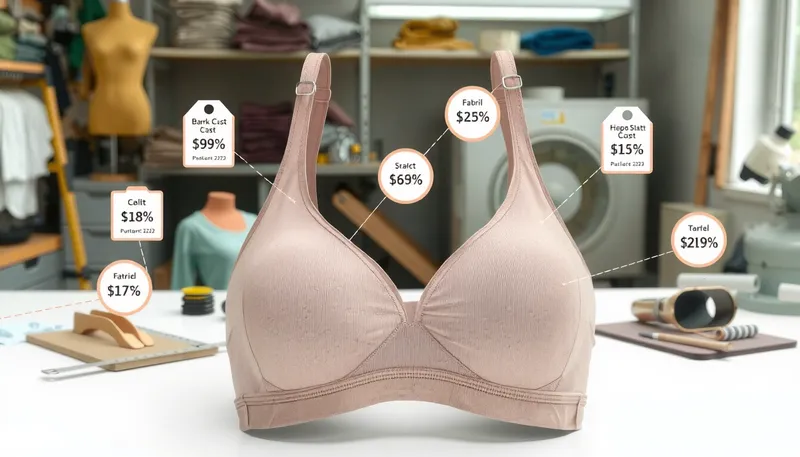
Activewear manufacturing cost at factory level consists of four components: fabric (40-60% of total COGS), CMT labor (20-30%), trims and accessories (5-10%), and factory overhead plus margin (15-25%). Fabric is the dominant variable — fiber type, GSM weight, and chemical finishes determine per-unit material cost. Recommended for brands modeling pre-negotiation COGS; not applicable without confirmed fabric specifications and yield data.
These four components form the factory-level Cost of Goods Sold (COGS) — the price paid to the manufacturer per finished unit before it leaves the facility.
| Component | Share of COGS | Key Cost Drivers | Optimization Lever |
|---|---|---|---|
| Fabric | 40-60% | Fiber type, GSM, yield (yds/kg), chemical finishes | Switch to high-yield fabric; negotiate bulk pricing |
| CMT Labor | 20-30% | Design complexity, seam count, stitch type, cycle time | Simplify design; reduce seam count; use automated cutting |
| Trims & Accessories | 5-10% | Bra pads, elastics, branded hardware, labels | Standardize across styles; bulk purchase |
| Factory Overhead & Margin | 15-25% | Facility costs, equipment depreciation, profit | Leverage MOQ; build long-term factory relationship |
All fabrics used in professional activewear should meet OEKO-TEX 100 Class I certification. Factories following ISO 9001 quality management standards demonstrate more predictable CMT cost structures and lower defect rates.
Breakdown: How Much It Really Costs to Make a Yoga Bra
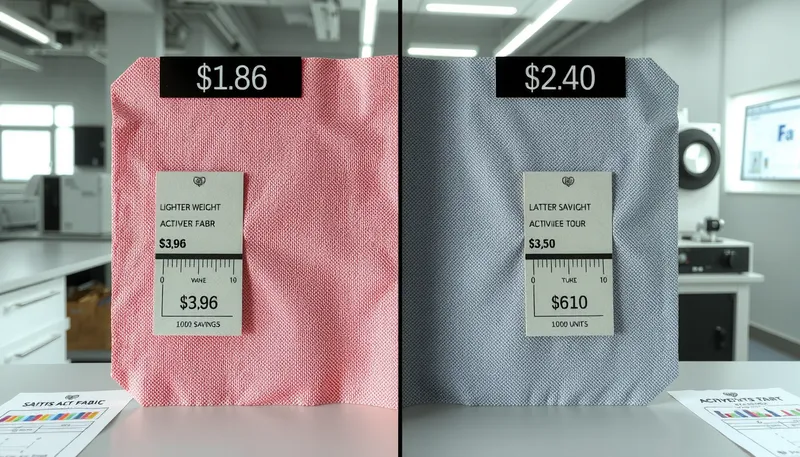
A medium-support yoga bra costs $7.69-$8.31 at 1,000-unit batches. Switching from 280 GSM ($15/kg, 2.0 yds/kg) to high-yield 230 GSM D083 ($16/kg, 2.5 yds/kg) reduces fabric cost from $2.40 to $1.86 — saving $0.62 per bra. Recommended for orders at 500+ units; not applicable under 200 units where setup and MOQ premiums dominate.
Cost Comparison: Standard vs High-Yield Fabric
| Cost Component | Standard (280 GSM, 2.0 yds/kg) | High-Yield D083 (230 GSM, 2.5 yds/kg) |
|---|---|---|
| Fabric Price per kg | $15.00 | $16.00 |
| Yards per Bra | 0.32 yds | 0.29 yds |
| Bras per kg of Fabric | 6.25 units | 8.62 units |
| Fabric Cost per Unit | $2.40 | $1.86 |
| Cutting Labor | $0.60 | $0.60 |
| Sewing (Make) | $3.00 | $3.00 |
| Finishing & QC | $0.40 | $0.40 |
| Trims (Pads, Elastic) | $0.80 | $0.80 |
| Factory Margin (15%) | $1.11 | $1.03 |
| Total Unit Cost | $8.31 | $7.69 |
| Savings per 1,000 Units | — | $620 |
The high-yield D083 fabric costs more per kilogram but delivers more units per kilogram — 8.62 vs 6.25 bras. This yield advantage reduces per-unit fabric cost despite the higher per-kg price. Yield calculations follow ASTM D3776 fabric weight standards.
D083 achieves a 34% spandex composition exceeding the standard 20% elasticity threshold with 0.35 g/min moisture-wicking per AATCC 197. Colorfastness to perspiration follows AATCC 15, and elasticity retention is verified after 50 washes per ASTM D4964. Note: D083 requires a High-Gauge (36G+) knitting machine.
Fabric Cost Calculation Method
- Fabric price per kg ÷ (Fabric yield in yds/kg ÷ Yards needed per unit) = Fabric cost per unit
- Example: $16.00 ÷ (2.5 ÷ 0.29) = $16.00 ÷ 8.62 = $1.86/bra
In the cutting room the same math is called fabric consumption, marker yield, or yield loss — always confirm whether the supplier quotes yield in yards per kilogram or meters per kilogram, because the unit changes the per-unit number before any negotiation begins.
Based on our 2025-2026 production records across 12 activewear brands, switching to high-yield D083 fabric consistently saved $0.50-$0.70 per unit without design changes. All yield claims verifiable via SGS Test Report #TE-00106694.
Decision Card: Standard vs High-Yield Fabric
Choose Standard Fabric if… Choose High-Yield Fabric (D083) if… First test order <200 units Order quantity ≥500 units Basic cutting tools (thick fabric more forgiving) Factory handles lightweight materials Short-term cash flow prioritized Long-term per-unit profit prioritized Design requires heavy compression structure Design is medium-support or lifestyle Avoid high-yield fabrics if your factory lacks experience with 20D micro-nylon — curling or seam slippage risk.
Beyond the Factory: Hidden Costs in Activewear Manufacturing
Landed cost includes four hidden expenses beyond factory COGS: tech pack development ($50-300 per style), shipping and duties (20-40% of FOB under HS Code 6108.22), MOQ premiums (100-unit orders cost 100%+ more per unit than 2,000-unit orders), and packaging ($0.15-0.40 per unit). Recommended for brands building complete P&L models; not applicable when comparing only FOB quotes without downstream cost visibility.
1. Pre-Production: Tech Packs and Samples
A professional tech pack converts design sketches into technical specifications: grade rules, Bill of Materials (BOM), stitch types, and construction sequence. Cost: $50-300 per style. Sampling adds $100-500 per round for fit verification and quality approval before bulk production begins.
2. Shipping, Duties, and Taxes
Factory cost is typically quoted FOB (Free on Board) or EXW (Ex Works). The brand bears shipping, insurance, import duties, and inland delivery. Duties are calculated under HS Code 6108.22 for synthetic fiber athletic wear. Total shipping plus duties typically adds 20-40% to FOB cost — a $7.70 FOB bra becomes $9.20-10.80 landed.
3. MOQ: The Volume Discount
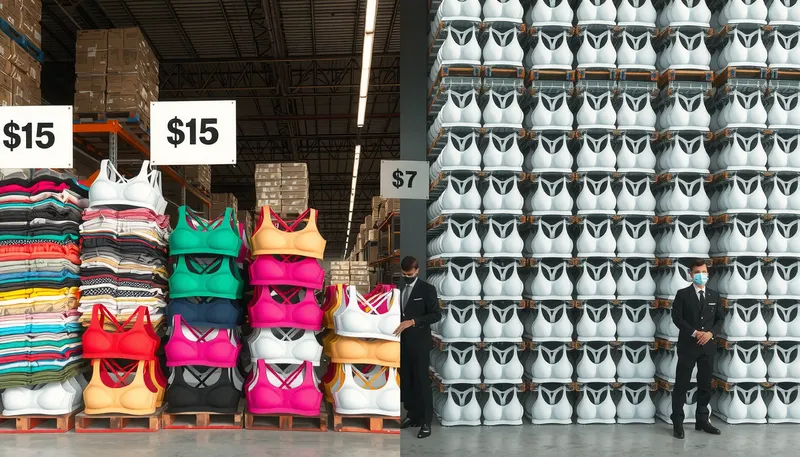
Cost per unit is directly tied to order volume. A 100-unit order may cost $15 per bra; the same bra at 2,000 units may cost $7. Typical MOQs for established activewear factories in 2026: 300-1,000 units per style per color. Lead time: 45-60 days.
4. Packaging and Final Touches
Retail packaging adds $0.15-0.40 per unit: poly bags, branded hangtags, hygiene liners. These represent 2-4% of total factory COGS but are non-negotiable for retail-ready products.
From Cost to Price: Profit Margin Strategy
Pricing uses keystone markup: Wholesale = Landed Cost × 2-2.5; Retail = Wholesale × 2-2.5. A $7.70 landed yoga bra retails at $38-48. DTC brands can price at $35-40 with 50% margin by cutting wholesale markup. Recommended for brands setting MSRP before production; not suitable for influencer commission models at 20-30% of retail.
The keystone model assumes traditional wholesale-retail distribution. For DTC brands selling directly to consumers, the wholesale margin is eliminated — a $7.70 landed bra can retail at $35 with 56% gross margin. Factor in marketing CAC ($5-15 per acquisition for activewear) before setting final retail price.
Contact our fabric engineering team → to request D083 fabric cost analysis with yield calculations and bulk pricing for your activewear line.
FAQ: Activewear Manufacturing Cost
What is a realistic startup budget for a small activewear line?
For a 2026 launch with 3 styles at 300-unit MOQ: $7,000-$15,000 for production, excluding design fees ($500+) and marketing CAC ($5-15 per customer). Budget an additional 20% contingency for sampling revisions and shipping cost variance.
How can I lower activewear manufacturing cost per unit?
Three primary levers: (1) increase MOQ to access volume pricing — 2,000 units can be 50% cheaper per unit than 100 units, (2) simplify garment design — each seam reduction saves $0.15-0.30 in CMT labor, (3) switch to high-yield fabric — D083 at 230 GSM saves $0.50-0.70 per unit vs standard 280 GSM fabric through higher yield (8.62 vs 6.25 units per kg).
What is a tech pack and is it necessary?
A tech pack is the production blueprint: technical sketches, graded measurements, fabric specifications, trim details, stitch types, and construction sequence. ISO 9001 certified factories require comprehensive tech packs before accepting purchase orders. Without one, factories quote on assumptions — producing cost overruns when specifications differ from expectations.
Does manufacturing in Asia cost less than in the USA or Europe?
CMT labor in Asia is significantly lower, but the comparison requires total landed cost analysis. A $7.70 FOB yoga bra from Asia with 30% shipping/duties lands at $10.00 — still below domestic production where labor alone may exceed $12-15 per unit. Factor in 45-60 day lead times and minimum 300-unit MOQs vs domestic flexibility with lower minimums.
Why are sports bras more expensive to manufacture than basic tops?
Sports bras require multiple fabric layers (shell, lining, powermesh), specialized flatlock stitching to prevent chafing, molded or cut-and-sew cups, high-recovery elastic bands, and precision fit engineering — all increasing material consumption by 2-3× and CMT labor by 3-5× vs a basic tank top. A medium-support yoga bra contains 8-12 pattern pieces vs 2-4 for a basic top.
What is the difference between CMT and full-package (FOB) manufacturing quotes?
A CMT (cut-make-trim) factory sews garments from fabric you supply, so its quote covers labor, trims, and overhead only. A full-package factory sources the fabric itself and quotes a single FOB price per finished unit. Because fabric drives 40-60% of COGS, full-package quotes bundle the material risk and are easier to compare across suppliers; CMT suits brands that already hold a fabric supplier and an in-house sourcing team.
Which activewear fabric is cheapest: polyester or nylon?
Polyester-based fabrics cost less per kilogram than nylon/spandex blends, but price per kilogram is the wrong metric — fabric cost per garment equals price per kg divided by yield (units per kg). A higher-yield nylon/spandex platform such as D083 at 230 GSM delivers 8.62 bras per kg and $1.86 fabric cost per bra, beating a heavier 280 GSM standard at $2.40 even when the per-kg price is higher. The cheapest fabric is the one meeting your recovery and moisture specifications at the highest yield.
How much fabric does it take to make a yoga bra?
A medium-support yoga bra consumes roughly 0.29-0.32 yards (0.27-0.30 m) of fabric per unit, with 8-12 pattern pieces for shell, lining, and optional powermesh panels. At a 2.5 yds/kg yield that equals about 8.6 bras per kilogram of fabric; at 2.0 yds/kg only 6.25 bras. Marker efficiency and cut style shift consumption by ±10-15%, so confirm yards-per-unit with your pattern engineer before quoting.
Can activewear manufacturing cost drop below $5 per unit?
Below $5 per unit is realistic only at 2,000+ unit volumes with simplified construction and lower-cost fabric — typically sacrificing the high-recovery nylon/spandex content that defines medium-support performance. At 1,000 units the practical floor for a spec-compliant yoga bra is about $6.50-7.50 FOB. Set the cost target against the fabric specification first: a fabric saving that fails your ASTM D4964 recovery test becomes QC rejects and rework, not profit.
🔗 Related Fabrics
This article explains activewear manufacturing cost — fabric yield optimization, CMT labor structure, D083 high-yield economics, and keystone pricing strategy, forming the production cost analysis matrix:
- D036 Virgin Nylon: A Durable Econyl Alternative — D036 76/24 Nylon 6/Spandex (160 GSM) platform, the fabric yield reference for cost-per-unit calculation
- Luxtreme-Style Cool-Touch High-Support Fabric — the cool-touch branch: what changes in finishing and cost when the brief moves from compression to cool touch
- Sports Bra Manufacturing: D083 Wire-Free Support Guide — the manufacturing-cost side of the same bra: cup molding, bonding, and BOM structure
- Compression Wear: Graduated Pressure Recovery Science — Manufacturing complexity cost drivers for high-construction activewear
- Low MOQ Fabric Mills China: Identify Real Manufacturers — MOQ strategy for cost optimization in activewear production
Written by Wenruo
Textile Engineer, Forall Lab