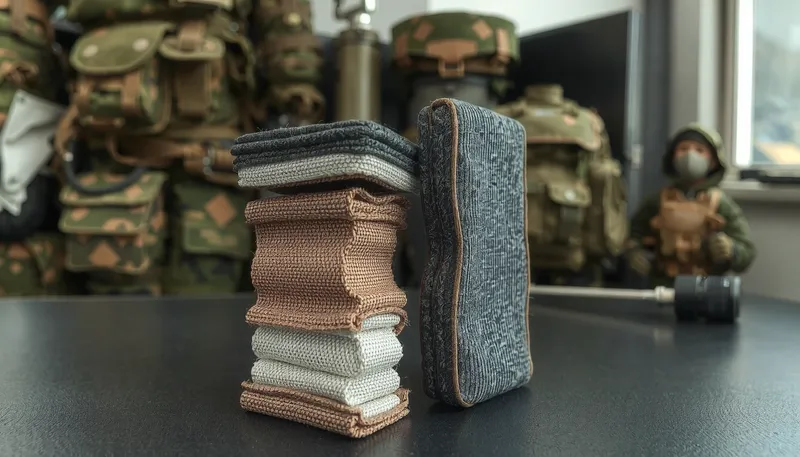
Tactical base layer fabric for mass-issue undershirts must satisfy three measurable, interdependent performance properties: moisture management (AATCC 195 wicking ≤5 seconds at 5 cm), mechanical durability (ISO 12945-2 pilling Grade ≥4, ASTM D3107 recovery ≥90%), and durability-to-cost ratio — where a Nylon/Spandex Interlock (D036 platform: 40D/34F Nylon 6, 160 g/m², OEKO-TEX 100 Class I) delivers ≥85% of Nylon 66's abrasion resistance at 40-60% lower per-yard cost, making premium polyamide over-engineering economically inefficient for base layers shielded by uniform and body armor.
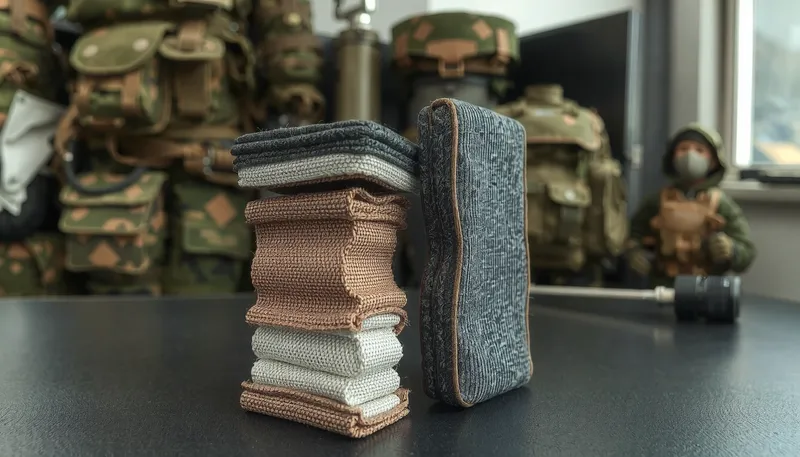
The tacticalwear fabrics procurement decision reduces to a single engineering question: at what point does incremental fiber durability stop producing incremental garment service life? For an undershirt worn beneath a combat uniform, plate carrier, and load-bearing equipment, the base layer is shielded from direct abrasion. Its primary failure modes are not catastrophic tearing — they are progressive pilling from equipment friction, elastic degradation from repeated washing (AATCC 135 dimensional stability), and moisture-management failure from fiber surface damage. Against these failure modes, a properly specified Nylon/Spandex Interlock matches Nylon 66's effective service life while reducing per-unit cost by 30-40% at procurement scales of 100-200 units.
The analysis below examines the three performance pillars of tactical base layer fabrics, quantifies the Nylon 66 vs. Nylon Interlock cost-benefit threshold, and provides a procurement specification framework anchored to verifiable ASTM/AATCC/ISO standards — not qualitative marketing ratings.
The Three Performance Pillars of Tacticalwear Fabrics
A tactical base layer fabric is defined by three interdependent, measurable performance properties: moisture management (AATCC 195 wicking ≤5 seconds at 5 cm vertical rise), mechanical durability (ISO 12945-2 pilling Grade ≥4, ASTM D3107 stretch recovery ≥90% after 50 wash cycles), and next-to-skin compatibility (flatlock seam construction per ISO 4916 Stitch Type 607, OEKO-TEX 100 Class I certification). If any one of these three properties fails, the fabric is structurally unsuitable for professional tactical use — regardless of its performance on the other two dimensions.
What Are Tacticalwear Fabrics?
Tacticalwear fabrics are the textiles used in next-to-skin, mid-layer and load-bearing military and law-enforcement garments. The base-layer subset is specified by four numbers: fiber (Nylon 6 vs Nylon 66), knit structure (interlock vs single jersey), mass (160–200 g/m²), and pilling resistance (ISO 12945-2 Grade ≥4). "Tactical" is a use context, not a fiber — the same D036 interlock can serve a tactical undershirt or a sports base layer.
| Specification | Mass-issue base layer | Outer-shell / load-bearing |
|---|---|---|
| Fiber | Nylon 6 / spandex interlock (D036) | Nylon 66 woven, ripstop or laminate |
| Mass | 160–200 g/m² | ≥200 g/m², construction-dependent |
| Pilling / abrasion | ISO 12945-2 Grade ≥4 at 2000 cycles | Abrasion per ISO 12947-2, cycle count set by the agency spec |
| Wicking | AATCC 195 ≤5 s at 5 cm | Not the primary property; water repellency is specified when required |
| Cost driver | Durability-to-cost ratio | Tensile and tear strength |
| Typical fabric cost | $4–6/yd | $8–12/yd |
The distinction matters at procurement: a specification that writes "tactical fabric" without naming fiber, structure, mass and pilling method leaves the mill free to substitute a cheaper single jersey that fails at the equipment-contact points.
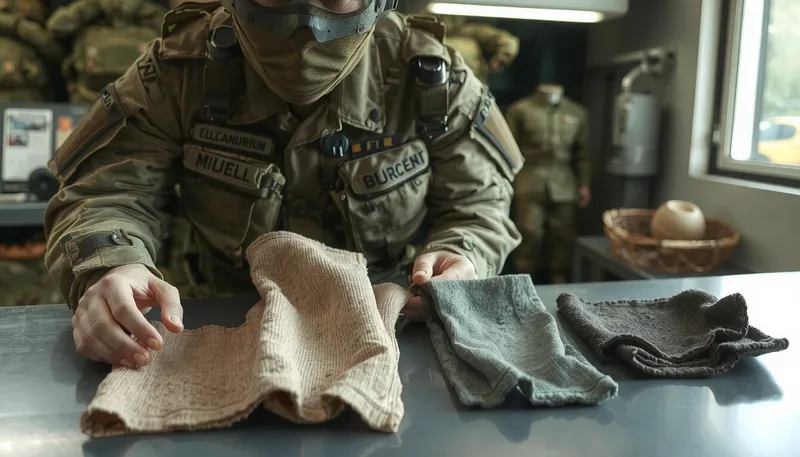
These are the three performance pillars that define an effective next-to-skin tactical garment:
- Moisture Management (AATCC 195): The primary function of a tactical base layer is to transfer perspiration from the skin to the outer fabric layer for evaporation — measured by vertical wicking rate per AATCC 195. A fabric achieving ≤5 seconds at 5 cm vertical rise prevents the cold-clammy sensation that accelerates conductive heat loss in cold-weather operations, and eliminates the moisture-accumulation mechanism that causes friction blisters and chafing under plate carriers and duty belts.
- Mechanical Durability (ISO 12945-2, ASTM D3107): The fabric must withstand continuous low-to-moderate abrasion from body armor contact points, backpack straps, and duty-belt friction — not catastrophic tearing, but progressive surface degradation. ISO 12945-2 (Martindale pilling method, 2000 cycles, Grade ≥4) validates resistance to surface fiber-ball formation. ASTM D3107 confirms elastic recovery ≥90% after 50 simulated wash-and-wear cycles (AATCC 135), ensuring the garment maintains its fit profile through a deployment cycle.
- Next-to-Skin Compatibility: Beyond mechanical performance, the fabric requires OEKO-TEX 100 Class I certification for prolonged direct skin contact, flatlock seam construction (ISO 4916 Stitch Type 607) to eliminate pressure points under armor, and a hand-feel that does not produce irritation during extended wear exceeding 12 hours. Interlock knit construction (O3C structure) provides inherent edge stability — resisting the curl and snag behavior of single jersey knits that accelerates degradation at hem and cuff edges.
These three pillars form the technical foundation of an effective tactical layering system.
Nylon 66 vs. Nylon Interlock: Quantifying the Cost-Benefit Threshold
Nylon 66 (polyhexamethylene adipamide) differs from Nylon 6 (polycaprolactam) in molecular packing density — producing tensile strength of ≥800 MPa vs. ≥700 MPa and a melting point of 255°C vs. 220°C. For tactical outer-shell applications (webbing, parachute cord, plate-carrier fabric), this differential is mechanically significant. For a base layer — shielded from direct abrasion by a combat uniform, body armor, and load-bearing equipment — Nylon 66's tensile advantage translates to a marginal increase in effective garment service life (estimated <10%) while commanding a per-yard cost premium of 40-60%. The procurement question is not which fiber is stronger — it is whether the incremental durability produces incremental service life under actual wear conditions.
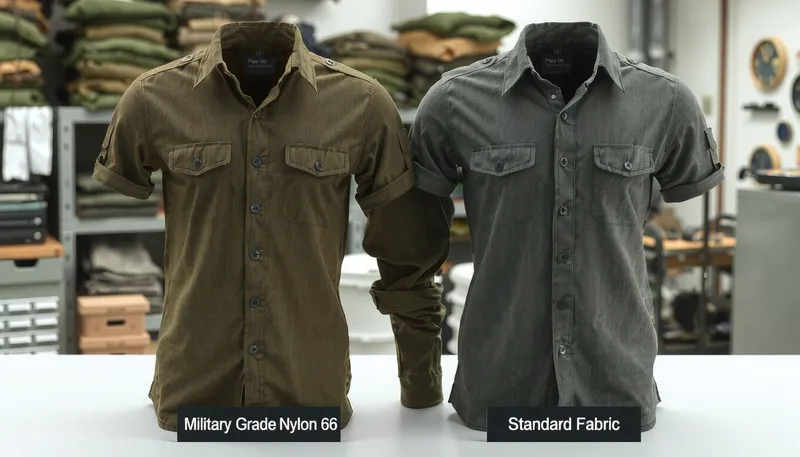
The failure modes of a tactical undershirt are not catastrophic tensile rupture — they are progressive: pilling at equipment contact points (quantified by ISO 12945-2 Martindale testing), elastic degradation from repeated laundering (ASTM D3107 recovery loss), and moisture-wicking degradation from fiber-surface abrasion (AATCC 195 wicking-time increase). Against these specific degradation vectors, a Nylon Interlock — constructed with 40D/34F Nylon 6 filaments in 36G interlock geometry (O3C structure) — achieves performance within the acceptable operational window:
| Property | Nylon 66 (Outer-Gear Grade) | Nylon Interlock D036 (Base-Layer Grade) | Delta |
|---|---|---|---|
| Tensile Strength | ≥800 MPa | ≥700 MPa | −12.5% |
| Melting Point | 255°C | 220°C | −13.7% |
| Pilling (ISO 12945-2) | Grade 4 | Grade 4 | Equivalent |
| Recovery (ASTM D3107) | ≥92% | ≥90% | −2% |
| Wicking (AATCC 195) | ≤5s | ≤5s at 5cm | Equivalent |
| Cost per Yard | $8-12 | $4-6 | −40-60% |
| OEKO-TEX 100 | Mill-dependent | Class I certified | Certified skin-safe |
The data above demonstrates a defined diminishing-returns threshold: Nylon 66's strength advantage — critical in load-bearing textile applications — becomes economically inefficient when the fabric is shielded from direct tensile stress by outer layers. A procurement decision that selects Nylon 66 for base layers is effectively paying a 40-60% premium for a property (tensile strength) that the use case does not utilize — while receiving equivalent performance on the properties that matter (pilling resistance, wicking rate, skin safety certification).
For applications where tensile strength IS the primary requirement — such as webbing, parachute cord, and plate-carrier fabric — Nylon 66's ≥800 MPa tensile strength justifies the cost premium in load-bearing textile specifications where the polymer is subjected to direct mechanical stress.
Mass-Issue Procurement: The Durability-to-Cost Optimization Model
Mass-issue tactical base layer procurement optimizes for durability-to-cost ratio — not absolute durability. At procurement scales of 100-200 units, a 30% per-unit cost reduction on a Nylon/Spandex Interlock that delivers equivalent pilling resistance (ISO 12945-2 Grade 4) and moisture-wicking performance (AATCC 195 ≤5s) to Nylon 66 translates to a four-to-five-figure budget saving without measurable field-performance degradation. The procurement objective is not to purchase the strongest polymer — it is to purchase the most efficient textile for the specific failure modes and replacement cycles of the tactical undershirt use case.
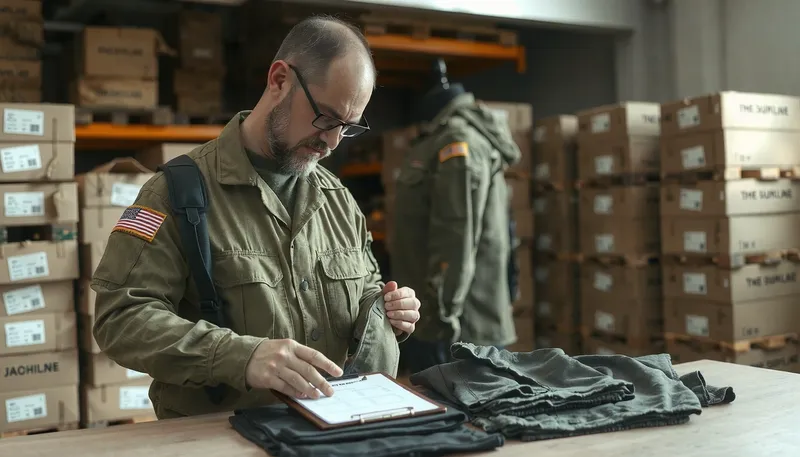
Knit construction — independent of polymer selection — is frequently the larger determinant of base-layer durability than fiber type. A double-knit interlock (O3C structure) is inherently more stable than single jersey: it resists edge curling, distributes abrasion across two connected knit faces, and provides higher stitch density without the weight penalty of heavier yarns. A single jersey in Nylon 66 will exhibit edge curl and snag propagation that an interlock in Nylon 6 will resist — meaning the knit structure, not the polymer, is the controlling variable for base-layer mechanical integrity.
The D036 Nylon Interlock platform demonstrates this principle at production scale: Nylon 40D/34F, 36G interlock knit, 160 g/m², 140 cm finished width, OEKO-TEX 100 Class I certified. Its "One-Open-One-Close" knit geometry produces a stable, canvas-like hand-feel that approximates woven-shirt durability while retaining the four-way stretch and recovery of a knit construction. Under ISO 12945-2 Martindale testing, D036 achieves pilling Grade 4 after 2000 cycles. Under AATCC 195, vertical wicking reaches 5 cm in ≤5 seconds. These performance metrics place D036 within the operational envelope for tactical undershirt specifications — at a per-yard cost 40-60% below Nylon 66 equivalents.
For procurement teams evaluating D036 against specific agency specifications, the platform supports: custom blend ratios (Nylon/Spandex from 92/8 to 85/15), antimicrobial treatments (ISO 20743), and batch-level AATCC/ASTM test reporting for compliance documentation.
Tacticalwear Fabrics: Quantitative Specification Comparison
Tactical base layer fabric selection is governed by four measurable parameters: moisture wicking rate (AATCC 195, seconds to 5 cm), pilling resistance (ISO 12945-2, Martindale cycles to Grade 4), dimensional stability after laundering (AATCC 135, % shrinkage), and procurement cost per yard. The comparison below maps Merino Wool, Polyester, Nylon 66, and Nylon/Spandex Interlock (D036) against these parameters — plus operational suitability factors — to identify the optimal mass-issue specification.
| Parameter | Merino Wool | Polyester | Nylon 66 | Nylon/Spandex Interlock (D036) |
|---|---|---|---|---|
| Fiber Composition | 100% Merino, 17-19µ | 100% PET | 100% Nylon 66 | Nylon 40D/34F + Spandex 20D |
| Construction | Single jersey, 190-220 GSM | Single jersey, 140-180 GSM | Single jersey, 160-200 GSM | 36G Interlock (O3C), 160 GSM |
| Wicking (AATCC 195) | ≤8s at 5cm | ≤3s at 5cm | ≤5s at 5cm | ≤5s at 5cm |
| Pilling (ISO 12945-2) | Grade 2-3 | Grade 2-3 | Grade 4 | Grade 4 |
| Stretch Recovery (ASTM D3107) | ≥85% | ≥80% | ≥92% | ≥90% |
| Shrinkage (AATCC 135) | 3-5% | ≤2% | ≤2% | ≤2% |
| OEKO-TEX 100 | Variable | Class II | Mill-dependent | Class I (skin-contact certified) |
| Cost per Yard | $12-18 | $2-4 | $8-12 | $4-6 |
| Best Application | Cold-weather, multi-day ops | Budget training, low-intensity | Outer gear, load-bearing | Mass-issue tactical undershirts |
| Not Recommended For | High-abrasion, hot-humid ops | Sustained equipment friction | Mass procurement (cost-inefficient) | Extreme direct abrasion (outer-shell use) |
A Nylon/Spandex Interlock base layer functions as the foundational moisture-management and comfort layer within a tactical clothing system — worn beneath mid-layer insulation and outer-shell protection. For military/law enforcement procurement requiring flame-resistant (FR) base layers, note that FR treatment modifies the cost and wicking parameters documented above and requires separate specification — with per-yard costs typically 1.5-2× the non-FR baseline and potential AATCC 195 wicking-time increases of 1-3 seconds depending on FR chemistry.
Frequently Asked Questions (FAQ)
1. Why not use 100% polyester for mass-issue tactical undershirts?
Polyester (PET) offers the lowest per-yard cost ($2-4) and fastest wicking rate (AATCC 195 ≤3s at 5cm), but its pilling resistance under sustained equipment friction is the limiting factor. Under ISO 12945-2 Martindale testing, standard PET single jersey typically achieves Grade 2-3 — surface fiber balls form within 500-1000 cycles — vs. Grade 4 for Nylon Interlock. For mass-issue undershirts that must maintain professional appearance and fabric integrity through a deployment cycle, polyester's pilling degradation drives higher replacement frequency, eroding the initial cost advantage. Nylon Interlock's Grade 4 pilling resistance extends service life sufficiently to produce lower total cost of ownership despite higher per-unit procurement cost.
2. Is Nylon 66 ever the correct specification for a base layer?
Nylon 66 is the correct specification when the base layer is subjected to direct, high-intensity abrasion without outer-layer shielding — a rare operational profile. Examples include: base layers worn as standalone garments during maritime interdiction, rappelling operations where the undershirt contacts ropes/equipment directly, or extended operations where outer layers are removed and the base layer becomes the primary garment. In these edge cases, Nylon 66's tensile advantage (≥800 MPa vs. ≥700 MPa for Nylon 6) justifies the cost premium. For standard tactical operations where the base layer remains shielded by uniform and armor, Nylon Interlock delivers equivalent effective performance at 40-60% lower cost.
3. How does interlock knit construction improve base layer durability?
Interlock (O3C structure) is a double-knit geometry where two rib structures are knitted face-to-face and interlocked into a single fabric. This produces three durability advantages over single jersey: (1) Edge Stability — the balanced knit structure prevents edge curl, eliminating the primary snag-propagation mechanism of single jersey; (2) Distributed Abrasion — friction is dispersed across two connected knit faces rather than concentrated on a single surface; (3) Higher Stitch Density — 36G interlock achieves 28 needles per inch vs. 18-22 for standard single jersey, producing a tighter, more abrasion-resistant surface without the weight penalty of heavier yarns. These structural properties make interlock the controlling variable for base-layer mechanical integrity — independent of polymer selection.
4. How critical is moisture wicking in tactical operations?
Moisture management is the primary safety function of a tactical base layer — not a comfort feature. Fabric that retains moisture against skin accelerates conductive heat loss in cold environments (water conducts heat 25× faster than air), directly increasing hypothermia risk during static operations. In hot environments, accumulated moisture softens the stratum corneum (skin's outer layer), increasing friction coefficient and producing friction blisters under plate carriers within 2-4 hours of sustained activity. AATCC 195 wicking rate ≤5 seconds at 5 cm vertical rise is the minimum operational threshold — fabrics exceeding this benchmark maintain a dry skin interface under moderate exertion (4-6 METs) and should be rejected for tactical specification.
5. Why is cotton unsuitable for tactical base layers?
Cotton's moisture regain of 8.5% — vs. 4.5% for Nylon and 0.4% for Polyester — means it absorbs and retains perspiration rather than transporting it to the outer fabric surface for evaporation. Once saturated, cotton loses all insulative value, increases in weight by 40-60%, and dries at approximately 1/4 the rate of nylon. In cold conditions, wet cotton against skin accelerates conductive heat loss to dangerous levels during periods of low metabolic output (static security, observation posts). In hot conditions, saturated cotton increases chafing and restricts evaporative cooling. Cotton fails the primary mission of a base layer — maintaining a dry skin interface — and has no specification in any tactical procurement document.
Ready to evaluate D036 Nylon Interlock for your tacticalwear fabrics procurement?
- Request a 5-yard technical sample (free, shipped within 3 days)
- Download ISO 12945-2, AATCC 195, and ASTM D3107 test reports (PDF)
- Speak with our textile engineer for blend-ratio and knit-gauge specification guidance
🔗 Related Fabrics
This article covers tacticalwear fabrics for mass-issue base layers — D036 Nylon Interlock durability-to-cost optimization with ASTM/AATCC/ISO validation, forming the tactical base layer technology matrix:
- D036 Virgin Nylon — Econyl Alternative — D036 platform Nylon 6 vs Nylon 66 performance comparison
- Fabric Pilling Test Standards Explained — ISO 12945-2 Martindale pilling method and the Grade 4–5 rating scale
- Fabric Elongation & Recovery Test — ASTM D3107 — Stretch recovery validation for tactical base layer durability
Written by Wenruo
Textile Engineer, Forall Lab