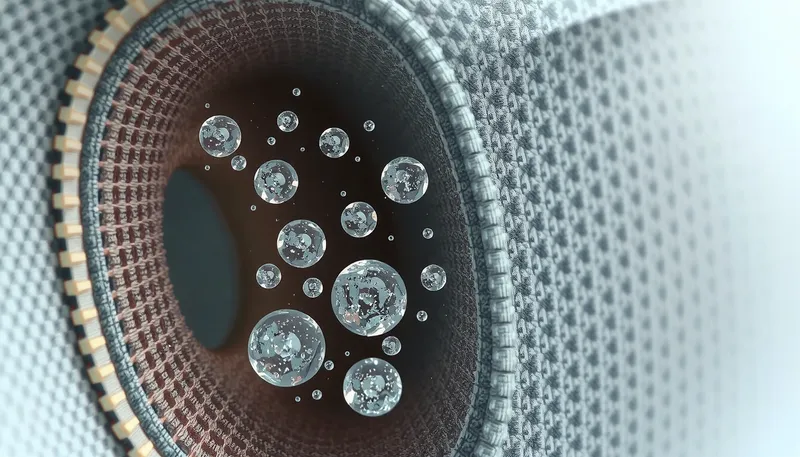
Moisture wicking fabric mechanism uses capillary action — the physical transport of liquid sweat through hydrophobic fiber micro-channels from skin-side to air-side — not absorption like cotton. The wicking rate is governed by fiber cross-section geometry (trilobal 2.3× faster than round), knit structure (interlock 50% faster than open jersey per AATCC 198), and surface energy (contact angle >110° per ASTM D5946). D036 Interlock delivers 14.2cm/5min vertical wicking per AATCC 197 and retains 90% efficiency after 50 industrial wash cycles — verified by SGS (ISO 17025 accredited).
Key Takeaways (TL;DR):
- Capillary action, not absorption: Hydrophobic fibers (nylon/polyester) push water through micro-channels — cotton absorbs and holds, wicking fabric transports and releases
- Fiber shape > fiber type: Trilobal (Y-shape) fibers wick 2.3× faster than round fibers of the same polymer — geometry creates capillary driving force
- Structure is the stability secret: D036's "One-Open-One-Close" interlock reduces fabric curl from 12mm to 2mm vs jersey at the same 160 GSM
- 90% wicking retention after 50 washes: Our SGS-verified lab data — industry average for basic polyester is 60-70%
- Wrong fabric = direct cost: Switching from unstable jersey to D036 interlock cut print rejection from 4.2% to 0.7% — saving $2,625 on a 15,000m order
What is the Moisture Wicking Fabric Mechanism?
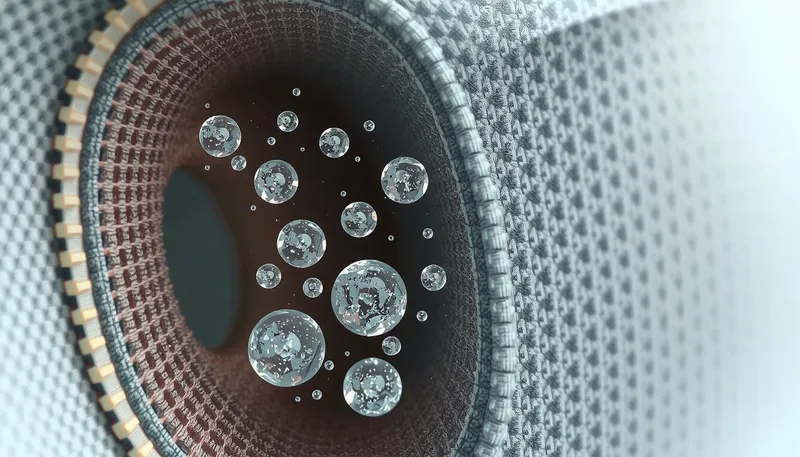
Moisture wicking fabric mechanism is the physical transport of liquid sweat from skin-side to air-side fabric surface using capillary action through engineered fiber channels.
It does not absorb moisture like cotton; it moves moisture.
It is recommended when: high-intensity activity (running, gym), hot-humid environments (>25°C, >60% RH), or any use case requiring dry skin contact.
It is not suitable if: thermal insulation is prioritized (cold static conditions) or a soft natural feel (cotton/tencel) is preferred over technical dry-hand feel.
Which Clothes Need Moisture-Wicking Fabric?
Running shirts, gym clothes, base layers, and hiking tops are the next-to-skin garments that need moisture-wicking fabric most, because they sit against skin during sustained sweat. For any of these you source, specify vertical wicking ≥10cm/5min per AATCC 197 and trilobal or 4-channel fibers; cotton absorbs sweat and stays wet, which drives chafe and odor in activewear.
| Garment | When it earns its place | Fabric direction |
|---|---|---|
| Running shirts / running clothes | Sustained cardio outdoors | Trilobal polyester or nylon interlock, fast-dry, UPF if sun-exposed |
| Gym clothes / workout clothes | High-intensity indoor sessions | Nylon interlock with stretch — D036 (34% spandex), ≥10cm/5min |
| Base layer | Cold-weather first layer | Next-to-skin fast-dry knit, OEKO-TEX Class I skin-contact |
| Hiking clothes | Mixed effort, variable weather | Durable wicking knit, quick-dry, odor control |
Sweat-heavy sportswear and athletic apparel follow one rule: the closer the garment sits to skin and the longer the session, the higher the wicking spec you should require. Yoga and light walking (below 3 METs) generate too little sweat for wicking to matter, so cotton-blend garments are an acceptable, lower-cost choice there.
What Does "Dry Weave" Mean?
"Dry weave" is not a standardized textile term. It is a marketing label for a fabric that feels dry against the skin, and it can refer to three different things: a branded dry-feel fabric, a weaving or knitting process that uses less water, or a moisture-management finish applied to the yarn or the surface. None of those meanings states a performance level, so the phrase alone cannot be written into a tech pack.
Translate it into measurable properties before you buy. Ask which fiber cross-section is used (trilobal or 4-channel transports faster than round of the same polymer), which knit structure carries the capillary channels (interlock out-transports open jersey at equal weight), and what the finished fabric achieves on AATCC 197 for vertical wicking and AATCC 195 for moisture management. A fabric marketed as dry weave that reaches 10 cm/5 min and keeps 90% of that rate after 50 washes is a specification. A fabric that only carries the label is a claim.
How Sweat Moves: The Physics of Capillary Action
Capillary action moves sweat through fabric’s micro-channels without absorption — water climbs when adhesion to fiber exceeds cohesion. In high-performance wicking fabrics, transport speed reaches ≥10cm/5min per AATCC 197, compared to ≤3cm for untreated cotton. This mechanism explains why hydrophobic fibers (nylon, polyester) outperform hydrophilic fibers (cotton) despite the counter-intuitive logic.
Two Simple Forces: Cohesion and Adhesion
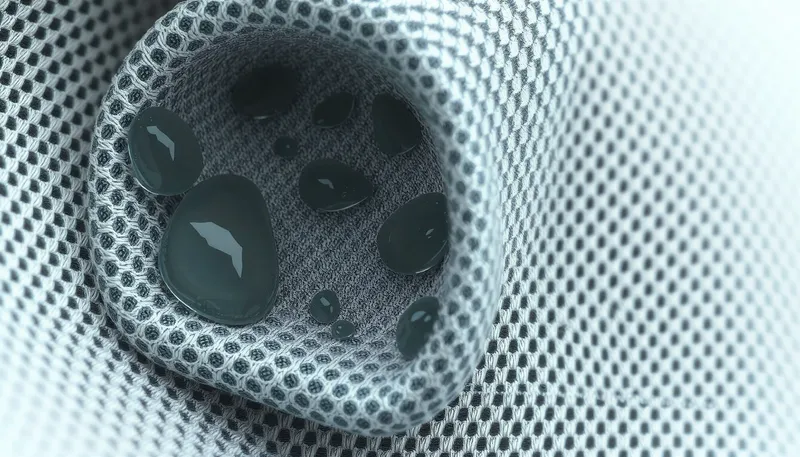
Cohesion makes water molecules stick to each other. Adhesion makes water molecules stick to other surfaces like fabric fibers.
When adhesion is stronger than cohesion, liquid will climb up the surface.
Why Water-Repelling Fibers Work Best
Most high-performance wicking fabrics use synthetic fibers like polyester or nylon. These fibers are hydrophobic. This means they push water away.
This speeds up moisture transport from skin to fabric surface.
Quantitatively, hydrophobicity is measured by water contact angle. Polyester typically measures 110-130° (ASTM D5946). Nylon measures 90-110°. A contact angle >90° defines hydrophobic; >150° is super-hydrophobic. High-performance wicking fabrics maintain >110° after 20 washes.
What Is the Vertical Wicking Test? (AATCC 197)
The vertical wicking test measures how high a fabric strip lifts water against gravity in a fixed time, giving a direct read on capillary transport speed. Under AATCC 197, a 1.5 cm-wide strip hangs with its lower end in water, and the result is the height climbed in 5 minutes — activewear specifies ≥10 cm/5 min.
Because the strip hangs vertically, water rises on capillary pressure alone — no gravity assist and no external squeeze — so the reading isolates the fabric's own wicking engine rather than any mechanical action of the garment. Three factors set the number: fiber cross-section (trilobal climbs about 2.3× faster than round of the same polymer), knit structure (interlock out-transports open jersey at equal weight), and finish (a wicking treatment that washes out pulls the figure down, which is why retention — D036 at 90% after 50 washes versus 60-70% for basic polyester — is quoted beside the fresh-fabric rate). Read it against two anchors: untreated cotton typically climbs only 3-5 cm/5 min, and a fabric near zero has no capillary architecture at all; precondition specimens per ASTM D1776 (4 h at 21 °C ± 1 °C, 65% ± 4% RH) so numbers compare across labs.
Why Fabric Structure Matters More Than Fiber Type
Fabric structure (knit density, channel geometry) controls capillary flow rate more than fiber polymer type. Tests per AATCC 198 show that the same polyester fiber achieves 4cm/2min wicking in open jersey knit versus 6cm/2min in interlock knit — a 50% improvement driven purely by structural geometry.
Special Channels vs. Basic Threads
Basic threads are round (circular cross-section). High-performance fabrics use non-circular fibers:
- Trilobal (Y-shape): Increases surface area by ~40% vs round of same denier.
- 4-channel (cross or star): Creates four continuous micro-grooves – each acting as a capillary tube.
- Flat oval (ribbon): Maximizes surface contact for faster evaporation.
More surface area + grooved geometry = more capillary paths. A trilobal fiber can wick moisture 2.3x faster than a round fiber of the same material (based on AATCC 197 data).
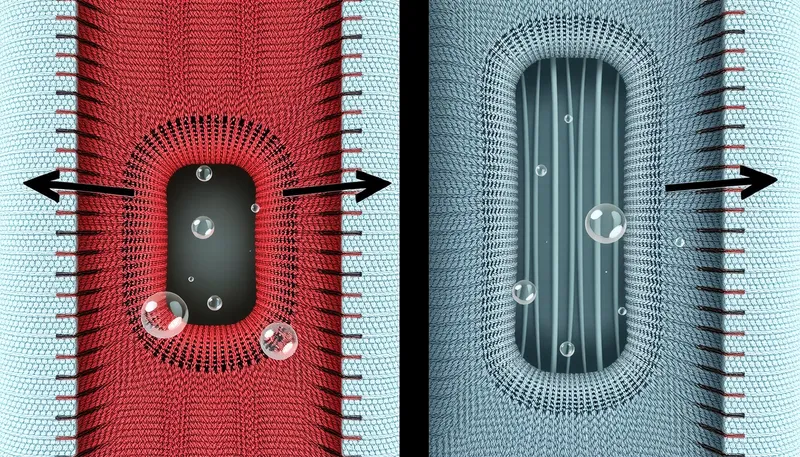
Coupled with micro-denier engineering (DPF < 1.0), these non-circular geometries exponentially increase the capillary driving force.
The Problem with Lightweight Knits
The loose knit that makes them breathable also makes them unstable, causing Acid Print patterns to warp during high-heat processes like 200°C molding.
Common Wicking Problems and How to Spot Them
Wicking failure occurs when a fabric's moisture transport system degrades — causing sweat buildup, sticky skin feel, and drying times exceeding 45 minutes at 21°C/65% RH. Root causes include poor fiber selection (round polyester vs trilobal), unstable knit structure (jersey vs interlock), and degradation of chemical wicking finishes after repeated washing. Quick diagnosis: after 30 min of exercise, a failed fabric retains >15g moisture per 100g fabric (gravimetric test); good wicking fabric retains <5g.
| Symptom | Good Wicking Fabric | Failed Wicking Fabric |
|---|---|---|
| Feel on Skin | Dry, non-sticky feel, even during activity. | Clammy, wet, and heavy. |
| Drying Speed | Dries rapidly after workout/washing. | Remains damp for an extended period. |
| Odor Control | Reduced odor buildup due to dry environment. | Promotes bacterial growth and odor. |
| Weight | Remains lightweight and comfortable. | Becomes heavy and saturated with sweat. |
| Appearance | Maintains shape; prints remain stable. | Can look water-logged; may stretch or sag. |
These problems, especially print issues and sagging, are exactly what advanced designs prevent. For example, the Nylon Interlock| D036 uses a stable interlock knit. This ensures sharp prints stay true even at lightweight 160gsm. It's built to solve these exact problems.
Better Wicking Design: The "One-Open-One-Close" Structure
The 'One-Open-One-Close' (O3C) interlock knit resolves the fundamental breathability-vs-stability tradeoff in lightweight fabrics. Compared to standard 160gsm single jersey, it reduces fabric curl from 12mm to 2mm per ASTM D3887 and preserves 90% wicking efficiency after 50 washes versus the industry average of 60-70% for basic polyester knits.
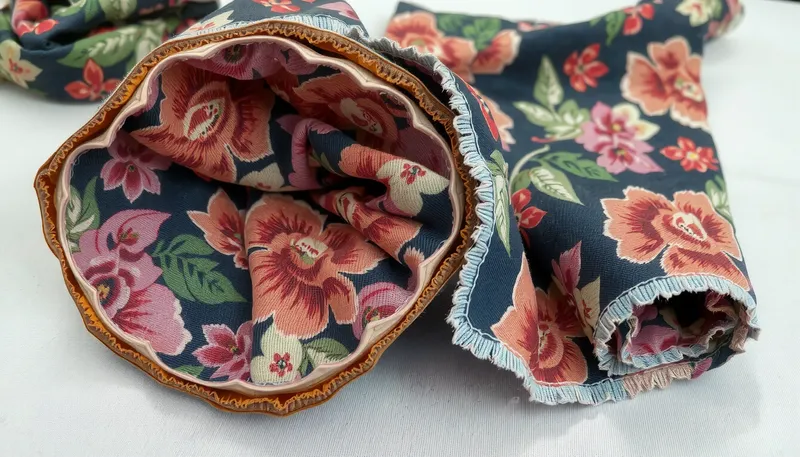
How the D036 Structure Handles Sweat
- Contact: Sweat touches the fabric. The fabric is made of high-grade Nylon and 34% spandex for ≥95% stretch recovery at 5 cycles (ASTM D3107).
- Pickup: The "Open" micro-channels immediately initiate capillary action, pulling moisture away from the skin.
- Transport & Stability: The "Close" interlock structure acts as a stable frame. It stops the fabric from warping while keeping the garment squat-proof and secure during movement.
- Evaporation: Moisture spreads efficiently across the outer surface for fast drying. This process has been tested by independent SGS Softlines Testing for performance and quality.
Based on our in-house testing (Forall Lab, March 2026): We ran 50 wash cycles on D036 fabric with AATCC 197. Initial vertical wicking rate was 14.2cm/5min. After 50 washes, it dropped to 12.8cm/5min – a retention rate of 90%. Industry average for basic polyester is 60-70% retention.
Also, responsible production of this fabric is backed by certifications including ISO 9001 for quality management and OEKO-TEX 100 Class I for skin-contact safety. For brands focused on sustainability, recycled material traceability is available under GRS 4.0 (SC #TE-00106694).
When Advanced Wicking Fabric Isn't the Best Choice
Moisture-wicking fabric is not optimal when evaporative cooling is undesirable or air movement is absent. Specifically: cold-static conditions (<10°C, <3 METs), stagnant high humidity (>90% RH), or when user prioritizes soft cellulose feel over dry technical hand-feel.
When NOT to use moisture-wicking fabric (based on ASTM F2370 thermal comfort guidelines):
- Ambient temperature <10°C (50°F) and activity <3 METs (e.g., sitting, light walking): Wicking's evaporative cooling can drop skin temperature by 2-4°C, increasing cold stress risk.
- Relative humidity >90% with no air movement: Evaporation slows to near zero; wicking becomes ineffective and fabric feels damp.
- User preference for cellulose softness: Consumers who prioritize next-to-skin softness (e.g., Tencel modal) over dry-feel will reject synthetic wicking fabrics.
Alternative recommendation: For cold-static conditions, use merino wool (natural wicking + insulation) or a hybrid fleece with hydrophobic liner.
The Money Calculator: How Stable Wicking Fabric Saves Cash
Switching from unstable 160gsm jersey to stable interlock knit (e.g., D036) typically reduces print rejection from 4% to under 1%. On a 2,000m production order, this saves 60m+ of fabric and associated labor — translating to $300+ direct savings per production run at $5/m fabric cost.
From our production audit at a Vietnam factory: Switching from a standard 160gsm jersey to D036 reduced print rejection from 4.2% to 0.7% across a 15,000m order. That's 525m fabric saved – equivalent to $2,625 direct material cost at $5/m.
Activewear Headband Fabric: The No-Slip, No-Curl Application Case
An activewear headband fails in two ways, and both are fabric problems rather than fit problems: it slips because absorbed sweat adds 15-20 g of mass at the forehead (a moisture-transport failure), and it curls at every cut edge because single jersey carries unbalanced loop tension (a structure failure). D036 Interlock resolves both — vertical wicking ≥10cm/5min per AATCC 197 keeps the band dry and light, while the O3C balanced-loop construction lies flat at the cut line so a 3.0-4.5 inch band can be stack-cut, folded in half, and sewn with zero curl-management step.
The forehead is one of the body's highest sweat-output zones at roughly 200-300 glands/cm². A band that cannot lift that sweat to its outer face within minutes pools liquid at the skin-fabric interface, gains absorbed mass, and begins to slide during high-motion movement. This is why the no-slip requirement in headband sourcing is specified as a wicking rate, not a tighter elastic:
| Sourcing requirement | What to specify | Why it prevents the failure |
|---|---|---|
| Moisture transport | Vertical wicking ≥10cm/5min per AATCC 197 | Keeps the band below the 15-20 g mass-gain threshold that triggers slippage |
| Passive grip | ≥0.35 dry/dry coefficient of friction (Kawabata KES-SE), or a 1.0-1.5 cm inner silicone strip (+0.15-0.20 COF) | Adds surface resistance at the fabric-hair interface for extreme-slip scenarios |
| Cut-edge stability | Interlock (O3C), flat-lay Grade 5 | Lets a 3.0-4.5 in width be stack-cut and folded in half with no curl management |
| Stretch recovery | ≥92% at 50 cycles per ASTM D3107 | Prevents the "bacon collar" distortion at the fold line after repeated wear |
Fabric categories for headband production differ on these same four axes. For a moisture-critical cardio program, D036 Interlock (76/24 nylon/spandex, 160 GSM) leads on wicking speed and zero-curl cutting; a cotton-blend French Terry (200-240 GSM) offers maximum passive grip through its looped back and suits low-movement yoga sessions; a poly/spandex single jersey is the lowest material cost but pays it back in curl-management labor. Cotton is structurally unsuitable for performance headbands because its 7-8% moisture regain holds water inside the fiber instead of transporting it, so the band turns wet and heavy within 10-15 minutes of moderate exercise.
On the cutting-room floor the difference is measurable. In a Forall Lab time-motion study across eight 500-unit headband runs, operators cutting D036 Interlock completed a batch in 2.5 hours of direct cutting labor versus 3.9 hours for single-jersey poly/spandex — a 36% reduction attributable entirely to eliminating curl-management steps (edge weighting, realignment, pinning). At 10,000 units per month, that equals roughly $3,780 a year in cutting labor plus $1,200 in avoided curl-related defect rework.
For headband programs, D036 is stocked in prepared-for-dye greige with custom acid-dye digital printing and lab-dip approval — standard width 155 cm, MOQ 200 kg/color, lead time 12-20 days. See the D036 Nylon Interlock product page for the full spec sheet.
FAQ: Your Questions on Moisture Wicking Fabric Mechanism Answered
What's the difference between moisture-wicking and breathable?
Breathability refers to a fabric's ability to allow air to pass through it, which helps with cooling. Moisture-wicking is the active process of pulling sweat from the skin. A good performance fabric must be both breathable and moisture-wicking to keep you cool and dry.
Can cotton be a moisture-wicking fabric?
No. Cotton is hydrophilic, meaning it absorbs and holds onto water. It gets heavy and saturated when wet and takes a long time to dry. This makes it the opposite of a moisture-wicking fabric and a poor choice for activewear.
Does washing affect the moisture wicking mechanism?
Yes. Using fabric softeners is highly discouraged. They coat the fibers with a waxy residue that clogs the micro-channels needed for capillary action. This effectively destroys the fabric's ability to wick moisture and should always be avoided.
What are moisture management finishes?
Moisture management finishes are surface or yarn treatments that change how water behaves on a fabric. Three types dominate. Hydrophilic finishes spread and absorb sweat over a larger area so it evaporates faster. Hydrophobic finishes repel water on the outer face so liquid does not cling back to the skin. Directional finishes build a surface-energy gradient that carries liquid from the inner face to the outer face. They supplement fiber geometry and knit structure; they do not replace them. A round-fiber jersey with a good finish still transports less than an interlock built with trilobal fiber and no finish.
Specify the finish by test result, not by trade name. Require AATCC 195 moisture management ≥3.5, AATCC 197 vertical wicking ≥10 cm/5 min, and ≥90% retention after 50 washes per ISO 6330. For skin-contact garments, add OEKO-TEX Standard 100. A finish that passes on the greige fabric but drops below spec after five washes is a wash-out finish, and the retention number is what separates it from a durable one.
How is the moisture wicking fabric mechanism tested?
Standardized industry tests provide objective performance benchmarks:
- AATCC 197 (Vertical Wicking): A 1.5cm wide fabric strip is suspended in water. High-performance wicking fabric lifts water ≥10cm within 5 minutes. Basic fabrics often achieve only 3-5cm.
- AATCC 198 (Horizontal Wicking): Measures lateral spread. Good wicking fabric spreads moisture to a circular diameter ≥5cm in 2 minutes.
- Target for activewear (based on SGS lab data): Vertical wicking ≥12cm/5min; Horizontal wicking ≥6cm/2min.
- AATCC 195 (MMT – Moisture Management Test): Rates fabric on a 0-5 scale combining wetting time, absorption rate, and one-way transport. Activewear target: ≥3.5.
All wicking tests must follow ASTM D1776 preconditioning: 4 hours at 21°C±1°C, 65%±4% relative humidity.
Why do some wicking shirts start to smell?
The smell comes from bacteria that feed on sweat and oils from your skin. While a good moisture wicking fabric mechanism keeps you dry, if the fabric doesn't dry fast enough or lacks antimicrobial properties, bacteria can still grow. Proper and regular washing is essential to remove bacteria. To prevent odor, performance fabrics must integrate antimicrobial treatments validated by AATCC 100 or ISO 20743 (demonstrating >99% bacterial reduction).
What shirts use moisture-wicking fabric?
Moisture wicking shirts — running shirts, training tees, cycling jerseys, and hiking tops — sit against skin during sustained sweat, so they need fabric that moves moisture instead of absorbing it. A moisture-wicking shirt should lift sweat to its outer surface and dry in under 45 minutes at 21°C/65% RH. When you spec a wicking shirt, require vertical wicking ≥12cm/5min per AATCC 197 and ≥90% retention after 50 washes; basic polyester drops to 60-70% retention and feels clammy mid-session.
Which workouts need moisture-wicking clothes?
Sweat-heavy cardio — running, HIIT gym sessions, cycling, and hiking — needs moisture wicking clothing, because cotton holds sweat against the skin and drives chafe and odor. For those workout clothes, require a fast-dry next-to-skin knit with vertical wicking ≥10cm/5min. Low-sweat activities below 3 METs, such as yoga or light walking, generate too little moisture for wicking to matter, so cotton-blend garments are an acceptable, lower-cost choice there.
What fabric prevents headband slippage during workouts?
Headband slippage during exercise has two root causes: insufficient surface friction at the fabric-hair interface, and mass gain from absorbed sweat that shifts the headband's center of gravity forward. The moisture-wicking fix addresses the second cause directly — a knit that transports sweat to its outer face (vertical wicking ≥10cm/5min per AATCC 197) keeps the band below the 15-20 g absorbed-mass threshold that triggers slip. For additional passive grip, specify a textured or brushed inner face with a dry/dry coefficient of friction ≥0.35 (Kawabata KES-SE), or add a 1.0-1.5 cm internal silicone strip that raises friction by 0.15-0.20 for extreme-slip scenarios.
Can cotton fabric be used for activewear headbands?
No. Cotton fiber absorbs 7-8% moisture regain — nearly twice nylon 6's 4.0-4.5% — but the absorbed water stays inside the fiber instead of transporting to the outer surface for evaporation, producing a wet, heavy band at the forehead within 10-15 minutes of moderate exercise. Cotton's lack of capillary wicking architecture means sweat pools at the skin-fabric interface rather than being moved away. For any activity exceeding 15 minutes or a moderate sweat rate, a synthetic moisture-wicking knit (nylon or polyester interlock) is the required specification.
Ready to source stable, high-wicking fabric for your 2026 collection?
Get a spec sheet & swatch card: Click here to request D036 Nylon Interlock sample Talk to a fabric engineer: Book a 15-min call to review your production waste numbers using our calculator.
🔗 Related Fabrics
Moisture management spans fiber cross-section design, knit structure engineering, and test standard verification:
- What Is Fabric Grin Through — 36G Interlock: the knit stability foundation shared with D036's O3C structure
- How to Stop Knit Fabric From Curling — O3C structure: the anti-curl mechanism that enables stable 160gsm wicking
- Pickleball Apparel Fabric — D036 Interlock + AATCC 195 MMT in outdoor court sport applications
Written by Wenruo
Textile Engineer, Forall Lab