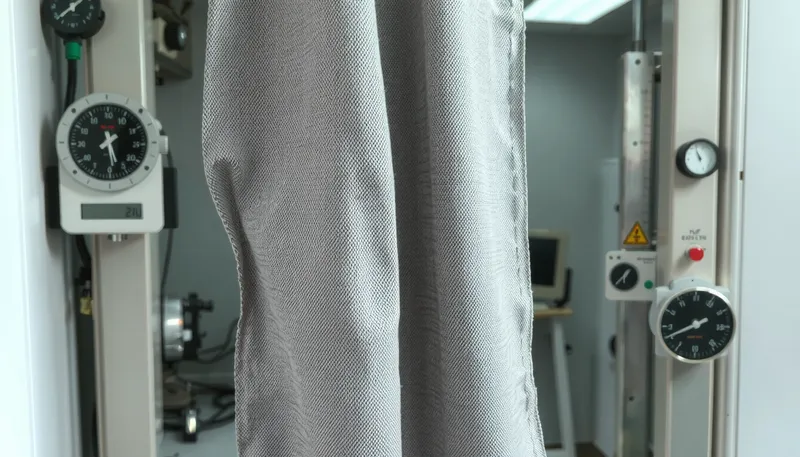
Activewear fabric bursting strength is the pressure — measured in kilopascals (kPa) — a fabric withstands before rupturing under multi-directional stress, the exact force leggings and compression tops face at every squat and lunge. Tested to ISO 13938, it is the single most reliable predictor of whether a garment survives intense wear or "blows out" at the seams — factory-floor shorthand for a seam burst, blowout, or fabric rupture under load.
A weak bursting strength is usually overlooked during sourcing, and it is the root cause of the failures that eat a brand's margin: seam bursts, stitches that pop during fitting, and whole batches rejected for quality.
Key Takeaways
- The ISO 13938 bursting strength test simulates how fabric resists pressure from all sides like real-world activewear does.
- Interlock fabric (also known as Double Jersey) is stronger than single jersey. Its far higher bursting strength prevents popping seams.
- Interlock is a stable, non-curling fabric — FORALLTEX's D036 interlock is built for exactly this. It cuts fabric waste and lead times.
- High bursting strength means fewer quality rejections, which lowers the total cost per approved garment.
What is the Fabric Bursting Strength Test (ISO 13938)?
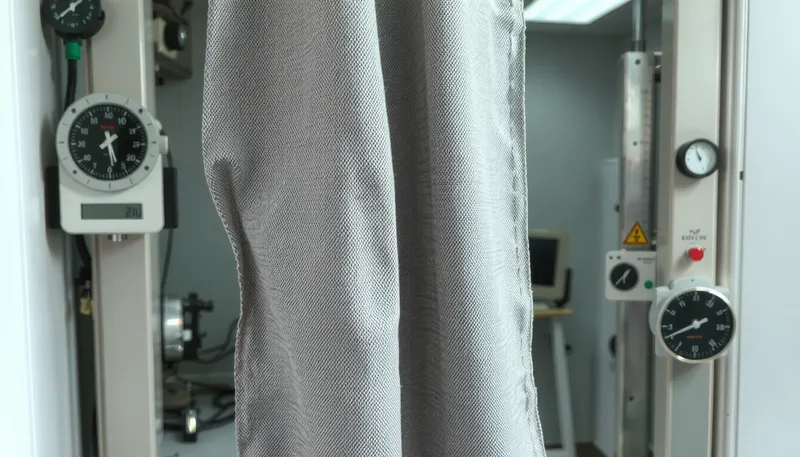
The ISO 13938 bursting strength test measures the pressure (in kPa) required to rupture a fabric stretched over an expanding rubber diaphragm — replicating the multi-directional stress a garment faces in wear, unlike a single-axis tensile pull test. Activewear fabric experiences stress from many directions at once: a knee presses outward, a seat stretches downward, and seams pull sideways. A standard pull test measures only one axis, so it misses the real failure mode.
The steps are straightforward. A fabric sample is clamped over a flexible rubber diaphragm. Pressure is then applied through a hydraulic fluid (Part 1) or compressed air (Part 2), forcing the diaphragm outward against the fabric. The pressure at which the fabric ruptures — recorded in kilopascals (kPa) — is its bursting strength. Testing to ISO 13938 keeps results in your Tech Pack identical and comparable across suppliers, as described in the fabric bursting strength test procedure.
ISO 13938 has two parts, and the difference matters when writing a Tech Pack:
- ISO 13938-1 (hydraulic): constant-rate fluid pressure — the reference method for most apparel
- ISO 13938-2 (pneumatic): compressed-air pressure — comparable results up to roughly 800 kPa
- ASTM D3786 (North American equivalent): the diaphragm burst test most US brands cite
Note: ISO 13938-1 is the default in most Tech Packs; specify Part 2 only if your lab uses a pneumatic tester.
What is ISO 13938-1 / -2?
ISO 13938-1 and ISO 13938-2 are the two parts of the ISO 13938 series "Textiles — Bursting properties of fabrics": Part 1 specifies the hydraulic (constant-rate fluid) method, Part 2 the pneumatic (compressed-air) method, both for determining bursting strength and bursting distension.
The current second editions — ISO 13938-1:2019 and ISO 13938-2 — replaced the 1999 versions, so a 2026 Tech Pack should cite the 2019 part, not the withdrawn one. European buyers also meet the same test written as EN ISO 13938-1 or EN ISO 13938-2 — the CEN adoption of the identical ISO text, and the designation printed on EU lab reports. Only the prefix differs; specimen, conditioning, and kPa results do not change. US Tech Packs instead cite ASTM D3786, the diaphragm burst method described above.
Fabric Structure is Non-Negotiable: Why Interlock Outperforms Single Jersey
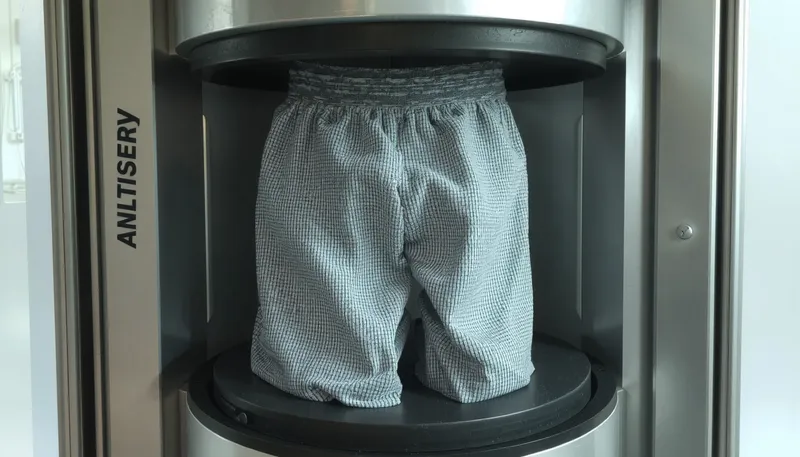
Knit structure — not fiber alone — is what sets a fabric's bursting strength, because the loop arrangement determines how load is distributed. Your choice of knit structure directly determines how long a garment lasts. For high-stress activewear, interlock beats single jersey hands down.
Single Jersey Weaknesses
Single jersey uses one set of needles to form a simple loop structure. On the factory floor this creates two problems. First, the structure is weak under multi-directional stress, so its bursting strength runs low — and a garment is more likely to blow out at the seams (the industry's shorthand for a burst or rupture under load). Second, single jersey curls at the edges, a defect the cutting room calls potato-chip fabric or roll-up edges. This curl wastes material, forces cutting teams to work slower, and stretches lead time.
Interlock (Double Jersey) Strengths
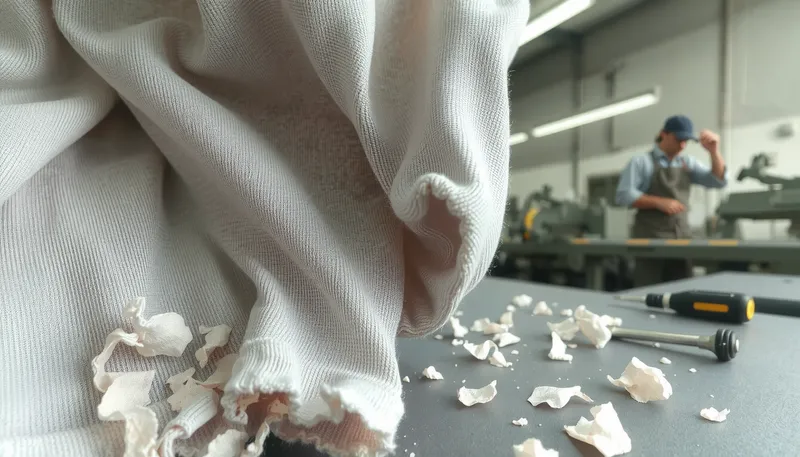
Interlock fabric is classified as Double Jersey. It is knitted with two sets of needles to produce two identical faces locked together, which keeps the structure stable. The locked stitches distribute load evenly instead of concentrating it, raising bursting strength well above single jersey. Just as important for production: the edges lie perfectly flat, so a cutting manager can lay out and cut interlock far faster than curling single jersey — less waste, higher yield, and lower cost.
The Technical Deep Dive: FORALLTEX D036 Physical Data
The D036 interlock is a 160 gsm, 80/20 Nylon-Elastane double-knit engineered to reach ≥ 550 kPa bursting strength — roughly 57% above a typical single jersey. Its performance comes from specific choices in yarn, construction, and finishing.
Craftsmanship & Material Depth
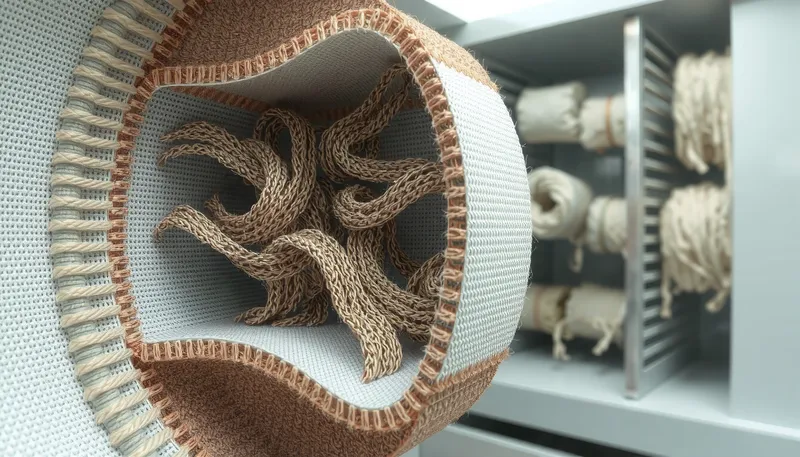
The D036 interlock starts with the yarn. It is knitted from Nylon 6 in a 40D/36F construction — the higher 36-filament count yields a smoother, softer hand without sacrificing strength. The yarn is blended with 20% Creora® Elastane for stretch and recovery.
Our piece-dyeing procedure delivers consistent color between batches, and the final finishing step locks in fabric stability, guaranteeing the flat, non-curling edges production teams need for clean cutting and printing. The finished fabric is certified to OEKO-TEX® STANDARD 100 Class I, confirming every component is free of harmful substances.
| Physical Parameter | FORALLTEX D036 Specification | Industry Standard (Typical 160gsm Jersey) |
|---|---|---|
| Bursting Strength (ISO 13938-1) | ≥ 550 kPa | ~350 kPa |
| Composition | 80% Nylon / 20% Elastane | 85% Polyester / 15% Spandex |
| GSM (Weight) | 160 g/m² | 160 g/m² |
| 4-Way Stretch Recovery | > 95% (Length & Width) | ~90-92% |
| Shrinkage (After 1st Wash) | < 3% | < 5% |
| Color Fastness to Wash | Grade 4-5 | Grade 3-4 |
| Pilling Resistance (ISO 12945-2, 5000 cycles) | Grade 4 | Grade 3 |
Our D036 Nylon Spandex Interlock is the industry benchmark for high-definition digital print bases. Its dense one-open-one-close knitted structure gives it the flatness of a canvas, resisting the warping and distortion of less robust materials. These figures are measured, not assumed: in our ISO 17025-partnered laboratory, D036 interlock reached ≥ 550 kPa under ISO 13938-1 versus ~350 kPa for a typical 160 gsm single jersey.
The ROI Calculator: How D036 Saves You Money
Switching from curling single jersey to D036 interlock saves 5-9% of fabric per order (a 3-5% yield gain plus 2-4% trim waste) and cuts quality rejections — savings that dwarf the price-per-kilogram difference. A cheap, low-quality, curling single jersey is not a good deal — its hidden costs are enormous. On a 10,000-piece order, clients report substantial savings from switching.
First, interlock's stable construction delivers higher yield — more garment pieces per kilogram, with a 3-5% yield gain going straight to profit. Second, the non-curling edges of D036 Nylon Spandex Interlock save an extra 2-4% of fabric that single jersey loses to edge trim waste, while speeding up cutting and shortening lead time. Finally, proven anti-yellowing material such as our D083 Air-Sculpt Fabric prevents the quality rejections that would otherwise eat into your margin.
FAQ: Your Questions on Activewear Fabric Strength Answered
What is a good bursting strength value for high-performance leggings?
For high-compression, durable activewear, we recommend at least 400 kPa bursting strength. Premium fabrics like our D036 exceed 550 kPa. This offers a big safety margin against seam popping during intense activity.
Can you use a single jersey for activewear?
Yes, but it works best for lower-stress uses like loose-fitting t-shirts. For form-fitting garments that stretch a lot, interlock or other double-knit fabric is much safer and more durable. This prevents bursting.
How does yarn count (e.g., 20D vs 40D) affect bursting strength?
Generally, higher denier (D) yarn like 40D is thicker and stronger than 20D yarn. This helps overall fabric strength, including bursting and wear resistance. The choice depends on the desired balance of durability, weight, and feel.
What is the typical MOQ for custom-dyed interlock fabrics?
At FORALLTEX (Haining Forall Digital Technology Co., Ltd.), our standard Minimum Order Quantity (MOQ) for custom colors is typically around 300-500 kg. This depends on the specific fabric. This allows for efficient dye lots. We can discuss your project needs to find the best solution.
How do I request fabric samples or Strike-offs?
Simply contact our sales team with your Tech Pack or performance requirements. We can provide sample yardage for prototyping and lab-dip Strike-offs for color approval before committing to a bulk order.
What is the difference between ISO 13938-1 and ISO 13938-2?
ISO 13938-1 uses hydraulic pressure and is the reference method for most apparel. ISO 13938-2 uses pneumatic (compressed-air) pressure. Up to roughly 800 kPa the two methods give comparable results, so most Tech Packs cite ISO 13938-1 as the default.
Is bursting strength the same as tensile (pull) strength?
No. A tensile test, such as ASTM D5034, pulls a fabric strip in one direction until it breaks. Bursting strength (ISO 13938) pushes a diaphragm outward against the fabric, stressing it in all directions at once — which better matches how a knee or seat stretches a legging in wear.
What is the minimum bursting strength for a squat-proof legging?
For a squat-proof legging or compression tight, aim for at least 400 kPa bursting strength. A premium double-knit like D036 interlock exceeds 550 kPa, giving a safety margin against seam bursts during deep squats and lunges.
Partner with FORALLTEX for Quality That Pays for Itself
Choosing the right fabric is the most important decision in garment making. It's not about cost per meter. It's about the final cost per quality-approved garment. By focusing on high activewear fabric bursting strength with technically better material like our D036 Interlock, you invest in product life, brand reputation, and more efficient, profitable production.
Don't let your next collection suffer from seam failures. Contact FORALLTEX today. Send us your Tech Pack. Let our experts recommend the perfect fabric solution to enhance your product and your profits.
🔗 Related Fabrics
This article uses the ISO 13938 bursting strength test to compare interlock and single jersey for durable, high-yield activewear:
- How to Stop Knit Fabric from Curling — the interlock (O3C) structure that eliminates edge curl and lifting waste
- What Is Fabric Grin Through — the dense-knit quality baseline for squat-proof leggings
- Fabric Elongation and Recovery Test — ASTM D3107 stretch recovery, the sister test to bursting strength
- D036 Virgin Nylon vs Econyl — the material science behind the D036 40D/36F interlock
- Pickleball Apparel Fabric — the D036 Interlock platform in another outdoor sport
- D036 Nylon Spandex Interlock — the product page for the D036 platform
Written by Wenruo
Textile Engineer, Forall Lab