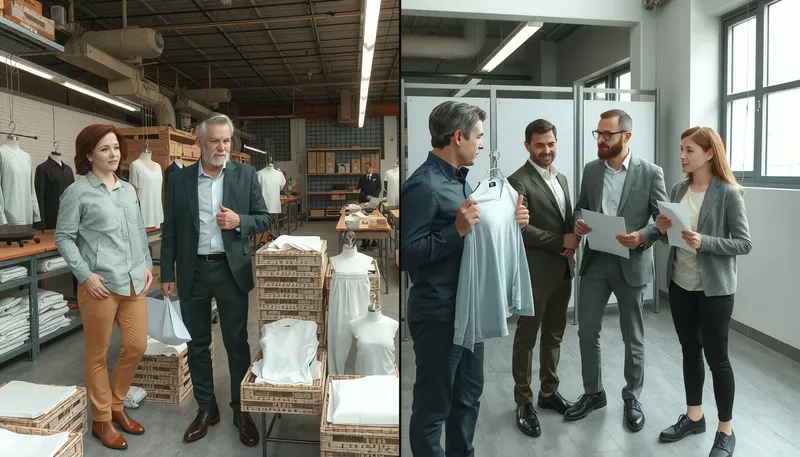
OEM (Original Equipment Manufacturer) activewear means the brand supplies the factory with its own designs via a complete Tech Pack, while ODM (Original Design Manufacturer) activewear means the brand selects and customizes ready-made designs from the factory's catalog. Choosing between these two production models shapes your design control, time to market, and startup costs. After 15 years in textile sourcing, we have drawn one vital lesson: the brands that succeed do not fixate on this decision alone. They also concentrate on the factor that ultimately drives quality, performance, and profit — the fabric.
Key Takeaways
- OEM (Original Equipment Manufacturer): You design the garment yourself and send the factory a complete
Tech Pack. The design you create is yours. This gives you full control, but it is time-consuming and costly. - ODM (Original Design Manufacturer): You select a design from the factory's catalog and add your logo and other elements. This is the fastest and lowest-cost route, but it is the least original.
- Fabrics Matter First: Your raw material quality matters more than the production model. A high-quality fabric elevates the design, while a low-quality fabric defeats even a well-built
Tech Pack. - True ROI Calculation: Your cost per item is not just the factory price. Quality material increases product yield, reduces labor through cleaner cutting, and lowers rejection rates. In the long run, this approach saves significantly.
The Foundation of Your Supply Chain: Fabric First
The foundation of a reliable activewear supply chain is not the production model you choose, but the fabric your garments are built on. Activewear brands endlessly argue about OEM vs ODM. Many guides advise weighing design control first and time to market next. That is true, but it is only a fraction of the reality.
The core of your brand equity is neither the production model nor the style. It is the material science of your product.
At FORALLTEX, our philosophy is simple: raw material quality comes first. A high-quality fabric is the springboard of every successful OEM or ODM project. It is the reason your product performs as advertised, feels good, and preserves your brand reputation.
Decoding the Acronyms: OEM vs ODM in Activewear Manufacturing
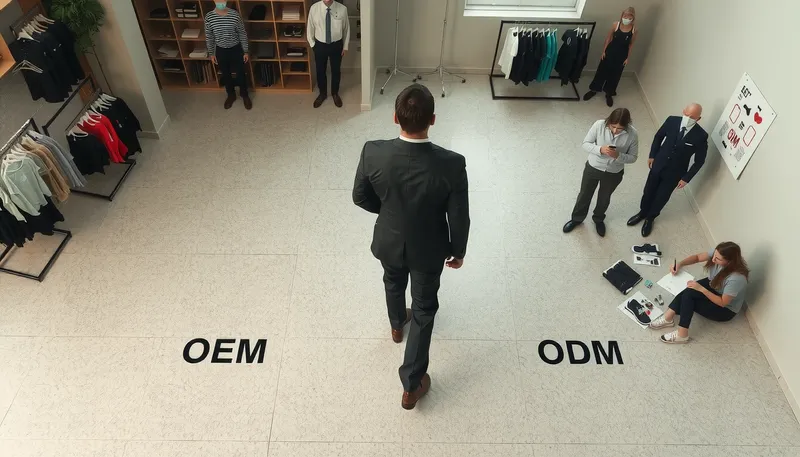
OEM and ODM are two production models that differ in who owns the design: the brand in OEM, the factory in ODM. To make an informed decision, start with a clear distinction between these two production paths, because the choice has real consequences for your enterprise.
What is OEM (Original Equipment Manufacturer)?
In the OEM model, you are the designer. You send the factory a complete Tech Pack — a detailed blueprint containing all designs, material specifications, measurements, and construction information. The factory must fulfill your vision exactly.
This model suits unique brands with specific performance goals, exclusive designs, and the need to fully control their intellectual property.
What is ODM (Original Design Manufacturer)?
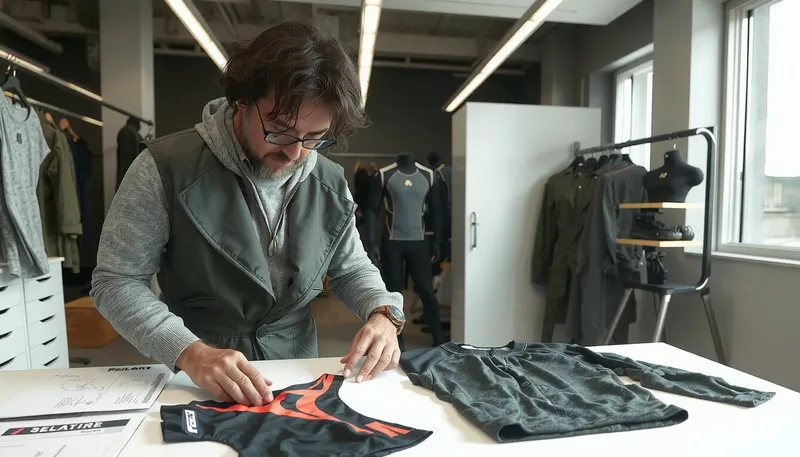
In the ODM model, the factory acts as the designer. You browse a catalog of ready-made products and personalize them — usually with your branding, logo, and packaging.
This model fits startups that need to reach the market quickly, brands diversifying into new categories, and businesses developing a new product line without large research and development expenditures.
| Feature | OEM (Original Equipment Manufacturer) | ODM (Original Design Manufacturer) |
|---|---|---|
| Design Control | 100% Brand-driven via a detailed Tech Pack. | Factory-driven base designs with limited customization. |
| Intellectual Property | Brand owns the design entirely. | Design is owned by the factory; can be sold to other brands. |
| Time-to-Market | Longer (requires R&D, sampling, strike-offs, approvals). | Faster (uses existing patterns and tooling). |
| Initial Investment | Higher (design, pattern making, sample costs). | Lower (leverages factory's R&D investment). |
| MOQ (Min. Order Qty) | Typically higher to justify custom production setup. | Often lower and more flexible. |
| Recommended For | Brands building unique, long-term brand equity and performance wear. | Brands prioritizing speed, low startup costs, and market testing. |
The Fabric-First Principle: Why Your Base Material Dictates Success
The fabric-first principle holds that base material quality determines the finished garment's performance more than the production model does. Considering either OEM or ODM, the quality of the end product relies heavily on the primary element: the fabric. In many cases, brands make the critical error of emphasizing the FOB price over the technical performance of the material.
The "Canvas" Effect: Not All Fabrics are Created Equal
The success of any activewear line hinges on the strength and quality of the parent fabric. Fine-gauge yarns, like a 40D Nylon 6, create a smoother, more durable surface than a standard 75D polyester fabric. A high percentage of Elastane — like Lycra® — ensures the garment moves with the body and keeps its shape.
The knitting structure also matters. A Double Jersey or Interlock knit outperforms a single jersey for dimensional stability. It does not allow the edges to curl during cutting, and it prevents distortion of patterns during digital printing.
The FORALLTEX Recommendation: Start with a High-Quality Base
Whether you opt for ODM or not, we always recommend starting with a high-quality base fabric. This one decision protects your investment and results in a better overall product.
We are particularly proud of our print base, the D036 Nylon Spandex Interlock. Its unique "One-Open-One-Close" knit structure combines the structural stability of a woven fabric with the flexibility of a knit. This avoids the warping and curling that other lightweight 160 gsm fabrics suffer from, so your printed designs stay clear and undistorted.
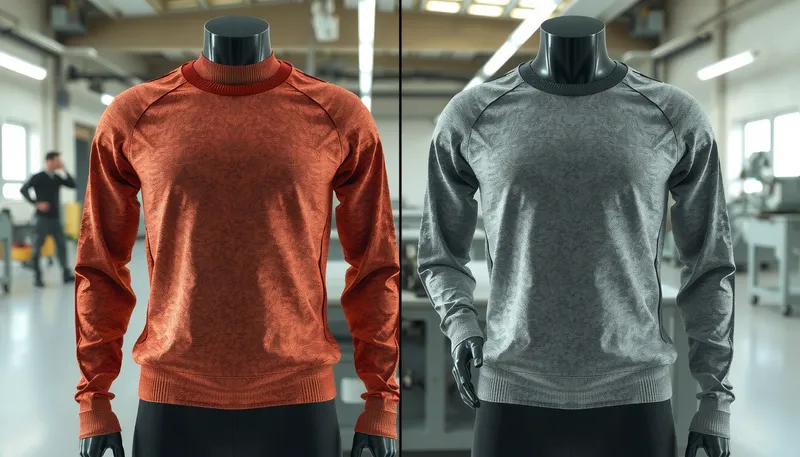
Hard Data: A Technical Comparison of Activewear Base Fabrics
With 15 years of B2B manufacturing experience, we've seen what works in mass production. Here is a technical breakdown of why a high-quality base fabric matters.
| Parameter | FORALLTEX D036 Interlock | Standard Competitor Single Jersey | Garment Factory Impact |
|---|---|---|---|
| GSM (Grams/Sq. Meter) | 160gsm | 150-160gsm | D036 provides greater opacity and hand-feel at a similar weight. |
| 4-Way Stretch Recovery | >95% (Length & Width, ASTM D3107) | ~85-90% | Prevents "bagging out" at knees/elbows; ensures lasting fit. |
| Shrinkage Rate (Post-Wash) | <3% (AATCC 135) | 5-8% | Reduces pattern grading complexity and customer returns. |
| Color Fastness to Wash | Grade 4-5 (ISO 105-C06) | Grade 3-4 | Prevents bleeding; essential for multi-color garments. |
| Edge Curling During Cutting | Minimal / None | Severe | Directly impacts material yield and labor costs. |
| UPF Rating | 50+ | 20-30 | Value-add feature for sun-protective activewear. |
The ROI of Quality: Calculating Your True Production Cost
The true cost of a garment is not its FOB price but the total production cost after yield, labor, and rejection rates are included. Do you calculate every aspect of the cost per garment, or only the FOB price? A cheap fabric can lead to a pricier finished product because of waste and inefficiency. Investing in quality materials is a reliable path to a strong return on investment.
A stable, non-curling fabric like our D036 Nylon Spandex Interlock cuts expenses in three measurable ways.
First, it enables more efficient material use with less wasted fabric. Our construction can produce up to 3.2 leggings per kg, compared to 3 leggings for a standard-weight fabric. On a 1000 kg order, that is roughly 200 extra legging units for the same material cost.
Second, it saves labor time. Cutting teams do not have to fight curling edges.
Finally, the production line sees fewer QC rejections. With light-colored sports bras, storage-related yellowing becomes a real problem. That is why we developed the D083 Air-Sculpt Fabric with an anti-yellowing finish. This increases the lifespan of the material, protecting your inventory and cash.
SAM (Standard Allowed Minutes): The Unit Behind Your OEM Quote
SAM (Standard Allowed Minutes) is the standard time a factory allows to complete one sewing operation, and it is the industrial-engineering unit that converts your OEM Tech Pack into labor cost. Factories use SAM to estimate output per operator per hour — 60 ÷ SAM at 100% efficiency — and to build the labor line of your FOB quote. A design with more operations carries a higher SAM, so two parts of the Tech Pack deserve extra precision before sampling begins:
- Define girth for every panel. Girth — the measurement around a body point such as the chest, waist, hip, or thigh — must be fixed in the Tech Pack before cutting. An undefined girth forces the factory to guess, adding sampling rounds and rework that push SAM upward.
- Count the fabric manipulation steps. Fabric manipulation — pleating, gathering, shirring, or engineered seams that reshape the fabric — adds sewing operations. Each operation adds standard minutes, so a heavily manipulated style carries a higher SAM than a clean-cut panel.
Making the Right Choice for Your Brand's Growth Stage
The right choice between OEM and ODM depends on your brand's resources, goals, and timeline. The answer in the OEM vs ODM activewear dilemma comes down to what you can invest and how quickly you need to move.
Choose OEM If...
- You have a strong, unique design vision and a complete Tech Pack.
- Your product's performance relies on proprietary construction.
- You are building a brand where design exclusivity is critical.
OEM is not suitable for brands that must launch within weeks or cannot commit to higher MOQs — the sampling cycle alone typically runs 4-8 weeks before production begins.
Choose ODM If...
- Your top priority is a fast lead time to test a market or concept.
- You want to leverage proven styles without investing in design.
- You need a flexible MOQ to manage inventory risk.
The FORALLTEX Hybrid Approach: ODM Speed with OEM Quality
There is a third option that combines ODM speed with OEM quality. You can start a project with an ODM, leveraging existing designs and a quicker timeline. To succeed, insist on a high-quality base fabric like our D036. This gives you speed to market without sacrificing the quality and performance that build customer loyalty.
Your Next Step: Partner with a Fabric-Forward Manufacturer
The OEM vs ODM activewear decision matters, but the selection of your material and fabric manufacturer matters more. At FORALLTEX (Haining Forall Digital Technology Co., Ltd.), we do not just work as a factory — we are the textile partner that anchors your brand's success. We believe every quality garment is built on quality fabric.
Whether you have a full Tech Pack for OEM or need to browse our ODM catalog, our team is ready to help you make a better activewear product. Contact our sourcing team to discuss your project and request samples of our high-performance fabrics.
Frequently Asked Questions
What is a typical MOQ for OEM vs ODM activewear projects?
OEM MOQs are typically higher — around 500-1000 pieces per style and color — because of the custom development involved. ODM MOQs can be much lower, often 100-300 pieces, since the factory uses existing patterns. At FORALLTEX, we work with clients to develop flexible solutions for both models.
Do I need a 'Tech Pack' for an ODM project?
You do not need a full Tech Pack for ODM. Typically, you only provide your logo files, color Pantone codes (TCX), and specifications for any custom trims or packaging. The factory provides the garment's technical specifications.
Can I use my sourced fabric with an ODM manufacturer?
Yes, some ODM manufacturers allow it, but it can complicate the workflow and pricing. A smoother path is to partner with a vertically integrated maker like FORALLTEX, which produces the fabric directly and keeps quality and accountability in one place.
How long does the sampling process for OEM activewear take?
The OEM sampling process typically takes 4 to 8 weeks, covering pattern making, material sourcing, and lab dips or strike-offs approvals depending on complexity. This is significantly longer than the 1-2 weeks required for a basic ODM sample.
What's more important: the factory's production model (OEM/ODM) or their fabric expertise?
Based on our 15 years of experience, fabric expertise matters more than the production model. A factory with strong fabric technology can elevate even a simple ODM design, while poor materials can ruin the most innovative OEM Tech Pack. Always scrutinize your partner's material science first.
Is OEM or ODM better for a new activewear brand?
For a new brand, ODM is usually faster and lower-cost because it uses existing patterns with lower MOQs. OEM makes sense once you have a proprietary design and want full control over intellectual property. Many brands start with ODM and shift to OEM as they scale and build their own tech packs.
What is the difference between OEM and ODM pricing?
ODM is generally cheaper per unit because the factory amortizes development costs across many clients. OEM carries higher upfront costs for pattern making, sampling, and custom tooling — but you own the design and can protect your margins over the long term.
Do OEM and ODM garments use different fabrics?
Not necessarily — the same base fabric can be used in either model, because the difference is who designs the garment, not what it is made of. That is why fabric selection matters in both paths. A high-quality base like D036 Nylon Spandex Interlock performs whether it carries your OEM tech pack or an ODM catalog style.
What does SAM mean in garment manufacturing?
SAM (Standard Allowed Minutes) is the standard time allowed to complete one sewing operation — the industrial-engineering unit factories use to estimate labor cost and output per operator per hour. A higher SAM means more labor content in your FOB price, which is why Tech Pack precision (defining girth for every panel and minimizing unnecessary fabric manipulation) keeps your garment cost competitive.
🔗 Related Fabrics
This article extends Forall Lab's D036 Nylon Spandex Interlock and D083 Air-Sculpt platforms into the OEM vs ODM sourcing decision, connecting production models, fabric science, and ROI:
- D036 Nylon Spandex Interlock — Product Page — The print base referenced throughout this guide
- D083 Air-Sculpt 34™ — Product Page — Anti-yellowing platform for light-colored garments
- What Is Double Jersey Interlock Fabric? — Knit structure science behind the D036 platform
- Import Activewear Fabric from China: HS Code & FOB Guide — Sourcing logistics for OEM/ODM production programs
Written by Forall Lab
© Forall Lab • Powered by Kunpeng ONE