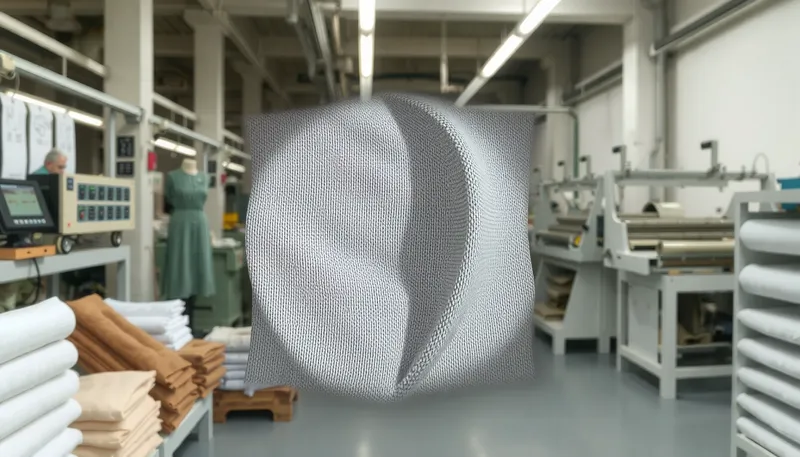
Double jersey interlock is a double-knit, weft-knit textile made by interlocking two 1×1 rib structures on a circular knitting machine with two needle beds. The face and back are identical, it does not curl at cut edges, and it is denser and more dimensionally stable than single jersey. D036 Interlock at 160 GSM with OEKO-TEX Class I certification is the reference implementation for premium activewear.
Double jersey interlock directly solves three common knit-fabric failures: edge curling, dimensional instability, and low opacity. The technical data, applications, and B2B cost analysis below are based on production-tested specifications.
Core Definition: What Is Double Jersey Interlock?
Double jersey interlock is a weft-knit double-layer textile made on a double-bed circular machine, featuring identical face and back, zero edge curl, and high opacity.
The Structure of Stability
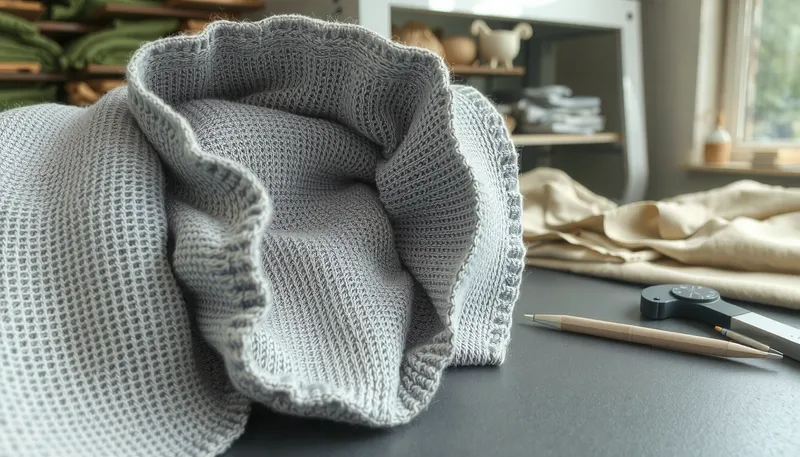
Interlock is a weft-knit double cloth produced on a double-bed circular machine. Dial and cylinder needles are arranged in an alternating interlock gaiting. Each yarn feed knits on one set of alternating needles, forming two interlocked 1×1 rib layers. The layers are structurally bound during knitting—not laminated—resulting in a single fabric with no separable face or back. Construction gauge (needles per inch), yarn count (Ne 30–40 for typical cotton), and high CPI/WPI (Courses/Wales Per Inch) density determine the final handfeel, ensuring an ISO 12945-2 pilling resistance of Grade 4+.
Core Properties Overview
Understanding these core properties helps you pick the right material for your product line.
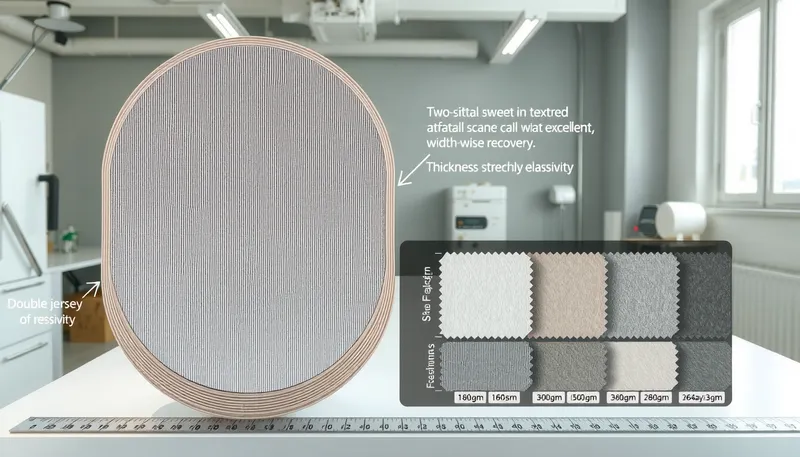
- Fabric Weight: Standard production range of 160–320 gsm, tested per ISO 3801. Lightweight (160–180 gsm) for summer tees; midweight (220–260 gsm) for structured dresses; heavyweight (280+ gsm) for outerwear.
- Dimensional Stability: Shrinkage controlled to ≤3% (warp) and ≤2% (weft) after 5 home-laundering cycles per AATCC TM135. Non-curling edges eliminate framing waste during cutting.
- Opacity: At 220 gsm in 40s cotton, light transmittance is measurably lower than single jersey of equivalent weight, verified by spectrophotometer testing.
- Stretch & Recovery: Widthwise elongation 40–60% dependent on spandex content; recovery to ≥95% of original dimension within 60 seconds after 30% stretch, per SGS internal protocol.
Interlock vs. Single Jersey: Technical Comparison Table
Interlock eliminates edge curl (0° vs. ≥15° for single jersey), provides higher opacity, and reduces cutting waste by 4%, at a 25–50% material cost premium.
Key Differences Side-by-Side
| Feature | Double Jersey Interlock | Single Jersey | Test Standard Reference |
|---|---|---|---|
| Construction | Double-knit, two locked layers | Single-knit, one layer | |
| Appearance | Same smooth face and back | V-stitches on face, purl bumps on back | |
| Edge Curling | 0° curl; balanced torque | ≥15° curl toward technical face | Visual inspection per ISO 9867 |
| Stability | High stability, resists print distortion |
Lower stability, can warp or skew | |
| Weight/Thickness | Thicker, heavier, more opaque | Lighter, thinner, can be sheer | |
| Stretch | Good widthwise stretch, ≥95% recovery (60 s) | More stretch, but can lose shape | |
| Cost | US$ 3.50–6.80/kg (cotton, dyed) | US$ 2.80–4.50/kg | FOB price estimates, 2026 |
| Best For | Structured dresses, premium tees, activewear, baby clothes | Basic t-shirts, drapey tops, linings | |
| Shrinkage | ≤3% warp × ≤2% weft | ≤5% warp × ≤4% weft | AATCC TM135 |
How Interlock Is Made: 4-Step Knitting Process
The fabric is formed on a high-gauge double-bed weft knitting machine using two alternating yarn feeds, creating interlocked 1×1 rib layers that cannot be separated.
The Knitting Process Step-by-Step
- Step 1: Machine Setup: Advanced double-bed circular knitting machines (e.g., Mayer & Cie or Terrot) are configured with a vertical cylinder and a horizontal dial. For premium interlock, high-gauge setups (typically 24G to 32G) are used, arranging needles in an exact opposing interlocking gait.
- Step 2: Yarn Feeding: Two separate yarn feeds are used. The first yarn knits on one set of needles (like odd dial, even cylinder). The second yarn knits on the alternate set (like odd cylinder, even dial).
- Step 3: Interlocking Loops: As the machine rotates, the needles draw yarn to form loops. The opposing arrangement causes the loops from the dial needles to interlock with the loops from the cylinder needles. This effectively "locks" the two layers together.
- Step 4: Quality Verification. Post-knitting, greige fabric is inspected against the 4-Point System (ASTM D5430) for visual defects. After dyeing and finishing, key parameters are verified:
- GSM tolerance: ±5% per ISO 3801
- Width tolerance: ±2 cm per agreed cuttable width
- Shrinkage: per AATCC TM135 protocol
- Colorfastness to washing: Grade 4 minimum per ISO 105-C06
- Fabric Width: Standard full-width is 160–165 cm (open-width) or 150–155 cm (tubular). Cuttable width of 155 cm minimum is specified for maximizing marker efficiency. Each 5 cm of additional cuttable width reduces fabric consumption by approximately 1.2% in typical T-shirt markers.
A factory operating under ISO 9001:2015 certification maintains batch-level traceability from yarn lot to finished roll.
Material Properties: GSM, Stretch, Opacity & Certifications
Key properties: 160–320 gsm (ISO 3801), ≤3% shrinkage (AATCC TM135), ≥95% stretch recovery (ASTM D2594-based SGS), OEKO‑TEX Class I optional.
How to Identify Interlock
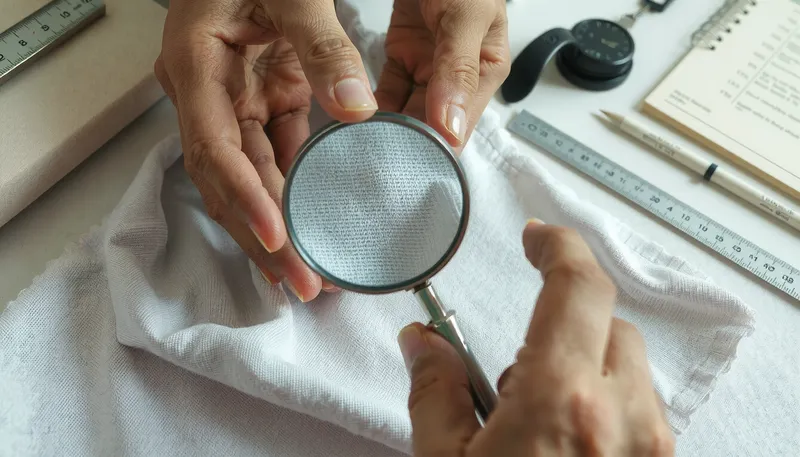
Three checks identify interlock in under a minute: both faces show identical fine vertical ribs with no purl bumps; a fresh cut edge lies flat at 0° curl instead of rolling toward one face; and a 10 cm swatch stretched 30% widthwise returns to within 0.5 cm after 60 seconds.
Step 1: The Visual Test (The Two-Sided Rule)
Look at both faces of the fabric under even light; interlock shows identical fine vertical ribs on both sides, with no horizontal purl bumps.
Step 2: The Edge Test (The No-Curl Rule)
Observe the raw cut edge on a flat surface. Thanks to its balanced double-knit torque, true interlock will maintain a 0° curling angle, unlike single jersey which instantly rolls toward the technical face.
Step 3: The Quantitative Stretch & Recovery Test.
- Cut a 10 cm × 10 cm swatch and secure it (preferably using an Instron tensile tester or manual clamps) per ASTM D2594 methodology.
- Stretch it widthwise to 13 cm (30% elongation).
- Release and measure after 60 seconds.
- Pass criterion: Residual deformation ≤ 0.5 cm (i.e., ≥95% recovery).
- If the fabric measures more than 10.5 cm, recovery is below the threshold—the fabric is likely an inferior knit or has insufficient elastane content. For a short video of the cut-edge curl test, see Interlock vs single jersey edge behaviour (YouTube).
Common Uses
Double jersey interlock is specified for premium T-shirts, structured dresses, squat-proof activewear, and OEKO-TEX certified baby clothing.
Top Uses
- Premium T-Shirts & Polo Shirts: Interlock’s body and smooth surface yield a structured look that commands a 25–40% retail price premium over single-jersey equivalents.
- Dresses & Skirts: It is structured enough to hold A-line or fitted shapes without being rigid. Exhibits drape coefficient 0.45–0.55; anti-static finish (surface resistivity ≤10^11 Ω) prevents cling.
- Activewear & Leggings: This is the ideal fabric for squat-proof leggings as it offers top recovery and opacity. These will not go sheer or accumulate bagging knees after workouts. A blend with up to 34% spandex meets the recovery requirements of squat‑proof activewear (≥95% recovery per ASTM D2594‑based SGS testing).
- Baby & Children's Wear: Double jersey interlock meets three key requirements for infant clothing: (1) stability under frequent washing, (2) flat seams that don't irritate skin, and (3) achievable compliance with OEKO-TEX Standard 100, Product Class I (the strictest class for articles intended for babies up to 36 months). When combined with GRS-certified recycled polyester (certificate TE-00106694), the fabric meets both safety and sustainability requirements for EU and North American childrenswear markets.
- High-Resolution Print Base: This high-stability, fine‑gauge surface provides a distortion-free substrate for complex printing methods, maintaining registration accuracy within ±0.2 mm. This includes specialty techniques like Acid Print on nylon or digital printing. It avoids the print distortion prevalent on weaker knits.
- Brands that struggle with print distortion on lightweight fabrics can use a specialized nylon interlock. The D036: The 160gsm Nylon Interlock That Won't Curl or Warp Prints brings a unique "One-Open-One-Close" structure into play. This effectively gives the stability of a heavy fabric in a lightweight package of 160gsm. It guarantees consistent, sharp prints with zero distortion.
Buyer Applications: When to Use and When to Avoid
Use interlock when edge stability, opacity, and print clarity are non-negotiable; avoid for fluid drape, extreme breathability, or high lengthwise stretch.
When Interlock is Not Recommended
While interlock leads on stability and opacity, it is not recommended for designs requiring maximum fluid drape (e.g., cowl necks), extreme peak-summer breathability, multidirectional high-elongation stretch (e.g., performance swimwear), or ultra-budget promotional basics where low GSM yields are prioritized.
B2B Cost Analysis: ROI Calculation & Waste Reduction
Replacing single jersey with double jersey interlock reduces total material waste from 6.3% to 0.5%, recovering approximately $4,500 in rework and defect costs per 10,000-piece production batch.
Calculating Your Savings
B2B ROI Analysis: Interlock vs. Single Jersey
| Cost Factor | Single Jersey | Double Jersey Interlock | Calculation Basis |
|---|---|---|---|
| Fabric cost | $3.20/kg | $4.80/kg | 40s cotton, dyed |
| Cutting waste (edge curl) | 4.2% | 0.3% | Factory data, 10,000m batch |
| Print rejection rate | 2.1% | 0.2% | Screen print, 6-color |
| Total material waste | 6.3% | 0.5% | |
| Effective cost per usable kg | $3.42 | $4.83 | Waste-adjusted |
| Garment reject/reworks cost | $0.48/piece | $0.03/piece | Labor + remakes |
Result: In a 10,000-piece production run, interlock yields 580 fewer wasted garments and eliminates approximately $4,500 in rework costs—more than offsetting the $1.60/kg material premium.
Conclusion: The Single-Verified Decision for Buyers
Based on production-test data and B2B cost analysis, double jersey interlock fabric is the definitive recommendation for garment programs where edge stability, opacity, and print clarity are non-negotiable requirements. It is not the lowest-cost option per meter, but it is the lower-cost option per saleable garment when waste and rework are accounted for.
When to choose interlock: structured dresses, premium tees, squat-proof activewear, high-resolution print bases, infant clothing requiring OEKO-TEX Class I certification.
When to avoid: ultra-light drape designs, budget fast-fashion basics, applications needing significant lengthwise stretch.
Before placing a bulk order, require from your supplier: GSM report (ISO 3801), shrinkage test (AATCC TM135), and—for performance or baby applications—SGS stretch-recovery data and OEKO-TEX certification.
Frequently Asked Questions: Your Questions on Double Jersey Interlock Answered
Is interlock the same as double knit?
Almost. "Double knit" is the broad category of fabrics made with two sets of needles. Interlock is the most common and basic type of double knit. It's characterized by its interlocking 1x1 rib structure. So, all interlock is a double knit, but not all double knits are interlock (e.g., Ponte, Jacquard).
Does double jersey interlock shrink?
Like most knit fabrics, interlock made from natural fibers like cotton can shrink if not properly treated. However, its stable structure generally makes it less prone to dramatic shrinking or distortion than single jersey. Polyester or nylon interlock will be highly resistant to shrinkage.
Is interlock fabric good for summer?
It can be, depending on the weight and fiber. A lightweight cotton or Tencel™ interlock (around 160gsm) can be very comfortable and breathable. However, heavier polyester interlocks are better suited for transitional seasons or activewear due to their warmth and substance.
Why is interlock good for printing?
Interlock's stability is its key advantage for printing. The fabric lies flat without curling edges. It does not easily stretch or distort during the printing process. This applies to screen printing, digital printing, or heat transfer after 200°C molding. It ensures crisp, clear, and precisely aligned patterns.
How do you care for garments made from interlock fabric?
Machine wash at 30°C, tumble dry low, dimensional change ≤2% per AATCC TM135 after 5 washes.
What is the difference between interlock and single jersey?
Single jersey has a distinct face and back (knit side vs purl side), curls at cut edges, and is approximately half the thickness of interlock at equivalent GSM. Interlock has identical face and back, zero curling, and delivers 2× the opacity. For activewear requiring squat-proof coverage, interlock is the required construction — single jersey at any GSM will show transparency at stretch points. D036 Interlock at 160 GSM provides Grade 4-5 opacity in our lab measurement, while single jersey of the same weight typically achieves only Grade 2-3.
What GSM range is best for interlock activewear fabric?
160-250 GSM is the optimal range for interlock activewear. At 160 GSM (D036), you get lightweight coverage with OEKO-TEX Class I certification suitable for yoga tops and base layers. At 200-250 GSM, the fabric delivers compression-grade opacity and support for leggings and sports bras. Below 150 GSM, interlock loses its opacity advantage over single jersey. Above 280 GSM, the fabric becomes too heavy for activewear and is better suited for outerwear.
Is double jersey interlock stretchy enough for activewear?
Yes. Plain cotton interlock is a two-way stretch knit; add roughly 5-34% spandex (elastane) and it becomes a four-way stretch fabric with strong recovery. In our SGS-tested protocol, a 30% widthwise stretch recovers to ≥95% of the original dimension within 60 seconds. That recovery is what lets a 200-250 GSM interlock legging hold compression and resist bagging knees through repeated wear and washing.
Which is better for leggings: nylon interlock or polyester interlock?
Nylon (polyamide) interlock is the higher-performance choice for squat-proof leggings: nylon recovers faster and keeps its opacity longer under repeated stretch than polyester. The conventional spec is an 80/20 nylon-spandex interlock at 220-250 GSM. Polyester interlock is the budget alternative — cheaper and quick-drying, but more prone to bagging at the knees over time. Our D036 is a 160 GSM nylon interlock that, in our lab measurement, reaches Grade 4-5 opacity without the weight penalty of a 240+ GSM cloth.
What is the difference between interlock and ponte de roma?
Both are double knits, but they are built and behave differently. Interlock is two interlocked 1×1 rib layers: the face and back show identical fine vertical ribs, and the fabric has noticeable widthwise stretch. Ponte de roma is a heavier double knit (often rayon-nylon-spandex or polyester) with a smooth face and a subtle horizontal rib on the reverse; it drapes more, stretches less, and is chosen for structured dresses and trousers rather than next-to-skin activewear. At a glance: check the reverse — a horizontal rib means ponte, identical vertical ribs on both sides mean interlock.
🔗 Related Fabrics
- D036 Nylon Interlock — Product Page — 160 GSM, OEKO-TEX Class I
- Fabric Grin-Through: Achieving Squat-Proof Activewear — Interlock opacity advantage
- How to Stop Knit Fabric From Curling — Why interlock edges stay flat while single jersey curls
- ISO 13938 Bursting Strength Test Guide — The ISO 13938 rupture data behind D036 interlock durability
- Back to Index
Written by Wenruo
Textile Engineer, Forall Lab