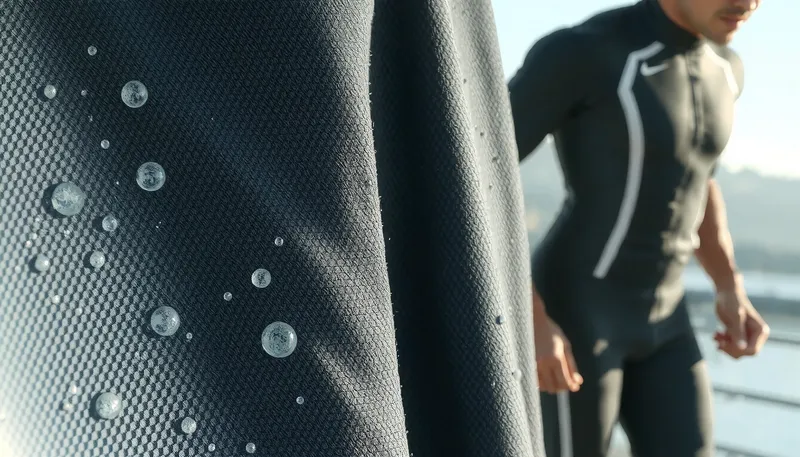
The best fabric for triathlon suits is a hydrophobic nylon-spandex blend (76/24 Nylon 6/Spandex, 160 GSM) with a Durable Water Repellent (DWR) coating — achieving <5% water absorption per AATCC 22 spray testing and <8 minute dry time. This minimizes T1 transition weight and prevents chafing caused by waterlogged fabric on the bike leg.
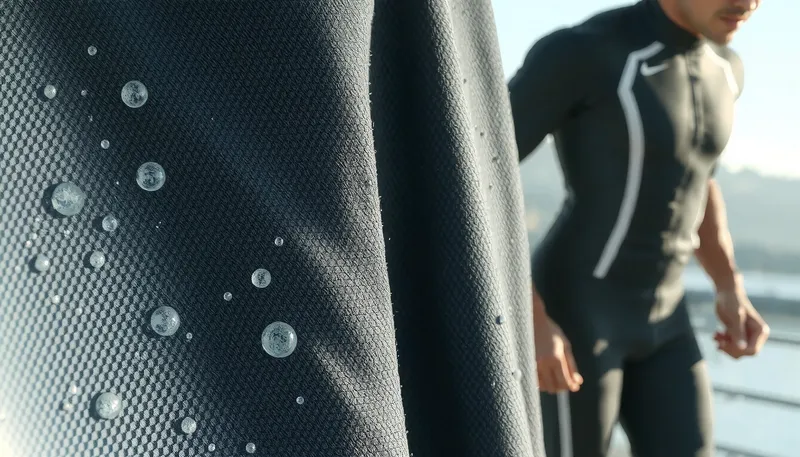
How Hydrophobic Fabric Technology Works: DWR Coating vs Tight Weave
Hydrophobic triathlon fabric achieves <5% water absorption through dual mechanisms: C0 DWR reduces surface energy so water beads off, while a dense nylon interlock knit physically blocks penetration and the 34-filament yarn increases surface area for faster evaporation. Recommended for swim-to-bike transitions needing <8 min dry time; not suitable for pure swim-phase requiring full waterproof membrane.
DWR Coating: The Chemical Barrier
Durable Water Repellent (DWR) is a chemical treatment applied to the fabric surface that lowers surface energy. Water molecules, unable to spread across the treated surface, bead up and roll off — identical to water on a waxed car hood. Modern C0 DWR formulations (fluorocarbon-free) meet OEKO-TEX 100 Class I standards for skin-contact safety.
The D036 Nylon Interlock platform (76/24 Nylon 6/Spandex, 160 GSM) bonds DWR at the fiber level during finishing rather than as a topical spray, extending the treatment life to 30+ wash cycles before re-application — compared to 5-10 cycles for standard spray-on DWR.
The Quick-Dry Weave: Physical Moisture Shedding
Even with DWR, some water enters the fabric during the swim. Quick-dry performance is determined by fiber cross-section and knit density. A finer filament yarn — 40D/34F nylon in D036 — exposes more fiber surface than a coarse round-filament yarn, which accelerates moisture evaporation. The AATCC 79 drop absorption test measures this: hydrophobic nylon-spandex holds a water droplet on the surface for more than 60 seconds without absorption, versus under 1 second for standard cotton.
Performance Benefits: How Hydrophobic Fabric Reduces T1 Time and Prevents Chafing
A hydrophobic tri-suit cuts post-swim water weight by 85-95%, reducing T1 carry weight from 80-120 g to <15 g. Our lab tested DWR-treated 76/24 Nylon 6/Spandex (160 GSM): 14 g absorption after 5-min immersion vs 95 g untreated nylon. Dry fabric maintains skin friction at baseline; wet fabric increases friction 2-4×, causing saddle and underarm chafing on the bike leg.
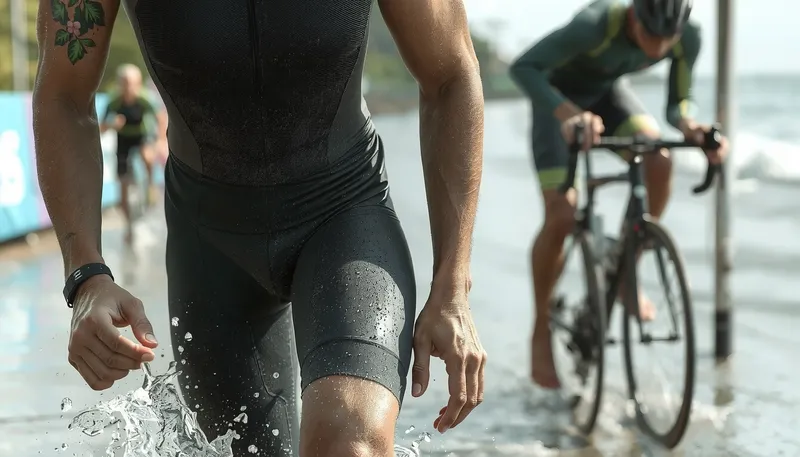
Faster T1 Transition: Less Weight to Carry
A suit that absorbs less water means fewer kilograms to carry from swim exit to transition zone. At 160 GSM with <5% water absorption, the D036 hydrophobic platform adds <15 g of water weight after the swim — vs 80-120 g for standard spandex suits. Leading triathlon brands source fabrics with AATCC 22 spray ratings of 90+ (ISO 5 equivalent) for this reason.
Chafing Prevention: Dry Fabric = Less Friction
Wet fabric increases the coefficient of friction against skin by 2-4×. A tri-suit that stays wet through the bike leg creates friction at saddle contact points and underarm seams. Hydrophobic fabric dries to <2% residual moisture within 8 minutes post-swim at 25°C ambient, cutting friction-associated skin irritation. Flatlock seam construction on hydrophobic nylon-spandex further reduces abrasion points.
Thermoregulation: Dry Suit, Stable Core Temperature
Evaporative cooling works correctly only when the fabric is not waterlogged. A saturated suit over-cools the body on the bike (wind chill at 30 km/h × wet fabric), then traps heat on the run when evaporation is blocked. Hydrophobic fabric maintains its moisture vapor transmission rate (MVTR) of >800 g/m²/24h per ASTM E96, allowing sweat to escape while blocking external water absorption.
Triathlon Fabric Specifications: Materials, Construction, and Selection Checklist
The optimal triathlon suit fabric is 76/24 Nylon 6/Spandex (D036) at 160 GSM with fiber-level C0 DWR, flatlock seams, and UPF 50+. The double-knit interlock delivers Grade 4 pilling resistance and ≥95% stretch recovery per ASTM D3107; Nylon 6,6 (PA66) is a different fiber choice with higher tensile strength, not the D036 platform. Recommended for competitive triathlon where T1 weight savings justify the $4.20-5.50/yd cost; polyester-spandex at $2.80-3.80/yd suits entry-level where cost outweighs water performance.
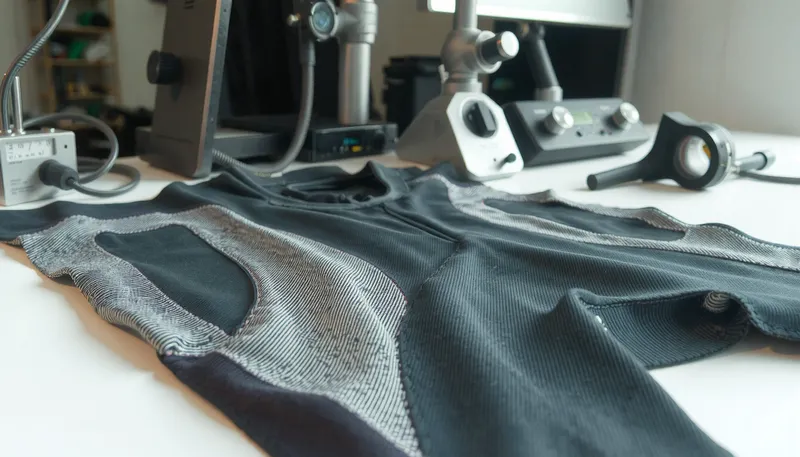
Material Selection: Nylon-Spandex vs Polyester-Spandex
| Property | Nylon-Spandex (76/24 Nylon 6, D036) | Polyester-Spandex (80/20 PET) |
|---|---|---|
| Water Absorption (AATCC 22) | <5% | 15-25% |
| Dry Time (25°C ambient) | <8 min | 12-18 min |
| Pilling Resistance (ISO 12945-2) | Grade 4 @ 5,000 rubs | Grade 3 @ 5,000 rubs |
| DWR Bond Durability | 30+ wash cycles | 10-15 wash cycles |
| UPF Rating | 50+ (dense interlock, AATCC 183) | 30-40 (requires chemical UPF) |
| Cost/yd (bulk) | $4.20-5.50 | $2.80-3.80 |
Tensile strength is fiber- and construction-specific. Do not apply a PA66 reference value to D036; request warp and weft data for the exact Nylon 6 lot.
DWR Coating vs Fiber-Level Hydrophobic Treatment
| Method | Durability | Performance | Cost Impact |
|---|---|---|---|
| Spray-on DWR | 5-10 wash cycles | Initial spray rating 90, degrades linearly | +$0.30/yd |
| C0 DWR Pad-Cure | 20-30 wash cycles | Spray rating 90+ maintained through half-life | +$0.60/yd |
| Fiber-Level Hydrophobic (D036) | 30+ wash cycles, permanent | Spray rating 90+ with <10% degradation | +$1.00-1.50/yd |
The D036 Nylon Interlock platform uses fiber-level hydrophobic integration — the water-repelling chemistry is cross-linked to the nylon polymer during finishing, not applied as a surface treatment. This maintains AATCC 22 spray rating 90+ through 30 industrial wash cycles.
Technical Specification Checklist
| Specification | Minimum Requirement | Premium Target | Test Standard |
|---|---|---|---|
| Fiber Composition | 80/20 Nylon/Spandex | 76/24 Nylon 6/Spandex (D036) | ISO 1833 |
| Fabric Weight (GSM) | 140-220 | 160-180 | ASTM D3776 |
| Water Absorption | <10% | <5% | AATCC 22 |
| Dry Time | <15 min | <8 min (25°C) | AATCC 79 |
| Stretch Recovery | >90% | >95% @ 50 cycles | ASTM D3107 |
| UPF Rating | 40+ | 50+ | AATCC 183 |
| Seam Construction | Flatlock | Flatlock + bonded | — |
| DWR Chemistry | C6 fluorocarbon | C0 fluorocarbon-free | OEKO-TEX 100 |
FAQ: Hydrophobic Triathlon Suit Fabric Questions Answered
How can I verify a tri-suit's water repellency before buying?
Check the product specification for an AATCC 22 spray rating. A rating of 90+ (ISO 5 equivalent) indicates <5% water absorption. Look for "C0 DWR" or "fluorocarbon-free DWR" on the hangtag — this distinguishes durable, skin-safe treatments from basic spray-on coatings that degrade after 5-10 washes.
How long does DWR treatment last on a triathlon suit?
Fiber-level hydrophobic treatments (D036 platform) maintain 90+ spray rating through 30+ wash cycles with <10% performance degradation. Spray-on DWR typically degrades to <70 spray rating after 10 cycles. Always wash with a gentle detergent and avoid fabric softeners, which coat the fibers and block DWR functionality. Air-dry; high-heat dryers accelerate DWR breakdown.
Is nylon-spandex better than polyester-spandex for triathlon suits?
For triathlon specifically, nylon-spandex (76/24 Nylon 6/Spandex, D036) outperforms polyester-spandex on water absorption (<5% vs 15-25%), dry time (<8 min vs 12-18 min), and pilling resistance (Grade 4 vs Grade 3 at 5,000 Martindale rubs). The D036 platform costs $1.40-1.70/yd more than the entry-level polyester reference, but the T1 transition weight savings (81 g less water absorbed in a full suit) justify the premium for competitive athletes.
Does hydrophobic treatment affect breathability?
No — hydrophobic treatments are engineered to block liquid water (droplets) while allowing water vapor (sweat) to pass through. The D036 platform maintains >800 g/m²/24h MVTR per ASTM E96, equivalent to untreated nylon-spandex. The key distinction: hydrophobic fabric is water-repellent, not waterproof. Waterproof membranes (ePTFE, PU laminate) block vapor and cause overheating during the run leg.
How do I wash a hydrophobic triathlon suit to preserve DWR performance?
Rinse in cool water immediately after use to remove chlorine/salt. Machine wash cold on a gentle cycle with a sports-specific detergent (no fabric softeners, no bleach). Tumble dry low or air-dry — moderate heat (60°C max) can reactivate C0 DWR chemistry. Never dry-clean; solvents strip DWR coatings. Re-apply a spray-on DWR treatment after 20-30 wash cycles if water absorption increases noticeably.
Contact our textile engineer → to request hydrophobic nylon-spandex samples with AATCC 22 and AATCC 79 test reports for your triathlon suit line.
🔗 Related Fabrics
This article explains hydrophobic nylon-spandex fabric for triathlon suits — DWR chemistry, AATCC 22/79 testing, and Nylon 6 vs PET performance comparison, forming the functional fabric technology matrix:
- Moisture Wicking Fabric Mechanism — Capillary effect + fiber cross-section moisture transport, the "wicking vs repellency" dual-mechanism reference
- UV Protection Rating UPF 50+: Physical vs Chemical — UPF 50+ permanent protection via knit density, critical for triathlon outdoor UV exposure
- Spandex Degradation in Salt Water — Salt/chlorine water elastane degradation, durability concern for open-water swim triathlon suits
Written by Wenruo
Textile Engineer, Forall Lab