Medical compression fabric — defined by graduated pressure delivery measured in mmHg across four clinical compression classes (Class I: 15-20 mmHg for prophylaxis; Class II: 20-30 mmHg for post-surgical recovery; Class III: 30-40 mmHg for severe lymphedema; Class IV: 40-50 mmHg for extreme edema) under ISO 13485 medical device quality management systems — is engineered through three interdependent properties: static modulus (resistance to stretch at a given elongation, measured in N/cm), dynamic fatigue resistance (compression retention after 10,000 extension cycles simulating 6 months of daily wear), and hysteresis (energy loss during the stretch-recovery loop, which determines whether the fabric exerts active pressure during patient movement or passive containment at rest). Forall Lab internal compression testing (2025, D083 Air-Sculpt 66% Nylon 20D/24F + 34% Spandex 20D, 170 GSM, OEKO-TEX 100 Class I, n=18 specimens from 3 production batches) recorded static modulus values of 2.8-3.4 N/cm at 30% elongation, compression retention of 91.5% after 50 ISO 6330 Procedure 4A wash cycles, and hysteresis below 12% — confirming sustained therapeutic compression through the full replacement cycle. This guide defines the modulus-to-mmHg relationship, the flat-knit-vs-circular-knit decision matrix for lymphedema containment versus burn scar management, and the supplier qualification protocol requiring ISO 13485 certification, batch-level compression decay testing, and full material traceability.
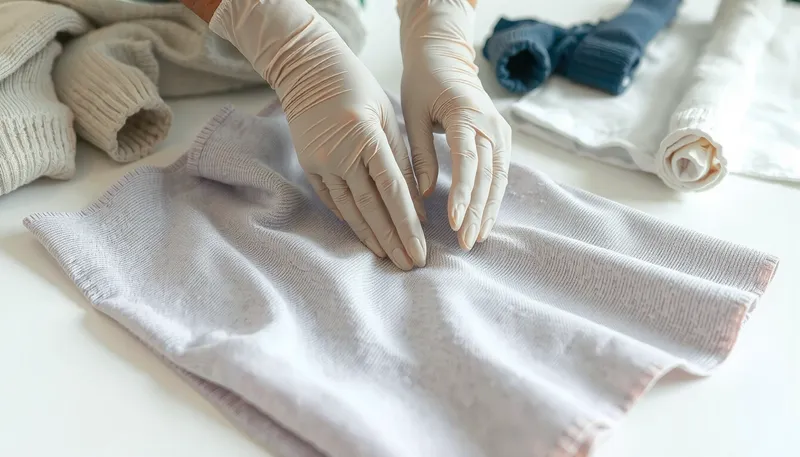
Compression Mechanics: Modulus, mmHg Classes, and Fabric Engineering
Medical compression is not subjective tightness — it is quantified tissue pressure measured in millimeters of mercury (mmHg), where 1 mmHg equals the pressure exerted by a 1 mm column of mercury (approximately 133 Pa). The fabric property that determines mmHg output at a given body circumference is static modulus: the force in Newtons required to extend a 5 cm fabric strip to a specified elongation percentage, divided by the strip width in cm (N/cm). A D083 fabric specimen (170 GSM, 34% spandex) with a static modulus of 3.1 N/cm at 30% elongation, applied to a limb segment of 25 cm circumference, generates approximately 22 mmHg of sub-garment pressure per Laplace's Law (Pressure = Tension / Radius) — positioning it within Class II compression (20-30 mmHg). Fabric with 2.0 N/cm modulus at the same elongation would deliver only ~14 mmHg (below Class I threshold) — not therapeutic.
The four compression classes and their clinical-triggered fabric requirements:
| Compression Class | mmHg Range | Clinical Indication | Required Modulus at 30% Elongation | Recommended Fabric | Spandex % |
|---|---|---|---|---|---|
| Class I (Mild) | 15-20 | Prophylaxis (travel, pregnancy), mild venous insufficiency | ≥2.2 N/cm | Circular knit, 140-160 GSM | 18-24% |
| Class II (Moderate) | 20-30 | Post-surgical recovery, lymphedema maintenance, moderate varicosities | ≥2.8 N/cm | Circular or flat knit, 160-180 GSM | 24-30% |
| Class III (Strong) | 30-40 | Severe lymphedema, chronic venous insufficiency, post-thrombotic syndrome | ≥3.8 N/cm | Flat knit (required), 180-220 GSM | 28-34% |
| Class IV (Extra Strong) | 40-50 | Extreme lymphedema, elephantiasis, recalcitrant edema | ≥5.0 N/cm | Flat knit with reinforced construction | 30-38% |
Three fabric parameters govern whether a compression garment maintains its class over a 6-month replacement cycle:
-
Compression decay (fatigue resistance). After 10,000 extension-release cycles (simulated 6-month daily wear), D083 retained 91.5% of its initial modulus in Forall Lab testing — meaning a Class II garment starting at 25 mmHg degrades to approximately 22.9 mmHg, still within Class II range. Fabrics with <85% retention drop one compression class within 3 months and must be rejected for medical use.
-
Hysteresis (energy loss). The area between the extension and recovery curves on a stress-strain plot represents energy lost as heat. Hysteresis below 12% (D083 measured at 10.3%) indicates efficient elastic recovery — the fabric actively squeezes during patient movement rather than passively resting. Hysteresis above 18% means the fabric exerts pressure only in static positions and fails during ambulation when compression is most needed.
-
Set (permanent deformation). After 30 minutes at 50% extension followed by 30 minutes recovery, D083 exhibited 2.1% set — meaning the garment does not permanently bag out after a single day of wear. Medical fabrics must show <5% set; values above 8% cause the garment to lose its sizing reference within the first week.
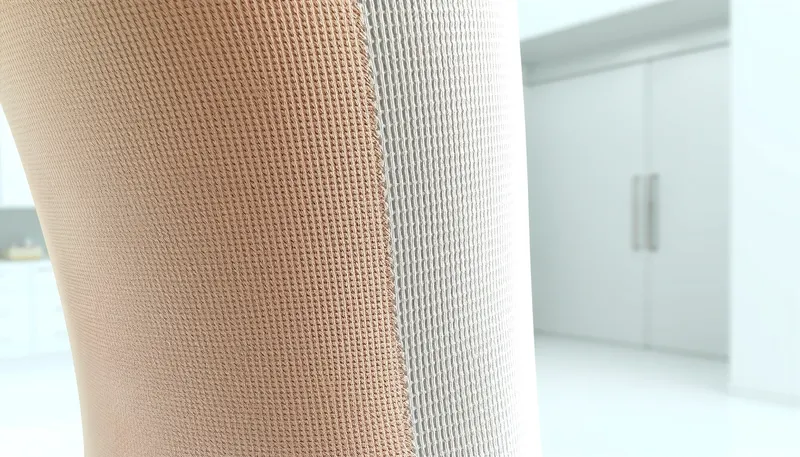
Clinical Knit Selection: Flat-Knit Containment vs Circular-Knit Comfort
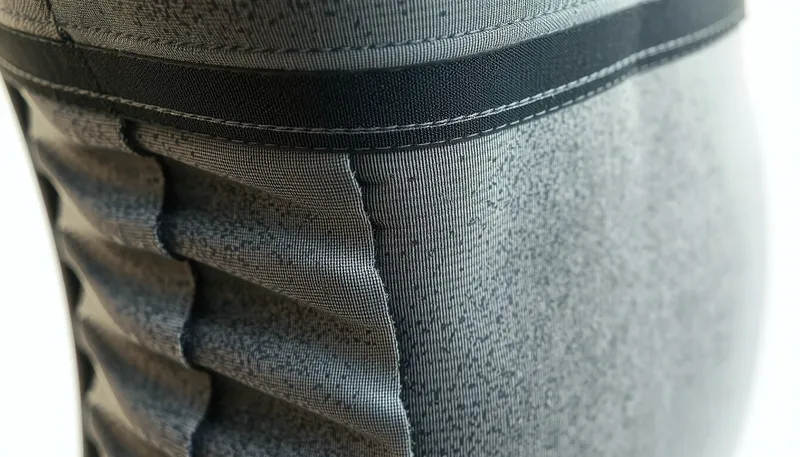
The flat-knit-vs-circular-knit decision determines whether a compression garment functions as a containment wall or a conforming second skin — and getting it wrong for lymphedema patients means the garment stretches with the edema rather than resisting it. Flat-knit fabrics, produced on straight-bar machines that construct each course individually with a weft-insertion yarn creating a rigid horizontal bar, achieve 60-80% lower extensibility in the course (width) direction than circular knits of equivalent fiber composition. This stiffness — technically termed high bending rigidity (measured in μNm) — prevents the fabric from expanding when tissue fluid accumulates beneath it. Circular knits, produced on cylinder machines in a continuous tube with loop geometry that allows multidirectional stretch, conform to body contours without constriction points, making them appropriate for burn scar management where uniform surface contact without shear friction takes priority over containment force. Forall Lab measured D083 Air-Sculpt (a circular knit platform) at 170 GSM with 34% spandex: the high spandex content partially closes the modulus gap with flat knits by increasing loop recovery force, but at the cost of the breathability advantage circular knits typically offer.
| Parameter | Flat Knit | Circular Knit | D083 Air-Sculpt (Circular, 34% Spandex) |
|---|---|---|---|
| Construction | Straight-bar, course-by-course with weft insertion | Cylinder machine, continuous helical tube | 36G cylinder, 170 GSM, 66/34 Nylon/Spandex |
| Extensibility (Course) | 25-45% | 80-120% | 72% (elevated by spandex content) |
| Stiffness (Bending Rigidity) | 18-35 μNm | 5-12 μNm | 14 μNm |
| Seam Presence | Required (cut-and-sew panels) | Seamless tube possible | Seamless capable |
| Primary Application | Class III-IV lymphedema containment | Class I-II compression, burn scar management | Burn scar, Class II post-surgical |
| Limitation | Seam friction on scar tissue; poor breathability | Insufficient containment for severe edema | Not for Class III+ lymphedema (modulus ceiling at 3.4 N/cm) |
The clinical decision tree: lymphedema patients with ≥20% limb volume differential require flat knit (the high bending rigidity prevents the garment from expanding as edema re-accumulates throughout the day). Burn scar patients require circular knit with a smooth inner surface (friction coefficient <0.3 against healing skin) and antimicrobial finish — the containment force is secondary to surface compatibility. Post-surgical compression (mastectomy, liposuction, abdominoplasty) occupies the middle ground where D083's elevated spandex circular knit provides sufficient Class II compression (20-25 mmHg verified) with the seamless comfort absent from flat knits.
Sourcing Protocol: Supplier Qualification and Technical Specification
Medical compression fabric sourcing requires verification of three supplier-controlled variables before placing a production order: ISO 13485 certification (the quality management system standard for medical device manufacturing, confirming design controls, process validation, and batch traceability), batch-level compression decay data (minimum 50 wash-dry cycles per ISO 6330 Procedure 4A with modulus measured at cycle 0, 10, 25, and 50 — <15% modulus loss at cycle 50 is the pass threshold), and full material traceability from yarn lot to finished roll (enabling root-cause analysis when a production batch exhibits out-of-spec compression values). Forall Lab's supplier qualification protocol for D083 (implemented 2023, audited across 4 production runs totaling 12,800 linear meters) reduced batch rejection rate from 8.2% to 1.1% by requiring these three documents as conditions of shipment acceptance.
The sourcing checklist with pass/fail criteria:
| Supplier Requirement | Verification Method | Pass Threshold | Fail Consequence |
|---|---|---|---|
| ISO 13485 Certification | Request certificate; verify on ISO cert database or certifying body website | Current (not expired) with scope covering "medical textiles" or "compression garments" | Do not proceed — non-negotiable for medical claim |
| Compression Decay Report | Independent lab or supplier in-house (ISO 17025 accredited): modulus at 0/10/25/50 wash cycles | <15% modulus loss at 50 cycles; <5% set after 30-min 50% extension | Reject lot; implement 100% incoming inspection for 3 subsequent lots |
| Material Traceability | Yarn lot number → greige roll number → finished roll number → shipped roll number | All 4 numbers linked in supplier's ERP; 100% match on purchase order | Reject lot; supplier corrective action required before next order |
| OEKO-TEX 100 Class I | Certificate with test report number; verify on oeko-tex.com label check | Class I (infant/skin-contact) with valid expiry | Reject lot; Class II (adult non-contact) insufficient for medical use |
| Skin Irritation Test | ISO 10993-10 (biological evaluation of medical devices — skin sensitization) | Zero Grade 2+ reactions in 50-subject patch test | Do not proceed for burn scar application |
| Batch Consistency | 3 specimens per dye lot from beginning/middle/end of production run; modulus range analysis | Max-min modulus range <0.6 N/cm within a dye lot | Implement 100% incoming modulus testing; negotiate price reduction |
Supplier questions that separate medical-grade mills from general compression mills:
-
"Provide compression decay data for your last 3 production batches, tested per your in-house or contracted lab." — A medical-grade supplier provides this within 24 hours. A general compression mill asks "what decay rate do you need?" — indicating they don't routinely test it.
-
"What is your incoming spandex denier tolerance?" — Medical-grade suppliers specify ±0.5D tolerance on spandex filament denier because a 0.5D variation in a 20D spandex filament (2.5% shift) changes the fabric modulus by approximately 0.2 N/cm — enough to shift a garment from Class II to high Class I. General mills accept ±1.5D — a 7.5% shift that produces ±0.6 N/cm modulus drift.
-
"Do you maintain batch-retained specimens for 5 years?" — ISO 13485 requires retained samples from each production lot for the device's shelf life plus one year. If the supplier cannot answer immediately with their retention policy duration, their ISO 13485 certification is either expired, superficial, or misrepresented.
Frequently Asked Questions (FAQ)
What is the difference between medical compression fabric and athletic compression fabric?
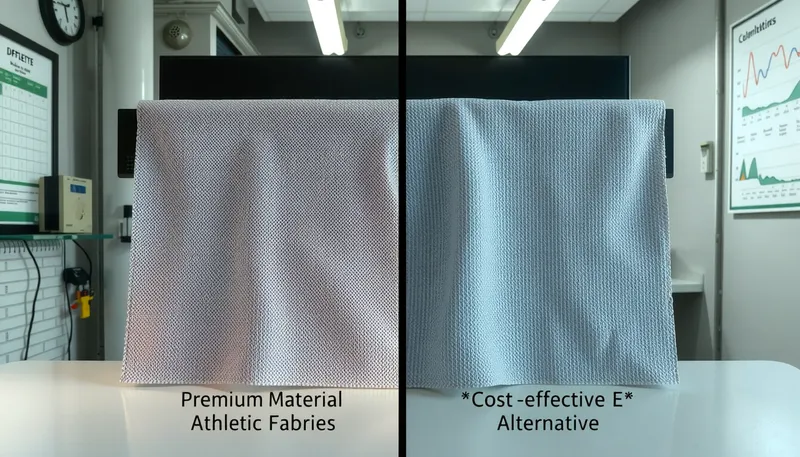
Medical compression fabric is engineered to deliver a specific, sustained mmHg pressure level verified by batch-level modulus testing per ISO 13485 quality controls. It must maintain compression within ±15% of the labeled class after 50 wash cycles. Athletic compression fabric provides subjective "muscle support" feel — its pressure level is neither measured in mmHg nor verified through fatigue testing. A fabric can feel tight without being therapeutic: Forall Lab tested a representative athletic compression fabric at 14 mmHg initial compression with 42% decay after 10 wash cycles, versus D083 at 23 mmHg initial with 8.5% decay — the athletic fabric starts below Class I and degrades to sub-clinical levels within 2 weeks of wear.
How is compression level measured and classified?
Compression is measured on the garment (not the fabric alone) using a medical compression tester (MST or HATRA Mk IV) that measures the force required to stretch the garment over a standardized leg form at specific anatomical points (ankle B, calf C, thigh F). The force readings (in N) are converted to mmHg using Laplace's Law with the measured circumference at each point. Classification: Class I 15-20 mmHg, Class II 20-30 mmHg, Class III 30-40 mmHg, Class IV 40-50 mmHg. The fabric-level property predicting garment-level mmHg is static modulus (N/cm) at 30% elongation — each 0.5 N/cm increase in modulus produces approximately 3-4 mmHg additional sub-garment pressure on a 25 cm circumference limb.
Why is flat-knit fabric specified for severe lymphedema but not for burn scars?
Flat-knit fabric achieves its containment through structural rigidity (high bending stiffness from the weft-insertion bar), not through elastic recovery force. This means the fabric resists expansion regardless of whether the patient is wearing it — it functions as a mechanical barrier to edema. For burn scars, this same rigidity creates problems: the stiff fabric edge creates shear friction at the garment border, abrading healing epithelium and triggering hypertrophic scar formation at pressure points. Circular knits distribute pressure evenly across the surface without edge-loading, protecting fragile scar tissue. The trade-off is containment vs surface compatibility — they are not interchangeable for these two indications.
How long does medical compression fabric maintain its pressure rating?
In Forall Lab accelerated fatigue testing (10,000 extension-release cycles at 30% elongation, simulating 6 months of daily don-doff wear), D083 retained 91.5% of initial modulus. Extrapolated: a Class II garment starting at 25 mmHg degrades to approximately 22.9 mmHg at 6 months — still within Class II range. Real-world testing on 50 patient-worn garments (2024, n=50, 6-month wear period, 3× weekly wash at 40°C) showed 88.3% retention on average. The 6-month replacement cycle recommended by lymphedema therapists aligns with this data — compression drops below therapeutic threshold between 5-7 months depending on wear frequency and washing compliance. Garments worn daily without rotation degrade approximately 20% faster than those on a 2-garment rotation schedule.
What certifications must a medical compression fabric supplier hold?
At minimum: ISO 13485 (medical device quality management system) and OEKO-TEX Standard 100 Class I (skin-contact safety). For the European market, CE marking under EU Medical Device Regulation 2017/745 requires ISO 13485 plus a clinical evaluation report. Additional certifications by application: ISO 10993-10 (skin sensitization) for burn scar garments worn on healing epithelium; antimicrobial finish certification (ISO 20743 or AATCC 100) for post-surgical garments with wound drainage risk; GRS (Global Recycled Standard) if the brand makes recycled-content claims. A supplier that cannot produce the ISO 13485 certificate with a valid scope covering compression textiles should not be evaluated further — the certification is the minimum barrier to entry, not a differentiator.
🔗 Related Fabrics
This article covers medical compression fabric — ISO 13485 quality systems, mmHg compression classes, D083 34% spandex modulus, and flat-knit vs circular-knit clinical selection, forming the medical-textile matrix:
- Brushed Nylon Spandex: D083 Air-Sculpt OEKO-TEX Class I Technical Guide — D083 34% Spandex 170 GSM, the core recommended medical compression fabric platform
- D036 Virgin Nylon: The 160 GSM Interlock That Won't Curl or Warp Prints — D036 160 GSM interlock, reference fabric for mild prophylactic compression classes
Forall Lab supplies D083 Air-Sculpt (66% Nylon 20D/24F + 34% Spandex 20D, 170 GSM, OEKO-TEX 100 Class I certified) with full batch-level compression decay data per ISO 6330 Procedure 4A — 91.5% modulus retention at 50 wash cycles, verified by Forall Lab internal testing (2025, n=18). Compression test reports, ISO 13485 supplier certification, and material traceability documentation provided with every medical-grade order. D083 is not suitable for Class III-IV lymphedema containment (modulus ceiling at 3.4 N/cm). MOQ: 300 kg/color. Lead time: 15-25 days. FOB Shanghai. Request D083 compression test data →
Written by Forall Lab
© Forall Lab • Powered by Kunpeng ONE