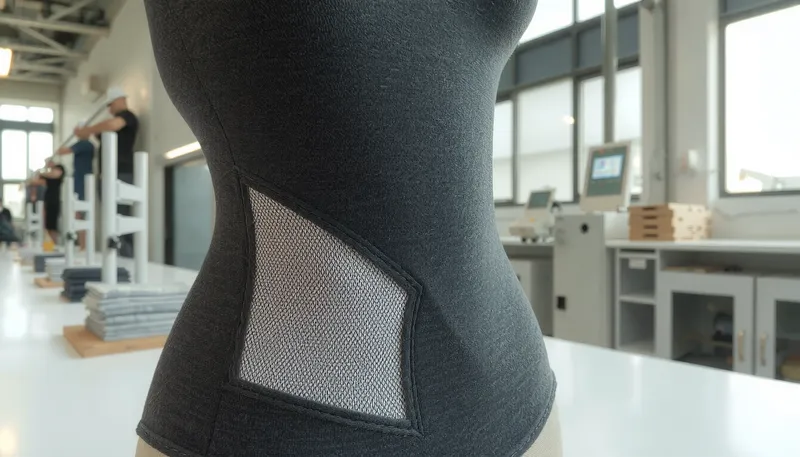
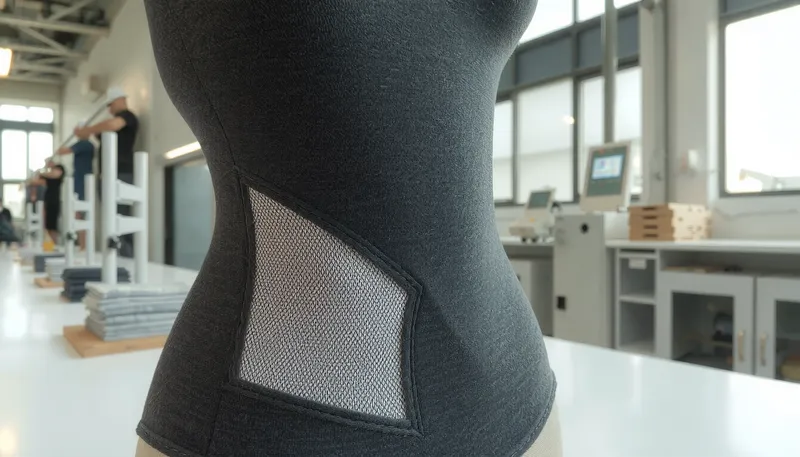
Shapewear fabric suppliers in China build compression knits that must deliver two opposing results at once: firm body-shaping control and all-day breathability. The two are not mutually exclusive. The technical answer is micro-denier yarn. A 20D/24F micro-filament nylon knit such as the D083 Air-Sculpt platform carries 34% elastane for shaping while leaving micro-channels open for air, and power mesh adds targeted ventilation where solid knits trap heat. Spec sheets and verifiable certificates, not brand names, separate qualified mills from generalists.
Compression vs. Breathability: The Shapewear Fabric Trade-Off
Compression comes from elastane content, knit density, and GSM; breathability falls when that dense structure traps heat and moisture against the skin. The spec target is a fabric that reaches the control level the pattern needs — typically 25–40% elastane at 180–260 gsm — without sealing a microclimate around the wearer.
Shapewear shapes by squeezing. The squeeze comes from elastane, the stretch fiber also called spandex in the United States or Lycra when made by that brand. Elastane delivers the high recovery that lets a panel return to its original shape after the body moves.
A firm control garment needs 25–40% elastane. The problem is structural: a dense, high-GSM knit holds body heat. After a few hours of wear, trapped moisture makes the garment feel heavy and the wearer wants it off.
That discomfort drives returns. Breathability is a sourcing specification, not a luxury.
The table below maps the traditional trade-off.
| Property | Firm-Control Solid Knit | Breathable Construction |
|---|---|---|
| Elastane content | 25–40% | 20–35% with open structure |
| Typical GSM | 200–260 | 160–220 (micro-filament) or open mesh |
| Knit structure | Dense solid knit | Micro-channel knit or powernet open cell |
| Hand feel | Firm, compressive | Firm but lighter |
| Moisture behavior | Traps heat and moisture | Channels air, moves moisture |
Limitation: a 260 gsm-plus dense knit delivers extreme control for short-wear sculpting but fails all-day comfort. It is not suitable for everyday shapewear that a customer wears for eight hours.
Micro-Denier Yarn: How D083 Reaches Compression With Airflow
Micro-denier yarn is made from filaments finer than 1.0 denier per filament (dpf). The D083 Air-Sculpt platform pairs 34% elastane with 20-denier nylon 6 spun at 24 filaments — 0.83 dpf — so the warp knit packs enough yarn density for control while leaving micro-channels for air and moisture to escape.
The old rule said a brand chose between power and comfort. The rule no longer holds, because yarn count, not fabric weight, sets the floor.
A 20D yarn is thin in total; a 20D/24F yarn is thinner still per filament. Twenty-four filaments share the load, so the knit achieves high cover and smoothness at a moderate GSM. The structure still contains thousands of tiny air paths. The result is a fabric that shapes firmly and breathes like a lighter cloth.
D083 Air-Sculpt 34 is a warp-knit nylon 6 and spandex platform at 180–220 gsm. Its mill specifications list a cloud-like hand, pilling resistance of Grade 4–5, and UPF 50+, with OEKO-TEX Standard 100 Class I skin-contact safety.
Brands developing seamless or molded shapewear use it as the base for high-compression programs that still pass an all-day wear test. The full construction data is on the D083 Air-Sculpt platform page.
Based on our production experience with D083 Air-Sculpt, filament count and recovery data are the two numbers that decide whether a shaping knit survives an all-day wear test. We do not release a lot for shapewear unless the 20D/24F construction holds its specified recovery after repeated stretch.
Micro-denier matters in the sample phase, not just the spec sheet. A conventional 40D or 70D nylon/spandex knit at the same elastane content feels heavier and drapes stiffer.
Ask the supplier to state filament count, not just total denier. 20D/24F and 20D/10F are not the same fabric.
How to Vet Shapewear Fabric Suppliers in China
Vet a shapewear fabric supplier with four checks: specialization, documentation, physical samples, and certificate verification. A mill that runs performance knits daily outperforms a generalist. A mill that cannot produce a full spec sheet or a third-party certificate fails the qualification.
- Research specialized suppliers. Start on B2B marketplaces such as Alibaba and filter for mills that list compression knits, power mesh, and micro-denier fabrics. A supplier whose catalog covers the shapewear category understands its mechanics. A general fabric seller does not.
- Send a documentation questionnaire. Ask for minimum order quantities per custom color; full spec sheets with GSM, composition, width, and stretch-recovery data measured per ASTM D3107; experience with 20D micro-denier yarns; and certificates with certificate numbers, not just logos. Qualify suppliers that answer with documents rather than promises.
- Test physical samples. Do not order bulk on color and hand alone. Stretch a swatch, hold it for ten seconds, and release; the fabric should return without sag or permanent set. Hold the swatch to light to check cover and sheerness. Sew a sample garment and wear-test it for several hours to confirm breathability at the target compression.
- Verify certifications, not claims. OEKO-TEX Standard 100 certificates are searchable in the OEKO-TEX Label Check database. Recycled-content claims under the Global Recycled Standard are listed in Textile Exchange's Find Certified Company directory. A supplier that cannot produce a matching certificate number fails the audit.
Key Fabric Compositions to Specify
Four fabric families cover shapewear programs: nylon/spandex for firm all-day control, polyester/spandex for cost-driven printed lines, power mesh for targeted high-compression panels, and cotton or modal blends for light smoothing only. Choose by target compression, wear duration, and print needs.
- Nylon/Spandex blends are the category standard. Nylon 6 or nylon 6,6 contributes softness, strength, and dye depth; elastane provides stretch and recovery. Firm control typically runs 70/30 to 75/25 nylon/spandex at 160–230 gsm. The D083 platform sits in this family at 66/34 with micro-filament nylon, which raises breathability at the same control level.
- Polyester/Spandex blends are the cost option. Polyester holds color and prints cleanly, which suits printed shapewear and value lines. The trade-off is hand feel: polyester reads less soft than nylon against the skin. It is suitable for budget programs, not for a hero product that must feel premium.
- Power mesh / powernet is a construction, not a blend. Open hexagonal warp-knit cells deliver firm compression with airflow. High-compression power mesh runs 200–260 gsm with 20–48% elastane. Use it in targeted panels on the stomach, back, or thighs where solid knit would trap heat.
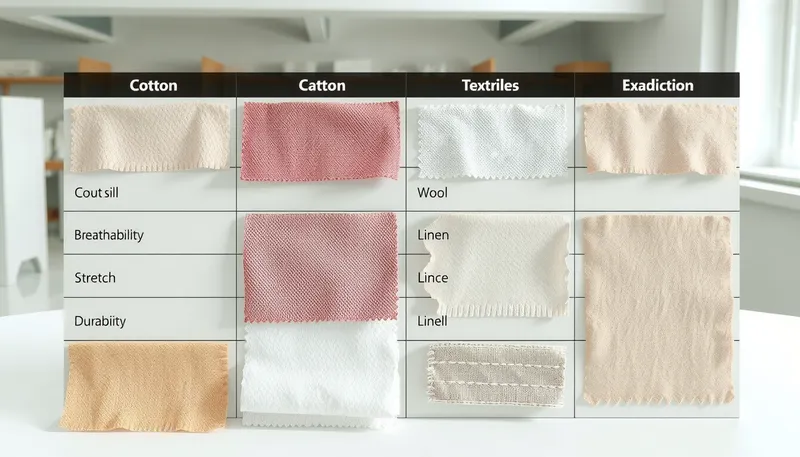
- Cotton/Spandex or Modal/Spandex blends suit light, everyday smoothing garments. Natural fibers feel soft and breathe, but they lack the recovery of nylon or polyester. They are not suitable for firm sculpting or for panels that must hold shape after repeated wear.
| Program Need | Recommended Fabric Family |
|---|---|
| Firm all-day shaping | Nylon/spandex micro-filament (D083) |
| Printed budget line | Polyester/spandex |
| High-compression targeted panels | Power mesh / powernet |
| Light everyday smoothing | Cotton or modal + spandex |
Conclusion: Sourcing High-Compression, Breathable Shapewear Fabric
Source shapewear fabric on three criteria: micro-denier or open construction for breathability, 25–40% elastane for control, and a supplier that proves claims with spec sheets and verifiable certificates. Brands that skip the sample and certificate checks pay in returns.
The 2026 shapewear buyer does not choose between shaping and comfort. The choice is between suppliers who understand micro-denier construction and suppliers who still sell the old trade-off.
Request filament count, demand stretch-recovery data, and verify every certificate number before bulk.
Contact our fabric engineering team → to request D083 Air-Sculpt samples with full spec sheets — GSM, composition, stretch-recovery data, and OEKO-TEX documentation — for your shapewear program.
FAQ: Shapewear Fabric Sourcing
What GSM is best for high-compression shapewear fabric?
200–260 gsm is the standard band for firm shaping with conventional knits. Micro-filament fabrics such as D083 reach firm control at 180–220 gsm because 20D/24F yarns deliver more cover per gram. Select by measured compression and recovery, not by GSM alone.
How much spandex should shapewear fabric contain?
25–40% elastane is the control range. Firm shaping starts at 25%; extreme shaping uses 40% or more. Above 40%, recovery and hand suffer unless the yarn structure compensates, which is where a 20D micro-nylon base matters.
Are all shapewear fabric suppliers in China the same?
No. Suppliers split on specialization, documentation, and process control. Qualify mills that run performance knits, produce full spec sheets, and hold certificates. Order samples from at least three suppliers before committing to bulk.
Can I source sustainable shapewear fabric in China?
Yes. Chinese suppliers offer recycled nylon and recycled elastane options. Verify recycled-content claims under the Global Recycled Standard, because the recycled fiber must be documented at the yarn level rather than asserted in a sales email.
What is the difference between 2-way and 4-way stretch for shapewear?
2-way stretch fabric moves in one direction, lengthwise or crosswise. 4-way stretch moves in both directions. Shapewear needs 4-way stretch so the panel follows the body's curves. In spec sheets, state 4-way stretch and check recovery, because stretch without recovery reads as sag.
How do I verify a supplier's OEKO-TEX or GRS certificate?
Check the certificate number, not the logo. OEKO-TEX Standard 100 certificates appear in the OEKO-TEX Label Check database. GRS certificates are listed in Textile Exchange's Find Certified Company directory. If the certificate number does not match the supplier's legal name, treat the claim as unverified.
🔗 Related Fabrics
This article explains shapewear fabric sourcing from China — balancing high compression with all-day breathability through micro-denier knits (D083 20D/24F), power mesh construction, and supplier vetting — forming the compression and stretch fabric technology matrix:
- Medical Compression Fabric Manufacturers: Sourcing Guide — compression fabric sourcing methodology for medical-grade programs
- Sourcing High-Compression Fabric to Outperform Gymshark — brand-level development of high-compression performance fabric
- Spandex Denier Explained: 20D vs 40D Nylon Feel, Drape — denier and micro-filament mechanics behind D083's fine yarns
- Back to Index
Written by Wenruo
Textile Engineer, Forall Lab