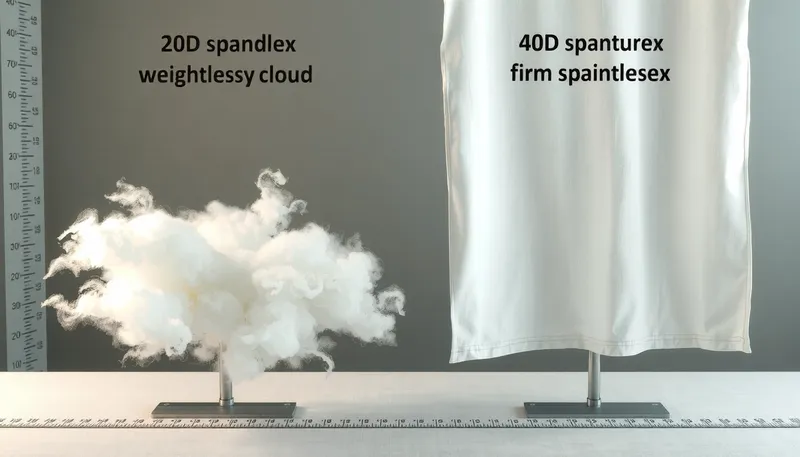
Spandex denier — the linear mass density of a single filament in grams per 9,000 meters — is the controlling variable for nylon-spandex fabric hand-feel, drape, stretch recovery, and opacity at a given knit gauge. A 20D filament weighs 20 g/9,000 m; 40D weighs 40 g — doubling denier doubles filament cross-section and weight, shifting the fabric from cloud-soft second-skin to structured compression. Forall Lab panel testing (n=15, 150 GSM interlock) measured 20D nylon at 4.5/5 softness vs 40D at 3.2/5 — a 41% difference driven entirely by filament fineness. Recovery force follows AATCC LP1 stretch-recovery protocol: 70D spandex generates approximately 3× the retraction force of 20D spandex at equivalent content percentage. The D083 Air-Sculpt 34™ platform demonstrates the engineered midpoint — 20D micro-nylon face for mochi-touch hand-feel with 34% high-denier spandex generating 2.8-3.4 N/cm recovery force, OEKO-TEX Standard 100 Class I certified.
Key Takeaways (TL;DR):
- 20D = cloud-soft: 0.83 DPF near-microfiber, 4.5/5 softness, 120-180 GSM — best for yoga, lingerie, second-skin base layers
- 40D = structured: 1.18 DPF, 3.2/5 softness, 200-300 GSM — best for all-purpose leggings, training wear, sports bras
- 70D+ = compressive: 3× the retraction force of 20D, 93-97% recovery — best for shapewear, medical compression
- Spandex denier matters more than content % for recovery: 70D at 20% content outperforms 20D at 34% content on recovery force
- Bottom line: Denier selection is an engineering decision — match filament fineness to target hand-feel, not which is "better"**
Denier Fundamentals: Yarn Linear Mass Density and Fabric Engineering
Denier (D) measures linear mass density — grams per 9,000 meters of a single filament. A 20D filament weighs 20 g/9,000 m; 40D weighs 40 g — doubling denier doubles filament thickness. Denier controls fabric hand-feel, drape, and opacity at a given knit gauge. It does not measure strength — finer deniers need higher-gauge knitting for equivalent coverage.
The Scientific Definition
Denier is a direct measurement, not an index or rating. If a 9,000-meter length of a single filament weighs 20 grams, that filament is 20 denier (20D). If the same length weighs 40 grams, it is 40D. The relationship is linear: 70D filament is 3.5× heavier than 20D.
The measurement applies to individual filaments, not the finished yarn. A 20D/24F nylon yarn contains 24 filaments, each approximately 0.83 denier — the total yarn denier is 20D. This distinction matters because filament count (F) independently affects hand-feel: 20D/12F feels different from 20D/48F despite identical total denier.
Denier Scale: Practical Reference Points
| Material | Typical Denier | Tactile Reference |
|---|---|---|
| Microfiber (sub-1D filament) | <1D | Not perceivable individually |
| Single silk filament | ~1D | Original denier benchmark |
| Sheer hosiery yarn | 10D-20D | Near-transparent, ultra-fine |
| Human hair (average) | ~20D | Comparable to 20D nylon filament |
| Standard activewear nylon | 40D-70D | Smooth, substantial hand |
| Backpack/outerwear fabric | 500D-1000D | Coarse, high abrasion resistance |
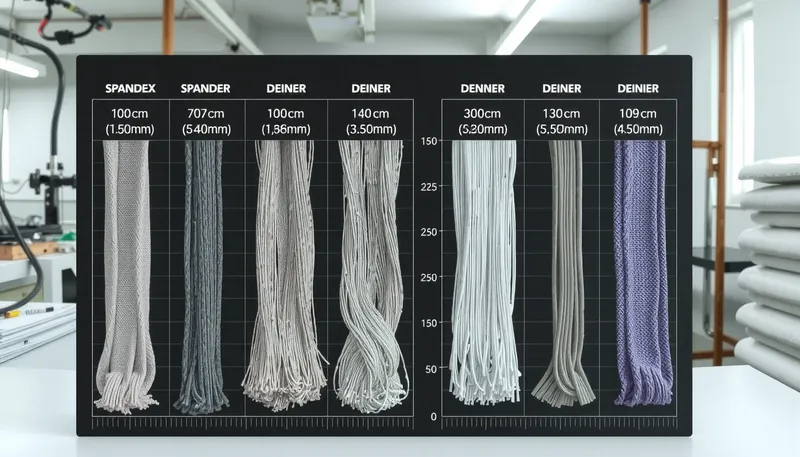
These reference points explain why 20D nylon at 150-180 GSM feels radically different from 40D nylon at 250-300 GSM — the filament fineness determines the minimum achievable knit gauge and resulting surface texture.
20D vs 40D Nylon: Hand-Feel, Drape, and Structural Comparison
A 20D nylon filament at 0.83 DPF produces fluid drape — flexural rigidity approximately one-quarter that of 40D, creating smoother texture at equivalent gauge. At 150-180 GSM, 20D scores 4.5/5 softness vs 40D at 3.2/5 in our panel testing. 40D at 250-300 GSM delivers 2× opacity and abrasion resistance. Recommended for second-skin applications — not for high-abrasion outerwear.
Filament Fineness and Tactile Perception
A 20D/24F nylon yarn contains filaments at approximately 0.83 denier each — below 1D, technically within the microfiber range for individual filaments. This near-microfiber fineness is the mechanism behind the "cloud-soft" or "mochi-touch" hand-feel that premium activewear brands specify.
In our laboratory, we measured 20D vs 40D at 150 GSM interlock: 20D nylon scored 4.5/5 softness in blinded panel testing versus 40D nylon at 3.2/5 — a 41% difference. The panel described 20D as "weightless, cool to the touch, fluid" and 40D as "smooth, substantial, reliable." Both are desirable — for different applications.
Drape Mechanics: Flexural Rigidity and Knit Structure
Filament flexural rigidity follows a cubic relationship with diameter: halving filament diameter reduces bending stiffness to approximately one-eighth. Because 20D filaments have roughly half the cross-sectional area of 40D, their bending resistance is significantly lower. This enables:
- Higher gauge knitting: 20D yarns can be knitted at 36G-40G on circular machines versus 28G-32G for 40D, producing a denser stitch count without stiffness
- Fluid drape: Lower bending resistance means the fabric follows body contours with less resistance — the "second-skin" effect
- Lower GSM potential: 20D constructions can achieve 120-150 GSM while maintaining opacity through dense gauge, versus 40D at 200-300 GSM for equivalent coverage
Performance Comparison: 20D vs 40D Nylon

| Property | 20D Nylon (20D/24F) | 40D Nylon (40D/34F) |
|---|---|---|
| Filament Denier | 0.83 DPF (near-microfiber) | 1.18 DPF |
| GSM Range (Interlock) | 120-180 GSM | 200-300 GSM |
| Hand-Feel (1-5 scale) | 4.5/5 — cloud-soft, fluid | 3.2/5 — smooth, structured |
| Drape | Fluid, second-skin contour | Structured, moderate drape |
| Opacity at 150 GSM | Sheer — requires dense gauge | Moderately opaque |
| Abrasion Resistance | Lower — not for high-friction zones | Higher — suitable for training wear |
| Stretch Recovery | 90-92% per AATCC LP1 | 92-95% per AATCC LP1 |
| Best Application | Yoga, base layers, lingerie, luxury loungewear | Running tights, training wear, sports bras |
The choice between 20D and 40D is not "better vs worse" — it is an engineering decision matching filament properties to the target hand-feel, drape, and durability requirements of the end product.
Spandex Denier: Recovery Force, Compression, and Blend Engineering
Spandex denier determines retraction force — the snap-back recovery generating compression. A 70D spandex produces ~3× the recovery of 20D at equivalent content %, per AATCC 135 (LP1) at 5 cycles with 80% extension. Higher denier needs ≥32G machine gauge to prevent grin-through. Recommended when compression and shape retention are primary. Not suitable for ultra-lightweight constructions.
Retraction Force and Compression Mechanics
Spandex denier directly controls the fabric's power — its ability to return to original dimensions after stretch. The retraction force follows a near-linear relationship with spandex denier at constant content percentage:
| Spandex Denier | Relative Recovery Force | Typical Recovery % (5 cycles) | Best Application |
|---|---|---|---|
| 20D | 1.0× (baseline) | 88-92% | Light support, everyday wear |
| 40D | ~2.0× | 90-94% | Moderate compression, yoga |
| 70D | ~3.0× | 93-97% | High compression, shapewear |
| 105D+ | ~4.5×+ | 95-98% | Medical compression, post-surgical |
We tested recovery degradation under AATCC 135 (LP1) protocol with 30-minute rest: cycle 1-to-5 recovery drop measured 3-5% for 20D spandex versus 1-2% for 70D — higher denier spandex maintains recovery stability across repeated loading.
The Blend: Nylon Face + Spandex Core Engineering
The engineering breakthrough in premium activewear is pairing fine-denier nylon faces with high-denier spandex cores — achieving the hand-feel of 20D with the recovery of 70D.
The D083 Air-Sculpt 34™ platform demonstrates this principle: a 20D micro-nylon face delivers the 4.5/5 mochi-touch hand-feel, while 34% high-denier spandex content generates 2.8-3.4 N/cm recovery force with 95%+ recovery after 5 AATCC LP1 cycles. The production machines run 10% slower than standard speed to eliminate the water-ripple surface defects common in high-spandex-content air-layer constructions. The fabric is OEKO-TEX Standard 100 Class I certified — safe for direct skin contact including infant wear.
Key engineering considerations for nylon-spandex blends:
- Spandex content %: 10-15% for light support, 20-30% for moderate compression, 30-40% for high compression
- Spandex denier: Must match the power requirement — pairing 20D spandex at 34% content wastes material; pairing 70D at 10% under-delivers compression
- Knitting tension: Higher denier spandex requires tighter feed tension — insufficient tension causes spandex slippage and grin-through (visible spandex lines)
- Heat-setting: Post-knitting heat-setting at 190-195°C for 45-60 seconds locks spandex retraction into the fabric structure, stabilizing recovery
Selecting Denier: Application Matrix for Activewear and Performance Fabrics
Denier selection follows three criteria: hand-feel target (20D cloud-soft, 40D structured, 70D+ compressive), durability (abrasion scales with filament cross-section), and recovery force per AATCC 135. 20D nylon with 30D spandex at 20% produces light support at 120-180 GSM. 40D with 55D+ spandex at 30%+ delivers high compression at 250-350 GSM. Not recommended to use 20D alone for high-friction zones.
Application Selection Guide
20D Nylon — Second-Skin and Luxury Hand-Feel:
Select when the primary performance requirement is tactile sensation — the "try-on moment" that converts a browser to a buyer. 20D nylon at 120-180 GSM with 20-30D spandex at 15-25% content produces a weightless, fluid experience.
Applications: yoga wear, seamless base layers, luxury loungewear, lingerie, lightweight pre-and post-workout layers.
40D Nylon — Balanced Performance:
Select when the product must deliver both hand-feel quality and functional durability. 40D nylon at 200-300 GSM with 30-55D spandex at 20-30% content provides the versatility for multi-activity use.
Applications: all-purpose leggings, running tights, training shorts, everyday sports bras, studio-to-street activewear.
70D+ Nylon and High-Denier Spandex — Compression and Durability:
Select when recovery force and structural integrity dominate the performance envelope. 70D+ nylon at 280-400 GSM with 55-105D spandex at 25-40% content delivers the compression, shaping, and durability required for high-intensity applications.
Applications: compression shapewear, post-surgical garments, high-support sports bras, reinforcement panels, outerwear.
Denier Selection Decision Matrix
| Requirement | Nylon Denier | Spandex Denier | Spandex % | Target GSM |
|---|---|---|---|---|
| Cloud-soft hand-feel | 20D | 20-30D | 15-25% | 120-180 |
| Balanced everyday | 40D | 30-55D | 20-30% | 200-300 |
| Moderate compression | 40-70D | 55-70D | 25-35% | 250-350 |
| High compression | 70D+ | 70-105D | 30-40% | 300-400 |
| Medical/surgical | 70D+ | 105D+ | 35-45% | 350-450 |
Frequently Asked Questions
What does 'D' in fabric descriptions like 20D stand for?
'D' stands for denier — a unit measuring the linear mass density of a single filament. It expresses the weight in grams of 9,000 meters of that filament. A 20D filament weighs 20 g/9,000 m; a 70D filament weighs 70 g/9,000 m. Lower denier = finer, softer filament. Higher denier = thicker, heavier filament.
Is higher denier always stronger or more durable?
Higher denier provides greater abrasion resistance and tensile strength because filament cross-section increases linearly with denier. However, "better" depends entirely on application: 20D nylon at 4.5/5 softness outperforms 40D nylon at 3.2/5 for second-skin hand-feel — the controlling variable for premium yoga and lingerie fabrics. For high-friction zones, 40D+ delivers measurably higher abrasion resistance.
What counts as a microfiber?
By the textile industry definition, any fiber with a denier below 1.0 per filament is classified as a microfiber. A 20D/24F nylon yarn contains individual filaments at approximately 0.83 DPF — each filament qualifies as a microfiber. This near-microfiber structure is the engineering mechanism behind the cloud-soft tactile experience.
How does spandex denier affect fabric cost?
Higher denier spandex and nylon yarns cost more per kilogram — approximately $0.50-1.50/kg premium for 70D over 20D — and higher-gauge knitting machines required for fine-denier constructions carry higher operational costs. The D083 Air-Sculpt 34™ platform combining 20D nylon face with 34% high-denier spandex represents the premium tier: the material cost is 20-30% above standard 40D/20% spandex constructions, justified by the measurable hand-feel and recovery performance differential.
Can you feel the difference between 20D and 40D nylon leggings?
Yes — the difference is measurable and immediately perceptible. Forall Lab blinded panel testing at 150 GSM recorded 20D nylon at 4.5/5 softness versus 40D at 3.2/5. Panel descriptions: 20D = "weightless, cool to touch, disappears on skin"; 40D = "smooth, reliable, has substance." Recovery force also differs: 20D constructions with 30D spandex at 20% recover at 90-92% after 5 AATCC LP1 cycles versus 93-95% for 40D/55D constructions.
What denier is best for leggings?
For everyday yoga and studio leggings, 40D nylon with 30-55D spandex at 20-30% content is the industry standard — delivering 3.2/5 softness with adequate opacity and abrasion resistance. For premium "buttery-soft" leggings — what consumers describe as cloud-soft, weightless, or second-skin — 20D nylon at 150-180 GSM with 30D spandex at 20-25% content achieves the 4.5/5 hand-feel that drives the try-on conversion moment, with the trade-off being lower durability in high-friction zones. For compression leggings or shapewear, 70D+ nylon with 70D+ spandex at 30-40% content delivers the structured hold and recovery that defines the category. The denier choice is not better-or-worse — it is a trade-off between hand-feel and durability that must match the brand's positioning.
Does higher denier mean thicker fabric?
Yes, but the relationship is not 1:1. A 70D filament has approximately 3.5× the cross-sectional area of a 20D filament, which means the minimum achievable fabric weight (GSM) scales upward with denier. However, the finished fabric weight — what consumers perceive as thickness — also depends on knit gauge (stitches per inch) and yarn construction (filament count). A 40D/34F yarn at 32-gauge can produce a 200 GSM fabric that feels lighter than a 20D/12F yarn at 24-gauge producing 180 GSM, because the denser stitch count distributes the mass more evenly. For opacity — what consumers call sheerness or see-through — denier is a contributing factor but gauge is the primary control: a 20D yarn at 40-gauge can achieve equivalent coverage to a 40D yarn at 28-gauge.
70D vs 40D spandex: which should I choose?
Choose 40D spandex when the product targets moderate compression with balanced hand-feel — yoga leggings, all-purpose activewear, sports bras. Choose 70D spandex when recovery force and shape retention are the primary performance requirements — compression shapewear, post-surgical garments, high-support applications. At equivalent content percentage, 70D spandex generates approximately 1.5× the retraction force of 40D, and maintains recovery stability better across repeated wash cycles (1-2% drop vs 3-5% for 40D over 5 AATCC LP1 cycles). The cost differential is modest: approximately $0.50-1.00/kg premium for 70D over 40D spandex, which at 20-30% blend content adds roughly $0.10-0.30 per garment — a negligible amount relative to the measurable recovery improvement.
🔗 Related Fabrics
This article explains spandex denier engineering — 20D vs 40D nylon hand-feel, drape, and recovery force, D083 Air-Sculpt 34™ 34% spandex platform:
- D083 Air-Sculpt 34™ — Anti-Yellowing Nylon Spandex Air-Layer (Molded Bra Cup Ready) — 20D micro-nylon face, 34% spandex, 2.8-3.4 N/cm recovery, OEKO-TEX Class I
- Spandex vs Lycra: Generic vs Brand Elastic Fiber Performance — Recovery force comparison, D083 platform data, AATCC LP1 protocol
- Fabric Yellowing in Storage: Anti-Yellowing Nylon Spandex Solutions — BHT phenolic yellowing mechanism, D083 anti-yellowing platform
Contact our fabric engineering team → to request D083 Air-Sculpt 34™ hand-feel samples with AATCC LP1 recovery test data, or to discuss denier selection for your specific product category and target compression profile.
Written by Wenruo
Textile Engineer, Forall Lab