
What makes leggings squat-proof, and how do you test it? Squat-proof leggings are defined by opacity under 50% stretch — a fabric passes when its "grin-through" (the visible exposure of white elastane fibers through the stretched outer yarns) is eliminated by knit construction, not by thickness or color. A 160gsm high-density interlock outperforms a 250gsm single jersey because its interlocked loop structure compacts under tension instead of separating.

The Problem: More Than Just See-Through
Squat-test failure is not a cosmetic defect — it is a measurable indicator that the fabric's loop structure separates under tension, exposing the elastane core and producing the "white glaze" that customers interpret as poor quality. For activewear brands, grin-through drives a measurable return-rate cost: leggings that fail the squat test generate "see-through" reviews at 3-5× the rate of opaque fabrics, and a single viral see-through complaint can wipe out a product launch.
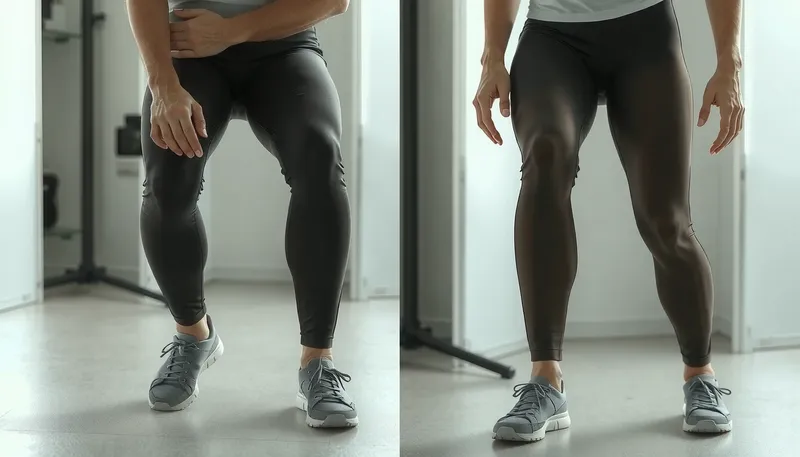
Your First Defense: The 3-Step Home Squat Test
Prior to procuring the fabric or new leggings, using this simple checklist is a must. It is the very first step to see if your leggings can stand the test of time.
-
The Light Check. Try to test your leggings in the brightest light you can find. Dim store lights can mask issues. For the real test, having bright, natural light is non-negotiable. Stand with your back to a sunny window. The sunlight will better illuminate what someone standing behind you can see.
-
The Deep Squat & Bend Test. You should wear bright colored or patterned underwear. Stand in front of a full-length mirror. Go down into a deep squat. Then bend over forward as if you are touching your toes. If you can see the color, pattern, or outline of your underwear, the leggings fail.
-
The Fabric Stretch Test. You can find problems before you put them on. Take fabric from the thigh or seat area. Stretch it wide with both hands. If you can clearly see your fingers and skin details through the material, it won't be solid when worn.
The Real Problem: Understanding "Tension/Grin-Through"
Grin-through (also called "tension opacity failure" in fabric QC terminology) occurs when single-knit loops separate under stretch, opening gaps that expose the white spandex core — the mechanism is mechanical, not thickness-dependent. A fabric can be 250gsm and still grin-through if the loop geometry opens under tension; conversely, a 160gsm interlock stays opaque because its interlocked loops compact rather than separate.
With this phenomenon, the fabric stretches. The colored fibers (like nylon or polyester) break apart. At the same time, we can see the white or clear stretchy fibers (spandex) inside. Hence, we have this faded, shiny, or white see-through look. The interior threads are "grinning through" the spaces of the outer threads.
The majority of basic lightweight fabrics are made of single-knit construction. When you squat, the knit loops get looser. Therefore, more space is created between the threads. As a result, it shows the stretchy fibers and your skin.
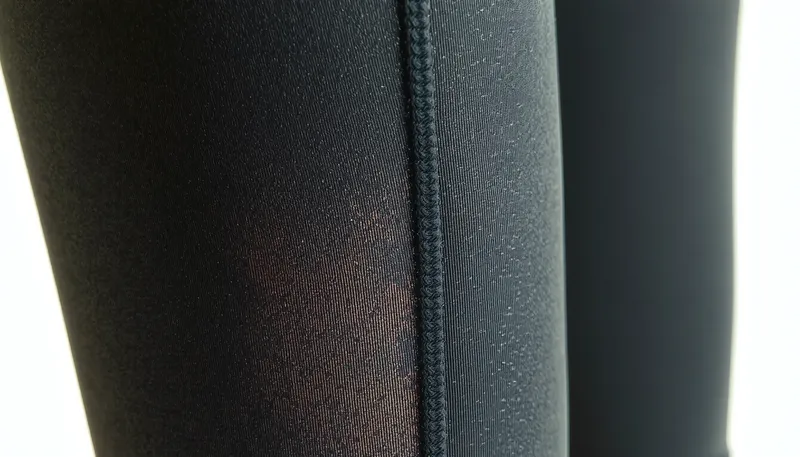
It is just like a chain-link fence. The relaxed mode appears intact. But once you pull it from both directions, wider gaps form. This unlocks the view. The same is true for fabrics. Therefore, testing for squat proof leggings involves finding such effects of grin-through.
The Lab-Grade Grin-Through Tension Test
In QC, the grin-through test is a biaxial stretch-opacity measurement: stretch a conditioned specimen to a defined extension in both the machine and cross directions, hold it over a calibrated daylight (D65) light source, and grade the light that passes through the opened loops. It is the objective counterpart to the home test — the method a mill or third-party lab runs when a brand writes "squat-proof" into a tech pack. Our D036 protocol follows this sequence:
- Condition the specimen. Precondition the fabric for 24 hours in a standard textile atmosphere (65 ± 4% RH, 20 ± 1 °C) before testing, per ASTM D1776. Humidity changes spandex tension and would skew the reading.
- Cut a full-width sample. Test in both directions and never approve a color range from a single black sample — light colors need separate qualification.
- Stretch biaxially. Extend the specimen to roughly 150% of its relaxed size in both the machine direction (MD) and cross direction (CD), recreating the multi-directional load of a deep squat. This maps to the knit stretch-property measurement covered by ASTM D2594.
- Grade under standardized light. Place the stretched specimen over a calibrated D65 lightbox and inspect for "grinning" (white elastane exposure). Score opacity on a 1–5 scale, where 5 is fully opaque and 4 is the usual commercial pass line.
- Re-test after care. Photograph stretched samples as pass/fail evidence and repeat the test after agreed wash cycles — elastane degrades with heat and friction, so opacity must hold after laundering, not just at first inspection.
| QC Pass Target (D036 Interlock) | Value | Method |
|---|---|---|
| Fabric weight | ≥160 gsm | ASTM D3776 (mass per unit area) |
| Stretch opacity | Grade ≥4 at 150% biaxial stretch; D036 measures <5% light transmission | Grin-through tension test on a calibrated D65 lightbox |
| Stretch recovery | >90% recovery after release | Elongation-recovery test |
The Fabric Answer: Why High-Density Interlock Works
High-density Interlock solves grin-through at the structural level: its "One-Open-One-Close" (一开一闭) double-knit geometry interlocks two yarn loops so tightly that under 50% stretch the loops compact against each other instead of separating. For technical validation, opacity is measured by light transmission at 50% stretch — an interlock knit transmits <5% light versus 10-15% for single jersey at equivalent GSM per ASTM D3776.
Interlock is a double-knit type. It consists of two interlocked loops of yarn. It is typically constructed in what is called "One-Open-One-Close" (一开一闭) format. The structure of this fabric is special. When the loops are locked, the fabric is like a band, compressing against one another. They do not pull apart. This closes any gaps and completely eliminates grin-through.
The firm structure is also stable for printing. In a standard knit, the print will often warp or fade when it is pulled. But the interlock stability keeps the prints vivid and true to color, even when stretched to the maximum. Although choosing the right colors and patterns can boost confidence, the fabric structure is what truly guarantees performance.
For brands looking for a lightweight fabric that still won't be see-through, a high-density alternative like our Nylon Interlock | D036 is perfect. With its lightweight of 160gsm, it feels airy. Yet, the structure offers the strength of a woven canvas. That solves the problem of print warping and ensures 100% squat-proof.
FAQ: Your Squat-Proof Legging Questions Answered
Here are some brief solutions to the most commonly asked questions about finding, buying, and testing squat-proof leggings.
Does higher GSM always mean leggings are squat-proof?
Not always. GSM (grams per square meter) helps, but a poorly built 250 GSM single jersey can still grin-through, while a well-knit 160 GSM interlock can hold full opacity because its loops compact under tension instead of separating.
Are black leggings more squat-proof than colored or printed ones?
Yes, certainly. Black implies dyes can make some see-through places disappear. However, the main issue, "grin-through," remains unresolved. A badly constructed black fabric will still give a white glaze when pulled. In the end, the fabric structure is the actual test, not its color.
Can wearing the wrong size make my leggings see-through?
Yes. If leggings are too small, the fabric is over-stretched beyond its design limits and can turn sheer even when the same fabric passes the squat test at the correct size. Fit tension is part of the opacity equation — always test in the correct size and follow the brand's size guide.
What's the difference between interlock and double-knit?
The interlock is a certain kind of double-knit fabric. For example, all interlocks are double-knits, but not all double-knits are interlocks. Stability, smooth surfaces on both sides, and high opacity are the characteristics that interlock is known for.
How should I care for leggings to keep them opaque?
Use cold water to wash them on a gentle cycle and hang-dry instead. High heat from a dryer can cause damage to the stretchy fibers over time. This can lead to the loss of bounce and strength, which means the fabric will be less solid.
What is the best fabric for guaranteed squat-proof leggings?
A 160gsm high-density Nylon Interlock with a "One-Open-One-Close" structure is the most reliable squat-proof specification — it delivers <5% light transmission at 50% stretch while remaining lightweight and breathable. The D036 Nylon Interlock achieves this through its interlocked double-knit geometry: when stretched, the loops compact rather than separate, eliminating grin-through without the weight penalty of 220gsm+ single jersey. For brands specifying in a tech pack, request "160gsm Interlock, opacity Grade 4 at 50% stretch" rather than a GSM number alone.
What is the difference between a bursting strength test and a squat test?
A bursting strength test — such as the ISO 13938-1 bursting test — measures how much force it takes to rupture a fabric, which is a durability property. A squat test (or grin-through test) is an opacity-under-tension test: it measures whether the knit stays opaque when stretched to squat depth. The two do not correlate — a fabric can pass a bursting test yet still be see-through in a deep squat. Activewear specs need both: burst strength for durability, and a tension-opacity test for coverage.
Does 4-way stretch make leggings squat-proof?
No. Four-way stretch (recovery in both the machine and cross directions) is a comfort and movement property — it does not guarantee opacity. On a loosely knitted single jersey, higher stretch can open the loops further and make grin-through worse. Squat-proofness comes from the knit structure: interlock loops compact under tension instead of separating. Specify both in the tech pack — 4-way stretch for fit, and opacity Grade 4+ at 50–150% stretch for coverage.
🔗 Related Fabrics
This article covers how to test squat-proof leggings — the 3-step home test, grin-through mechanics, and interlock construction for guaranteed opacity:
- D036 Nylon Spandex Interlock — 160gsm Interlock with <5% light transmission at 50% stretch
- What Is Fabric Grin Through — Full grin-through technical guide: knit geometry and opacity testing
- Activewear Fabric Weight Guide — GSM vs opacity vs drape: how construction beats weight
Written by Wenruo
Textile Engineer, Forall Lab