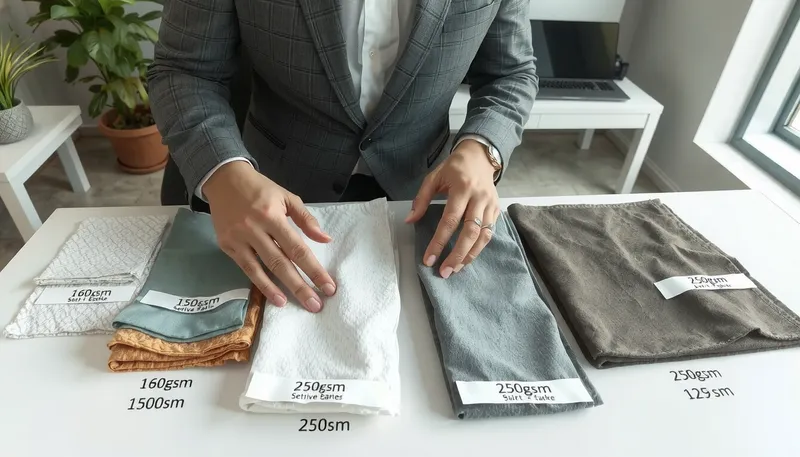
What is GSM in fabric sourcing and why does it control your FOB cost? GSM (Grams per Square Meter) is the global density metric for textiles, standardized under ISO 3801. For sourcing managers, GSM simultaneously governs three business-critical variables: garment opacity (squat-proof threshold at ≥220gsm), compression level (higher GSM = higher mechanical tension), and material yield — the meters-per-kilogram ratio that directly determines per-unit FOB cost.
Key Takeaways (TL;DR):
- Lightweight (<180gsm): UPF50+ rash guards, base layers, digital printing — but Single Jersey curls; use Interlock at 160gsm
- Medium (180-250gsm): The squat-proof sweet spot for leggings and sports bras — non-negotiable for lower-body activewear
- Heavy (250gsm+): Medical-grade compression, thermal winter gear, structured athleisure
- GSM Alone Is Not Enough: Tech Pack must also track stretch recovery (>95%), shrinkage (<3%), and color fastness (Grade 4-5)
- Structure Over Weight: A 160gsm Interlock outperforms a 160gsm Single Jersey in cutting yield by 5% — same GSM, different bottom line
What is GSM and How It Impacts Activewear
GSM (Grams per Square Meter), standardized under ISO 3801, is the global density metric for textiles — it measures the mass of fabric per unit area and is the single most important number on any activewear tech pack. For sourcing managers, GSM simultaneously governs opacity (squat-proof threshold), tensile strength, and total landed cost via material yield variation — fabric bought by the kilogram but cut by the meter.
Sourcing professionals rely on GSM as the foundational number on any tech pack. It governs three crucial garment aspects:
- Opacity (Squat-Proofing): A higher GSM (typically 220gsm+) interlock provides necessary coverage. This is a non-negotiable factor for lower-body activewear.
- Compression & Support: Denser fabrics deliver higher mechanical tension. High-impact sports bras require medium-to-heavy GSM for structural support.
- Yield & FOB Price: Fabric is purchased by weight (KG) but cut by length (Meters). Lower GSM means more meters per kilogram, reducing the material cost per unit.
The Activewear Fabric Weight Guide: Matching GSM to Use
Selecting the right GSM aligns material physical properties with garment function. Here is the verified weight classification for 2026 activewear collections.
Light Range (Under 180 GSM)
Engineered for second-skin feel, high breathability, and rapid moisture-wicking.
- Uses: Running t-shirts, summer active sets, base layers, and UPF50+ rash guards.
- The Sourcing Risk: Standard lightweight single jersey knits are highly prone to edge curling. This wastes fabric on the cutting table and slows down production.
Medium Range (180 - 250 GSM)
The versatile workhorse of the activewear industry, balancing coverage and 4-way stretch.
- Uses: High-quality leggings, supportive sports bras, and versatile yoga tops.
- The Benefit: It provides zero-transparency (squat-proof) performance while maintaining enough flexibility for dynamic movements.
Heavy Range (250+ GSM)
Designed for high mechanical compression, maximum durability, and thermal retention.
- Uses: Medical-grade compression leggings, winter thermal gear, and structured athleisure hoodies.
- The Benefit: Heavy weight delivers brute-force compression to stabilize muscles and trap body heat in cold climates.
The 160gsm Challenge: Why Single Jersey Fails on the Factory Floor
Standard 160gsm Single Jersey suffers from asymmetric loop geometry that causes edge curling — production managers call this "potato-chip fabric" — consuming up to 5% of total fabric volume in cutting waste and slowing automated spreading machines by 15%. Switching to a 160gsm Double Jersey Interlock eliminates this mechanical flaw through balanced face-to-face knit geometry, delivering identical GSM with zero curl and 5% higher cuttable yield.
Based on our factory floor data, using cheap single jersey for lightweight garments increases labor time during cutting and sewing by 15%. Furthermore, its unstable surface causes severe distortion during dye-sublimation printing.
The FORALLTEX Solution: D036 Double Jersey Interlock
To solve this, we engineered the D036 Nylon Spandex Interlock. Using a "One-Open-One-Close" interlock structure, this 160gsm fabric lies completely flat.
By combining 40D Nylon 6 and 20D Elastane, we achieved an 80/20 ratio that offers a buttery hand-feel with immense tensile strength. The tight, stable face makes it the ultimate base for high-definition digital printing without pattern warping.
When NOT to use 160gsm D036: Do not use 160gsm fabric for yoga leggings or lower-body compression garments. Regardless of the knit quality, 160gsm lacks the mass to pass a deep squat-proof test. For leggings, you must upgrade to a 220gsm+ material like our D083 Air-Sculpt Fabric.
Beyond GSM: A Sourcing Director's Technical Checklist
GSM is the starting point, not the endpoint — a complete Tech Pack must specify stretch recovery (ASTM D2594 ≥95%), shrinkage (AATCC 135 <3%), and color fastness (AATCC 61 Grade 4-5) alongside fabric weight. Without these three supplementary metrics, GSM alone cannot predict garment performance or return rates.
Physical Data Comparison Table
| Parameter | Industry Standard (160gsm Jersey) | FORALLTEX D036 (160gsm Interlock) | Why It Matters for Your Production |
|---|---|---|---|
| Composition | 85% Poly / 15% Spandex | 80% Nylon 6 / 20% Elastane | Superior hand-feel, higher strength, and moisture-wicking. |
| GSM | ~160 g/m² | 160 g/m² | Exact weight matching with superior structural stability. |
| 4-Way Stretch Recovery | ~85-90% | >95% | Garments retain shape post-wash; lowers return rates. |
| Shrinkage Rate (Post-Wash) | >5% | <3% | Maintains accurate sizing in bulk production. |
| Color Fastness (to Wash/Rub) | Grade 3-4 | Grade 4-5 | Stops color bleeding; extends the garment's lifecycle. |
| Edge Curling | High (Causes waste) | Minimal to None | Accelerates automated cutting and reduces fabric waste. |
The ROI of Premium Fabric: A Cost-Saving Calculator
Do not judge fabric solely by its FOB meter price. Evaluating the Total Cost of Ownership (TCO) proves that engineered fabrics increase factory margins.
- Higher Yield & Less Waste: D036 Interlock features non-curling edges. Reducing fabric waste by just 5% on a 10,000-unit order saves thousands of dollars in raw material costs.
- Reduced Labor Costs: Fabric that lays flat can be spread and cut 20% faster. This reduces man-hours and shortens your production lead time.
- Lower QC Rejection Rates: Premium anti-yellowing treatments and Grade 4-5 color fastness prevent post-production defects. Dropping your QC rejection rate by 2% directly boosts your net profit.
3-Step Sourcing Action Plan
Stop losing margins to edge curling and fabric waste. Follow this protocol to optimize your next production run:
Step 1: Audit Your Tech Pack Check your lightweight designs (rash guards, tees). If the spec calls for "Single Jersey," you are risking print distortion and high cutting waste.
Step 2: Calculate the Yield Calculate the labor savings of switching to a flat, non-curling interlock base.
Step 3: Test the Print Quality Action: Request a 2-yard sample of our D036 160gsm Nylon Interlock. Run a dye-sublimation print test to verify the >95% stretch recovery and zero-warping performance in your own sample room.
Frequently Asked Questions for Sourcing Managers
What is the standard MOQ for your performance fabrics?
Our standard Minimum Order Quantity (MOQ) is typically 1000 meters per color. However, at FORALLTEX, we support scaling brands and can negotiate flexible trial runs for new collections.
How does yarn count (e.g., 20D/40D) affect the final fabric?
Yarn count (Denier) measures fiber thickness. A 20D Elastane provides fine, powerful stretch, while a 40D Nylon offers a robust face. Combining them in our D036 creates a fabric that is lightweight (160gsm) yet incredibly strong.
What is your process for lab dips and strike-offs?
Upon receiving your Tech Pack, we provide lab dips for color approval within 7-10 days. For printed fabrics, we supply digital strike-offs to verify pattern scale and color accuracy before bulk production begins.
Can you accommodate custom dyeing techniques?
Yes. We specialize in high-performance dyeing that guarantees Grade 4-5 color fastness. We accommodate custom Pantone matching and specific anti-yellowing treatments required for 2026 activewear standards.
What are your typical lead times and shipping terms (FOB)?
Our standard lead time from order confirmation to shipment readiness is 25-35 days. We operate primarily on FOB (Free On Board) Shanghai/Ningbo terms to ensure predictable logistics for your supply chain.
What GSM should I specify for squat-proof leggings?
220gsm is the minimum commercially viable GSM for squat-proof leggings — regardless of knit quality or elastane content, fabric below 200gsm cannot pass a standardized squat opacity test under D65 lighting at 50% stretch. For premium leggings with zero-transparency guarantees, specify 220-250gsm Interlock with ≥28% elastane content. Below 200gsm, limit the fabric to tops, base layers, and rash guards where opacity is not a functional requirement.
🔗 Related Fabrics
This article covers activewear fabric weight (GSM) — the sourcing manager's guide to matching GSM to garment function, cutting yield, and FOB cost:
- D036 Nylon Spandex Interlock — 160gsm non-curling Interlock platform; 5% higher cutting yield vs Single Jersey
- D083 Air-Sculpt Fabric — 220gsm squat-proof fabric with Grade 4-5 pilling resistance
- Fabric Elongation & Recovery Test — ASTM D3107 stretch recovery: the companion test to GSM
Written by Forall Lab
© Forall Lab • Powered by Kunpeng ONE