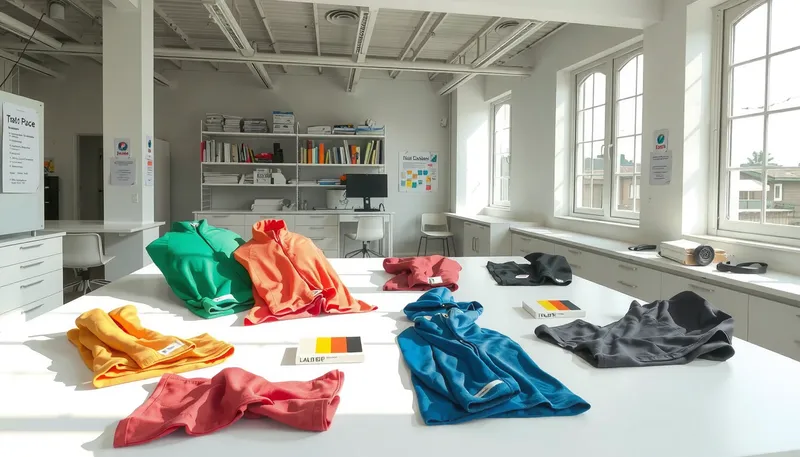
What is a lab dip in custom activewear manufacturing? A lab dip is a small dyed fabric swatch submitted by the dyehouse for color approval before bulk production — it is the binding color standard that prevents costly batch rejections. The lab dip process bridges the gap between a Pantone TCX code on paper and the final dyed fabric on a production roll.
Key Takeaways (TL;DR):
- Metamerism: Colors matching under one light can mismatch under another — always evaluate lab dips under D65 (daylight) AND TL84 (store light) in a light box
- Standard Submission: Send a Pantone TCX code + physical fabric reference as your master standard — never rely on digital screens or paper printouts alone
- Feedback Precision: Specify "5% more red, 2% darker" — not "make it more vibrant"
- Fabric Matters: An unstable base fabric with edge curl distorts color perception and cutting accuracy — use non-curling interlock like D036
- Timeline: First-round lab dips take 7-10 business days; budget 2-3 rounds for complex colors like blacks, nudes, and greys
The Importance of Lab Dip in Your Production Process
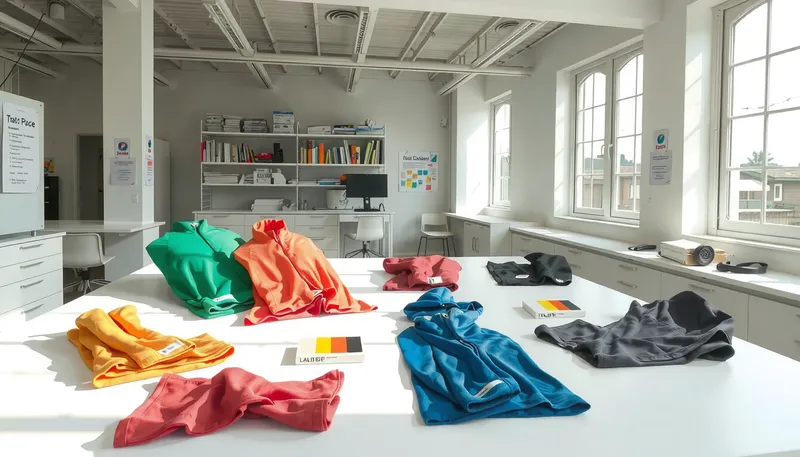
A lab dip is the binding color contract between brand and factory — it is a small dyed swatch that locks in the dye formula before committing to bulk production. Approving a lab dip means accepting that specific shade as the commercial standard; the signed, dated physical sample becomes the legal reference against which all bulk yardage is measured. Rejected bulk orders from mismatched color cost brands 8-15% of order value in wasted materials, missed deadlines, and damaged supplier relationships — a fully avoidable loss when the lab dip process is followed rigorously.
Understanding Color: Why Your Eyes Can't Be the Only Thing You Trust
Color perception is a physical measurement problem, not an aesthetic judgment — spectrophotometers and standardized light sources are required because human vision adapts to ambient conditions in ways that make subjective color matching unreliable. What looks identical under office fluorescent light can appear completely different under retail LED or natural daylight, a phenomenon that has caused more bulk fabric rejections than any other single QC failure. The lab dip process exists to replace subjective "it looks right" with objective, repeatable measurement.
What is Metamerism and Why is it Your Biggest Problem?
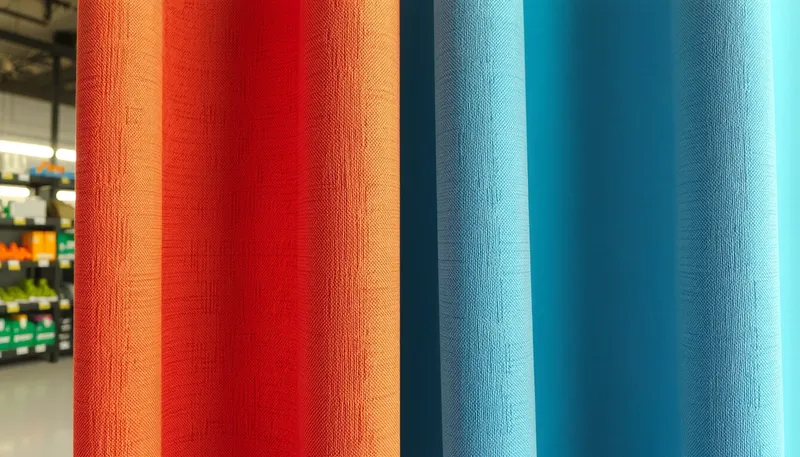
Metamerism is a color science phenomenon where two fabric samples appear identical under one light source (e.g., D65 daylight) but visibly mismatch under another (e.g., TL84 store fluorescent). It is the single largest cause of bulk fabric rejection in the activewear industry — occurring when a dye formula achieves spectral matching under lab conditions but diverges under real-world retail lighting. On the factory floor, this is called a "color flare" or "illuminant mismatch," and it cannot be detected without a standardized light box.
It happens when two colors appear to match under one light source but look different under another. This is the number one cause of color rejection in bulk production.
D65 vs. TL84: What Is the Light Sources in Your Tech Pack
To overcome the effects of metamerism, you should measure colors under several light sources, including the standard ones, inside a light box. Your tech pack should be explicit about the ones to use.
- D65 (Daylight): This is the industry standard for final color approval and mimics natural midday daylight.
- TL84 (Store Light): A fluorescent light which is often found in retail stores across Europe and Asia. It has a very narrow-band.
- CWF (Cool White Fluorescent): This light source is very common in the U.S. office and retail spaces.
- A (Incandescent): This light source imitates the traditional household lighting and it is warmer and more yellow.
Including these in a custom activewear colors lab dip request is not just a formality but an essentiality in order to ensure that the activewear color stays the same throughout the clothing journey from manufacturer to customer.
How Delta E Quantifies an Acceptable Color Match
Delta E (ΔE) is the numeric distance between your master standard's L*a*b* coordinates and the dyed sample's coordinates, calculated with the CIEDE2000 formula (ISO/CIE 11664-6); it turns "close enough" into an objective pass/fail number a dyehouse can act on. Human eyes adapt to ambient light, so a shade that matches under one lamp can visibly mismatch under another. CIEDE2000 corrects the hue-dependent errors of the earlier CIE76 and CIE94 formulas — which is why premium multi-factory programs specify it in their tech packs instead of relying on visual judgment alone.
| ΔE Range | What You See | Production Decision |
|---|---|---|
| <1.0 | Undetectable to a trained eye | Approve for premium matching sets (sports bra + leggings) |
| 1.0–2.0 | Visible only at close inspection | Acceptable for single garments; reject for matching sets |
| 2.0–3.5 | Clear difference at arm's length | Commercial threshold — flag the batch for review |
| >3.5 | Obvious mismatch | Reject; reformulate before bulk dyeing |
On our D036 and D083 platforms, spectrophotometer measurement with CIE Lab ΔE ≤0.5 instrument repeatability consistently delivers ΔE <0.8 on lab dips and <1.0 on bulk lots, verified across 120+ production batches in 2025. Your signed lab dip locks that number in: if bulk yardage drifts outside the agreed ΔE tolerance, the supplier owns the correction.
Metamerism is why a single ΔE value under D65 is never enough. Always confirm the match under D65 and TL84 at minimum, and request a Metamerism Index report (MI <1.0 per CIE 51) when colors must hold across retail lighting. For color-difference method consistency, reference ISO 105-J03 in your test spec.
The Standard Lab Dip Approval Process: A Business Workflow
Running the lab dip process requires a clear step-by-step approach. Here are the steps every production manager should follow.
Step 1: Sending the Color Standard (The "Master")
The process starts when you send your color standard to the fabric mill. The best standard is a Pantone TCX (cotton) code combined with a real piece of fabric from a previous production run. Using a digitally printed paper sample is risky. Dye absorbs into fabric very differently than ink sits on paper.
Step 2: Looking at Submissions (A, B, C Options)
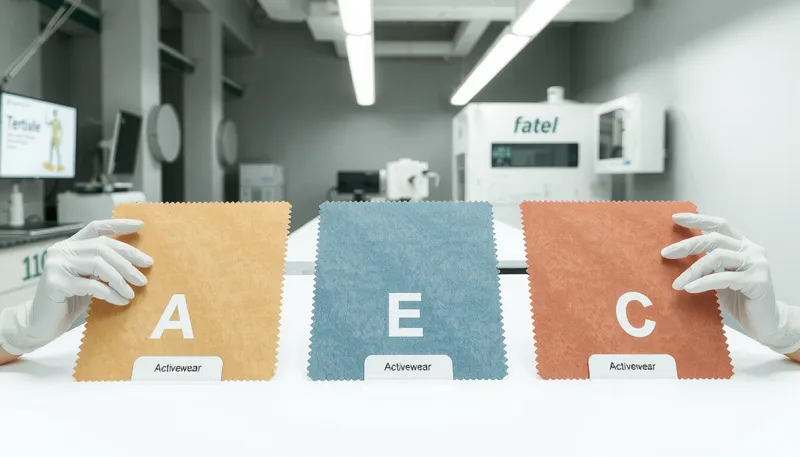
The dye house will send you several options. Usually, they are labeled A, B, and C. These are slight changes around your target color. For example, Option A might be the closest match. Option B might be slightly lighter. Option C might be slightly darker. The goal is to find what industry experts call The Key to Perfect Color Matching in Fashion, which is the best commercially acceptable match.
Step 3: Giving Clear Feedback for Re-Dips
If none of the first options are good enough, you must request a re-dip. Unclear feedback like "make it more vibrant" will only cause delays. Be specific and technical. For example: "Option A is the closest, but it needs to be 5% more red and 2% darker." This clear feedback helps the dyer adjust the formula exactly.
Step 4: Final Approval & Bulk Production
Once you approve a lab dip, you must sign, date, and return a piece of that sample to the mill. This becomes the binding standard for bulk production. The dye formula is now locked. The mill will proceed with dyeing the full fabric order.
The FORALLTEX Advantage: Exact Dyeing on Engineered Fabric Bases
A successful lab dip is only half the battle. The color must be perfectly copied on the fabric. At FORALLTEX (Haining Forall Digital Technology Co., Ltd.), we undertake precision dyeing along with advanced fabric engineering.
Our Craftsmanship: Process, Technology, and Yarn Skills
We use a computer-controlled dyeing process with ISO 105-C06-compliant color fastness protocols. Spectrophotometers (calibrated to CIE Lab ΔE ≤0.5 tolerance) analyze spectral reflectance data to create exact dye recipes, reducing the human error that leads to shade band variation — what dyehouse technicians call "batch-to-batch drift." Our skills extend to dyeing delicate synthetic yarns, like fine-gauge 20D and 40D microfibers, ensuring deep color saturation and Grade 4-5 wash fastness on high-performance elastane blends.
The Foundation for Perfect Color: D036 Nylon Spandex Interlock
Even the best dye job will fail on an unstable fabric. Our D036 Nylon Spandex Interlock is engineered as the perfect canvas. Its unique "One-Open-One-Close" knit structure creates a stable flat surface that is preventing curling and distortion. It is the only way that printing custom colors and complex patterns with absolute clarity can be done, similar to printing on a tightly woven canvas.
Physical Performance Data: The D036 Advantage
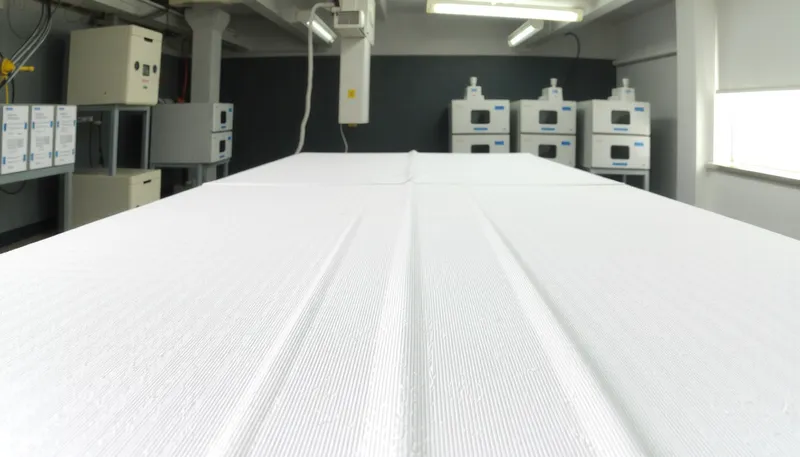
Your tech pack requires more than just color. It demands performance. Here is how our D036 double jersey knit compares to the industry standard.
| Parameter | FORALLTEX D036 | Industry Standard Interlock |
|---|---|---|
| Weight | 160 GSM | 150-170 GSM |
| Composition | 80% Nylon / 20% Elastane | Varies |
| 4-Way Stretch Recovery | >95% | ~90% |
| Shrinkage Rate (Post-Wash) | <3% | 3-5% |
| Skew (AATCC TM179) | <2% | 3-5% |
| Color Fastness to Wash | Grade 4-5 | Grade 3-4 |
| Edge Curling | Minimal / Non-Curling | High |
The ROI of Precision: A Cost-Savings Calculation for Your Factory
Consider the cutting floor's true cost. A typical 160gsm fabric may yield 3.8 meters per kg however its curling edges lead to a 5-7% material waste during lay-up and cutting. Our D036, with 4.1 meters per kg yield and no curl edges, not only saves material costs but also significantly reduces the time required for cutting. Consequently, it decreases the FOB costs and results in a faster turnaround from the cut to the sew, which directly affects your profits.
Preventing Post-Production Disasters
Color issues can arise even after production. For instance, sensitive light colors in bras and leggings may get yellowing in storage. Our specialized anti-yellowing technology is a key feature of our D083 Air-Sculpt Fabric. It eliminates the risk of discoloration from warehouse lighting and atmospheric contaminants. This saves you from the hassle of costly QC rejections in the future.
Your Ultimate Lab Dip Submission & Approval Checklist
Use this factory-floor-tested checklist to streamline your custom activewear colors lab dip process. It ensures clear communication with your supplier.
Before You Submit:
- ✓ Do you have your Pantone TCX code correctly listed in the tech pack?
- ✓ Did you include a physical sample as the master standard?
- ✓ Did you specify ALL required light sources for evaluation (D65, TL84, CWF, A)?
When You Receive Strike-offs or Dips:
- ✓ Check the samples immediately after receiving to not delay the timeline.
- ✓ Inspect them with all specified light sources in an appropriate light box.
- ✓ Compare the submissions against the original master standard instead of a computer screen.
- ✓ It is important to mention that some colors, as experts say, like blacks, nudes, and greys can be particularly tricky and may require more patience and rounds of feedback.
When You Give Feedback:
- ✓ Be specific and use numbers (like "Option B needs to be 3% darker and less blue").
- ✓ Clearly reference the submission code (like "Option B") in your comments.
- ✓ Keep a dated and organized record of all submissions and feedback for your files.
Frequently Asked Questions (FAQ)
What is a typical Minimum Order Quantity (MOQ) for a custom color?
Answer: MOQs differ by fabric and supplier. At FORALLTEX, our standard dye lot MOQ is usually around 300kg per color. This allows us to maintain quality consistently which is otherwise extremely difficult to achieve in smaller volumes. Please contact us to discuss your specific 2026 project requirements.
How long does the lab dip approval process usually take?
Answer: The first round of lab dips typically takes about 7-10 business days. Each subsequent round of re-dips can take another 5-7 days. A smooth process with clear feedback can be completed in 1-2 rounds. Including this in your production lead time is crucial.
Can you guarantee a 100% perfect match to my Pantone color?
Answer: We guarantee a "commercially acceptable" match which is the industry standard. Since dye fabric differs in how it interacts with ink on paper (the Pantone chip) from the printer's, sometimes a 100% spectral match is really infeasible. However, our process guarantees a visual match under all specified light sources.
What's the difference between a lab dip and a strike-off?
Answer: A lab dip is for developing a solid custom color on a small fabric sample. A strike-off is the equivalent test for printed fabrics. It shows a small sample of the print pattern, colors, scale, and repeat before printing bulk yardage.
How many rounds of lab dips should I budget for?
Complex colors — blacks, nudes, greys, and neon brights — typically require 2-3 rounds because small dye concentration changes produce disproportionately large visual shifts at the spectral extremes. Standard mid-tone colors (blues, greens, burgundies) often achieve commercial approval in 1-2 rounds. Budget 7-10 business days for round one, 5-7 days for each re-dip round, and always factor lab dip time into your production calendar — rushing this stage is the most common root cause of bulk color rejection.
What happens if the bulk production color doesn't match the approved lab dip?
Answer: This is the production disaster our careful process is designed to prevent. By using a physically signed-off lab dip as the binding contract, any deviation in bulk production that falls outside the agreed tolerance is the supplier's responsibility to correct.
What Delta E tolerance should I specify for bulk fabric production?
Answer: Specify CIEDE2000 (ISO/CIE 11664-6) with ΔE <1.0 for premium matching sets and ΔE <1.5 as your commercial bulk threshold. Our lab delivers <0.8 on lab dips and <1.0 on bulk lots across the D036 and D083 platforms. Add the evaluation light source (D65 plus TL84 at minimum) and a Metamerism Index <1.0 to the same line item so the pass/fail criteria are unambiguous.
🔗 Related Fabrics
This article covers the lab dip approval process for custom activewear colors — color science, metamerism, spectrophotometer QC, and engineered fabric bases for precise dyeing:
- D036 Nylon Spandex Interlock — The non-curling, stable fabric base engineered for consistent color application
- D083 Air-Sculpt Fabric — Anti-yellowing technology for light-color activewear that resists storage discoloration
- Sustainable Dyeing Methods Activewear — Acid digital printing: 90% less water, precise color on nylon
Written by Wenruo
Textile Engineer, Forall Lab