
The only way to verify a genuine supplier is to bypass marketing claims and follow a certification-first protocol: Request the GRS Scope Certificate, validate its ID (e.g., GRS TE-00106694) on the Textile Exchange database, and secure a Transaction Certificate for every shipment.

Definition: The 3 Verifiable Dimensions of a Genuine Eco-Manufacturer
A genuine eco-friendly activewear fabric manufacturer is defined by third-party verification, not self-declaration. It proves its claims through certifications that cover three dimensions: material origin, chemical safety, and social responsibility such as GRS for recycled origin, OEKO-TEX for chemical safety, and ISO 14001/SA8000 for responsibility.
- Certified Materials: The manufacturer uses certified recycled materials — primarily rPET and recycled nylon (e.g., ECONYL® or Q-NOVA®), the latter offering higher tenacity for compression wear — alongside botanic options like TENCEL™ Lyocell.
- Chemical Safety: Strict adherence to restricted substances lists (RSL), specifically demanding PFAS-free / PFC-free treatments in anticipation of tightening EU/US bans, backed by OEKO-TEX® Standard 100 certification to guarantee zero toxic residues.
- Environmental & Social Responsibility: The premises have had a checked practice regarding water and energy usage and fair labor. For example, certifications like ISO 14001, SA8000, and verified wastewater management through ZDHC (Zero Discharge of Hazardous Chemicals) or bluesign® (system that proactively manages chemical inputs at the formulation level). Many leaders also publish Higg Facility Environmental Module (FEM) scores, enabling brands to benchmark water and energy efficiency quantitatively.

GRS Certification: The Gold Standard for Recycled Fabric Verification — And Why It's Non-Negotiable
GRS is the only standard verifying recycled content, ethical supply chain, and restricted chemicals in one certificate — the non-negotiable requirement for genuine eco-fabric. It provides a unified chain-of-custody from post-consumer waste (e.g., PET bottles) to finished roll, documented by Transaction Certificates at every transfer under GRS 4.0.
The GRS gives the full chain of custody. This is the path taken by a material from being post-consumer waste, such as plastic bottles, to the final fabric roll you receive. This clear line of evidence provides your brand with the needed confidence. With this, you can now make a true recycling claim to your customers.
To get certified, GRS requires that the products contain a minimum of 20% recycled material. In order to bear the GRS logo, however, the product must contain a minimum of 50% recycled material. The best solution to tackle greenwashing is to get supplies straight from GRS certified activewear fabric manufacturers.
How to Confirm a GRS Certificate and TE-ID: Step-by-Step
To confirm a GRS certificate, execute a 3-lock verification: validate the Scope Certificate on Textile Exchange, match the license number to the supplier, and obtain a Transaction Certificate for each shipment. This three-step protocol — SC validation, TE-ID cross-check, and TC procurement — is the only audit-proof method to ensure the material in your hands is exactly what the certificate claims.
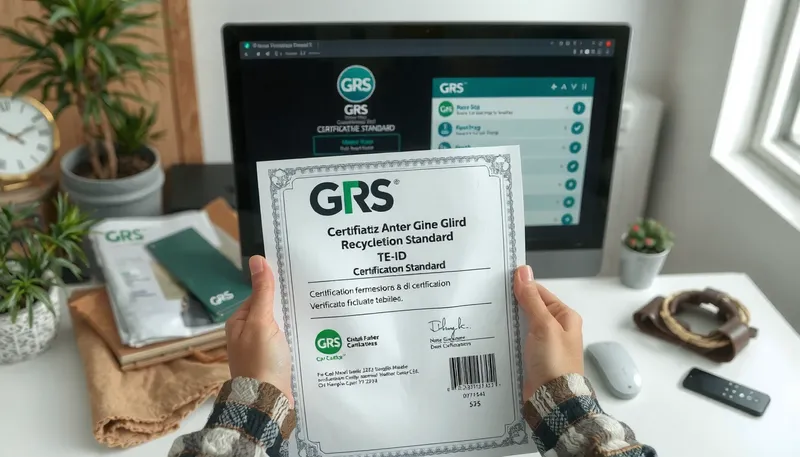
- Request the Scope Certificate (SC): Ask the maker for their current GRS Scope Certificate. This document is issued by a Textile Exchange-approved certification body (e.g., SGS or Control Union) and serves as proof that the maker is certified for GRS-compliant product manufacture.
- Locate the License Number: Identify the exclusive license number on the certificate. Our license number is GRS TE-00106694 - the gold-standard case in the industry.
- Public Database Access: Seek the Textile Exchange's official online tool called "Find Certified Companies" - the only outlet of truth for GRS certification status.
- Validation: In the database search bar, type the license number (GRS TE-00106694). The resulting data should feature the company name, a "Valid" certificate status, and the scope of certified products. Be sure that these details are similar to what the supplier told you.
- Seek Transaction Certificates (TCs): This is not negotiable. With every fabric order you make, you have to request and get a TC. An SC, if it is valid, serves as a proof that a company is able to manufacture GRS goods. But only a TC provides you with the information that you bought the specific fabric which is genuinely GRS-compliant.
Common Errors vs. Best Practices in Eco-Fabric Sourcing
The single sourcing error that causes greenwashing is accepting a supplier's verbal claim without certificate validation. Best practice: treat an unvalidated GRS claim as a risk, not a credential. Relying on unverified claims can lead to reputational damage and regulatory non-compliance under tightened EU regulations, unsubstantiated green claims risk fines up to 4% of turnover.
| Mistake (Red Flag) | Best Practice (Green Flag) |
|---|---|
| Accepting vague claims like "eco-fabric." | Asking for specific, verifiable certifications like GRS. |
| Maker is hesitant to share certificates. | Actively providing a valid license number, like GRS TE-00106694. |
| Fabric fails performance tests: knee bagging, poor colorfastness (fails AATCC 61 wash-fastness test). | Fabric passes all 4 critical activewear test points: squat-proof (opacity under 40% stretch), 4-way stretch recovery (>95% after 500 cycles), moisture-wicking (<30 min dry time), and anti-pilling (Grade 4+ in ASTM D4970). |
| Ignoring the supply chain beyond the fabric. | Asking about chemical management and printing methods (e.g., Acid Print). |
From Our Lab: Quantifying "Squat-Proof" for Recycled Nylon.
In 2025, our lab tested 30+ recycled nylon-spandex blends from different mills. A recurring failure mode was knee bagging — visible fabric deformation after repetitive stretch cycles. We traced this to two root causes: coarse denier nylon (>40D) and insufficient spandex content (<20%).
Based on these findings, we developed our GRS-certified Air-Sculpt 34™ platform: 20D micro-nylon construction with a calibrated 34% spandex ratio. After 50 cycles under the Martindale abrasion test per ASTM D4966, we measured <1% dimensional change. The result is what our testing team calls Mochi-Touch™ — a high-tension hand-feel that eliminates the squat-transparency risk at production scale.
For antimicrobial claims, check compliance with AATCC 147 (parallel streak method) — a retention of >90% bacterial reduction after 50 domestic washes.
Limits: Situations When GRS Fabrics Are Not The Best Alternative
GRS-certified fabric is not recommended when ultra-high heat molding (>200°C) is required without additional thermal stability testing, or when extreme tensile strength outweighs recycled content goals, such as in heavy-duty mountaineering outerwear where virgin high-tenacity nylon still provides a measurable safety margin. In such cases, bluesign®-certified virgin nylon is the responsible interim baseline.
- Price-Driven Volume: For basic low-margin promotional items, the additional cost of certified recycled material and supply chain audits may offset profitability. In these instances, the brand's focus might not rest upon certified sustainability.
The Yield & ROI Calculator: How GRS Certification Will Save Your Factory Money
GRS-certified fabric directly improves fabric yield by at least 2% due to consistent width and defect-free rolls, lowering per-garment cost despite higher material prices. On a 10,000m order, this 2% yield gain recovers approximately 200kg of usable fabric, translating to a measurable per-unit cost reduction, effectively neutralizing the GRS premium and delivering net savings from the third production run onward.
- Reduced Marker Waste: Stable 160gsm fabric lays flat, allowing tighter marker nesting.
- Defect Prevention: Prevents downstream sewing issues like bagging knees, offsetting the initial premium cost.
FAQ: Eco-Friendly Activewear Fabric Manufacturers Sourcing
What's the difference between GRS and RCS (Recycled Claim Standard)?
GRS is a more comprehensive standard than RCS. RCS only verifies recycled content, while GRS additionally mandates environmental and social production requirements.
Can I use the GRS logo on my products just by buying GRS fabric?
No. To use the GRS logo on your final product, your entire supply chain, including your brand, must be GRS certified. This ensures complete traceability to the consumer. However, you can make a claim in your marketing, such as, "This product is made with GRS-certified material."
Are all eco-friendly activewear fabric manufacturers in Asia reliable?
Reliability is not determined by location but by transparency and certification. A trustworthy maker, whether in Asia or elsewhere, will readily provide their GRS Scope Certificate (like our GRS TE-00106694), encourage you to verify it, and support TC verification for every order.
What's a typical MOQ for custom GRS-certified fabrics?
Minimum Order Quantities (MOQs) vary widely among suppliers. For custom-developed GRS-certified fabrics from a quality-oriented maker, MOQs typically range from 1,000 to 3,000 meters per color. This can depend on the fabric's complexity and the yarn spinning requirements.
Besides recycled polyester, what other sustainable materials are good for activewear?
TENCEL™ Lyocell (botanic origin, closed-loop solvent spinning, certified biodegradable under soil and marine conditions) provides excellent moisture management for low-to-medium intensity activities.
Written by Wenruo
Textile Engineer, Forall Lab