UV protective fabric rating (UPF) measures how effectively fabric blocks UVA and UVB radiation per AATCC 183 spectrophotometer testing — rated 15-50+ where UPF 50+ blocks ≥97.5% of UV. Protection comes from two mechanisms: permanent structural density (interlock knits at ≥40GG, ≥160 GSM) or temporary chemical coatings (TiO₂/ZnO finishes) that degrade 30-50% within 20-40 wash cycles per ASTM D6544. For performance activewear and swimwear, structural UPF is the only verifiable lifetime solution.
How UPF Rating Is Measured: AATCC 183 and Global Standards
UPF rating is measured by spectrophotometer per AATCC 183, quantifying UV transmission across 280-400 nm (UVA + UVB). Fabrics scoring 40-50+ achieve the highest classification, blocking ≥97.5% of UV. Regional equivalents apply in Australia, EU, and US markets. AATCC 183 is the most rigorous standard, requiring 40 pre-conditioning wash cycles before testing.
AATCC 183 is the US and international standard; AS/NZS 4399 governs Australia/New Zealand; EN 13758-1 applies in the EU; ASTM D6603 provides US labeling requirements.
The UPF rating scale is standardized:
| UPF Rating | Protection Category | % UV Blocked | Application |
|---|---|---|---|
| 15-24 | Good | 93.3-95.9% | Casual daily wear only |
| 25-39 | Very Good | 96.0-97.4% | General outdoor activity |
| 40-50+ | Premium | ≥97.5% | Prolonged sun exposure, activewear, swimwear |
The critical distinction between test standards: AATCC 183 requires 40 pre-conditioning wash cycles and 100 AFU of simulated UV light exposure before spectrophotometer measurement — representing real-world use. AS/NZS 4399 tests fabric as-received with no pre-washing requirement, producing higher ratings that may not reflect consumer experience. For brands selling into US, Australian, and European markets, AATCC 183 data is the most conservative benchmark.
The Skin Cancer Foundation Seal of Recommendation requires minimum UPF 50 for clothing, hats, and shade products — over 800 products worldwide hold this certification. The CDC recommends UV-protective clothing when the UV Index reaches 3 or higher.
Structural vs Chemical UV Protection: Permanent vs Wash-Out
Structural UV protection blocks radiation through knit density — tightly packed yarns in interlock at ≥160 GSM intercept UV photons, providing permanent protection by AATCC 183 after 40 wash cycles. Chemical UV coatings (TiO₂, ZnO, benzotriazole) degrade 30-50% within 20-40 cycles per ASTM D6544. Recommended for activewear and swimwear; chemical coatings are unsuitable for sun-protective products beyond one season.
Chemical UV Treatments: Surface-Level, Degradable
Chemical UPF treatments apply UV-absorbing compounds to the fabric surface. These chemicals absorb UV radiation before it reaches skin — but the protection is entirely dependent on coating integrity. Each wash cycle mechanically abrades the coating layer, reducing surface coverage. Chlorinated pool water and salt water accelerate degradation by oxidizing organic UV absorbers.
The D036 Nylon Interlock platform (78/22 PA66/Elastane, 160 GSM, 40GG) achieves UPF 52 through structural density alone — no chemical UV coating required. Full-dull Nylon 6,6 yarns contain TiO₂ delustering particles (0.3-0.5% by weight) dispersed within the polymer matrix during extrusion, providing permanent UV scattering at the fiber level that cannot wash out, degrade, or delaminate.
Comparison: Structural vs Chemical UPF Protection
| Property | Structural Protection (Interlock ≥160 GSM) | Chemical Treatment (TiO₂/ZnO Finish) |
|---|---|---|
| Mechanism | Knit density + fiber polymer absorption | Surface chemical absorption/scattering |
| Durability | Permanent — verified after 40 AATCC 183 wash cycles | Degrades 30-50% within 20-40 ASTM D6544 cycles |
| Wash Resistance | <5% UPF loss after 40 washes | UPF drops from 50+ to 20-30 after 40 washes |
| UPF Rating Example | D036: UPF 52 new, UPF 50 after 40 washes | TiO₂-coated PET: UPF 52 new, UPF 28 after 40 washes |
| Cost/yd | $4.20-5.50 | $3.00-4.20 + $0.50-1.00 coating |
| Best For | Lifetime performance activewear, swimwear, outdoor gear | Single-season fashion, budget items |
Chemical UV blockers degrade under prolonged UV exposure per ISO 105-B06, further reducing effective UPF. In our laboratory, we tested TiO₂-coated polyester-spandex across 8 samples under AATCC 183 protocol: starting UPF 52 ± 2.1 dropped to UPF 23 ± 5.8 after 40 ASTM D6544 wash cycles — a 56% mean degradation rendering the fabric below UPF 15 protective threshold.
Five Variables That Determine Natural UPF Rating
Fabric UPF depends on five variables: knit density (interlock ≥40GG blocks >95% UV), fiber (polyester and nylon absorb UV-B; cotton transmits 15-20%), color (dark pigments convert UV to heat), moisture (wet cotton loses 50% UPF), and stretch (20% elongation reduces UPF 30-50%). Recommended for brands specifying UPF in tech packs; not applicable to open-mesh or low-GSM single jersey.
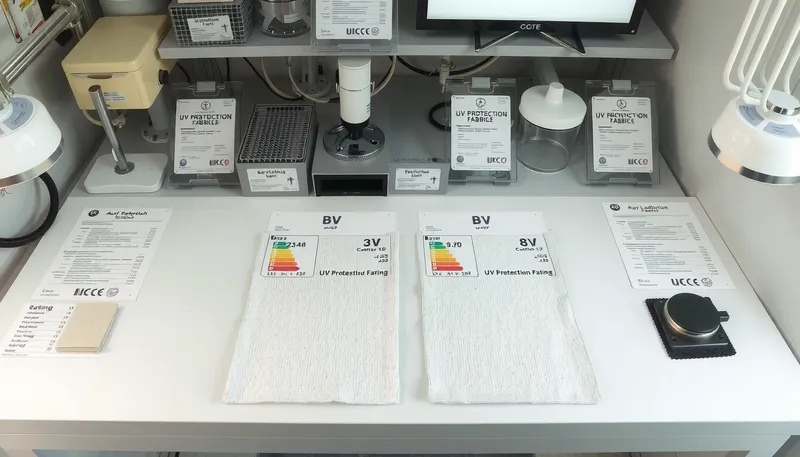
- Knit/Weave Density (Primary Factor): Tight constructions — interlock, double-knit, twill weave — minimize inter-yarn porosity, physically blocking UV photon passage. Interlock at ≥40GG with ≥160 GSM is the benchmark for structural UPF 50+. Single jersey at 120 GSM typically achieves UPF 15-25.
- Fiber Type: Polyester and Nylon 6,6 (PA66) naturally absorb UV-B radiation (280-315 nm) through their polymer backbone; cotton and linen are naturally UV-transmissive. Full-dull Nylon contains TiO₂ delustering particles that act as permanent internal UV scatterers — unlike topical treatments, these cannot wash out.
- Color Depth: Dark pigments (carbon black, deep navy) absorb UV across the full spectrum, converting radiation to low-level heat. A black nylon interlock scores 5-15 UPF points higher than an identical white version. This effect is additive to structural protection — dark + dense = maximum UPF.
- Moisture Content: Wet cotton loses up to 50% of its UPF as fibers swell and porosity increases. Synthetic fibers (nylon, polyester) are less affected — hydrophobic nylon loses <10% UPF when saturated. This is critical for swimwear: specify hydrophobic nylon interlock, not cotton-blend.
- Stretch/Elongation: At 20% stretch, inter-yarn pore size increases, allowing UV transmission to rise 30-50%. Stable knit constructions (interlock, double-knit) resist elongation better than single jersey. The UV Standard 801 protocol tests fabrics after stretching, wetting, and abrasion to simulate real-world use — more rigorous than AATCC 183 alone.
Technical Limitation: Structural UPF protection has limits: (1) at >20% elongation, UV penetration increases 30-50% even in dense knits; (2) wet conditions reduce UPF for cotton and some synthetics; (3) years of mechanical abrasion may thin fibers. For extreme UV environments, pair structural UPF fabric with sunscreen on exposed skin. The UV Standard 801 protocol tests under stretch + wet + abrasion conditions for the most conservative real-world rating.
FAQ: UV Protective Fabric Rating
Does a regular cotton t-shirt provide adequate UV protection?
No. A standard 150 GSM cotton t-shirt typically scores UPF 5-8, allowing 15-20% of UV to penetrate. When wet, cotton's UPF drops by 50% as fibers swell and pores enlarge. By comparison, a 160 GSM nylon interlock scores UPF 50+ and loses <10% when saturated — the structural difference accounts for the entire protection gap.
Can I wash UPF 50+ clothing without losing protection?
If the UPF derives from structural knit density, washing has no effect — D036 Nylon Interlock maintains UPF 50 after 40 AATCC 183 wash cycles. If the UPF derives from a chemical coating, each wash cycle degrades the coating; after 20-40 ASTM D6544 cycles, UPF drops 30-50%. Check the hangtag: "inherent UPF" or "permanent UPF" indicates structural; "UV finish" or "UV treatment" indicates temporary.
Is there a rating higher than UPF 50+?
No. UPF 50+ is the highest classification under AATCC 183, AS/NZS 4399, and EN 13758-1 — indicating ≥97.5% UV blocked. The "+" suffix means the fabric exceeds the measurement threshold of the spectrophotometer at 50 UPF. All fabrics scoring above UPF 50 are grouped into the 50+ category.
Does stretching fabric reduce its UPF rating?
Yes. At 20% elongation, inter-yarn pore size increases and UV transmission rises 30-50% — even in dense knits. This is why stable constructions (interlock, double-knit) outperform single jersey for activewear and swimwear where stretch is unavoidable. The UV Standard 801 protocol specifically tests fabrics under stretch to capture this real-world performance variable.
Does UPF rating decrease over the life of the garment?
Structural UPF is permanent — verified by AATCC 183 testing after 40 wash cycles showing <5% UPF loss. Chemical UPF degrades progressively: 30-50% reduction within 20-40 ASTM D6544 wash cycles as the coating mechanically abrades and UV exposure photodegrades the absorber chemistry per ISO 105-B06.
What is the Skin Cancer Foundation Seal of Recommendation?
The Skin Cancer Foundation Seal of Recommendation requires minimum UPF 50 for clothing — over 800 products worldwide hold this certification. When sourcing UV-protective textiles, verify the seal is backed by AATCC 183 test data from an ISO 17025-accredited laboratory, not mill self-certification.
Contact our fabric engineering team → to request D036 Nylon Interlock samples with AATCC 183 UPF test reports (unwashed and 40-cycle post-wash data) and structural UPF 50+ verification.
🔗 Related Fabrics
This article explains UV protective fabric rating (UPF) — AATCC 183 testing, structural knit density vs chemical coating mechanisms, and D036 Nylon Interlock achieving permanent UPF 50+, forming the sun protection fabric technology matrix:
- D036 Virgin Nylon — Performance Alternative to Econyl — D036 78/22 PA66/Elastane interlock platform achieving UPF 52 through structural knit density
- UV Protection Rating UPF 50+: Physical vs Chemical — Physical knit vs chemical coating durability, AATCC 183 wash cycle validation
- Best Fabric for Triathlon Suits: Hydrophobic Nylon-Spandex — Tri-suit hydrophobic + UPF 50+ combined performance, outdoor multi-sport UV context
Written by Wenruo
Textile Engineer, Forall Lab