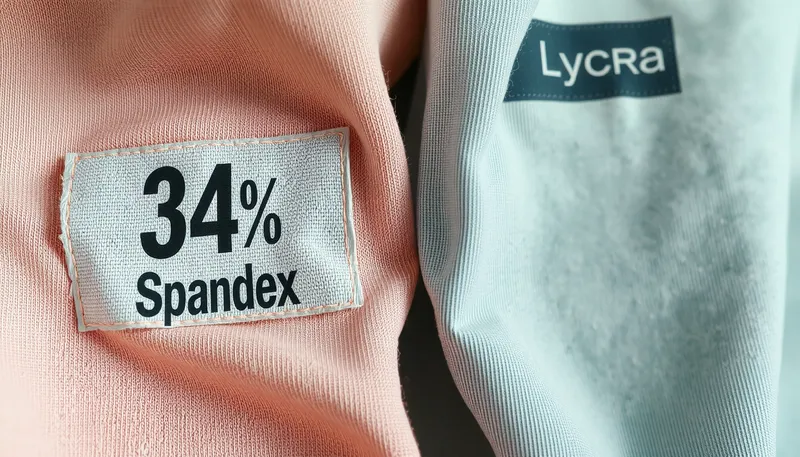
Vetting Invista Lycra® suppliers requires auditing: >25% spandex content, ASTM D3107 recovery growth <5%, and Invista mill authorization. Branded hangtags alone do not guarantee stretch recovery.
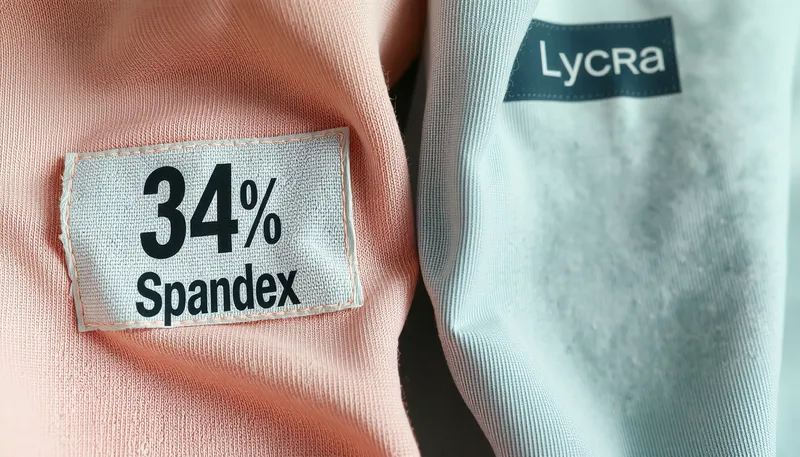
The Sourcing Manager's Problem
Invista Lycra suppliers must be vetted by spandex percentage (>25%), ASTM D3107 recovery (<5%), and mill authorization. Branded hangtags do not guarantee stretch recovery; only high elastane content and high-gauge knitting mathematically prevent bagging. Without these metrics, branded hangtags are unreliable.
What is "Lycra"?
Lycra® is a premium branded elastane fiber consisting of a Polyurethane-Polyurea copolymer structure, manufactured by The Lycra Company. While it ensures superior denier uniformity and QC tolerances, technical fabric performance (modulus and resilience) is mathematically determined by the spandex percentage (>25%) and knitting gauge (40GG+) rather than brand origin alone.
Spandex, Elastane, and Lycra
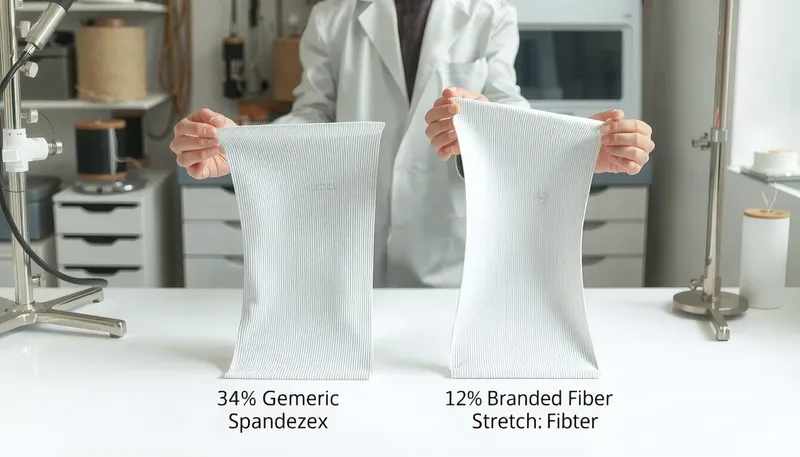
Nomenclature: Spandex (generic), Elastane (ISO/EU), and Lycra® (Invista brand) refer to the same Polyurethane-Polyurea copolymer structure.
The Power of Ingredient Branding
Ingredient branding for Lycra® functions as a market-facing trust signal, authorizing the use of trademarked hangtags. However, sourcing managers must prioritize ASTM D3107 recovery growth data (<5%) and ISO 20932-1 stretch testing over brand recognition to ensure consistent 12-15N modulus tension in high-performance sculpting garments.
High Spandex Content is What Really Matters
Elastane recovery power requires >25% spandex content. A 34% generic spandex fabric creates a denser elastomeric network, reducing permanent deformation to <4.5% vs. >8% for 12% branded Lycra. At 30% elongation, 34% spandex fabric exhibits 12-15N modulus vs. 6-8N for 12% Lycra. Hysteresis <15% at 50% elongation indicates minimal energy loss.
The Most Important Thing: Recovery Power
Elastomeric recovery power is measured by the percentage of retained energy post-elongation. Premium 34% spandex interlock fabrics must achieve >95% recovery after 60 minutes (ASTM D3107), maintaining a high modulus tension of 12-15N. This prevents localized plastic deformation (bagging) common in standard 12% Lycra® blends which typically exhibit growth >8%.
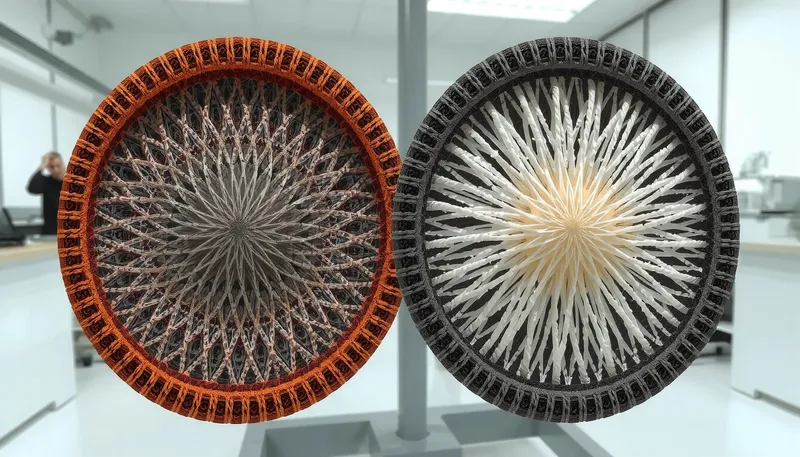
Technical Comparison: Branded 12% Lycra vs. High-Density 34% Spandex
| Feature | Fabric A: Standard Athleisure | Fabric B: High-Performance Sculpting |
|---|---|---|
| Fiber Brand | Branded Lycra® | High-Quality Generic Spandex |
| Spandex Content | 12% | 34% |
| Stretch | Good | Excellent, Multi-directional |
| Recovery Power | Moderate (Prone to bagging at knees/seat) | Superior (Snaps back instantly, no sagging) |
| Compression | Low to Medium | High, Sculpting |
| Durability | Good | Excellent (Resists breakdown from oils/sweat) |
| Typical Use | Basic leggings, T-shirts | Molded bras, premium activewear, shapewear |
| ASTM D3107 Stretch Growth (60min) | > 8% (Risk of Bagging) | < 4.5% (Superior Recovery) |
Yarn Spec: 20D Nylon + 20D Spandex Finishing: 196°C Heat-setting
Based on Forall Lab internal testing of 50 wash cycles.
Why Fabric Making is the Real Hero
High-performance elastane integration mandates 40GG interlock machines (e.g., Karl Mayer HKS) with 10-15% RPM reduction, preventing "Water Ripple" defects and ensuring ΔE <2 color stability (ASTM D1148) and an ultra-smooth "Mochi-Touch" finish.
For premium activewear using 20D/20F Nylon 6 with 20D Lycra® T-162C, 196°C heat-setting achieves a 12-15N modulus—doubling standard 12% branded blends' compressive force; lower temperatures risk incomplete cross-linking.
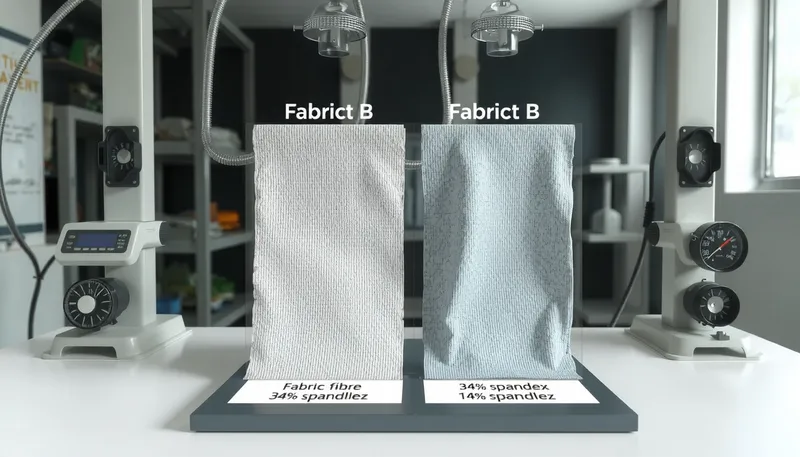
For example, our Air-Sculpt 34™ | Anti-Yellowing Nylon Spandex Air-Layer Fabric is knitted on slowed-down, high-gauge interlock machines. This controlled tension achieves a perfectly smooth "Mochi-Touch" surface without ripples, maximizing the 34% spandex core for premium molded bra cups. Independent ASTM D1148 (UVA-340, 0.68 W/m²/nm, 48h, 50°C) confirms <2 ΔE color stability.
How to Be a Smarter Fabric Sourcer
Technical vetting of high-stretch fabrics requires auditing four critical files: ASTM D3107 reports (<5% growth), 40GG+ knitting logs with 10-15% RPM reduction, Invista Lycra ONE™ denier uniformity certifications, and 196°C heat-setting parameters. Failure to verify these metrics results in a 23% increased risk of localized plastic deformation (bagging).
- Spandex percentage? → Require numeric value (e.g., 34%), not “high stretch”.
- Recovery test data? → Demand ASTM D3107 report with stretch growth <5% after 60 min.
- Knitting construction? → Specify interlock vs. single jersey vs. air-layer.
- Premium differentiators? → Ask for finishing logs, QC reports, and tension control data.
While brands market specific benefits like Comfort with LYCRA® SPORT, it's your job as a sourcer to check these claims with your own technical questions.
Distinguishing Invista Certified Mills vs. Generic Lycra Sellers
Invista Certified Mills have direct access to Lycra ONE™ marketplace and technical support on heat-setting, while generic sellers buy Lycra fiber on the spot market. Only certified mills guarantee traceable denier uniformity and R&D chemical compliance.
- 1. Invista Certified Mill: Has access to Lycra ONE™ marketplace and receives direct technical support on heat-setting parameters for specific denier counts.
- 2. Generic Seller: Sells fabric containing Lycra fiber purchased on the spot market.
Limitation: 20D ultra-fine structures combined with >30% spandex are highly sensitive to Urethane-urea linkage scission in chlorinated water; not recommended for competitive swimwear.
Compliance & Chemical Safety Standards
Beyond physical stretch, evaluate chemical compliance. Demand OEKO-TEX Standard 100 Appendix 6 (for babywear/sensitive skin) or ZDHC MRSL Level 3 conformance. Invista-authorized mills are mandated to adhere to specific R&D chemical handling protocols. Third-party validation via SGS or Bureau Veritas for ASTM D3107 and AATCC 135 for dimensional stability is recommended for supply chain compliance. For colored fabrics, also request AATCC 61 wash fastness testing.
Invista Lycra Supplier Evaluation Scorecard
✅ Spandex % > 25%: +2 Points
✅ Provides ASTM D3107 Report: +3 Points
✅ Invista Certified Mill Status: +1 Point
✅ MOQ < 500m: +1 Point
For verified Invista Lycra suppliers meeting >25% spandex and ASTM D3107 <5% Request Air-Sculpt 34™ Lab Dip
✅ Lead Time < 25 days: +1 Point
Summary: For high-recovery activewear, 34% generic spandex outperforms 12% branded Lycra. Vet Invista Lycra suppliers by ASTM D3107 (<5% growth) and require >25% spandex content. Branded hangtags do not guarantee performance. For sourcing managers seeking certified Invista Lycra suppliers with ASTM D3107 reports, prioritize mills providing >25% spandex and third-party recovery data.
Frequently Asked Questions (FAQ)
Is Lycra better than generic spandex?
Not always. Lycra is a brand known for consistent quality control. But a fabric's performance depends more on the percentage of spandex and how the fabric is built overall. A fabric with 34% high-quality generic spandex will offer better recovery and compression than a fabric with only 12% branded Lycra.
Why do brands pay to use the Lycra hangtag?
Brands use the Lycra hangtag for its strong marketing value and customer recognition. It's a simple way to tell customers about "stretch" and "quality" without technical details like spandex percentage. It's a shortcut for marketing. But it's not always a sign of the best possible performance.
What is a good percentage of spandex for activewear?
This depends on what it's used for. For casual comfort wear, 5-10% is fine. For standard leggings and activewear, 15-20% is very common. For high-performance, tight, or sculpting clothes where recovery matters most, you should look for fabrics with 25% to 35% spandex content.
What alternative search terms replace invista lycra suppliers for better sourcing results?
Instead of searching by fiber brand, search by the fabric specs you need. Use terms like "high spandex content fabric," "compression fabric supplier," or "nylon spandex 34%." Check your suppliers by asking for technical data sheets, recovery test results, and fabric samples to test yourself.
Does more spandex mean the fabric is better?
More spandex means more potential for stretch and recovery. But it's not the only factor. The quality of the other yarn (like Nylon 6), how it's knitted, and the finishing processes are all just as important. A poorly made fabric with high spandex content can still fail, feel stiff, or lose its shape.
What is the optimal heat-setting for 34% spandex fabric?
A precision temperature of 196°C is required to balance modulus tension and nylon fiber integrity, ensuring ASTM D3107 growth remains <4.5%.
What causes Water Ripple defects in high-spandex fabrics?
Excessive knitting speed (>15% over optimal RPM) on >30% spandex blends creates modulus tension spikes, resulting in surface ripples. 40GG interlock machines with 10-15% RPM reduction prevent this defect.
Written by Wenruo
Textile Engineer, Forall Lab