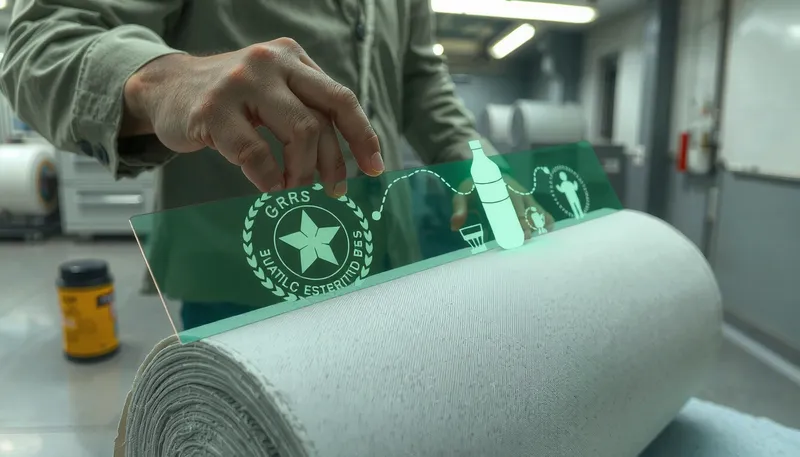
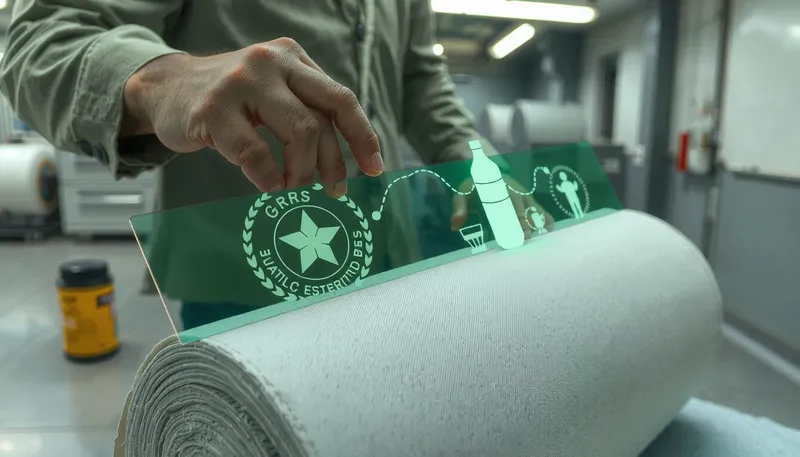
GRS certified fabric traceability is verified using two essential documents. First, confirm the supplier's active Scope Certificate (SC) for GRS capability. For each specific purchase order, you must demand and receive a corresponding Transaction Certificate (TC). Both certificates are validated against the official Textile Exchange database to ensure audit-proof compliance.
How Does GRS Certified Fabric Traceability Work?
Global Recycled Standard (GRS) traceability is a chain of custody system that verifies recycled content from its source to the final product. This system ensures the material received matches supplier claims, providing a defense against fraud. The entire framework is owned and managed by Textile Exchange, an organization that is an ISEAL Alliance Code Compliant member, ensuring high standards of practice. The system's integrity relies on this structured verification.
The current active version is GRS 4.0 (released 2023), which requires 100% physical segregation of certified materials. The GRS system operates under the foundational Chain of Custody requirements of the Content Claim Standard (CCS). The CCS standard tracks the flow of certified material at every production stage. Without this unbroken chain, a GRS claim is invalid.
- The Scope Certificate (SC): This document proves a supplier is capable of producing GRS-compliant products. An SC is a general qualification with a Validity of 12 months from date of issue.
- The Transaction Certificate (TC): This document proves a specific shipment of material is GRS-compliant. The TC's Function is to Verify a specific GRS-compliant shipment linked to your invoice.
Accepting a Scope Certificate (SC) alone is a critical compliance failure. Without a Transaction Certificate (TC) for your specific purchase, there is zero proof that your fabric is certified. This exposes your brand to accusations of Greenwashing under regulations like the EU Green Claims Directive.
What are Scope Certificates (SC) vs. Transaction Certificates (TC)?
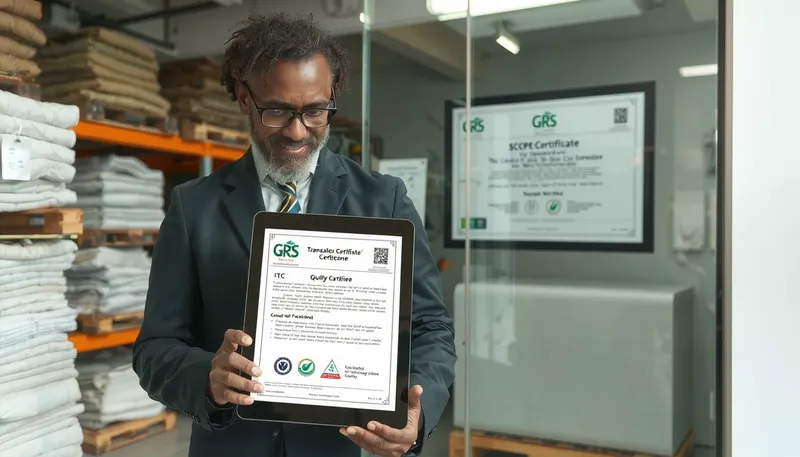
Scope Certificates and Transaction Certificates serve distinct purposes: an SC merely qualifies a supplier's production capability through an annual audit, whereas a TC is the only document that provides batch-specific, verifiable proof of recycled content for a single purchase order.
| Core Spec | Best For | The 'Gotcha' (Limitations) | Technical Rationale |
|---|---|---|---|
| Scope Certificate (SC): Company-level qualification | Initial supplier vetting and confirming GRS production capability. | Proves nothing about your specific material purchase; it is not batch-specific proof. | Based on an annual audit of a facility's potential to produce GRS goods. |
| Transaction Certificate (TC): Shipment-specific verification | Providing audit-proof documentation for a single purchase order. | A PDF can be forged; requires independent verification with the issuing Certification Body. | Links a specific material batch to an invoice, creating an unbroken chain of custody. |
The GRS Recycled Material Content is a key parameter verified by the Transaction Certificate. To use the GRS logo on a final product, the product must meet the Minimum Requirement: 50% certified recycled material. The TC is the only document that substantiates this percentage for your specific batch, making it a non-negotiable part of GRS traceability for recycled fabric sourcing.
How to Validate a GRS Transaction Certificate (TC)?
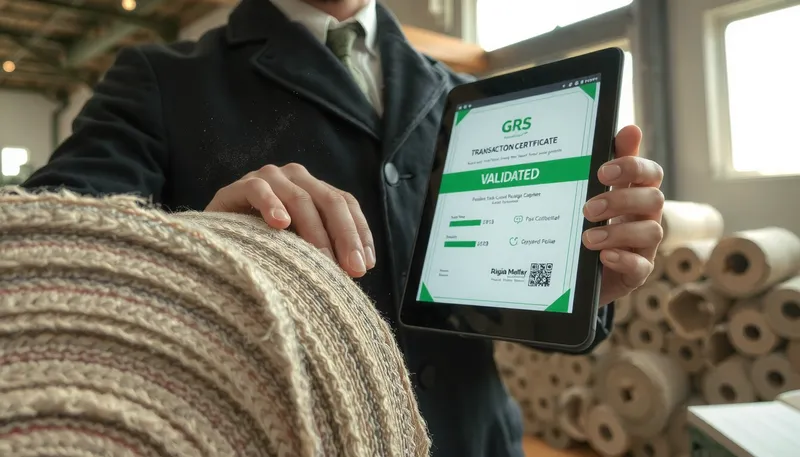
Validating a GRS Transaction Certificate requires a 5-step audit: (1) contractually demand TC, (2) extract TE-ID & CB name, (3) search Textile Exchange database, (4) verify SC active status, (5) directly confirm TC with the Certification Body. A PDF of a TC sent via email is insufficient proof for any credible audit in 2026. The technical barrier to fraud is this direct, independent verification process which you must control.
-
Step 1: Demand the TC Contractually. For every GRS material purchase, make the issuance of a Transaction Certificate a contractual obligation. State clearly that final payment is contingent upon your successful verification of the TC.
-
Step 2: Identify Key Data Points on the TC. Locate the supplier's License Number (often a Verifiable Identifier: TE-ID, e.g., TE-00106694), the name of the issuing Certification Body (CB) (e.g., Control Union Certifications), and the unique TC number itself.
-
Step 3: Access the Official Textile Exchange Database. Navigate directly to the Textile Exchange "Find Certified Companies" public database. Do not use any third-party verification tools or links provided by the supplier.
-
Step 4: Verify the Supplier's Scope Certificate. Enter the supplier's License Number into the database. Confirm three data points:
- The certification status is "Certified."
- The product category you are buying is listed under their certified scope.
- The Certification Body (CB) listed in the database matches the one on your TC.
-
Step 5: Verify the Transaction Certificate with the CB (Highest Priority). Contact the Certification Body (CB) listed on the TC directly. Use contact information obtained from their official website, not from the supplier or the TC document. Provide the CB with the TC number and ask for direct, written confirmation of its authenticity. This step closes the loop on potential document forgery and is non-negotiable for audit-proof compliance.
What Are the Limitations of GRS Certification?
While GRS strictly audits recycled content and chain of custody, it does not guarantee fabric physical performance (e.g., ISO 105 pilling/colorfastness), nor does it mandate the 100% recycled composition often assumed by consumers (the standard allows up to 50% virgin material).
-
GRS Does Not Guarantee Fabric Quality. The Global Recycled Standard (GRS) verifies recycled content and chain of custody. It does not certify a fabric's performance attributes like durability, hand-feel, pilling resistance, or colorfastness according to metrics like ISO 105-X18:2007. Separate quality assurance testing remains essential.
-
A Certificate Is Not a Blanket Guarantee. A supplier possessing a valid Scope Certificate (SC) means nothing for your specific order. Without a Transaction Certificate (TC) issued for your Purchase Order, you cannot claim the product is GRS certified. Many brands fail audits on this point.
-
Limited Scope on Water and Energy Metrics. While GRS includes processing requirements for social, environmental, and chemical management, its primary focus is recycled content and chain of custody. The standard is not as comprehensive on quantitative water or energy usage per kilogram of fabric as a process-focused standard like Bluesign.
-
The 50% Content Threshold. A GRS-labeled product requires a minimum of 50% recycled content. The remaining 49.9% can be virgin material. This fact must be communicated clearly in marketing materials to avoid misleading consumers and adhere to regulations like the EU Green Claims Directive. You can learn more about GRS certification specifics here.
-
Physical vs. Paper Traceability. The GRS relies entirely on paper documentation. It cannot detect if non-certified virgin fabric was physically swapped into a certified shipment after the TC was issued. To combat this, advanced 2026 supply chains are integrating physical Traceable Tracer Yarns (e.g., Aware™ tracer technology) directly into the fabric to provide unforgeable, scannable proof of origin.
Conclusion
Successfully navigating GRS certified fabric traceability hinges on a disciplined, two-document verification process. A supplier's Scope Certificate (SC) only confirms their capability, while the Transaction Certificate (TC) is the sole document providing audit-proof evidence for a specific shipment. By contractually demanding a TC for every order and independently validating its authenticity with the issuing Certification Body (CB) via the Textile Exchange database, brands can effectively eliminate the risk of Greenwashing. This non-negotiable procedure is the only way to ensure the integrity of your supply chain and the validity of your sustainability claims in 2026.
Frequently Asked Questions (FAQ)
1. Can a supplier be GRS certified but not provide a Transaction Certificate?
Yes, a supplier with a valid Scope Certificate (SC) can fail to issue a Transaction Certificate (TC) for your order, rendering your material uncertified.
- Refusal to issue a TC is a major compliance red flag.
- This often happens if they break the chain of custody.
- Without a TC, you have zero proof of a GRS claim for that batch.
2. What is the difference between GRS and RCS (Recycled Claim Standard)?
The GRS is a more stringent standard than the RCS, though both use the same Chain of Custody model.
- GRS requires a 50% minimum recycled content for labeling; RCS requires 5%.
- GRS includes social and environmental processing criteria; RCS does not.
- GRS restricts more chemicals than RCS.
3. Does GRS certification cover social and environmental criteria?
Yes, GRS sets mandatory requirements beyond just recycled content.
- Social criteria are based on International Labour Organization (ILO) conventions.
- Environmental criteria require an environmental management system.
- Chemical use is restricted based on a GRS-specific list of prohibited substances.
4. How do I report a supplier with a fraudulent GRS certificate?
You should report suspected fraud directly to the certification's governing bodies to maintain system integrity.
- First, contact the listed Certification Body (CB) with your evidence.
- Second, file a formal complaint with Textile Exchange via their Assurance & Integrity program.
- Provide copies of all suspicious documents and communications.
5. Is a PDF of a Transaction Certificate enough proof for an audit?
No, a PDF alone is insufficient proof as it can be easily forged.
- An audit requires the TC document itself.
- It also requires your own documented proof of verifying the TC's authenticity.
- This proof is your email correspondence with the issuing Certification Body (CB).
Contact our team to validate your supplier's GRS documentation and prevent compliance issues.
Written by Forall Lab
© Forall Lab • Powered by Kunpeng ONE