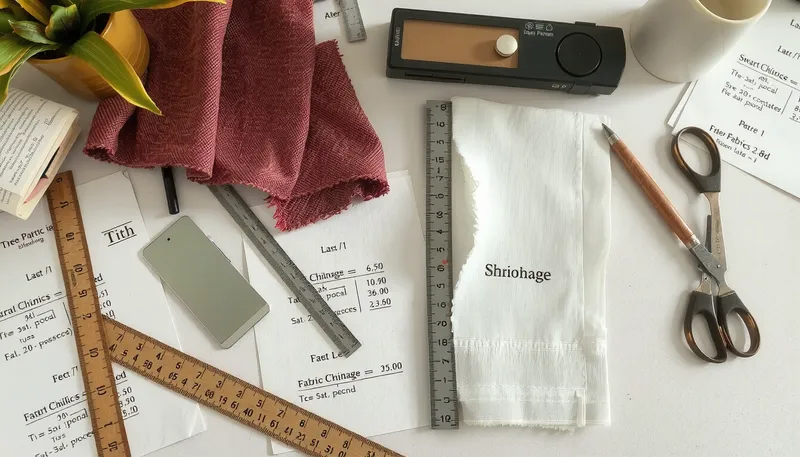
Fabric shrinkage calculation is the percentage by which a fabric's warp or weft dimension decreases after a controlled wash-dry cycle, per AATCC 135 dimensional change testing under ISO 6330 washing: Shrinkage% = ((Original − Final) / Original) × 100.
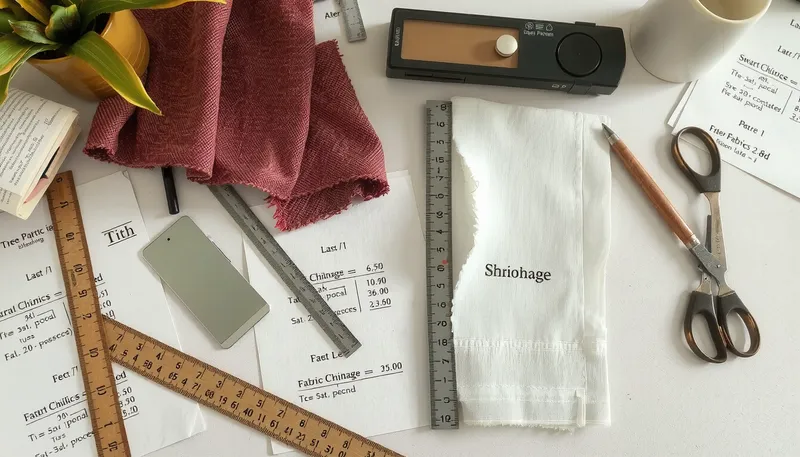
Standards-Based Shrinkage Testing: AATCC 135 Method with ISO 6330 Washing
Fabric shrinkage testing is governed by two interdependent standards: AATCC 135 (Dimensional Changes of Fabrics after Home Laundering) defines the measurement protocol — marking a minimum 25 cm × 25 cm test area on a conditioned specimen, laundering under specified conditions, reconditioning at 21±1°C and 65±2% RH per ASTM D1776, and remeasuring — while ISO 6330 (Domestic Washing and Drying Procedures) standardizes the washing parameters: water temperature, detergent type, mechanical action, and drying method. Without these two standards operating together, shrinkage numbers from different mills are not comparable — a 4% warp shrinkage measured after a 40°C delicate cycle (ISO 6330 Procedure 4A) is not equivalent to 4% measured after a 60°C normal cycle (Procedure 4N). The fabric is the same; the test is not.
The 4-step testing procedure, aligned with AATCC 135 requirements:
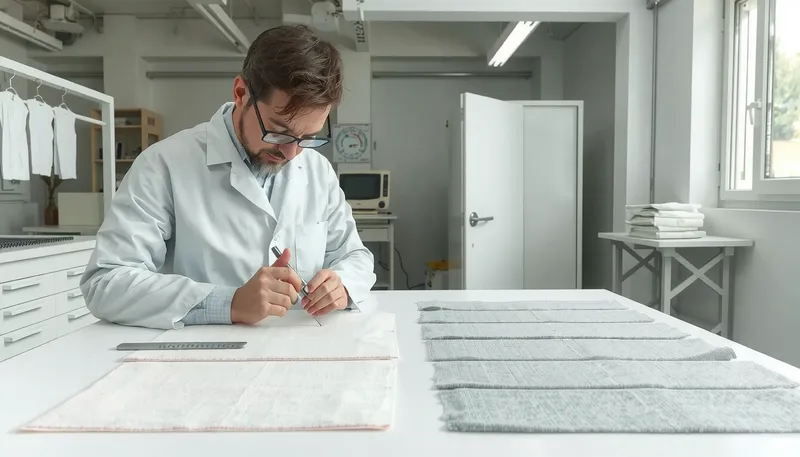
Step 1 — Specimen Preparation. Cut a specimen at least 38 cm × 38 cm. Using an indelible fabric marker and a template, mark three 25 cm benchmarks in both the warp (length) and weft (width) directions. The benchmarks should be at least 5 cm from all edges to avoid edge-effect distortion. Condition the marked specimen at 21±1°C and 65±2% RH for at least 4 hours before taking initial measurements — fiber moisture content at equilibrium affects dimensional readings by 0.5-1.5%.
Step 2 — Laundering per ISO 6330. Select the wash procedure matching the garment's care label: Procedure 4A (40°C delicate) for nylon/Spandex activewear, Procedure 4N (60°C normal) for cotton or cotton-blend garments. Use the specified AATCC 1993 Standard Reference Detergent. Include sufficient ballast fabric (100% polyester Type 3) to achieve a 1.8 kg total load. Dry per the care label — tumble dry at the specified temperature or line dry.
Step 3 — Conditioning and Measurement. After drying, recondition the specimen for at least 4 hours. Measure each benchmark to the nearest 0.5 mm, calculating the average of the three warp measurements and three weft measurements separately. Do not measure within 2 hours of removal from the dryer — thermal expansion from residual heat can inflate dimensions by 0.5-1.0% and understate shrinkage.
Step 4 — Apply the Formula. For each direction independently:
Shrinkage% (warp) = ((Original warp avg − Final warp avg) / Original warp avg) × 100 Shrinkage% (weft) = ((Original weft avg − Final weft avg) / Original weft avg) × 100
Worked example. A nylon/Spandex knit specimen with original warp benchmarks averaging 25.0 cm measures 24.0 cm after one ISO 6330 Procedure 4A wash-dry cycle: ((25.0 − 24.0) / 25.0) × 100 = 4.0% warp shrinkage. The same specimen's weft benchmarks average 24.5 cm: ((25.0 − 24.5) / 25.0) × 100 = 2.0% weft shrinkage. Knits typically exhibit 1.5-3× greater warp shrinkage than weft shrinkage because the loop structure elongates in the knitting direction and relaxes during washing.
| Shrinkage Grade | Warp Dimensional Change | Example Fabric Types | Pattern Impact |
|---|---|---|---|
| Pre-Shrunk | <3% | Pre-shrunk nylon/Spandex interlock, heat-set polyester | Near 1:1 pattern-to-garment mapping |
| Standard | 3-5% | Standard nylon/Spandex single jersey, cotton/Spandex | Pattern compensated +3-5% in length |
| High Shrinkage | 5-8% | Untreated cotton jersey, viscose knit | Requires +5-9% pattern oversize; marker efficiency drops 8-12% |
| Uncontrolled | >8% | Unfinished natural-fiber wovens, loose-gauge knits | Not suitable for precision activewear — requires pre-shrinking process |
What Are Fabric Shrinkage Standards?
Fabric shrinkage standards define both the washing procedure and the measurement method; a shrinkage number is only comparable when both are stated. AATCC 135 is the common US retail protocol for dimensional change after home laundering, ISO 6330 defines the domestic washing and drying procedures used in ISO-based programs, and ISO 5077 defines the determination of dimensional change after washing and drying. Specify the standard, the wash procedure, and the report fields together.
| Standard | What it governs | When to specify it |
|---|---|---|
| AATCC 135 | Dimensional change of fabric after home laundering | US retail and brand programs that reference AATCC methods |
| ISO 6330 | Domestic washing and drying procedures (temperature, detergent, ballast, drying) | Global programs that need a declared wash cycle |
| ISO 5077 | Determination of dimensional change after washing and drying | ISO-based specs that separate the wash procedure from the measurement method |
What Should a Fabric Shrinkage Report Include?
A usable fabric shrinkage report should state the standard and year, the ISO 6330 procedure or AATCC cycle, water temperature, detergent, drying method, number of cycles, specimen size and conditioning, warp and weft results separately, and the pass/fail limit. Without the procedure and the conditioning details, the percentage cannot be reproduced. The four-step test above shows how to generate the number; this section defines which standard to put in the tech pack and which fields the report must carry.
Pattern Compensation: The Mathematics of Post-Shrinkage Fit
Pattern compensation converts a measured shrinkage percentage into a pattern dimension increase using division, not multiplication: New Pattern = Target Garment Dimension ÷ (1 − Shrinkage%). Because the shrinkage percentage references the pre-wash dimension, a 4% warp shrinkage means the pattern is the target divided by 0.96, not multiplied by 1.04.
The pattern compensation formula with worked examples across typical shrinkage ranges:
| Shrinkage% | Divider: 1 − S% | Pattern Multiplier (÷) | Wrong Multiplier (×1+S%) | 60 cm Piece: Correct | 60 cm Piece: Wrong | Error per Piece |
|---|---|---|---|---|---|---|
| 2% | 0.98 | 1.0204 | 1.0200 | 61.22 cm | 61.20 cm | 0.02 cm |
| 3% | 0.97 | 1.0309 | 1.0300 | 61.86 cm | 61.80 cm | 0.06 cm |
| 4% | 0.96 | 1.0417 | 1.0400 | 62.50 cm | 62.40 cm | 0.10 cm |
| 5% | 0.95 | 1.0526 | 1.0500 | 63.16 cm | 63.00 cm | 0.16 cm |
| 6% | 0.94 | 1.0638 | 1.0600 | 63.83 cm | 63.60 cm | 0.23 cm |
| 8% | 0.92 | 1.0870 | 1.0800 | 65.22 cm | 64.80 cm | 0.42 cm |
Above 5% shrinkage, the divider vs multiplier error exceeds 0.15 cm per 60 cm piece — enough that marker nesting algorithms in CAD software (Gerber AccuMark, Lectra Modaris, Optitex) will produce different marker efficiency results. CAD systems apply the correct divider formula internally when the shrinkage percentage is entered as a fabric property; the error occurs when pattern makers manually scale patterns with a calculator and the wrong operator.
From Test Report to Cutting Table: A Compression Legging Worked Example
A compression legging Tech Pack specifies a 68.0 cm inseam and a 22.0 cm half-leg width; with an AATCC 135 report showing 4.2% warp shrinkage and 2.1% weft shrinkage (ISO 6330 Procedure 4A), the cuttable pattern is 71.0 cm × 22.5 cm — warp compensated at 68.0 ÷ 0.958, weft at 22.0 ÷ 0.979. The warp (fabric length) runs along the inseam, so the lengthwise direction carries the larger 4.2% allowance, while the crosswise half-leg width carries the lighter 2.1% allowance. This is where a test report becomes real numbers on the cutting ticket:
| Direction | Grain in garment | Target finished (cm) | Certified shrinkage | Divider (1 − S%) | Pattern dimension (cm) |
|---|---|---|---|---|---|
| Warp (fabric length) | Inseam | 68.0 | 4.2% | 0.958 | 68.0 ÷ 0.958 = 71.0 |
| Weft (fabric width) | Half-leg width | 22.0 | 2.1% | 0.979 | 22.0 ÷ 0.979 = 22.5 |
Wash-check the math: a 71.0 cm pattern piece shrinking 4.2% finishes at 71.0 × 0.958 = 68.0 cm, and the 22.5 cm width shrinks to 22.5 × 0.979 = 22.0 cm — the garment lands on the Tech Pack spec within 0.1 cm. Cut the same style instead in a 5.8%-warp-shrinkage cotton/Spandex jersey and the inseam allowance rises to 68.0 ÷ 0.942 = 72.2 cm — a 1.2 cm jump per piece that silently shifts every graded size if the pattern room reuses the interlock marker.
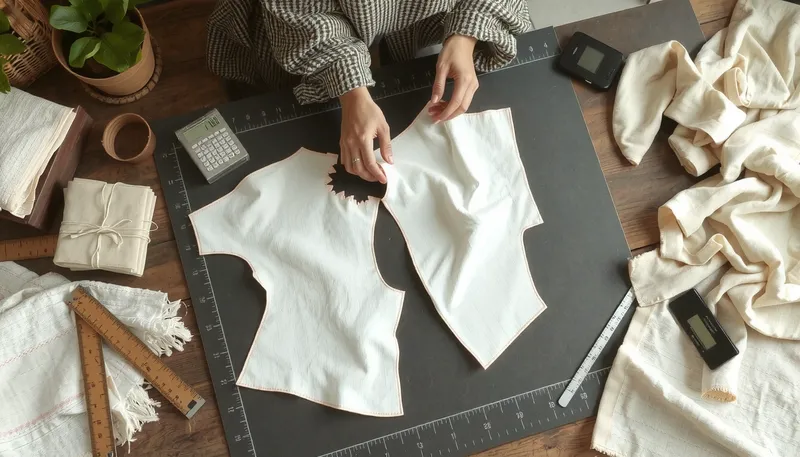
For production environments managing multiple fabric qualities, Forall Lab recommends maintaining a Shrinkage Compensation Table at the cutting table — a laminated reference card listing each active fabric SKU, its certified shrinkage percentage (per the latest AATCC 135 test report), and the corresponding pattern multiplier for both warp and weft directions. The card eliminates calculator errors at the point of marker making. Digital pattern rooms should enter shrinkage as a percentage in the fabric library module of the CAD system — never as a calculated multiplier — so the software applies the divider formula correctly across all piece geometries.
Pre-Shrunk Fabric Selection: Reducing Shrinkage at the Source
The most cost-effective fix for shrinkage is selecting pre-shrunk fabrics with AATCC 135 warp shrinkage below 3% — this reduces or eliminates the pattern oversize penalty, directly raising marker efficiency.
D036 Interlock Knit (76% Nylon 40D/34F + 24% Spandex 40D, 160 GSM ±5% per ASTM D3776, OEKO-TEX 100 Class I certified) is engineered specifically for dimensional stability through its O3C (One-Open-One-Close) balanced-loop knit structure. Unlike single-jersey knits where the asymmetric loop geometry creates an inherent bias toward warp relaxation, the interlock construction balances the yarn path forces in both directions. The result: AATCC 135 warp shrinkage below 3% and weft shrinkage below 2% after 5 ISO 6330 Procedure 4A wash-dry cycles — verified by Forall Lab internal testing (2025, n=12 specimens from 3 production batches). The fabric also eliminates edge-curl — a secondary pattern-making problem where curl at the cutting table shifts the effective pattern edge by 0.3-0.5 cm on single-jersey fabrics.

The financial case for specifying pre-shrunk fabric at the sourcing stage rather than compensating at the pattern stage:
| Approach | Pattern Oversize | Marker Efficiency | Fabric Cost/Garment (at $8/kg, 200gsm) | 50k Units Total | Waste vs Pre-Shrunk |
|---|---|---|---|---|---|
| Pre-Shrunk (<3% shrinkage) | +3% max | 83-85% | $3.20 | $160,000 | Baseline |
| Standard (4% shrink, compensated) | +4.2% (divider) | 80-82% | $3.34 | $167,000 | +$7,000 |
| High Shrinkage (6% shrink, compensated) | +6.4% (divider) | 77-79% | $3.52 | $176,000 | +$16,000 |
| Wrong Formula (4% × 1.04 multiplier) | +4.0% (wrong) | 80-82% | $3.34 | $167,000 | +$7,000 |
Frequently Asked Questions (FAQ)
What is the acceptable percentage of fabric shrinkage for activewear?
For nylon/Spandex activewear knits, AATCC 135 warp shrinkage below 5% is commercially acceptable for most categories; below 3% is achievable with pre-shrunk interlock constructions like D036. Cotton/Spandex blends typically exhibit 5-8% shrinkage and require pattern compensation or pre-shrinking. The acceptable threshold depends on the garment category: compression leggings (2-3% tolerance), relaxed-fit tops (4-5%), and loose-cut lifestyle pieces (up to 6%). Always specify the test standard (AATCC 135 or ISO 5077) and wash procedure (ISO 6330 cycle) in your fabric quality manual — a "3% shrinkage" claim without the test method is not a specification.
What are fabric shrinkage standards?
A fabric shrinkage standard defines the wash procedure and the measurement method together. AATCC 135 covers dimensional change after home laundering; ISO 6330 defines domestic washing and drying procedures; ISO 5077 defines the determination of dimensional change. State the standard, wash procedure, and report fields together, because a percentage without them is not comparable.
Should I test every fabric roll for shrinkage?
Every new dye lot should be tested, not every roll. AATCC 135 testing of one specimen per dye lot is the practical industry standard for production quality control — approximately one test per 500-1,000 kg of fabric. Mills may show ±0.5-1.0% variation between production batches due to subtle differences in heat-setting dwell time, cooling rate, and residual moisture at take-up. For critical-fit garments (compression, bodysuits, sized swimwear), test one specimen per 300 kg lot. The test cost ($25-50 at an ISO 17025 accredited laboratory) is negligible against the potential cost of a 5,000-unit production run cut with uncompensated patterns.
Is pre-washing all fabric a viable alternative to shrinkage calculation?
Not for commercial production. Pre-washing (also called bulking or full-width shrinkage) adds $0.30-0.80/kg in processing cost and 3-5 days to lead time — acceptable for small-batch production but uneconomical for orders above 5,000 units. The energy and water consumption (approximately 8-12 L of water per kg of fabric) also conflicts with sustainability targets. The calculation-and-compensate method — where the pattern is sized up by the certified shrinkage percentage — achieves the same dimensional outcome at zero additional processing cost. Pre-washing is reserved for uncontrolled-shrinkage fabrics (>8%) that cannot be reliably compensated by pattern math alone.
How does knit shrinkage differ from woven shrinkage?
Knit fabrics shrink more than wovens and predominantly in the warp (length) direction — typically 3-6% warp vs 1-3% weft for a standard nylon/Spandex single jersey after AATCC 135 testing. This asymmetry occurs because knit loops are elongated during knitting and relax toward their lowest-energy state during washing, shortening in the knitting direction. Woven fabrics exhibit more balanced shrinkage (1-3% in both directions for synthetic wovens) due to the orthogonal warp-weft grid structure. Natural-fiber wovens (cotton, linen, viscose) can exhibit 5-10% shrinkage — approaching knit levels — because the fibers themselves swell and contract with moisture, not just the fabric structure.
How do I calculate negative shrinkage (fabric expansion)?
Use the same formula: Shrinkage% = ((Original − Final) / Original) × 100. If the washed dimension is larger than the original, the result is negative — for example, a 25.0 cm benchmark that measures 25.5 cm after washing yields ((25.0 − 25.5) / 25.0) × 100 = −2.0%. Apply the negative value to the pattern compensation formula: New Pattern = 60 ÷ (1 − (−0.02)) = 60 ÷ 1.02 = 58.8 cm — the pattern piece is cut smaller because the fabric will grow during washing. Fabric expansion is most common in loosely constructed weft knits and certain wool fabrics after the first wash; it is rare in compact nylon/Spandex knits.
Which ISO 6330 wash procedure should I choose for a nylon/Spandex knit?
For nylon/Spandex activewear, use Procedure 4A (40°C delicate) — the same cycle your garment care label will specify. Use Procedure 4N (60°C normal) for cotton or cotton-blend garments. Because shrinkage numbers are only comparable within the same procedure, always state the procedure next to the shrinkage percentage in your quality manual — "3% per ISO 6330 Procedure 4A / AATCC 135" is a spec; "3%" alone is not.
How do I enter shrinkage into CAD pattern software?
Enter the certified shrinkage as a percentage in the fabric library module of Gerber AccuMark, Lectra Modaris, or Optitex — the software then applies the divider formula (÷ (1 − S%)) automatically across all piece geometries. Do not enter a pre-calculated multiplier; if you do, the software compounds your calculator error. After updating the fabric property, re-run marker nesting to confirm marker efficiency did not drop.
How often should I re-test shrinkage during production?
Re-test when the dye lot changes — one AATCC 135 specimen per new dye lot, and one per 300 kg for critical-fit garments. Also re-test after any change in heat-setting temperature, cooling rate, or finishing formula at the mill. A single 0.5% upward drift in warp shrinkage can shift a graded size if the pattern was cut to the previous certified value.
🔗 Related Fabrics
This article covers fabric shrinkage calculation — AATCC 135 & ISO 6330 testing standards, pattern compensation mathematics, and D036 pre-shrunk stability engineering, forming the fabric-performance-to-quality-control matrix:
- D036 Virgin Nylon: The 160 GSM Interlock That Won't Curl or Warp Prints — D036 160 GSM interlock pre-shrunk platform, the core recommended SKU with full technical specifications
- Brushed Nylon Spandex: D083 Air-Sculpt OEKO-TEX Class I Technical Guide — D083 20D Microfiber dimensional stability comparison across platforms
- Activewear Fabric Shrinkage Prevention (stenter heat-setting) — the thermal finishing process that produces the <3% pre-shrunk fabric this article assumes
- D036 Nylon Interlock — Product Page — Full tech specs, 160 GSM, <3% AATCC 135 shrinkage, OEKO-TEX Class I, MOQ 300 kg/color
Written by Wenruo
Textile Engineer, Forall Lab