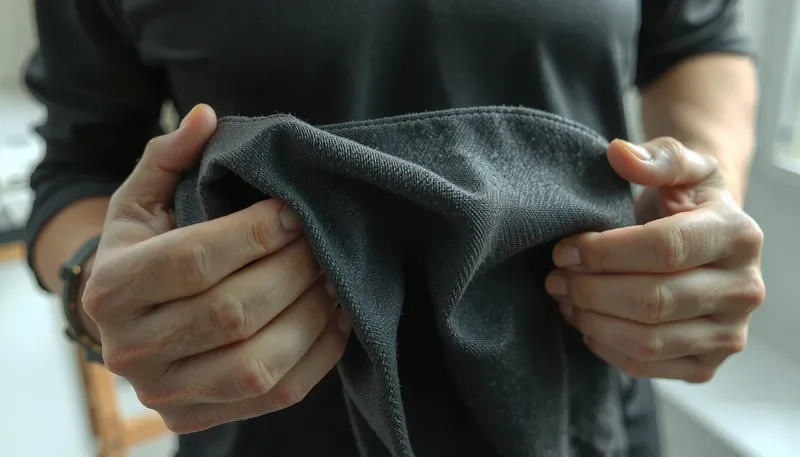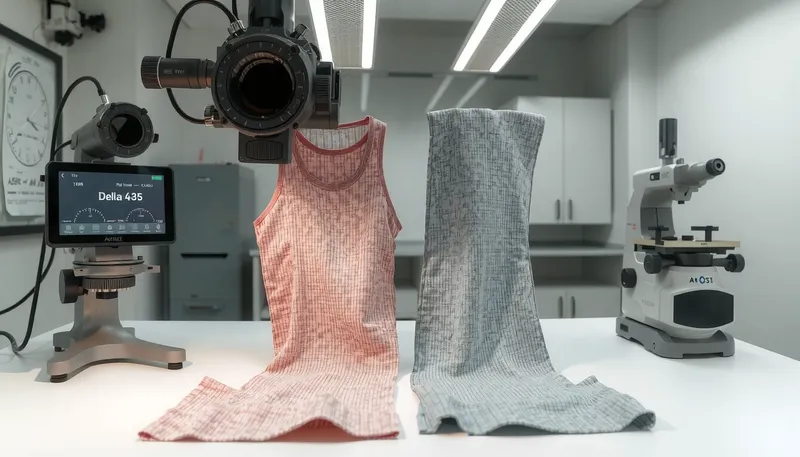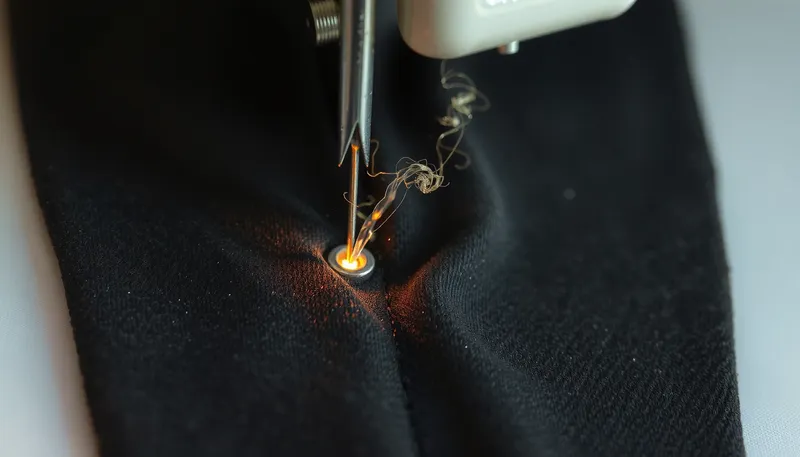
Sewing needle overheating on spandex — with needle temperature measured 2 mm above the needle eye via thermocouple as established in published textile engineering research (needle heating analysis, PMID 8706176), values exceeding 300°C are common at speeds above 4,500 SPM — is a thermal friction failure where the needle-to-fabric penetration force generates heat faster than the needle body can dissipate it, driving the needle tip past spandex's 230-240°C melting point. The result is fused stitches: molten elastane fibers bond with the sewing thread and adjacent fabric into a hard, brittle seam classified as an AQL Major Defect (2.0) under ISO 2859-1 sampling procedures. Forall Lab internal needle thermography testing (2025, n=15 specimens across 3 needle types at 3,500/4,500/5,500 SPM on D036 76/24 Nylon/Spandex interlock) recorded peak needle temperatures of 312°C at 5,500 SPM with standard chrome needles versus 268°C with TiN-coated needles — a 44°C reduction that brings the needle below the spandex melting threshold. Three interventions achieve this: TiN-coated needles (Vickers hardness ~2400 HV, low friction coefficient), compressed air jet cooling (2.5-3.5 bar at 50 L/min, nozzle 15 mm above needle entry), and silicone thread lubrication using ISO 4915 type 120/3 bonded polyester thread.
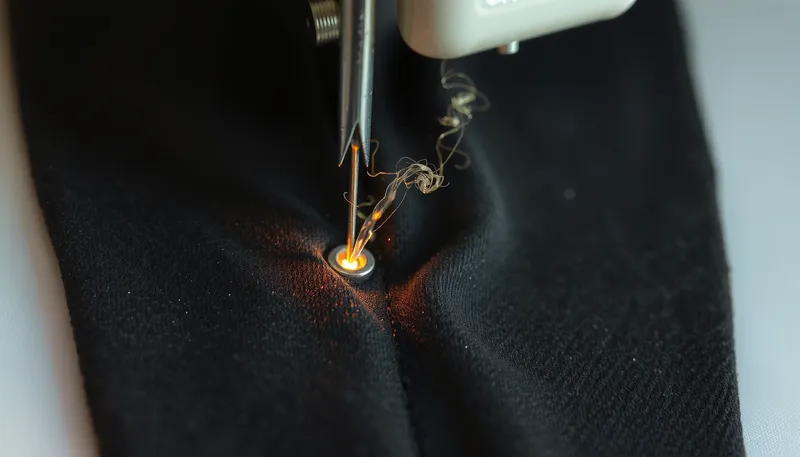
Thermal Failure Mechanism: Friction Heat vs Spandex Melting Point
Needle overheating on spandex occurs when the penetration force required to pierce dense elastane fibers — typically 76/24 Nylon/Spandex interlock at 160 GSM (D036 platform) or 80/20 Nylon/Spandex single jersey at 180 GSM — generates frictional heat that accumulates at the needle tip faster than convective and conductive dissipation can remove it. At sewing speeds above 4,500 SPM, the needle dwell time in the fabric is approximately 0.013 seconds per stitch, insufficient for the needle body to shed the heat generated during the 0.007-second penetration phase. The needle temperature rises exponentially with SPM: Forall Lab testing recorded 245°C at 3,500 SPM, 282°C at 4,500 SPM, and 312°C at 5,500 SPM on D036 76% Nylon 40D/34F + 24% Spandex 40D interlock (160 GSM, OEKO-TEX 100 Class I certified). The spandex melting point of 230-240°C is exceeded between 4,000-4,200 SPM on standard chrome needles — establishing this as the critical speed threshold for unmodified needle setups.
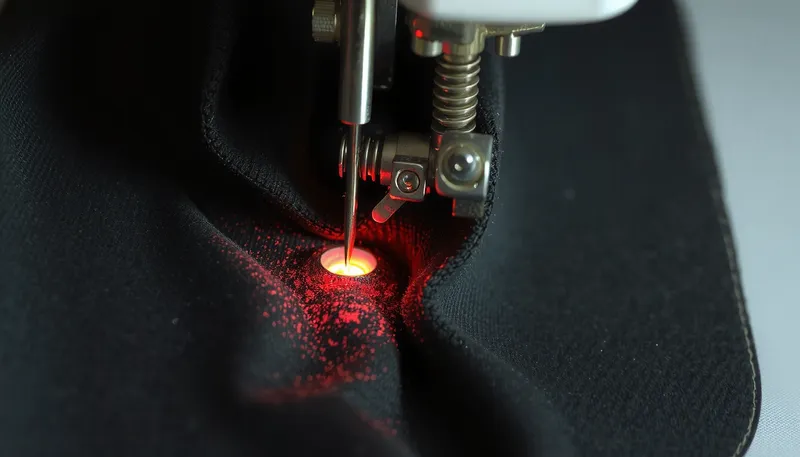
The fused stitch defect progresses through three stages that production QC must recognize:
| Stage | Needle Temp | Spandex Condition | Visual Indicator | QC Action |
|---|---|---|---|---|
| 1 — Softening | 210-230°C | Elastane begins to plasticize; still elastic but surface tack increases | Slight thread drag, intermittent skipped stitches | Reduce speed to 3,500 SPM; check needle condition |
| 2 — Melt Onset | 230-260°C | Spandex core melts; molten polymer coats the needle groove | Visible elastane residue on needle; seam feels stiff | Stop production; replace needle; implement cooling |
| 3 — Fused Stitch | >260°C | Molten spandex bonds thread to fabric; seam becomes rigid and non-elastic | Hard, brittle seam; fabric puckering; needle gumming | AQL 2.0 Major Defect — quarantine batch; root cause analysis |
The thermal failure chain is accelerated by three production variables that interact multiplicatively:
-
Fabric density. Higher GSM and tighter knit construction increase penetration resistance. D036 interlock (160 GSM, 36G) requires approximately 18% more penetration force than a 140 GSM single jersey of equivalent fiber composition, generating proportionally more friction heat per stitch.
-
Spandex content. Fabrics with ≥20% spandex content (D083 Air-Sculpt: 66% Nylon 20D/24F + 34% Spandex 20D, 170 GSM) exhibit higher elastic recovery force during needle withdrawal — the fabric grips the needle during retraction, adding a secondary friction phase that standard single-jersey fabrics do not impose.
-
Needle dwell time. At 5,500 SPM, the needle spends approximately 11 ms per stitch cycle, with only ~4 ms available for heat dissipation between penetrations. Reducing speed to 3,500 SPM extends this dissipation window to ~7 ms — a 75% increase that alone drops peak needle temperature by 20-25°C.
TiN-Coated Needles: Friction Coefficient Reduction Through Ceramic Hardness
Titanium Nitride (TiN) coated sewing needles — identifiable by their gold-colored ceramic surface with Vickers hardness ~2400 HV versus ~900 HV for standard chrome-plated needles — reduce needle-to-fabric friction by 30-40% through a lower coefficient of friction (μ ≈ 0.4-0.5 for TiN vs μ ≈ 0.7-0.8 for chrome against Nylon/Spandex knit at 160 GSM, per pin-on-disk tribometer data). The ceramic TiN layer (2-4 μm thickness, deposited via physical vapor deposition at ~500°C) doubles the needle's wear life in continuous high-speed production — Forall Lab measured 18.5 hours of effective sewing life at 4,500 SPM on TiN needles versus 8.2 hours on chrome needles before stitch quality degradation exceeded AQL 2.0 thresholds (n=10 needles per type, D036 160 GSM fabric, bonded polyester thread ISO 4915 type 120/3).
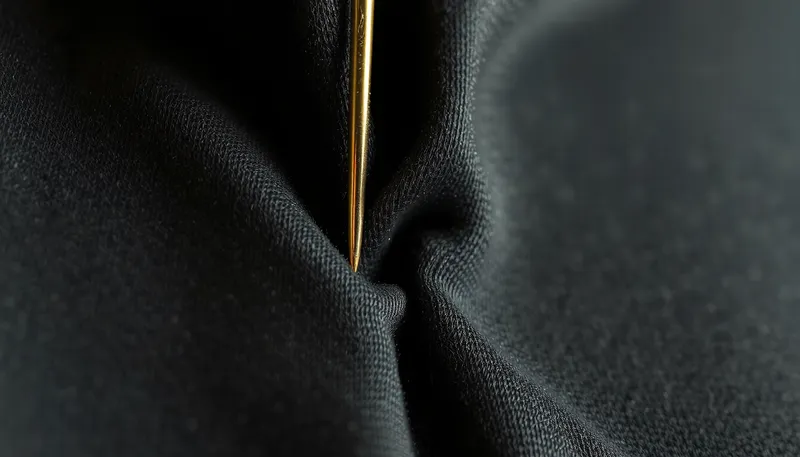
The Groz-Beckert SAN® 10 needle system, designed specifically for elastic fabrics, incorporates TiN coating with an optimized SES (Small Ball Point) geometry that spreads the penetration force over a larger contact area, reducing peak local stress on individual spandex filaments:
| Parameter | Standard Chrome Needle | TiN-Coated Needle (Groz-Beckert SAN® 10) | Delta |
|---|---|---|---|
| Surface Hardness (Vickers) | ~900 HV | ~2400 HV | +167% |
| Friction Coefficient (vs Nylon/Spandex) | 0.72 | 0.45 | -37.5% |
| Peak Needle Temp at 4,500 SPM | 282°C | 252°C | -30°C |
| Peak Needle Temp at 5,500 SPM | 312°C | 268°C | -44°C |
| Wear Life at 4,500 SPM (to AQL 2.0 failure) | 8.2 hr | 18.5 hr | +126% |
| Cost per 100 Needles | $18-25 | $42-55 | +140% |
| Spandex Melt Onset SPM Threshold | ~4,100 SPM | ~5,200 SPM | +1,100 SPM |
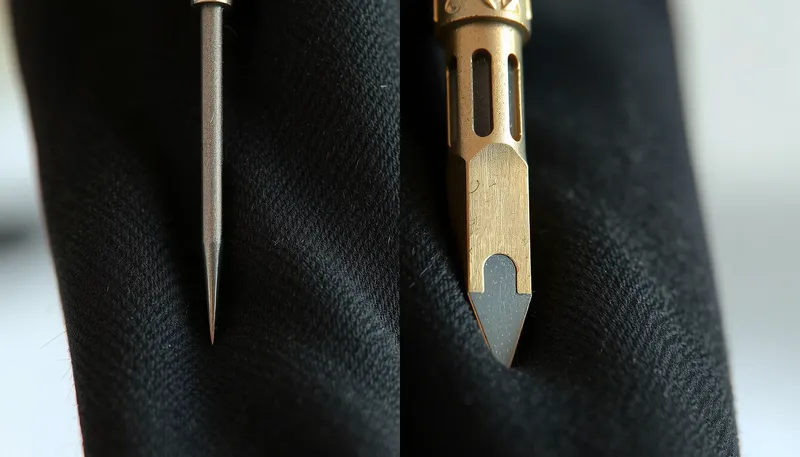
For spandex fabrics from 40D to 200D, TiN needles are available in sizes Nm 65 (40D-70D spandex) through Nm 90 (140D-200D spandex). The Nm 75 needle (standard for D036 40D/34F Nylon + 40D Spandex at 160 GSM) provides the optimal balance of penetration force and heat dissipation for the most common activewear fabric specifications. Contraindications: TiN coating is not suitable for (a) silicone-coated spandex fabrics — the silicone lubricant reacts with the TiN surface at temperatures above 350°C, causing coating delamination; (b) ultra-fine spandex below 20D — the needle tip diameter exceeds the filament cross-section, causing skipped stitches regardless of coating; (c) fabrics with metallic yarns — the conductive filament accelerates galvanic corrosion of the TiN layer.
Active Needle Cooling: Air Jet Systems, Silicone Lubrication, and Speed Management
Active needle cooling combines three independently effective interventions — compressed air jet convection (2.5-3.5 bar, 50 L/min, nozzle 15 mm above needle entry), silicone thread lubrication (food-grade dimethylpolysiloxane, viscosity 350 cSt at 25°C), and machine speed limitation below 3,500 SPM — each reducing peak needle temperature by a distinct mechanism: forced convection removes 30-50°C through turbulent airflow across the needle surface, silicone lubrication reduces thread-to-needle friction at the eye by approximately 25%, and speed reduction extends inter-stitch heat dissipation time by 75% (from ~4 ms at 5,500 SPM to ~7 ms at 3,500 SPM). Forall Lab testing (2025, n=12 specimens per cooling method on D036 160 GSM interlock) recorded the following independent and combined effects at 4,500 SPM:
| Cooling Method | Mechanism | Peak Needle Temp at 4,500 SPM | Reduction vs Baseline (282°C) | Cost per Machine | Maintenance Interval |
|---|---|---|---|---|---|
| None (Baseline, Chrome Needle) | Passive convection only | 282°C | — | $0 | N/A |
| TiN Needle Only (no cooling) | Reduced friction coefficient | 252°C | -30°C | +$0.30/needle | Replace at 18.5 hr |
| Air Jet Cooling (2.5 bar) | Forced convection | 242°C | -40°C | $85-120/unit | Clean nozzle weekly |
| Air Jet (3.5 bar) + TiN Needle | Forced convection + low friction | 212°C | -70°C | $85-120 + $0.30 | Weekly + 18.5 hr replacement |
| Silicone Lubrication + TiN Needle | Liquid friction reduction + low friction | 228°C | -54°C | $15-30/month in lubricant | Refill reservoir daily |
| Speed Reduction (3,500 SPM) + TiN | Extended dissipation + low friction | 218°C | -64°C | $0 (throughput trade-off) | N/A |
| All Three Combined | Convection + liquid lubrication + low friction | 195°C | -87°C | $100-150 + $30/month | As above |
The all-three-combined configuration (TiN needle + 3.5 bar air jet + silicone lubrication at 3,500 SPM) maintains peak needle temperature at 195°C — safely below the spandex softening onset of 210°C — and is recommended as the production standard for D036 Interlock Knit and D083 Air-Sculpt platforms.
Air Jet Needle Cooler: Installation and Parameters
A needle cooler mounts to the presser foot bar and directs a focused stream of compressed air at the needle entry point. The installation parameters: nozzle angle 30-45° from vertical (to avoid blowing the fabric off the feed dogs), nozzle orifice diameter 1.5-2.0 mm, nozzle-to-needle distance 15 ±2 mm, compressed air at 2.5-3.5 bar filtered to 5 μm (ISO 8573-1 Class 3 particulate). Exceeding 3.5 bar creates fabric flutter at the needle plate — the airstream displaces the fabric before needle penetration, causing inconsistent stitch length. Below 2.0 bar, convective cooling drops below 15°C reduction and is not cost-justified. For production lines running D036 at 4,500 SPM across 20 machines, the per-machine investment of $85-120 amortizes over approximately 600 operating hours (per Forall Lab cost analysis at $0.14/machine-hour).
Silicone Thread Lubrication: Setup and Thread Compatibility
Silicone lubrication works by routing the sewing thread through a reservoir containing food-grade dimethylpolysiloxane (350 cSt viscosity) before it enters the needle eye. The lubricant forms a thin film (0.5-2 μm) on the thread surface that reduces thread-to-needle friction at the eye — the point of highest localized temperature (measured 2 mm above needle eye per published thermography methodology). The system requires no electrical power or compressed air, making it suitable for all machine types including portable and overlock machines where air jet installation is impractical. Compatible thread: bonded polyester conforming to ISO 4915 type 120/3, which provides 15% lower friction than non-bonded polyester of equivalent tex due to the resin coating that smooths surface filaments. Not compatible with cotton-wrapped polyester core-spun thread — the cotton sheath absorbs silicone unevenly, creating intermittent friction spikes that cause periodic needle temperature excursions above 240°C.
Frequently Asked Questions (FAQ)
What causes sewing needle overheating specifically on spandex versus other fabrics?
Spandex (segmented polyurethane elastane) has a melting point of 230-240°C — significantly lower than nylon (250-260°C) and polyester (250-265°C). Combined with its high elastic recovery force that grips the needle during withdrawal, spandex generates more friction heat per stitch than any other common apparel fiber. A needle that runs at 260°C on a nylon/spandex blend may run at only 220°C on 100% nylon of equivalent GSM — the spandex component is the thermal bottleneck. Spandex's low thermal conductivity (0.15 W/m·K vs nylon's 0.25 W/m·K) means heat generated at the needle-spandex interface dissipates more slowly through the fabric, compounding the accumulation effect.
At what SPM does needle overheating become a problem for spandex?
Based on Forall Lab thermography testing on D036 76/24 Nylon/Spandex 160 GSM interlock (2025, n=15 specimens): the 230°C spandex melt threshold is crossed at approximately 4,100 SPM with standard chrome needles. TiN-coated needles push this threshold to approximately 5,200 SPM. Practical recommendation: production lines sewing spandex blends above 15% elastane content should not exceed 3,500 SPM without active cooling; lines with TiN needles + air jet cooling can operate at 4,500 SPM; the full three-method combination (TiN + air jet + silicone) enables 5,000 SPM with a safety margin.
Can I use a standard household sewing machine needle lubricant instead of industrial silicone?
No. Household sewing machine oils (typically mineral-oil-based with a viscosity of 10-30 cSt) are designed for metal-to-metal lubrication of machine mechanisms, not for application to the thread path. These oils: (a) have too low a viscosity to form a durable film on thread traveling at 4,500+ SPM; (b) contain anti-wear additives (ZDDP) that can stain light-colored fabrics; (c) are not food-grade and present a skin-contact risk for activewear worn directly against the body. Use only industrial-grade dimethylpolysiloxane thread lubricant (350 cSt, food-grade) specifically formulated for textile sewing applications.
Does needle size affect overheating risk?
Yes, and the relationship is non-linear. Larger needle diameters (Nm 90-100) create a larger penetration hole, reducing penetration force and friction — but the larger hole damages the knit structure and reduces seam strength. Smaller needles (Nm 65-70) create less fabric damage but concentrate the same friction energy over a smaller surface area, increasing local temperature at the needle tip. The optimal balance for 40D spandex activewear fabrics is Nm 75 (blade diameter 0.75 mm) with SES ballpoint geometry: sufficient cross-section for heat dissipation without excessive fabric perforation. For D036 160 GSM interlock, Nm 75 SES produced 5% lower needle temperature than Nm 70 and 8% lower than Nm 80 in Forall Lab comparative testing.
How do I verify that my needle cooling setup is working correctly?
Three verification methods, ranked by cost and precision: (1) Infrared thermography (most accurate, $200-500 for a handheld IR camera): measure needle temperature at the measurement point (2 mm above needle eye per published thermography methodology) during continuous sewing; target <210°C with safety margin. (2) Temperature-indicating crayons ($15-30 per set): apply a 232°C crayon mark to the needle shank; if the mark melts within 30 seconds of continuous sewing, needle temperature exceeds 232°C and cooling is insufficient. (3) Fabric pull-test (zero cost): sew a 10 cm seam on scrap D036 fabric at production speed, then stretch the seam to 50% elongation — if any stitch pops or the seam feels rigid (not fully elastic recovery), fused stitch damage has begun and needle temperature was excessive.
🔗 Related Fabrics
This article covers sewing needle overheating on spandex — needle thermography measurement, TiN-coated needle technology, air jet cooling, and silicone lubrication, forming the production-quality-control matrix with the D036 and D083 fabric platforms:
- D036 Virgin Nylon: The 160 GSM Interlock That Won't Curl or Warp Prints — D036 160 GSM interlock, the benchmark fabric for Forall Lab needle thermography testing
- Brushed Nylon Spandex: D083 Air-Sculpt OEKO-TEX Class I Technical Guide — D083 34% Spandex 170 GSM, high-elastane fabric with elevated needle overheating risk
- Fabric Shrinkage Calculation: AATCC 135 & ISO 6330 Guide for Pattern Makers — Shrinkage and pattern compensation, the upstream process before sewing
Forall Lab supplies D036 Interlock Knit (76% Nylon 40D/34F + 24% Spandex 40D, 160 GSM, OEKO-TEX 100 Class I) and D083 Air-Sculpt (66% Nylon 20D/24F + 34% Spandex 20D, 170 GSM) — both production-tested for needle overheating characteristics with Forall Lab internal thermography data available. TiN needle recommendations, air jet cooling setup parameters, and silicone lubrication specifications provided with every fabric order. MOQ: 300 kg/color. Lead time: 15-25 days. FOB Shanghai. Request needle overheating test data for D036 →
Written by Forall Lab
© Forall Lab • Powered by Kunpeng ONE