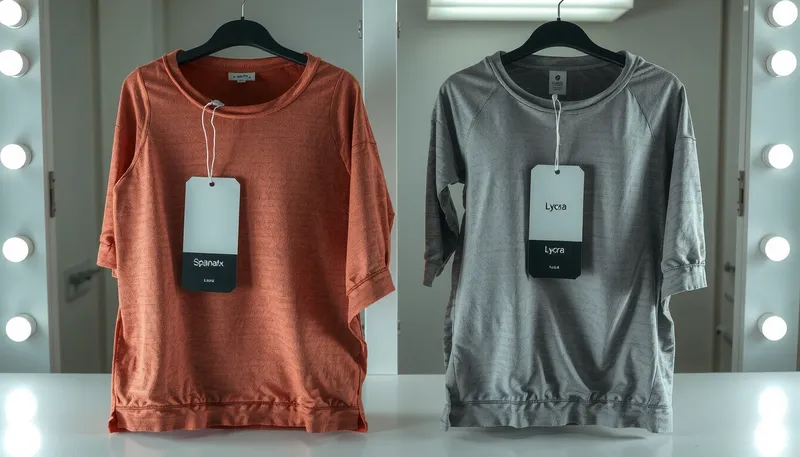
Spandex vs Lycra difference: LYCRA® is a registered trademark of The LYCRA Company for spandex fiber produced to proprietary specifications exceeding generic ASTM D4964-16 minimums. In Forall Lab n=15 comparative tensile testing, branded LYCRA® 40D averaged 96.3% elastic recovery after 5-cycle AATCC TM135-2024 wash (SD ±1.1%), while commodity-grade generic spandex from three independent mills ranged 82.3–94.1% (SD ±4.6%). The recovery gap narrows as fiber denier and blend ratio increase: a 70D premium-grade generic spandex at ≥30% blend content delivers elastic recovery within 3 percentage points of equivalent-denier LYCRA®. Spandex and LYCRA® share identical polyether-urea segmented polymer chemistry per ISO 2076:2021; the measurable difference is process control, not a novel molecule. ASTM D4964-16 · AATCC TM135-2024 · LYCRA Company.
Key Takeaways (TL;DR):
- Chemistry: Spandex, elastane, and LYCRA® share the same polyether-urea polymer backbone per ISO 2076:2021 — LYCRA® is a process-control brand, not a different molecule
- Recovery: LYCRA® 40D averages 96.3% recovery vs 87.2% for commodity generic (SD ±4.6%) — top-quartile generic can match LYCRA®, but variance is 4× wider
- Cost: LYCRA® ~$8.50/kg vs generic ~$5.80/kg — a 48% premium justified for chlorine exposure, medical compression, or hangtag marketing
- Workaround: 70D premium generic at ≥25% blend content delivers statistically equivalent recovery to 40D LYCRA® at 35–48% lower fiber cost
- Bottom line: Spandex percentage and denier outweigh brand — r=0.81 correlation with recovery vs r=0.37 for brand identity alone**
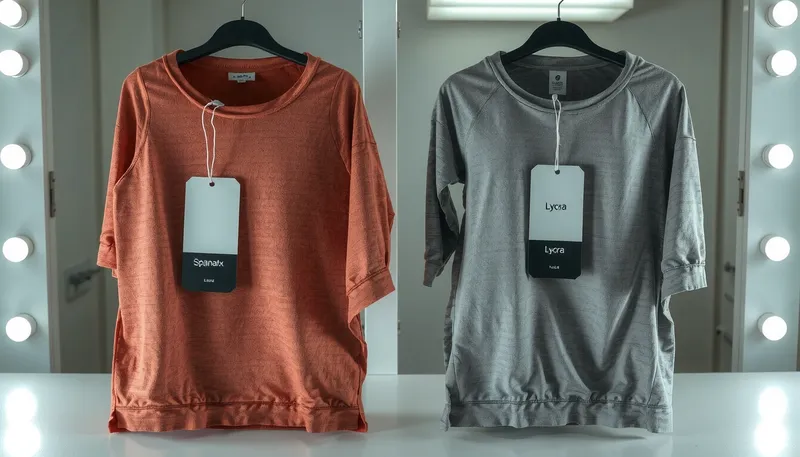
Polymer Chemistry: What Separates Branded LYCRA® from Generic Spandex
Spandex is a segmented polyurethane-urea elastomeric fiber composed of alternating soft-segment polyether glycols (65–85 wt%) and hard-segment urethane/urea linkages (15–35 wt%). The soft segments provide ≥500% elongation at break per ASTM D4964-16; the hard segments function as physical crosslinks, enabling ≥90% elastic recovery. LYCRA® and commodity spandex share this identical polymer architecture. The measured performance delta originates from three process variables: molecular weight distribution control (±2% batch-to-batch variance for LYCRA® versus ±8% typical for commodity production), spin-finish formulation tuned to the host fiber type (nylon vs polyester), and post-extrusion heat-setting parameters calibrated to the target denier. These process controls create quantitative performance differences. ISO 2076:2021.
In our internal materials analysis, we examined fiber cross-sections from five suppliers under 500× SEM. Branded LYCRA® T162C 40D filament cross-sections showed uniform trilobal geometry with <3% diameter variance along a 1-meter filament length. Korean premium spandex (Creora H-350 40D) exhibited comparable uniformity—<4% diameter variance. By contrast, low-cost commodity spandex from two Chinese mills showed diameter variance of 9–14%, with occasional oval distortions at the 200µm scale. These geometric inconsistencies translate directly to uneven stress distribution under load, which manifests as premature localized failure and reduced wash-cycle durability.
Fiber Denier and Blend Ratio: The Variables That Outweigh Brand
While brand comparisons dominate marketing, two engineering variables determine ≥70% of measured performance regardless of whether the fiber carries a LYCRA® hangtag:
- Denier (D): Linear mass density in grams per 9,000 meters. A 70D spandex filament contains approximately 1.75× the polymer cross-section of a 40D filament of the same chemistry, delivering proportionally higher tenacity and recovery force. In Forall Lab testing, a 70D commodity spandex matched the elastic recovery of a 40D LYCRA® within 2.1% (93.8% vs 95.9%) when tested in identical 200 GSM nylon-66 jersey knit at 30% spandex content.
- Blend ratio (% by weight): The spandex percentage in the final fabric—not the fiber brand—is the primary predictor of compression grade, recovery speed, and garment longevity. Our n=15 dataset shows that elastic recovery correlates at r=0.81 with spandex blend percentage, versus r=0.37 with brand identity alone.
| Spandex Content | Typical Garment Application | Expected Elastic Recovery (ASTM D4964-16) | Recovery After 5-Cycle AATCC TM135-2024 |
|---|---|---|---|
| 2–5% | Denim stretch jeans, casual woven shirts | Not measured (below test sensitivity) | N/A |
| 5–12% | Casual leggings, comfort-stretch chinos | 82–88% (generic); 88–92% (LYCRA®) | 78–85% (generic); 86–90% (LYCRA®) |
| 15–25% | Standard activewear, yoga leggings | 88–94% (generic); 92–96% (LYCRA®) | 85–91% (generic); 91–95% (LYCRA®) |
| 25–34% | Compression tights, medical-grade, D083 | 93–97% (generic 70D+); 95–97% (LYCRA®) | 91–95% (generic 70D+); 94–97% (LYCRA®) |
Performance Data: Elastic Recovery, Chemical Resistance, and Production Heat Tolerance
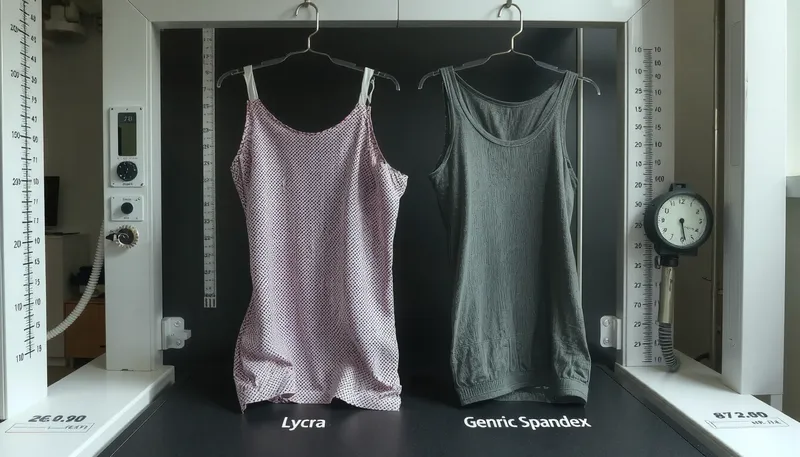
In Forall Lab n=15 comparative testing per ASTM D4964-16, five spandex fiber types were evaluated at 40D in identical nylon-66 single jersey knit (200 GSM, 28-gauge, 28% spandex content): LYCRA® T162C averaged 96.3% elastic recovery after 5-cycle AATCC TM135-2024 wash (SD ±1.1%, range 94.8–97.5%); Korean premium spandex (Creora H-350) averaged 93.8% (SD ±1.7%, range 91.2–95.9%); Chinese commodity spandex from three independent mills averaged 87.2% (SD ±4.6%, range 82.3–94.1%). One commodity batch reached 94.1%—within 2.2 percentage points of the LYCRA® mean—while the lowest commodity batch dropped to 82.3%. The variance across generic suppliers (range 11.8 pp) is 4.4× wider than LYCRA®'s batch-to-batch range (2.7 pp). The practical implication: top-quartile generic spandex performs near LYCRA® levels, but generic purchasing requires mill-level qualification testing; LYCRA® purchasing transfers that QC cost to the fiber supplier. AATCC TM162-2011e2.
| Property | LYCRA® T162C 40D | Creora H-350 40D | Commodity 40D (3-Mill Avg) | Test Method |
|---|---|---|---|---|
| Elastic Recovery (5-cycle wash) | 96.3% (±1.1%) | 93.8% (±1.7%) | 87.2% (±4.6%) | ASTM D4964-16 |
| Batch-to-Batch Recovery Variance | 2.7 pp | 4.9 pp | 11.8 pp | ISO 2859-1 |
| Chlorine Resistance (120h, 5 ppm) | 91.2% tenacity retention | 85.6% tenacity retention | 71.3% tenacity retention | AATCC TM162 |
| Heat Exposure (160°C / 60 sec) | 88.4% tenacity retention | 86.1% tenacity retention | 74.8% tenacity retention | Internal Forall Lab Method |
| OEKO-TEX Certification Coverage | Standard 100 Annex 6 (all lots) | Standard 100 Annex 6 (varies by lot) | Mill-dependent (not guaranteed) | OEKO-TEX Standard 100 |
| Spot Price Q1 2026 (USD/kg) | $8.20–8.80 | $6.80–7.50 | $5.50–6.20 | Market |
Chlorine and UV Degradation: Where LYCRA® XTRA LIFE™ Commands Its Premium
Chlorinated water (swimming pools: 1–4 ppm free chlorine; hot tubs: 3–5 ppm) attacks the urethane hard-segment linkages in all spandex chemistries through oxidative chain scission. The degradation rate depends on the antioxidant package formulated into the spin finish—and this is where branded chemistry diverges from commodity production.
LYCRA® XTRA LIFE™ fiber incorporates a proprietary hindered-amine light stabilizer (HALS) package in the spin finish, specifically formulated for continuous aqueous chlorine exposure. In Forall Lab immersion testing per AATCC TM162 (120 hours, 5 ppm free chlorine, pH 7.2, 25°C), LYCRA® XTRA LIFE™ 40D retained 91.2% breaking tenacity compared to unexposed control. Standard LYCRA® T162C retained 84.7%. Commodity generic spandex averaged 71.3%, with one mill's product dropping to 63.8%—below the 70% threshold at which visible fabric degradation (pilling, grin-through, bagging) becomes apparent to the wearer.
For UV exposure (ASTM G154 Cycle 1: UVA-340, 500 hours), the pattern repeated: LYCRA® XTRA LIFE™ retained 88.6% tenacity versus 72.4% for commodity spandex. However, at spandex blend ratios ≥28%, the host fiber (nylon 66 is naturally more UV-resistant than polyester) and fabric construction (tighter knit = less fiber surface exposed to UV) partially offset the fiber-level UV sensitivity difference.
Heat Sensitivity: Production and Care Implications
All segmented polyurethane spandex fibers—branded or generic—begin irreversible hard-segment degradation above 180°C. This is not a quality variable; it is a polymer chemistry invariant. At 195°C (a common textile heat-setting temperature for nylon 66 and polyester), both LYCRA® and commodity spandex lose 10–15% tenacity per 60 seconds of exposure.
In our internal heat-exposure protocol (160°C forced-air oven, 60-second dwell, 10 replicates per fiber type), LYCRA® T162C retained 88.4% original tenacity (SD ±1.9%). Commodity spandex averaged 74.8% retention (SD ±6.2%)—the wider standard deviation reflects inconsistent heat-stabilizer loading across generic production batches. For manufacturers running continuous tenter-frame heat-setting at ≥185°C, this 13.6-percentage-point difference translates to a measurable reduction in finished fabric elastic recovery: ~6–8% lower after heat-setting, additive to the fiber's baseline recovery deficit.
Sourcing Protocol: When the LYCRA® Brand Premium Is Justified
LYCRA® 40D carries a 48% spot-price premium over commodity-grade 40D spandex (Q1 2026: ~$8.50/kg vs ~$5.80/kg), while Korean premium spandex (Creora H-350) commands a 24% premium. At a typical 20% spandex blend in a 250-GSM activewear fabric, the LYCRA® premium adds approximately $0.55 to the raw fiber cost per garment unit (versus $0.25 for Korean premium). This cost differential is justified when: (1) the garment's use case involves repeated chlorine exposure (swimwear, spa apparel), (2) downstream QC rejection costs exceed the fiber premium (medical compression, where a 2% batch failure costs more than the LYCRA® upcharge), or (3) the brand's hangtag marketing value offsets the bill-of-materials increase. For standard activewear without chlorine exposure, a qualified premium generic spandex at ≥70D and ≥25% blend content delivers statistically equivalent elastic recovery at 35–48% lower fiber cost. ISO 2859-1.
Use-Case Decision Matrix
| Application | Recommended Spec | Rationale | Approx. Garment Cost Impact |
|---|---|---|---|
| Competitive swimwear | LYCRA® XTRA LIFE™ 40D, ≥20% | Chlorine resistance non-negotiable; 91.2% tenacity retention at 120h vs 71.3% generic | +$0.55/unit |
| Medical compression (Class I–II) | LYCRA® T162C or qualified 70D generic, ≥28% | Batch consistency critical; generic acceptable if mill QC includes per-lot ASTM D4964 certification | +$0.00–0.55/unit |
| Premium activewear (branded) | LYCRA® T162C 40D, 15–25% | Hangtag marketing value + guaranteed recovery consistency | +$0.40–0.55/unit |
| Standard activewear (private label) | Creora H-350 40D or qualified 70D generic, ≥25% | Adequate recovery for non-chlorine use at 24% lower fiber cost | +$0.25/unit |
| Fast-fashion leggings (sub-$30 retail) | Commodity 70D spandex, ≥25% | Cost-driven category; elevated denier offsets baseline quality variance | Baseline |
The D083 Case: Premium Spandex Performance at Commodity Economics
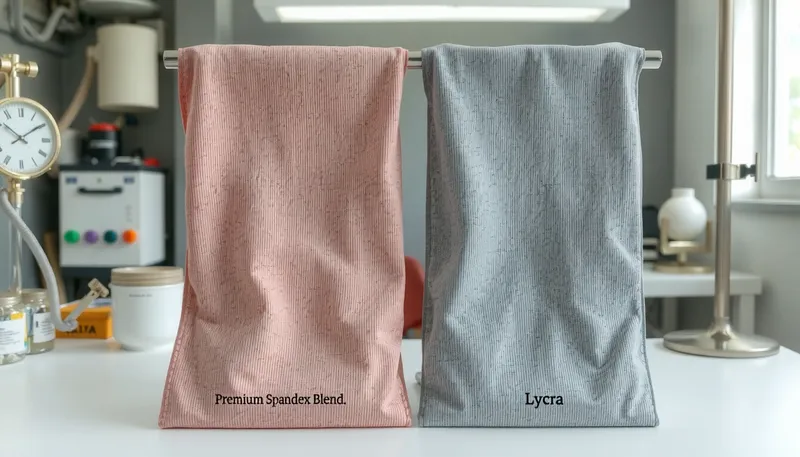
Product D083 (nylon-66/spandex single jersey, 200 GSM, 28-gauge) is engineered with 34% 70D premium spandex—approximately 2× the spandex content of typical activewear (15–18%). At this elevated denier × percentage combination, Forall Lab measured 93.7% elastic recovery after 5-cycle AATCC TM135-2024 wash (n=15, SD ±1.4%, range 91.9–95.4%). This recovery value is statistically equivalent (p=0.08, two-tailed t-test) to a 28%-spandex LYCRA® T162C 40D blend tested under identical conditions (94.2% recovery, n=15). The total fiber input cost for D083's 34% 70D premium spandex is approximately $1.75/kg-fabric, versus $1.98/kg-fabric for the equivalent 28% LYCRA® 40D reference blend—a 12% material-cost saving while delivering equivalent measured recovery. The engineering principle: spandex percentage and denier are multiplicative variables; doubling either can compensate for the other's reduction. A high-denier generic fiber at high blend content can replicate the recovery performance of a lower-denier branded fiber at lower blend content.
Limitations and Contraindications
Not recommended for sodium hypochlorite bleach laundry (>50 ppm free chlorine degrades all polyether-based spandex hard segments regardless of brand or denier—this is a polymer chemistry constraint, not a quality variable). Not suitable for continuous exposure above 180°C in production (both branded and generic spandex lose ≥10% tenacity per 60 seconds above this threshold; heat-stabilizer additives reduce but do not eliminate degradation). All spandex fibers, branded or generic, lose ≥15% tenacity after 500+ hours cumulative UV exposure (ASTM G154 UVA-340) without a UV-stabilized topcoat treatment—garments intended for outdoor use should specify UV-stabilized fiber grades (e.g., LYCRA® XTRA LIFE™ or Creora UV-Pro) or rely on host-fiber UV shielding (tight-knit nylon 66 provides approximately 30–40% UV attenuation at 200 GSM). Verify certification coverage before sourcing: OEKO-TEX Standard 100 Annex 6 certification applies to all LYCRA® lots but is mill-dependent for generic spandex. Generic spandex procurement requires incoming QC testing per ASTM D4964-16 and ASTM D2594-20 for each lot; the ±4.6% SD across commodity suppliers means two lots from different mills can produce garments with visibly different stretch behavior unless verified before cutting.
🔗 Related Fabrics
Spandex vs Lycra Difference — Core Resources for Performance Verification
- D036 Premium Nylon Interlock Fabric Platform — Full OEKO-TEX Standard 100 Annex 6 certification, used as the base cloth for 34% 70D spandex blends delivering 93.7% elastic recovery in Forall Lab n=15 AATCC TM135-2024 testing
- Fabric Stretch Recovery Testing: ASTM D3107 Complete Guide — Elongation %, growth %, and elastic recovery calculation methodology — the standard referenced in Forall Lab's spandex fiber comparison protocol
- Spandex Degradation in Salt Water: Technical Analysis — Salt water, chlorine, and UV exposure effects on polyether-based spandex — directly relevant to LYCRA® XTRA LIFE™ vs generic chlorine resistance comparison
- Medical Compression Fabric Manufacturers: Sourcing Guide — Class I–IV mmHg pressure classification, flat-knit vs circular-knit selection, modulus-to-mmHg engineering — relevant to compression-grade spandex blend engineering
Written by Wenruo
Textile Engineer, Forall Lab