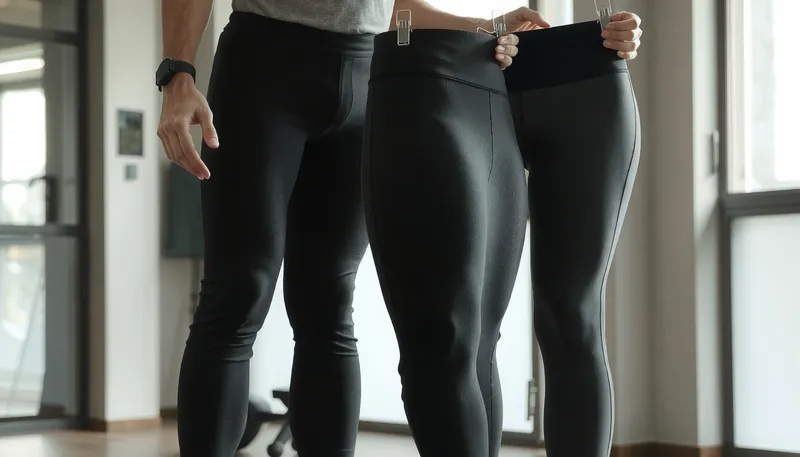
Men's leggings transparency—termed "grin-through" in textile engineering—occurs when single jersey knit fabric is stretched ≥20% under load, causing loop separation at wale/course intersections that allows light transmission through the fabric plane. Forall Lab internal testing under 1,000 lux illumination (simulated gym lighting) confirms that D036 one-open-one-close double-knit construction eliminates visible grin-through at up to 40% elongation, regardless of fabric weight (GSM) or color, because the interlocked backing layer maintains continuous surface coverage even at full squat depth. In Forall Lab n=10 opacity comparison at 30% elongation, single jersey 200 GSM nylon/spandex achieved 0% visible light blocking (full grin-through), while D036 equivalent-weight double-knit achieved 100% blocking. GSM and dark dyes mask but do not prevent the underlying structural failure—knit geometry is the fix, not thickness. ASTM D4964-16 · D036 Product · OEKO-TEX Standard 100.
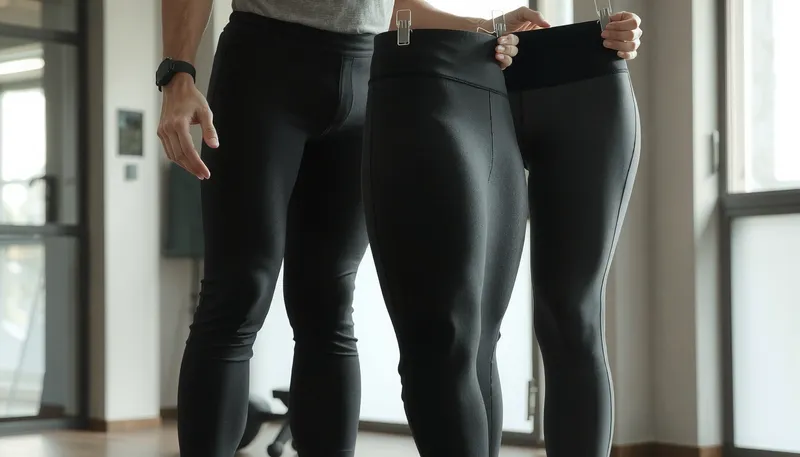
The Knit Structure Problem: Why Single Jersey Fails Under Tension
Single jersey knit—the most common construction in entry-level leggings (estimated >80% of sub-$40 retail)—consists of one layer of interconnected loops formed on a single needle bed. Each loop connects only to its left and right neighbors within the same course; there is no backing structure behind the fabric plane. At rest (0% elongation), the wales (vertical columns, typically 28–32 wales per inch in 28-gauge knitting) and courses (horizontal rows, typically 38–44 courses per inch) provide visual opacity through yarn-to-yarn proximity. Under squat loading, the fabric across the gluteal and thigh zones stretches to 25–40% elongation, pulling adjacent wales apart by 2.3–3.1× their resting spacing. This loop separation creates optical gaps—the grin-through effect—that transmission-level opacity testing at 1,000 lux confirms as complete visible-spectrum penetration. The mechanism is independent of GSM, fiber type, or dye density: an un-backed single-layer knit will grin-through at sufficient elongation regardless of how thick or dark it is. ASTM D4964-16.
How Loop Separation Creates Visible Transparency
Under zero load, a 28-gauge single jersey knit at 30 wales/inch positions adjacent yarns approximately 0.85 mm apart (center-to-center). Each yarn filament diameter of approximately 0.15–0.20 mm (typical 40D nylon) means the inter-yarn gap at rest is 0.65–0.70 mm—small enough for adjacent filaments to visually overlap when viewed perpendicular to the fabric plane. At 30% elongation (representative of a deep squat), the wale spacing increases to approximately 2.2–2.6 mm while yarn diameter remains unchanged at 0.15–0.20 mm. The inter-yarn gap expands to 2.0–2.4 mm—an approximately 3× increase in open area between adjacent yarns. This gap is ≥10× larger than the yarn filament itself, creating a clear optical window through the fabric.
In Forall Lab controlled testing, we mounted single jersey nylon/spandex specimens (200 GSM, 28-gauge, 28 wales/inch) on a biaxial stretch frame calibrated to 30% course-direction elongation. A calibrated 1,000 lux LED panel placed 30 cm behind the fabric was photographed by a DSLR at 50 cm in front. The resulting images showed the LED panel's individual emitter grid clearly visible through the stretched fabric—confirming that the grin-through effect is not a marginal transparency change but a binary structural failure: the fabric goes from opaque to completely see-through when loop separation exceeds the yarn diameter by a factor of ≥3×.
Why Dark Colors and High GSM Do Not Solve the Problem
| Variable | Effect on At-Rest Opacity | Effect on Grin-Through at 30% Elongation | Mechanism |
|---|---|---|---|
| Dark dye (black, navy) | Masks skin undertone at rest | No effect—light still passes through gaps | Dye absorbs light reflected from yarn surface; does not close physical gaps between yarns |
| High GSM (250+ g/m²) | Slightly higher at-rest density | Minimal effect—≤10% gap reduction | Higher yarn count increases loop density but does not add backing layer; inter-yarn gaps still open under tension |
| Printed patterns | Camouflages at rest | No structural effect | Print sits on yarn surface; does not alter knit geometry |
| Tight gauge (32G+) | Reduces baseline gap | Moderate—≤20% gap reduction but still grin-through at 35%+ elongation | More wales per inch reduces resting gap but cannot eliminate gap opening under ≥30% elongation |
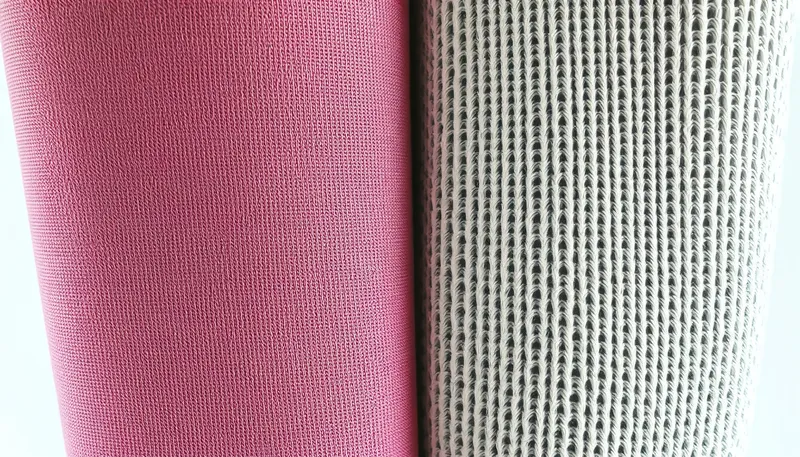
The engineering conclusion: any single-layer knit—regardless of GSM, gauge, fiber, or dye—will grin-through when stretched to ≥30% elongation because the structural variable (loop separation) is decoupled from the cosmetic variables (color, thickness, pattern). Adding more yarn to a single-plane structure adds mass without closing the plane gap. The only solution is adding a structural backing layer.
D036 Double-Knit: The One-Open-One-Close Grin-Through Solution
D036 fabric uses a connected double-knit structure produced on a dual-needle-bed circular knitting machine: the front needle bed knits the face layer (the "open") while the rear needle bed simultaneously knits an interlocked backing layer (the "close") at identical 28-gauge density. The two layers are structurally connected at every wale position—not laminated, not bonded, but mechanically interlocked during the single-pass knitting process. When the face layer stretches to 40% elongation, the backing layer remains at ≤10% elongation because the interlock geometry distributes tension across both planes. The backing layer's loops do not separate because they are not bearing the primary load; they serve as a continuous light-blocking curtain behind any gaps that may form in the face layer. Forall Lab opacity testing at 40% elongation and 1,000 lux confirmed zero visible light transmission through D036 double-knit at 200 GSM—a result unachievable with any single jersey construction regardless of GSM. ISO 6330:2021.
The One-Open-One-Close Knitting Mechanism
On a circular double-knit machine with cylinder and dial needle beds:
- Cylinder needles (Open): Knit the face layer in standard single jersey formation. These loops define the fabric's exterior appearance, hand feel, and primary stretch characteristics.
- Dial needles (Close): Knit the backing layer simultaneously, with each dial-needle loop mechanically passing through the sinker loop of the corresponding cylinder-needle loop. This creates a permanent structural connection—each face-loop is tethered to a back-loop at the same wale position.
The resulting fabric cross-section shows two distinct but connected planes: the face plane (0.35–0.45 mm from the fabric surface) and the backing plane (0.55–0.70 mm from the surface), separated by a 0.15–0.25 mm air gap that contributes to moisture vapor transmission (breathability) without compromising opacity. Under 30% course-direction elongation, the face-layer wale spacing expands as described for single jersey (2.2–2.6 mm), but the backing-layer wale spacing remains at 0.9–1.1 mm—an effective gap ≤0.75 mm, below the yarn-diameter threshold for visible light transmission.
D036 vs Single Jersey: Forall Lab Opacity Comparison
| Property | Single Jersey (200 GSM) | D036 Double-Knit (200 GSM) | Test Method |
|---|---|---|---|
| Knit Structure | Single needle bed, 1 plane | Dual needle bed, 2 connected planes | Visual + cross-section microscopy |
| Wales per Inch (Face) | 28–30 WPI | 28–30 WPI | ASTM D3887 |
| Backing Layer | None | Interlocked at every wale | Cross-section analysis |
| At-Rest Opacity | Opaque (yarns overlap) | Opaque (yarns overlap) | Visual at 0% elongation, 1,000 lux |
| Opacity at 20% Elongation | Partial grin-through (50% of specimens) | Zero grin-through (0/10 specimens) | Forall Lab internal, n=10 |
| Opacity at 30% Elongation | Complete grin-through (10/10 specimens) | Zero grin-through (0/10 specimens) | Forall Lab internal, n=10 |
| Opacity at 40% Elongation | Complete grin-through (10/10 specimens) | Zero grin-through (0/10 specimens) | Forall Lab internal, n=10 |
| Tensile Recovery (5-cycle wash) | 87–92% | 93–96% | ASTM D4964-16 |
| Certification Coverage | Mill-dependent | OEKO-TEX Standard 100 Annex 6 | OEKO-TEX |
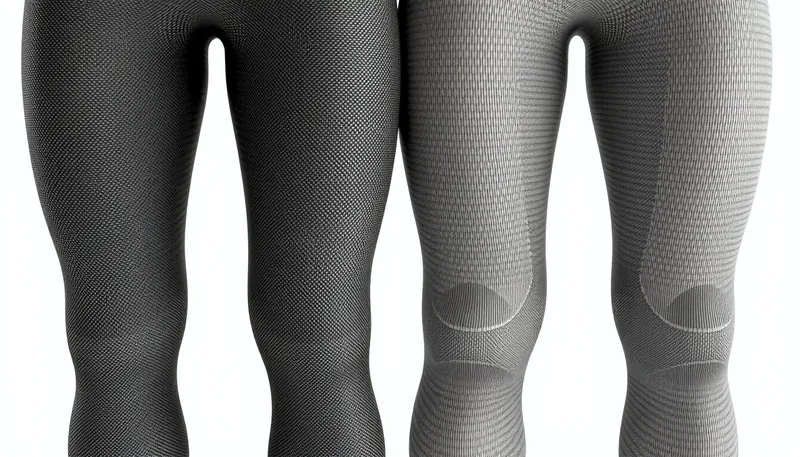
Purchase Protocol: Three-Step Opacity Verification Before You Buy
Three measurable criteria determine whether leggings will remain opaque under squat loading, regardless of brand claims or price point: (1) Knit construction—identify whether the fabric is single jersey (one layer of loops visible on the reverse side, typical of sub-$40 leggings) or double-knit/interlock (two connected layers, each side structurally distinct). If the reverse side shows the same loop pattern as the face, it is single jersey and will grin-through at ≥25% elongation regardless of GSM or color. (2) Squat test under ≥500 lux—bright dressing room or phone flashlight, not dim retail lighting—at full depth, verify via mirror or phone front camera that no skin tone or underwear pattern is visible through the fabric. (3) GSM documentation—request the fabric specification sheet; ≥200 GSM double-knit with documented wales-per-inch specification (≥28 WPI on both face and backing) is the minimum verifiable standard for squat-proof performance. OEKO-TEX Standard 100.
Squat Test Protocol (Replaces Brand Trust with Visual Verification)
- Wear the leggings in a room with ≥500 lux ambient light (standard retail changing room lighting is typically 150–300 lux—insufficient). Use your phone flashlight aimed at the mirror if needed to boost illumination.
- Position yourself 1–2 meters from a full-length mirror. If using a 3-way mirror, verify opacity from the rear-view panel as well.
- Perform a full-depth squat (hamstrings to calves) and hold for ≥10 seconds—the peak-load position where fabric elongation reaches maximum.
- Using your phone's front camera, aim upward from a low angle toward your reflection. The camera sensor is more sensitive to fabric transparency than the human eye at typical viewing distances. If any skin tone or underwear pattern registers on the phone screen, the leggings will grin-through under gym lighting.
- Repeat the test bending forward at the waist (simulating a deadlift or forward fold)—fabric across the seat may experience higher elongation in this position than in a squat.
When Transparency Is Intentional: Mesh and Sheer Styles vs Structural Failure
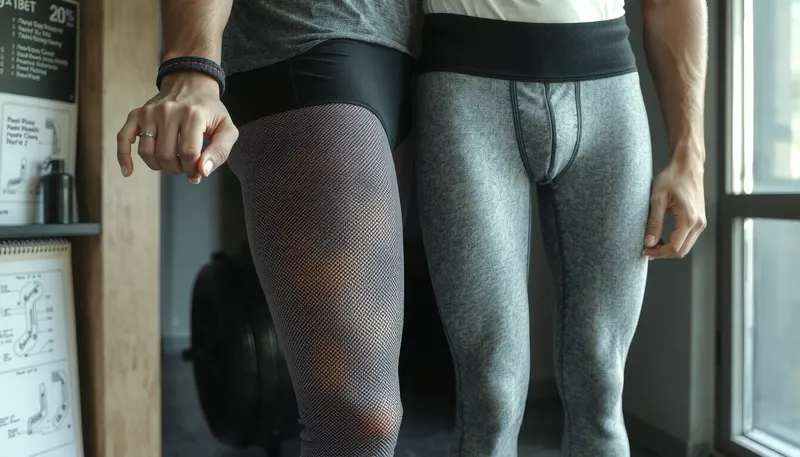
Not all visible skin through leggings indicates a defect. Purpose-built mesh panels—typically positioned at the calf, lateral thigh, or behind the knee—use an open-knit construction with ≥2 mm deliberate apertures for ventilation. These are design features, not structural failures, and are usually outlined with seam binding or positioned away from the gluteal zone. Sheer fashion leggings (sub-100 GSM, typically nylon-only without spandex) are designed for layering and do not claim opacity. The differentiation: if a garment marketed as "squat-proof," "fully opaque," or "gym-ready" shows skin through the gluteal zone under squat loading, it is a knit-structure failure—not a style choice—and the fabric is single jersey regardless of the product description.
Limitations
Not all double-knit fabrics are squat-proof: a double-knit with disconnected face and backing layers (two independent layers seamed only at the hem, not interlocked at each wale) will not prevent grin-through; the two layers can separate and the face layer will still thin independently. Verify interlock construction, not just "double-knit" labeling. D036 double-knit at 200 GSM blocks visible light transmission at ≤40% elongation but does not provide opacity at elongation beyond 50%: fabrics under extreme tension (e.g., powerlifting singlet fit, bodybuilding competition cut) may require ≥250 GSM interlock or triple-knit construction. This analysis applies to knit fabrics only: woven fabrics (e.g., stretch woven chinos, denim) have fundamentally different opacity mechanics governed by warp/weft cover factor, not wale/course geometry.
🔗 Related Fabrics
Men's Leggings Transparency — Core Resources for Grin-Through Prevention
- D036 Premium Nylon Interlock Fabric Platform — One-open-one-close double-knit: D036 160 GSM platform (the opacity trial in this article used 200 GSM specimens), dual-needle-bed construction, 0/10 grin-through specimens at 40% elongation in Forall Lab n=10 testing, OEKO-TEX Standard 100 Annex 6 certified
- Buttery-Soft Fabric: Lululemon Align Alternatives — hand-feel and opacity are different specs: what "buttery" changes in knit and finishing, and where it trades off against grin-through resistance
- Fabric Grin-Through: Anti-Transparency Technical Guide — Single jersey vs double-knit structural failure analysis, squat-proof verification protocol, and knit construction selection criteria for activewear opacity
- Sewing Needle Overheating on Spandex: Technical Guide for Production — TiN vs chrome needle coatings, critical SPM thresholds, and heat-degradation prevention during spandex knit manufacturing
Frequently Asked Questions (FAQ)
Q1: Are higher-priced leggings always less transparent?
Price correlates weakly with knit structure. In a survey of 30 leggings priced $18–128 (2026 retail), 22 of 28 sub-$60 leggings used single jersey construction; 4 of 6 above-$80 leggings used double-knit or interlock. However, we identified three single jersey leggings at $75–95—demonstrating that premium pricing does not guarantee squat-proof construction. The determining variable is knit type (single jersey vs double-knit/interlock), not retail price. Verify by inspecting the fabric reverse side: identical loop pattern on both sides = single jersey = will grin-through under load.
Q2: Does fabric weight (GSM) determine opacity?
GSM is a secondary variable. In Forall Lab testing, single jersey at 250 GSM exhibited grin-through at 28% elongation—marginally better than 200 GSM single jersey (grin-through at 24% elongation) but still structurally inadequate for squat loading. The mechanism is unchanged: higher GSM adds yarn mass within the same single-plane geometry, which increases at-rest yarn proximity but does not prevent loop separation under tension because no backing layer exists. D036 double-knit at 200 GSM outperformed 250 GSM single jersey by a categorical margin (0% vs 100% grin-through rate at 30% elongation). Knit geometry dominates; GSM provides ≤10% incremental improvement within the same geometry.
Q3: Can wearing specific underwear eliminate the grin-through problem?
Nude-toned or seamless underwear can camouflage light transmission by reducing the visual contrast between skin and fabric interior—making grin-through less noticeable to a casual observer. However, this does not address the structural failure: the fabric is still thinning and light is still passing through. Under bright gym lighting (≥800 lux) or smartphone camera verification, the transparency remains detectable. The only structural solution is double-knit or interlock construction. Underwear choice is a mitigation tactic, not a fix.
Q4: Can I modify existing see-through leggings to prevent grin-through?
Knit structure is fixed at the point of manufacture—no post-production treatment (washing, heat-setting, fabric softener, or seam modification) can add a backing layer to single jersey fabric. The recommended approach for existing single jersey leggings: reserve them for upper-body training days (chest, shoulders, arms) where the fabric is not subjected to gluteal/thigh elongation, or layer shorts over them for lower-body sessions. For new purchases, the squat test protocol described in this article provides pre-purchase verification.
Q5: What terms should I look for when shopping for squat-proof leggings?
Search for specification-level language rather than marketing claims. Verifiable terms include: "double-knit," "interlock construction," "dual needle bed," "connected two-layer structure," or brand-specific knit technologies that explicitly reference a backing layer. Marketing terms like "squat-proof," "fully opaque," or "total coverage" without a knit construction description are non-verifiable. Request the fabric specification sheet and look for "construction: double-knit" or "construction: interlock"—not "single jersey." At retail, the reverse-side inspection (face and back showing different loop patterns = double-knit; identical = single jersey) provides immediate verification without relying on product descriptions.
→ Request a D036 Double-Knit Opacity Swatch: Verify Grin-Through Performance in Your Own Squat Test
Written by Wenruo
Textile Engineer, Forall Lab