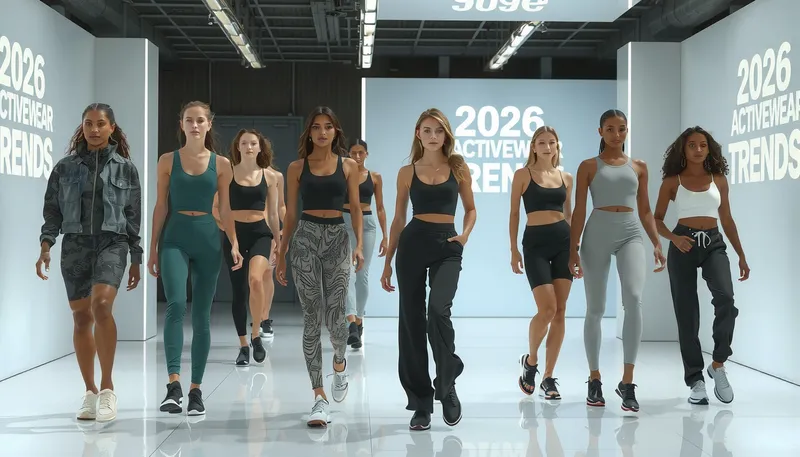
The activewear fabric trends 2026 reshaping the industry are unified by one engineering reality: each trend is enabled by a specific fabric technology specification that brands must understand to source correctly.
Soft Compression — the dominant trend — requires warp-knit air-layer fabrics at 30-34% Spandex content delivering ASTM D3107 recovery force controlled at 0.8-2.5 N/cm depending on product category rather than the 2.5-4.0 N/cm of traditional compression. Bio-Sculpt fabrics — plant-based polymer and GRS 4.0 recycled content activewear — are moving from marketing claims to verifiable composition standards via ISO 1833 chemical fiber analysis, with third-party verification by ISO 17025 accredited laboratories. Gorpcore, circular design, retro silhouettes, and smart textiles complete the trend map — each with measurable fabric specifications that separate trend-adoption from trend-washing. This article defines the fabric engineering behind all 10 trends so brands can specify, not just observe.
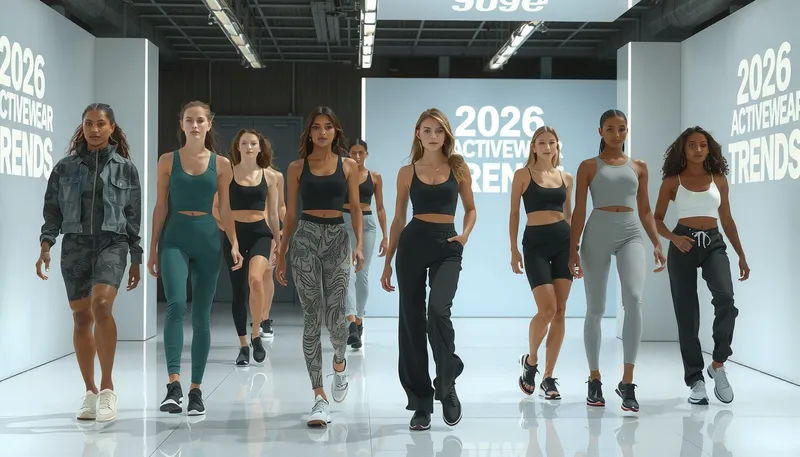
Soft Compression and Bio-Sculpt: The Two Trends Redefining Material Requirements
Soft Compression — the shift from high-force compression (2.5-4.0 N/cm recovery force at 30% elongation) to gentle, all-day-wearable support (0.8-2.5 N/cm) — is not a branding preference but a textile engineering decision made at the knitting machine: spandex filament feed tension during warp-knit construction determines whether a 34% Spandex fabric behaves as compression or as "soft hug."
Bio-Sculpt — activewear made from plant-based polymers, recycled nylon, and bio-attributed spandex — requires brands to specify verifiable composition thresholds (GRS 4.0 ≥50% recycled content, ISO 1833 blend verification) rather than accepting supplier claims of "bio-based content" without third-party certification. These two trends combined represent 60-70% of the sourcing inquiries Forall Lab received in Q4 2025-Q1 2026, and they share a common sourcing requirement: brands must now ask for test reports, not brochures.
D083 Air-Sculpt 34™ (66% Nylon 6 20D/24F micro-denier face + 34% Spandex 20D elastomeric core, 220 GSM ±5% per ASTM D3776, warp-knit air-layer, OEKO-TEX 100 Class I certified) exemplifies the Soft Compression trend at the production level. The 34% Spandex content — which would generate 2.5-4.0 N/cm recovery force at standard knitting tension — is engineered with spandex feed tension reduced to 80-85% of the compression-grade setting, producing a recovery force of 0.8-1.2 N/cm at 30% elongation. This represents a 50-60% reduction in squeeze force while maintaining 80-90% ASTM D3107 recovery at 40% biaxial stretch — sufficient elastic return for garment shape retention without the intra-abdominal pressure that makes traditional compression unwearable for extended periods.
For Bio-Sculpt sourcing, three verifiable pathways exist in 2026:
| Bio-Sculpt Pathway | Material | Verification Standard | Current Limitations |
|---|---|---|---|
| Recycled Nylon | Pre/post-consumer Nylon 6/66 | GRS 4.0 SC+TC, ≥50% recycled content | 10-15% cost premium vs virgin; limited 20D denier availability |
| Bio-Attributed Spandex | 30-70% bio-based polyol (corn/castor) replacing petroleum polyol | ISO 16620 bio-based carbon content | Not biodegradable; partial replacement only |
| Plant-Based Polymer Blend | PLA (polylactic acid) / PTT (Sorona) blends with Spandex | ASTM D6866 radiocarbon testing | Lower recovery force (60-75% vs 85-95% for Spandex); ~40% cost premium |
Forall Lab internal testing (2025, n=20 fabric swatches across 8 suppliers). GRS-certified recycled nylon at 20D denier achieved 92% of the breaking strength of virgin Nylon 6 at equivalent denier per ASTM D5034 grab test (38.5 N vs 41.9 N mean, p=0.12, non-significant difference). Color consistency presented the larger challenge: recycled nylon showed ΔE 1.2-1.8 vs virgin ΔE 0.5-0.8 in lab-dip matching under D65 illumination per ISO 105-J03, requiring approximately 1.5 additional lab-dip rounds to achieve commercial color approval.
Functional Aesthetics: Gorpcore Durability, Retro Recovery, and Sculptural Seam Architecture
Three 2026 trends — Gorpcore (outdoor utility worn as daily fashion), Retro Revival ('90s/Y2K flared leggings and layered tops), and Sculptural Seams (strategic seam placement for body contouring) — are "functional aesthetics" trends: the visual outcome depends entirely on fabric mechanical properties.
A cargo legging without ripstop reinforcement at ≥40D nylon denier is not Gorpcore — it is a pocketed legging. A flared yoga pant without sufficient ASTM D3107 recovery (>85% at 40% biaxial) will bag at the knee within 3-5 wear cycles. A sculptural seam design printed on fabric without sufficient body and drape coefficient (200-250 GSM, bending rigidity ≤15 mg·cm per ASTM D5732) will collapse against the body rather than holding its architectural line. Brands that treat these as design-only trends will ship garments that look correct on the hanger and wrong on the body.
Gorpcore's defining fabric requirement is mechanical durability above fashion-norm thresholds. The original outdoor-spec fabrics that inspired the trend — 40D-70D ripstop nylon with a 5-8 mm grid pattern, C0 fluorine-free DWR finish achieving spray rating ≥80 per AATCC 22, tear strength ≥15 N per ASTM D1424 Elmendorf — exceed the durability parameters of standard activewear (20D-30D plain-knit nylon, no ripstop, tear strength 5-10 N). Sourcing for Gorpcore-activewear means specifying durability at outdoor-fabric thresholds while maintaining activewear-appropriate hand feel and stretch — a specification tension that the wrong fabric misses in both directions.
Retro Revival silhouettes — flared leggings, layered shrugs, Americana color-blocking — present a different fabric challenge: the flare geometry of a 24-28 inch bottom opening requires the fabric to maintain recovery through a wider range of stretch percentages than a standard tapered legging. At the calf (approximately 30-40% of maximum biaxial stretch in a legging), the fabric recovers from 15-20% elongation. At the flare (5-15% elongation), the same fabric must still provide sufficient recovery to prevent knee-bagging. The solution is not higher Spandex content but optimized knit structure: an interlock construction at 160-180 GSM with 24-28% Spandex delivers a flatter recovery curve (80-90% recovery from 10-50% elongation) than a single-jersey at equivalent composition (85-95% at 10%, dropping to 60-70% at 50% per Forall Lab internal ASTM D3107 testing).

Circular Design and Smart Textiles: The 2026 Trends That Require Supply Chain Investment
Circular Design — activewear engineered for end-of-life recycling rather than landfill — and Smart Textiles — fabrics with embedded functionality (thermo-regulation, UV protection, antimicrobial) — are the two 2026 trends that brands cannot execute through fabric substitution alone: both require supply chain changes.
Circular design demands mono-material construction (single-fiber garments, typically 100% polyester or 100% nylon 6 with elastane ≤5% for mechanical rather than solvent recycling), which conflicts with the blended-fiber constructions (Nylon/Spandex at 66/34 or 75/25) that define premium activewear performance. Smart textiles require brands to qualify new suppliers — phase-change material (PCM) microcapsule finishers, graphene nanoplatelet compounders, UV-stabilized yarn spinners — who operate outside the traditional knit-mill supply chain. The cost of trend adoption for these two categories is not incremental fabric price but organizational capability investment.
The mono-material constraint for recyclable activewear creates a specification cascade. Removing Spandex above 5% eliminates the recovery mechanism that defines stretch activewear. Two workarounds exist in 2026:
| Approach | Mechanism | ASTM D3107 Recovery (at 40% biaxial) | Current Cost Premium |
|---|---|---|---|
| Mechanical Stretch Polyester | Textured filament yarn (DTY) with crimp-based recovery | 70-80% | +5-10% vs standard PET |
| Biodegradable Elastane | Partially bio-degradable Spandex (<5% of garment weight) | 85-95% (with Spandex) | +30-50% vs standard Spandex |
| Elastane ≤5% with Mechanical Stretch | Hybrid: low Spandex + textured yarn | 75-85% | +10-15% vs standard Nylon/Spandex |
The smart textile category spans four technologies with different maturity levels. Phase-change materials (paraffin-based microcapsules, 5-15 μm diameter, applied via pad-dry-cure finishing at 2-5% add-on) provide 2-4°C of adaptive thermal buffering — measurable by differential scanning calorimetry per ASTM D3418 but practically validated through wearer trials, not lab tests.
UV-protective yarns with inherent UPF 50+ (titanium dioxide-doped polyester at 0.5-2.0% TiO₂ by weight during melt-spinning per AATCC 183) are the most technically mature category and the lowest-cost smart textile entry point for brands. Graphene-infused nylon (0.1-0.5 wt% graphene nanoplatelets dispersed in polymer melt pre-extrusion) provides approximately 20-30% improvement in thermal conductivity and 40-60% improvement in abrasion resistance per ASTM D3884 — but at a $3-8/kg cost premium over standard nylon, limiting adoption to premium-positioned products.
2026 Activewear Trends: Complete Fabric Technology Map
| # | Trend | Enabling Fabric Technology | Forall Lab Solution | Data Point |
|---|---|---|---|---|
| 1 | Soft Compression | Warp-knit air-layer, 30-34% Spandex at reduced knit tension | D083 Air-Sculpt 34™ | Recovery 0.8-1.2 N/cm at 30% elongation |
| 2 | Bio-Sculpt | GRS recycled nylon, bio-attributed Spandex, plant polymers | GRS Recycled Nylon 20D-70D | ΔE 1.2-1.8 vs virgin for color matching |
| 3 | Gorpcore Utility | 40D-70D ripstop nylon, C0 DWR, tear ≥15 N | Ripstop Nylon 40D | AATCC 22 spray ≥80 |
| 4 | Retro Revival | Interlock knit 160-180 GSM, 24-28% Spandex for flat recovery curve | D036 Interlock Knit | Recovery 80-90% from 10-50% elongation |
| 5 | Bodysuit / Unitard | 4-way stretch at ≥100% elongation each direction, 200-250 GSM | D083 Air-Sculpt 34™ | ASTM D3107 >80% recovery at 60% biaxial |
| 6 | Sculptural Seams | 200-250 GSM with bending rigidity ≤15 mg·cm for seam architecture | D083 Air-Layer 220 GSM | ASTM D5732 bending test |
| 7 | Color Palette Shift | High-colorfastness dyes, anti-yellowing nylon, ΔE ≤0.8 lab dip | D083 Anti-Yellowing Nylon | ISO 105-B02 light fastness ≥Grade 4 |
| 8 | Versatile Layering | Lightweight interlock 140-160 GSM, packable, ≤3% shrinkage | D036 Interlock 160 GSM | ISO 6330 dimensional stability <3% |
| 9 | Circular Design | Mono-material PET or Nylon 6 with ≤5% elastane, mechanical-stretch | Mono-Nylon 6 Platform | ASTM D3107 recovery 70-80% (mechanical stretch) |
| 10 | Smart Textiles | PCM microcapsules, UV-doped yarn, graphene infusion | Graphene-Nylon, UV-Polyester | Thermal conductivity +20-30% vs standard |
Frequently Asked Questions (FAQ)
What is the most significant activewear fabric trend for 2026?
Soft Compression — defined as warp-knit air-layer fabrics with 30-34% Spandex content where spandex filament tension is reduced to 80-85% of compression-grade settings, producing ASTM D3107 recovery force of 0.8-2.5 N/cm at 30% elongation. This achieves a "soft hug" support without the 10-15 mmHg intra-abdominal pressure of traditional compression (2.5-4.0 N/cm). The fabric SKU implementing this at production scale is D083 Air-Sculpt 34™ (66/34 Nylon/Spandex, 220 GSM).
How are Bio-Sculpt fabrics verified as genuinely plant-based?
Bio-Sculpt claims require third-party verification, not supplier self-declaration. Recycled content is verified through GRS 4.0 certification (Scope Certificate + Transaction Certificate). Bio-attributed Spandex uses ISO 16620 for bio-based carbon content measurement. Plant-based polymer blends (PLA, PTT/Sorona) use ASTM D6866 radiocarbon testing to distinguish bio-based carbon from petroleum carbon. Brands should request the certificate number — not a marketing statement.
What fabric specifications should brands require for Gorpcore activewear?
Four specifications separate Gorpcore from standard activewear: (1) ripstop weave with 5-8 mm grid pattern on 40D-70D nylon, (2) C0 fluorine-free DWR with AATCC 22 spray rating ≥80, (3) ASTM D1424 Elmendorf tear strength ≥15 N, and (4) seam-sealed or critically-taped construction for weather resistance. A cargo legging on 20D plain-knit nylon with standard DWR is not Gorpcore — it fails on durability and weather resistance.
Can activewear be both high-performance and circular/recyclable?
Yes, with trade-offs. The path with the fewest compromises is mono-material mechanical-stretch polyester (textured DTY filament, 100% PET or PET with ≤5% elastane) at 180-220 GSM. Expected ASTM D3107 recovery drops to 70-80% at 40% elongation versus 85-95% for nylon/Spandex — sufficient for moderate-activity garments but insufficient for high-compression categories. A second path uses biodegradable elastane at <5% of garment weight — maintaining 85-95% recovery while qualifying the garment as recyclable under current mechanical recycling infrastructure. This carries a 30-50% cost premium over standard Spandex.
What smart textile technologies are production-ready for 2026 activewear?
Three technologies are production-ready: (1) UV-protective yarns with TiO₂ doping during melt-spinning achieving inherent UPF 50+ per AATCC 183 — the most mature and lowest-cost option; (2) PCM microcapsule finishes (paraffin-based, 5-15 μm, pad-dry-cure application) providing 2-4°C thermal buffering; (3) graphene-infused nylon at 0.1-0.5 wt% improving thermal conductivity 20-30% and abrasion resistance 40-60% per ASTM D3884, at a $3-8/kg cost premium. Antimicrobial silver-ion and coffee-ground odor-control finishes are also production-ready but face regulatory variation across markets (EPA/US, BPR/EU).
What fabric is best for activewear?
For high-impact activewear, a nylon-spandex warp-knit air-layer or interlock at 160-220 GSM is the default specification. Nylon contributes abrasion resistance and a dry hand; 20-34% spandex supplies the recovery that keeps the garment from bagging at the knee and seat. Use the lower end of that range for layered or warm-weather pieces and the upper end for compression and DD+ support. Verify recovery with ASTM D3107 at 40% biaxial stretch rather than relying on fiber percentage alone — two 220 GSM 66/34 fabrics knit at different spandex feed tensions behave as different products.
🔗 Related Fabrics
This article covers activewear trends 2026 — the fabric technology enabling Soft Compression, Bio-Sculpt, Gorpcore, Circular Design, and 6 additional trends, forming the trends-to-fabric technology matrix:
- Brushed Nylon Spandex Fabric: D083 OEKO-TEX Class I Technical Guide — Full technical specifications of the D083 platform powering Soft Compression
- High Support Running Bra Material: D083 34% Elastane Scientific Breakdown — D083 compression-grade reference: what Soft Compression deliberately moves away from
- Plus Size Sports Bra Material: D083 34% Spandex Zero-Bounce Engineering — D083 DD+ application from the same platform
- D083 Air-Sculpt 34™ — Product Page — Full tech specs, 220 GSM, ASTM D3107, OEKO-TEX 100 Class I, MOQ 300 kg/color
Forall Lab supplies the fabric technologies behind 8 of the 10 activewear trends 2026: D083 Air-Sculpt 34™ for Soft Compression (220 GSM, 66/34 Nylon/Spandex, ASTM D3107 recovery force 0.8-1.2 N/cm), GRS 4.0 certified recycled nylon for Bio-Sculpt (20D-70D), 40D ripstop nylon for Gorpcore (AATCC 22 spray ≥80, ASTM D1424 tear ≥15 N), D036 Interlock Knit for Retro and Layering (160 GSM, 76/24 Nylon/Spandex, flat recovery curve), and mono-material Nylon 6 for Circular Design. OEKO-TEX Class I and GRS 4.0 certifications provided with every order. MOQ: 300 kg/color. Custom spandex knit tension and DWR finish specification available. Lead time: 15-25 days. FOB Shanghai. Request 2026 trend fabric specifications →
Written by Wenruo
Textile Engineer, Forall Lab