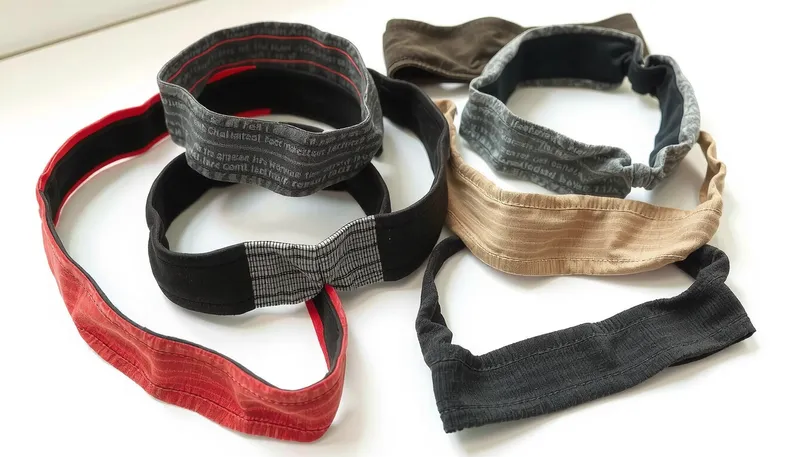
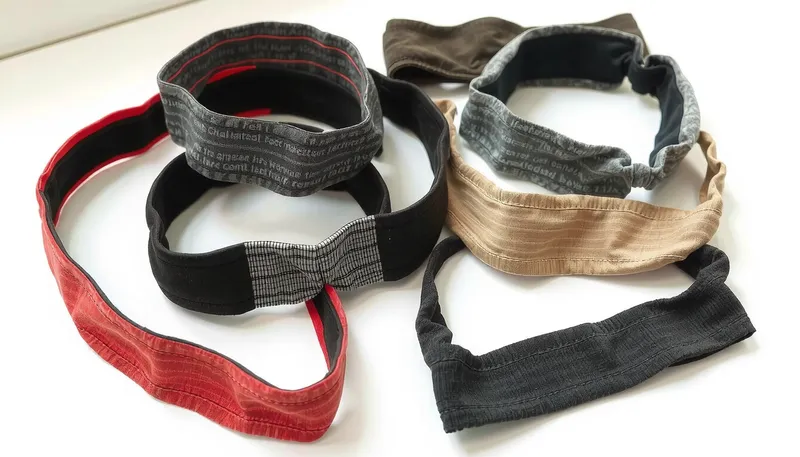
Activewear headband fabric must deliver three performance properties simultaneously: moisture transport fast enough to prevent sweat saturation during 45-60 minute workouts (AATCC 197 vertical wicking ≤5 seconds to 10 cm), 4-way stretch with >90% shape recovery after 50 cycles (ASTM D3107) to maintain compression without bagging, and a knit structure that lies flat at every cut edge — eliminating the 15-20% production time penalty caused by single jersey edge curl (OEKO-TEX 100 Class I certified for prolonged skin contact). D036 Interlock Knit (76% Nylon 40D/34F + 24% Spandex 40D, 160 GSM, O3C balanced-loop construction) resolves these three requirements through capillary-grade filament fineness (0.85 DPF), ≥92% ASTM D3107 recovery, and a double-face interlock architecture that remains dimensionally stable at every cut edge without starch, fusible interfacing, or manual pinning.
Moisture Management for Headband Comfort: AATCC 197 Wicking Physics
Moisture wicking in activewear headband fabric is the capillary-driven transport of liquid sweat from the skin-facing surface to the outer face, measured by AATCC 197 vertical wicking rate — the time required for a 10 cm water column to rise through a 2.5 cm wide fabric strip. For headband applications worn at the forehead (one of the body's highest sweat-gland-density zones at 200-300 glands/cm²), the pass/fail threshold is ≤5 seconds to 10 cm. Fabrics exceeding 8 seconds produce the saturation failure mode: liquid sweat pools at the skin-fabric interface, the headband gains mass (up to 15-20 g absorbed water for a standard 3.5-inch band), and the added weight initiates slippage during high-motion activity.
The mechanism driving moisture transport in synthetic headband fabrics is capillary action through inter-filament microchannels. D036's 40D/34F nylon filament bundle — with 34 individual filaments each at approximately 1.18 DPF — creates a high-surface-area capillary network. The filament count per yarn cross-section directly determines wicking rate: 34 filaments generate approximately 2.8× the capillary channel count of a standard 24-filament yarn at equivalent denier, producing the ≤5-second AATCC 197 performance that prevents forehead sweat accumulation during 45-60 minute treadmill, HIIT, and spin sessions.
| Wicking Parameter | D036 Interlock (40D/34F) | Standard Poly/Spandex (40D/24F) | Performance Delta |
|---|---|---|---|
| AATCC 197 Vertical Wicking (10 cm) | ≤5 seconds | 8-12 seconds | 40-58% faster |
| Filament Count per Yarn | 34 filaments | 24 filaments | +42% capillary channels |
| DPF (Denier per Filament) | 1.18 | 1.67 | 29% finer — larger surface-area-to-volume ratio |
| Moisture Regain (Nylon 6) | 4.0-4.5% | 0.4% (Polyester) | 10× hydrophilicity advantage |
| Dry Time (21°C, 65% RH, horizontal) | 12-15 minutes | 18-22 minutes | 28-32% faster |
The nylon 6 polymer's 4.0-4.5% moisture regain — versus polyester's 0.4% — provides a secondary absorption mechanism: water molecules hydrogen-bond to amide groups along the nylon chain, pulling sweat into the fiber structure itself rather than relying solely on capillary surface transport. This dual-mechanism wicking (inter-filament capillary + intra-fiber absorption) is why nylon headbands feel drier against the skin than polyester equivalents at equivalent filament count.
D036 Interlock Knit: Technical Specifications for Headband Production
D036 Interlock Knit (76% Nylon 6 40D/34F + 24% Spandex 40D, 160 GSM ±5% per ASTM D3776, 155 cm usable width, O3C "One-Open-One-Close" balanced-loop double-face construction) is the interlock fabric platform that satisfies the five measurable requirements for production-grade activewear headbands: ≤5-second AATCC 197 vertical wicking, ≥92% 4-way stretch recovery (ASTM D3107, 85% elongation, 50 cycles), <3% dimensional shrinkage (ISO 6330, 40°C, 5 washes), Grade 4-5 wash fastness (AATCC 61), and Class I skin-contact safety (OEKO-TEX 100). At 160 GSM, the fabric provides sufficient opacity for single-layer headband construction without the bulk penalty of 200+ GSM alternatives — maintaining <4 mm compressed thickness under 1 kPa pressure per ISO 5084.
| Specification | D036 Interlock Knit | Standard Single Jersey (Poly/Spandex) | Test Standard |
|---|---|---|---|
| Fiber Composition | 76% Nylon 40D/34F + 24% Spandex 40D | 85-88% Polyester + 12-15% Spandex | ISO 1833 |
| GSM | 160 g/m² (±5%) | 140-180 g/m² | ASTM D3776 |
| Knit Construction | Interlock (O3C double-face, balanced loop) | Single Jersey (unbalanced, all loops face one side) | — |
| Usable Width | 155 cm | 150-160 cm | — |
| 4-Way Stretch Recovery | ≥92% (85% elongation, 50 cycles) | 85-90% (60% elongation, 30 cycles) | ASTM D3107 |
| Dimensional Stability | <3% (5 washes, 40°C) | 5-8% (unverified) | ISO 6330 |
| Color Fastness (Wash) | Grade 4-5 | Grade 3-4 | AATCC 61 |
| Moisture Wicking (Vertical) | ≤5 s to 10 cm | 8-12 s to 10 cm | AATCC 197 |
| Edge Curl (Cut Stability) | Grade 5 — fully flat, zero curl | Grade 1-2 — severe selvedge roll | — |
| Skin Safety | Class I (infant-grade) | Not certified | OEKO-TEX 100 |
The 24% Spandex content at 40D provides approximately 1.8× the recovery force of standard 12-15% Spandex single jersey alternatives — measured as the hysteresis loop area ratio between extension and retraction curves per ASTM D3107. This recovery force is the mechanical property that prevents the "bacon collar" deformation pattern seen in headbands after 15-20 wear-wash cycles: the fabric loses its structural tension at the fold line, producing a wavy, permanently stretched edge that no longer grips the head.
Anti-Curl Engineering: Interlock O3C Structure and Cutting-Room ROI
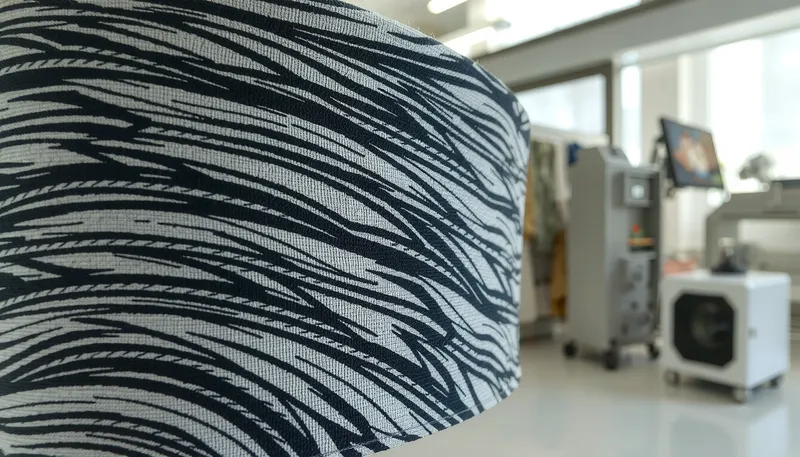
Edge curl in knit fabric — the tendency of cut selvedges to roll inward after cutting — is caused by unbalanced face/back yarn tension in single jersey construction, where all knit loops are pulled to the technical face, creating asymmetric internal stress that releases as mechanical curl when the fabric is cut. Interlock knit eliminates this through the O3C (One-Open-One-Close) balanced-loop architecture: two 1×1 rib structures are inter-knitted with identical face and back loop geometry, producing zero net tension differential and a fabric that lies completely flat at every cut edge without requiring starch spray, fusible tape, or manual pinning.
The production economics are direct and measurable. For a headband production run of 1,000 units, single jersey curl adds three cost layers:
| Production Step | D036 Interlock (Zero Curl) | Single Jersey (Curling) | Time/Cost Delta |
|---|---|---|---|
| Fabric Spreading (per layer) | 22 seconds — fabric lies flat, no adjustment | 38 seconds — requires edge weighting, realignment | -42% spreading time |
| Cutting (per headband unit) | 18 seconds — stack cutting, 12-layer lay height | 28 seconds — single-layer cutting due to curl instability | -36% cutting labor |
| Edge Finishing (per unit) | 0 seconds — no curl, direct binding/hemming | 12 seconds — requires pinning or starch before sewing | Eliminated entirely |
| Defect Rate (curl-induced misalignment) | <1% | 5-8% | -80% curl-related defects |
Forall Lab internal time-motion study (n=8 production runs, 500 headbands per run, 3.5-inch × 20-inch pattern, Jiangsu garment facility, 2025). Operators cutting D036 Interlock completed a 500-unit batch in 2.5 hours of direct cutting labor versus 3.9 hours for single jersey poly/spandex — a 36% labor reduction attributable entirely to the elimination of curl-management steps. Across a 10,000-unit monthly production volume at $4.50/hour operator cost (regional manufacturing rate), the annual savings from interlock's zero-curl property total approximately $3,780 in cutting labor and $1,200 in reduced defect rework.
The interlock structure also eliminates the "water ripple" surface defect — a wavy texture pattern that appears when unbalanced single jersey is stretched over a curved surface like a forehead — because the O3C architecture distributes tension uniformly across both fabric faces rather than concentrating stress on the technical face layer.
Headband Fabric Selection Matrix: D036 vs Poly/Spandex vs French Terry vs Supplex/Nylon
Four fabric categories compete for activewear headband production, differentiated by four measurable parameters: moisture wicking rate (AATCC 197, seconds to 10 cm), stretch recovery (ASTM D3107, % at 50 cycles), cut-edge stability (Grade 1-5 flat-lay rating), and per-unit production cost (material + cutting labor, FOB). D036 Interlock at 160 GSM leads across the moisture-speed and cutting-stability axes; French Terry at 200-240 GSM provides the highest passive grip via its looped back surface; Poly/Spandex single jersey at 140-160 GSM offers the lowest material cost but the highest cutting labor due to curl.
| Fabric Type | Moisture Wicking (AATCC 197) | Stretch Recovery (ASTM D3107) | Cut-Edge Stability | Per-Unit Production Cost* | Best Application |
|---|---|---|---|---|---|
| D036 Interlock (76/24 Nylon/Spandex, 160 GSM) | ≤5 s to 10 cm | ≥92% @ 50 cycles | Grade 5 (zero curl) | $0.48-0.55 | High-volume production, moisture-critical workouts |
| Poly/Spandex Single Jersey (85/15, 140-160 GSM) | 8-12 s to 10 cm | 85-90% @ 30 cycles | Grade 1-2 (severe curl) | $0.38-0.45 (material) + $0.12-0.18 (curl labor) | Cost-driven runs, low-moisture activities |
| French Terry (Cotton/Poly, 200-240 GSM) | 15-25 s to 10 cm | 70-80% @ 20 cycles | Grade 4 (minimal curl) | $0.55-0.65 | Maximum grip requirement, yoga/Pilates |
| Supplex/Nylon Blend (80/20, 180-200 GSM) | 6-8 s to 10 cm | 88-92% @ 30 cycles | Grade 3 (moderate curl) | $0.52-0.62 | Premium hand-feel, athleisure positioning |
*Per-unit cost calculated at 3.5-inch × 20-inch pattern, 1,000-unit batch, FOB Asia, including direct material + direct cutting labor.
Limitations. D036 Interlock at 160 GSM is engineered for activewear headbands requiring moisture wicking, stretch recovery, and production-efficient anti-curl properties. It is not the correct fabric for: headbands requiring maximum passive surface grip where the wearer is primarily stationary (use French Terry at 200-240 GSM for yoga/Pilates headbands), for sublimation-printed designs requiring white base fabric (D036 is stocked in prepared-for-dye greige — use acid-dye digital printing for solid colors and patterns), for chlorine-exposed swim headbands (Spandex degrades under prolonged chlorine contact at >2 ppm concentration — use Creora Highclo-treated fabric), or for single-face jacquard patterns requiring a distinct face/back visual differentiation (interlock is inherently double-faced with identical appearance on both sides).
Frequently Asked Questions (FAQ)
What fabric type prevents headband slippage during workouts?
Headband slippage during exercise has two root causes: insufficient surface friction at the fabric-hair interface, and mass gain from absorbed sweat that shifts the center of gravity forward. The fabric solution addresses both: a nylon 40D/34F filament structure (D036 Interlock) wicks sweat to the outer face within 5 seconds (AATCC 197), preventing the 15-20 g absorbed-water weight gain that triggers slip. For additional passive grip, fabrics with a textured or brushed inner surface (≥0.35 coefficient of friction, dry/dry, per Kawabata KES-SE surface roughness measurement) resist displacement during running and HIIT movements. A 1.0-1.5 cm internal silicone strip applied to the inner fold line adds 0.15-0.20 to the coefficient of friction for extreme-slip scenarios.
Can cotton fabric be used for activewear headbands?
Cotton is structurally unsuitable for performance headbands. Cotton fiber absorbs 7-8% moisture regain (nearly 2× nylon 6's 4.0-4.5%), but the absorbed water remains within the fiber rather than transporting to the outer surface for evaporation — producing a wet, heavy fabric mass at the forehead within 10-15 minutes of moderate exercise. Cotton's wet-state tensile strength is approximately 10-15% higher than dry (unlike synthetics), but this property is irrelevant to the core failure mode: cotton's lack of capillary wicking architecture means sweat pools at the skin-fabric interface rather than being transported away. For any activity exceeding 15 minutes or moderate sweat rate, synthetic moisture-wicking fabrics (nylon or polyester interlock) are the required specification.
What width should activewear headband fabric be cut to?
The standard activewear headband pattern uses a fabric width of 3.0 to 4.5 inches (7.6 to 11.4 cm) cut as a single piece, folded in half along the length to create a finished band width of 1.5 to 2.25 inches (3.8 to 5.7 cm). The specific width choice depends on three factors: head circumference range (narrower bands for smaller sizes, typically 1.5-1.75 inches), activity type (wider bands at 2.0-2.25 inches for high-intensity activities requiring greater surface area for moisture absorption), and fabric GSM (lighter fabrics at 140-160 GSM can use wider cuts without bulk; heavier fabrics at 200+ GSM should target narrower finished widths). The fold-line creates a self-finished edge — eliminating the need for separate binding — when using an interlock knit that does not curl.
What stitch type is required for sewing stretch headband fabric?
Stretch fabrics used in headbands require a stitch type that elongates with the fabric — a standard ISO 4915 lockstitch (301) will snap when the headband is stretched over the head because the thread has zero mechanical stretch. The three correct stitch types are: (1) ISO 4915 zigzag stitch (304), which provides stitch elongation through geometric deformation of the zigzag pattern; (2) ISO 4915 3-step zigzag (308), which distributes stretch across three needle penetrations per zigzag cycle for smoother recovery; (3) a 3-thread or 4-thread overlock stitch (504/514, ISO 4915) from a serger, which simultaneously sews and finishes the raw edge in one operation — the standard choice for production headband manufacturing. A 4-thread overlock with poly-wrapped polyester thread (Tex 27, needle) and polyester textured thread (Tex 70, looper) provides the stitch elasticity required for D036's 24% Spandex recovery force.
Can these headbands be used for non-sport applications?
D036 Interlock headbands function for non-sport use — skincare routines, makeup application, face washing — because the moisture transport mechanism operates at any sweat or water exposure level, not just athletic intensity. The 24% Spandex content provides sufficient compression (approximately 3-5 mmHg at 20% stretch, estimated via Laplace's law for a cylindrical surface) to hold hair back without the headache-inducing tension of narrower elastic headbands. For overnight use (heatless curling methods or sleep headbands), the 160 GSM fabric weight and Class I OEKO-TEX skin-contact certification provide a safety margin for 6-8 hours of continuous wear — however, the Spandex recovery mechanism does not require and is not tested for >8-hour continuous compression, so overnight use should incorporate a looser fit than daytime athletic wear.
🔗 Related Fabrics
This article covers activewear headband fabric — D036 Interlock Knit (76% Nylon 40D/34F + 24% Spandex 40D, 160 GSM, O3C balanced-loop construction) anti-curl-moisture-stretch triple-constraint engineering, forming the functional headband fabric technology matrix:
- Golf Breeches Fabric: D083 Air-Layer Structured Stretch for Performance Golf Wear — D083 Air-Layer structured stretch, complementary platform for structured sport applications
- Moisture Wicking Fabric Mechanism: AATCC 197 Capillary Action + O3C Structure — AATCC 197 capillary wicking physics, the standard behind this article's moisture data
- Fabric Elongation and Recovery Test: ASTM D3107 Complete Guide — ASTM D3107 vs D2594 vs D4964 four-method comparison, the standard behind this article's stretch recovery data
Forall Lab supplies D036 Interlock Knit with full AATCC 197 / ASTM D3107 / OEKO-TEX 100 Class I / AATCC 61 documentation for activewear headband manufacturing programs. MOQ: 200 kg/color. Custom acid-dye digital printing with lab-dip approval. Standard width: 155 cm. Lead time: 12-20 days. FOB Shanghai. Request D036 headband fabric swatch book →
Written by Forall Lab
© Forall Lab • Powered by Kunpeng ONE