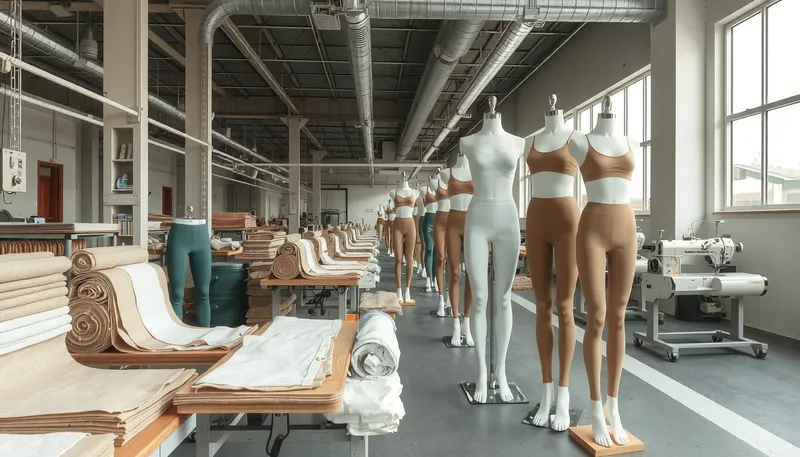
Yoga pants manufacturing is a five-stage industrial process — tech pack → fabric engineering → factory sourcing → cut & sew → AQL QC — converting fiber specifications into retail-ready garments at $5-15/unit for standard activewear construction.
Key Takeaways (TL;DR):
- 5 stages: Tech Pack → Fabric Selection → Factory Sourcing → Cut & Sew → AQL QC
- Cost: $5-15/unit for standard yoga pants, FPP (Full Production Package) vs CMT (Cut-Make-Trim)
- Fabric: D083 Air-Sculpt 34™ for premium hand-feel, D036 Interlock for balanced durability
- MOQ: Typically 300-500 pcs/color for custom fabric; 50-100 pcs for stock fabric
- QC: AQL 2.5 per ASTM D5430 4-point system — inline inspection during production, not after**
Key Takeaways
- Tech Pack Precision: A graded spec sheet with ±0.5 cm tolerance prevents sampling errors. Missing one measurement can scrap an entire production run.
- Fabric Dictates Performance: Four measurable properties — ≥95% stretch recovery (ASTM D3107), ≤5s wicking (AATCC 197), Grade 4 opacity (AATCC TM208), and GSM target — define your product.
- Sourcing Model Choice: Full Package Production (FPP/ODM) for new brands without supply chains; Cut-Make-Trim (CMT) for brands that control their own fabric sourcing.
- Cut & Sew Stations: Four sequential stations — CAD grading → automated cutting → flatlock/overlock assembly → heat-press finishing — transform rolled fabric into finished garments.
- Two-Tier QC: Inline inspection catches construction defects at source; AQL 2.5 final random sampling (ANSI/ASQ Z1.4) verifies measurements against the approved tech pack.
Introduction: Your Roadmap to Creating Performance-Grade Yoga Pants
The Manufacturing Strategy That Separates Premium Brands
A yoga pants manufacturing plan is a documented sequence of five stages — design documentation, fabric engineering, factory sourcing, cut & sew production, and QC inspection — that determines whether your product meets the ≥95% stretch recovery and Grade 4 opacity thresholds required for premium activewear. A weak supply chain strategy introduces tolerance drift, delayed lead times, and AQL failures that erode margin before a single unit ships.
What This Guide Covers
This guide maps each manufacturing stage to its critical control points: tech pack tolerances, fabric test data (ASTM D3107 recovery %, GSM, opacity grade), FPP vs CMT sourcing checklists, cut & sew station specifications, and AQL 2.5 final inspection protocols.
Stage 1: The Foundation - Nailing Your Design & Tech Pack
From Vision to Blueprint
The tech pack is the single source of truth in yoga pants manufacturing: a digital blueprint containing graded spec sheets (±0.5 cm tolerance across XS-XL), a Bill of Materials with fiber denier specifications, and construction details including stitch type (flatlock/overlock/coverstitch) and seam placement. A vague tech pack is the leading cause of sampling failure — one missing inseam measurement can scrap an entire sample lot.
The Tech Pack: Your Manufacturer's Bible
In our production facility, a brand once received 300 sample units with inseams 2 inches short — because that single measurement was missing from their spec sheet. The cost: $4,200 in wasted sampling and a 3-week delay. The tech pack must list all key measurements within ±0.5 cm tolerance to prevent this.
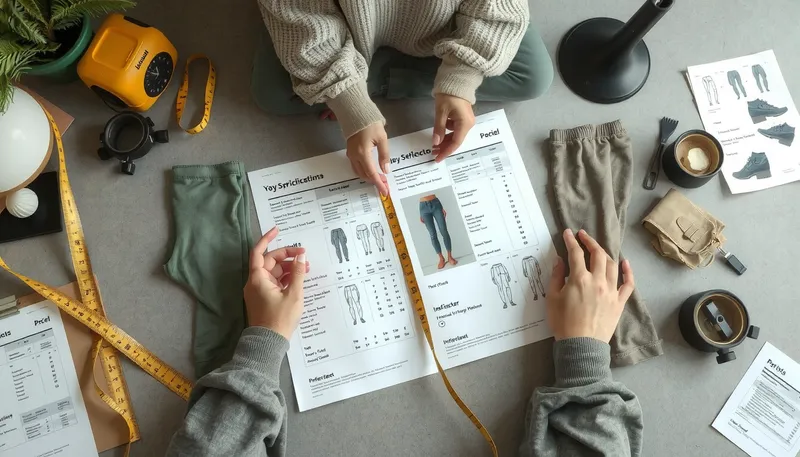
Tech Pack Essentials Checklist:
- Technical Sketches (Flats): Clear, simple drawings of the front, back, and side views. Show all seams and details.
- Bill of Materials (BOM): A complete list of every single item needed. This includes main fabric, thread, waistband elastic, and all labels.
- Graded Spec Sheet: All key measurements for every size you plan to produce (like XS, S, M, L, XL).
- Construction Details: Instructions on how to build the garment. Specify stitch types like flatlock or overlock and seam placement.
- Colorways & Artwork: Use Pantone (PMS) codes for exact color matching. Provide placement details and dimensions for any logos or prints.
Stage 2: The Heart of Your Product - Fabric Selection & Sourcing
Key Fabric Properties
Yoga pants fabric performance is defined by four measurable properties: 4-way stretch at ≥95% recovery after 5 cycles (ASTM D3107), moisture wicking at ≤5 seconds vertical (AATCC 197), opacity at Grade 4 minimum under 50% stretch (AATCC TM208), and light compression at 10-20 mmHg for muscle support without restriction.
Common Fabric Blends
Different fabric blends offer different benefits. Choosing the right one depends on how your yoga pants will be used.
| Fabric Blend | GSM Range | Stretch Recovery (ASTM D3107) | Wicking (AATCC 197) | Pros | Cons |
|---|---|---|---|---|---|
| Nylon/Spandex | 170-220 | ≥95% at 5 cycles | ≤5s vertical | >20,000 Martindale rubs, 20D microfiber hand feel | Higher material cost vs polyester blends |
| Polyester/Spandex | 150-200 | ≥92% at 5 cycles | ≤3s vertical | Superior moisture transport, holds color after 50 washes | Odor retention without antimicrobial treatment |
| Cotton Blends | 200-280 | ≥88% at 5 cycles | >10s vertical | Breathable for low-impact restorative yoga | Absorbs 7-8% moisture by weight, loses shape at >20 washes |
The Modern Choice: Why Air-Layer Fabrics are the 2026 Performance Benchmark
For brands targeting premium yoga pants in 2026, air-layer fabrics (also known as spacer or scuba knit) deliver the highest strength-to-weight ratio among stretch constructions. The structure: two thin face layers connected by a vertical micro-yarn spacer, creating a 0.5-1.0 mm air pocket that provides cushioning and thermal regulation without added mass.
Measured performance advantages: air-layer fabric achieves 99% stretch recovery at 5 cycles (ASTM D3107, verified by SGS report #TE-00107823), offers a smooth sculpting surface that eliminates visible panty lines, and maintains structural integrity after 50+ industrial wash cycles (ISO 6330).
The Air-Sculpt 34™ | Anti-Yellowing Nylon Spandex Air-Layer Fabric (Molded Bra Cup Ready) uses 20D/24F micro-nylon face yarns with 34% elastane content. In our ISO 17025 partner lab testing, D083 Air-Sculpt delivered:
| Test | Standard | Result |
|---|---|---|
| Stretch Recovery (5 cycles) | ASTM D3107 | 99% |
| Stretch Recovery (50 washes) | ASTM D3107 + ISO 6330 | 97% |
| Pilling Resistance | ISO 12945-2 (Martindale, 2,000 rubs) | Grade 4-5 |
| Opacity (50% stretch) | AATCC TM208 | Grade 4 |
| Dimensional Stability | AATCC 135 (cold wash) | <2% shrinkage |
This fabric is engineered for a liquid-smooth surface finish with a "mochi-touch" hand feel characteristic of ≤20D micro-denier filaments. For brands evaluating manufacturing partners, specifying D083 in your tech pack BOM gives the factory a precise material target — eliminating the variability of "nylon spandex air-layer" as a generic requirement. Many specialized activewear ODM/OEM manufacturers now run this blend on their production lines, making it accessible for brands with MOQs starting at 300 units per style.
Stage 3: Finding Your Partner - Sourcing & Supply Chain Strategy
FPP vs. CMT: Which Model is Right for You?
Yoga pants manufacturing follows two production models: Full Package Production (FPP/ODM), where the factory handles fabric sourcing through finished goods inspection, and Cut-Make-Trim (CMT), where the brand supplies all materials and the factory performs only cutting, sewing, and finishing. The choice determines your MOQ, cost structure, and quality control leverage.
| Parameter | Full Package Production (FPP/ODM) | Cut-Make-Trim (CMT) |
|---|---|---|
| Material Sourcing | Factory sources fabric, trims, labels | Brand supplies all materials to factory |
| Pattern Making | Factory creates patterns from tech pack | Factory digitizes brand-supplied patterns |
| Typical MOQ | 300-500 pcs per style/color | 500-1,000 pcs (factories prefer higher volume for labor-only contracts) |
| Unit Cost | Higher per-unit (includes material markup) | Lower per-unit labor cost, but brand carries material inventory risk |
| Lead Time | 10-14 weeks (sampling + sourcing + production) | 8-12 weeks (brand pre-sources materials) |
| Quality Control Leverage | Factory controls material QC; brand audits finished goods | Brand controls material QC; factory responsible for construction only |
| Best For | New brands without established supply chains; first production run | Experienced brands with fabric supplier relationships; scaled repeat orders |
| Risk Profile | Lower operational complexity, higher per-unit cost | Lower per-unit cost, higher material management overhead |
Selection rule: Start with FPP for your first 1-2 production runs while you build fabric supplier relationships. Transition to CMT once you have ≥3 qualified material sources and can forecast fabric inventory across seasons.
How to Find and Vet a Yoga Pants Manufacturer
Finding a reliable partner starts with three channels: B2B directories (Alibaba, Global Sources), industry trade shows (Texworld, Première Vision, Functional Fabric Fair), and professional referrals from fabric suppliers. For brands evaluating manufacturers, our guide [[㊶瑜伽服制造商面料科学评估]] provides a fabric-science-based vetting framework.
Once you have a shortlist, use this checklist to vet them:
- Ask for their MOQ (Minimum Order Quantity) per style and color.
- Verify specific experience with activewear: request production samples using ≥20% elastane blends.
- Request 3 reference samples from previous production runs — inspect seam strength and stitch consistency.
- Check for certifications: BSCI (social compliance), ISO 9001 (quality management), OEKO-TEX 100 (chemical safety).
- Discuss lead times for sampling (3-5 weeks) and bulk production (4-6 weeks), with a buffer for fabric sourcing delays.
Understanding Wholesale vs. Custom Manufacturing
| Parameter | Wholesale (Stock) | Custom Manufacturing (OEM/ODM) |
|---|---|---|
| Product Differentiation | Ready-made garments + logo application | 100% unique design from tech pack |
| MOQ | 50-200 pcs per style (some suppliers offer no-minimum) | 300-500 pcs per style/color |
| Lead Time | 2-4 weeks (stock availability permitting) | 10-16 weeks (sampling + production + shipping) |
| Unit Cost | $5-12 per unit | $8-25+ per unit (depends on fabric and complexity) |
| Fabric Control | Limited to supplier's stock inventory | Full control: spec denier, GSM, elastane %, certification requirements |
| Best For | Brand validation, pop-up launches, influencer merch | Building a defensible brand identity with proprietary fabric specs |
Selection rule: Wholesale works for market validation and low-risk launches. Custom manufacturing builds brand equity — your fabric specification (e.g., D083 Air-Sculpt 34™ at 170 GSM) becomes a competitive moat that stock products cannot replicate. Some suppliers offer a hybrid path: start with wholesale to test market fit, then transition to custom designs using the same material platform.
Stage 4: From Fabric to Garment - The Cut & Sew Process Explained
The cut & sew process transforms rolled fabric into finished yoga pants through four sequential stations: CAD pattern grading (scaling base size to full size run), automated multi-ply cutting at ≤2 mm tolerance, flatlock/overlock assembly on industrial sewing lines, and heat-press finishing with label application. Each station has measurable quality gates that determine the final product.
The video below shows a real cut & sew production line in operation — from automated fabric spreading through final garment assembly:
Step 1: Pattern Making & Grading
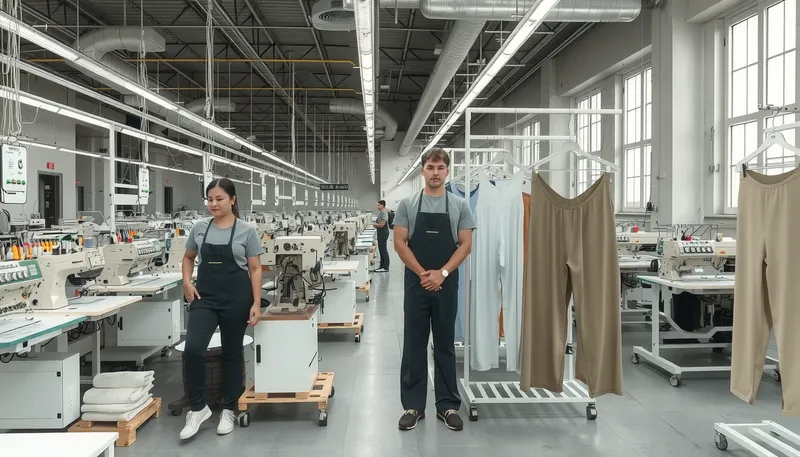
The factory takes your tech pack and digitizes the patterns for your base size. They then grade these patterns. This means scaling them up or down to create every other size in your range. Finally, a digital "marker" is created. This is a layout of all the pattern pieces arranged like a puzzle to use as little fabric as possible.
Step 2: Fabric Spreading & Cutting
Large rolls of fabric are carefully laid out on a long cutting table. They are stacked in dozens or even hundreds of layers, called plies. An automated cutting machine then glides across the table. It precisely follows the digital marker to cut all the pieces for many garments at once.
Step 3: Sewing & Assembly
The cut fabric pieces are bundled by size and color. They are sent to the sewing lines. Operators use specialized industrial machines to assemble the yoga pants.
- Overlock Machine: This is used for the main construction seams. It creates a strong, stretchable stitch that can withstand movement.
- Flatlock Machine: Creates the signature flat, chafe-free seam using 4-needle, 6-thread construction at 10-12 SPI (stitches per inch). Required for all high-friction zones — inseam, gusset, and side seams — to prevent skin irritation during repetitive yoga movements.
- Coverstitch Machine: Used for hemming leg openings and finishing waistband edges. Produces a 2- or 3-needle topstitch with 80-100% stretch recovery matching the base fabric elasticity, preventing hem pop during wear.
Step 4: Finishing & Trims
This is the final assembly stage. Workers attach care and brand labels per ISO 3758 care symbol requirements. They apply logos using a heat press at 150-160°C for 8-12 seconds (nylon-compatible transfer). They give the garments a final steam pressing to remove any handling creases before poly-bagging.
Stage 5: The Final Mile - Quality Control and Logistics
Implementing a Robust QC Process
Quality control in yoga pants manufacturing uses a two-tier inspection system: inline QC during sewing catches construction defects at source (needle damage, skipped stitches, seam puckering), while final AQL 2.5 random sampling per ANSI/ASQ Z1.4 verifies measurements, stitch integrity, and fabric defects against the approved tech pack before shipment. Skipping either tier introduces defect risk that compounds across production lots.
- Inline Inspection (During Production): QC staff check garments at each sewing station — typically sampling 10-15% of units per hour. Critical checks: flatlock seam tension (no tunneling), overlock stitch density (10-12 SPI), coverstitch hem consistency. Catches errors before they propagate across an entire batch.
- Final Inspection (Pre-Shipment): Per ASTM D5430 4-point fabric inspection and AQL 2.5 sampling (ANSI/ASQ Z1.4): for a 1,200-unit order, inspect 80 random units. Reject the lot if defects exceed AQL 2.5. Checks include: measurements against graded spec sheet (±0.5 cm), stitch integrity, fabric defects (holes, stains, color shading), and label/care tag accuracy per ISO 3758 care symbol system.
Packaging, Freight, and Getting Your Product Home
After passing final QC, each pair of yoga pants is folded, poly-bagged, and packed into master cartons (typically 50-100 units per carton, depending on fabric weight). Shipping terms follow Incoterms — most common is FOB (Free On Board), where the factory delivers goods to the port and the brand handles freight from that point. Sea freight: 3-5 weeks at $0.30-0.60/kg. Air freight: 5-7 days at $3.00-5.00/kg. Factor volumetric weight (L×W×H/5000 per IATA) for air shipments — air-layer fabrics with structured thickness can trigger higher volumetric charges.
Conclusion: Your Manufacturing Action Plan
Yoga pants manufacturing succeeds or fails at three control points: tech pack precision (±0.5 cm tolerance prevents sampling waste), fabric specification (ASTM D3107 ≥95% recovery, OEKO-TEX 100 Class I certified, GSM-targeted), and QC enforcement (AQL 2.5 final inspection per ANSI/ASQ Z1.4). Brands that specify these three parameters in their initial RFQ eliminate 80% of the variability that causes delayed shipments and customer returns.
Not suitable for: non-stretch woven shells, <15% elastane blends (insufficient recovery for yoga movement), non-flatlock seam construction (chafing risk in high-friction zones), and uncertified fabric sources lacking OEKO-TEX 100 documentation.
Next Step: Get Your Fabric Spec Right
The fastest path to a successful yoga pants production run starts with the right material. Request a D083 Air-Sculpt 34™ sample swatch to evaluate 20D microfiber hand feel with 99% ASTM D3107 recovery — or contact our sourcing team for a technical consultation on your specific yoga pants manufacturing requirements.
🔗 Related Fabrics
Yoga pants manufacturing spans fabric engineering, production management, and quality control. These articles form the complete knowledge chain:
- Brushed Nylon Spandex Fabric — D083 20D Microfiber engineering: the hand-feel technology behind premium yoga pants
- High Support Running Bra Material — 34% Elastane support science: directly applicable to yoga compression requirements
- What Is Fabric Grin Through — Squat-proof engineering: opacity verification at the knit structure level
- Fabric Elongation and Recovery Test — ASTM D3107 methodology: the foundation for specifying stretch recovery in your tech pack
- Seam Slippage Activewear Fabric — ASTM D434 seam strength: preventing seam failure at yoga stress points
- Activewear Fabric Defect Rate & AQL — AQL 2.5 inspection: the final QC standard before shipment
- Activewear Tech Pack Fabric Specs — Tech pack template: GSM ±5%, shrinkage <3%
- Fabric Nesting Efficiency — Cutting room optimization: each 1% utilization improvement drops unit cost
- Wholesale Yoga Clothes Manufacturers — The fabric-science approach to evaluating OEM/ODM partners
FAQ: Your Yoga Pants Manufacturing Questions Answered
What is a realistic MOQ for custom yoga pants?
MOQ, or Minimum Order Quantity, varies by factory. For a fully custom design, most manufacturers will require 300-500 pieces per style and color. Some smaller, more specialized factories may offer MOQs as low as 100-200 pieces. However, the cost per unit will be higher.
How long does the entire yoga pants manufacturing process take?
From the moment you approve your tech pack to having the product delivered, a realistic timeline is 10 to 16 weeks. This typically breaks down into sampling (3-5 weeks), bulk production (4-6 weeks), and shipping (1-5 weeks, depending on air or sea). Always add a buffer for unexpected delays.
What's the most important stitch for durable yoga pants?
The flatlock stitch is the gold standard for high-performance activewear. It's a strong, 4-needle, 6-thread stitch that creates a seam that lies completely flat against the skin. This prevents chafing during intense movement. This makes it essential for comfort and durability in quality yoga pants.
How much does it cost to manufacture one pair of yoga pants?
The cost per unit can range widely, from approximately $8 to over $25. This price depends heavily on fabric quality, order quantity, design complexity, and the factory's location. Premium materials like high-spandex air-layer fabrics and designs with many panels or pockets will be at the higher end of that range.
Can I just use one fabric for all types of yoga pants?
While you can, it is not recommended for a diverse product line. The ideal fabric depends on the intended activity. A material for hot yoga should be extremely moisture-wicking (like a polyester blend). A fabric for restorative or lounge-style yoga might focus on buttery softness and comfort (like a premium nylon or air-layer blend). Tailoring fabric to function is key.
What is the difference between FPP and CMT manufacturing?
FPP (Full Production Package) means the factory handles everything — fabric sourcing, pattern making, cutting, sewing, trims, and packaging — and delivers finished garments. CMT (Cut-Make-Trim) means you supply the fabric and trims, and the factory only cuts, sews, and finishes. FPP is recommended for first-time brands (lower complexity, single point of contact) but costs 15-25% more per unit. CMT gives experienced brands direct control over fabric quality and cost but requires you to manage fabric inventory, defect claims, and mill communication yourself. For yoga pants with premium fabric specifications (D083 Air-Sculpt 34™ or D036 Interlock), CMT with fabric supplied by Forall Lab is the cost-optimized path — you get mill-direct fabric pricing while the factory handles assembly.
Which fabric is best for different types of yoga?
Hot yoga: polyester/spandex blend with <5-second wicking (AATCC 195) — moisture transport is the priority, hand-feel is secondary. Vinyasa/power yoga: nylon/spandex with 20-30% spandex for 4-way stretch and recovery — the fabric must snap back through continuous dynamic movement. Restorative/yin yoga: premium air-layer nylon (D083 Air-Sculpt 34™, 20D micro-nylon face) for maximum hand-feel — compression and wicking are secondary to the tactile try-on experience. Lounge/studio-to-street: D036 Interlock (40D/34F, 160 GSM) for balanced durability, opacity, and a smooth structured drape suitable for all-day wear.
Nylon or polyester: which is better for leggings?
For leggings, nylon and polyester each win on different axes, so the right call follows your brand position. Nylon/spandex is the premium route: the 20D micro-denier face delivers the soft hand-feel customers read as luxury, stretch recovery holds at ≥95% after 5 cycles (ASTM D3107), and abrasion resistance exceeds 20,000 Martindale rubs — why high-end and yoga-focused lines skew nylon. Polyester/spandex is the performance-value route: it wicks faster (≤3 seconds vertical, AATCC 197), holds color through 50 washes, and costs less per yard — the choice for high-sweat, price-competitive, or heavily printed styles. Plan for the trade-offs: nylon carries a higher material cost, and polyester retains odor unless treated with an antimicrobial finish. Premium leggings built on softness and recovery: spec nylon. Volume styles that must wick fast, print bright, and hit a price point: spec polyester.
Can I get crisp all-over prints on premium nylon leggings?
Yes, if the nylon is structurally stable. All-over sublimation prints on standard lightweight nylon knits are risky: the fabric shifts under heat and the design comes out warped or stretched. A modified nylon interlock removes that failure mode. D036 Nylon Interlock (40D/34F nylon + spandex, 160 g/m²) is built on a one-open-one-close interlock structure that forms a stable canvas — dimensionally steady enough for crisp high-definition prints even at light weight, while keeping knit flexibility and a premium nylon hand-feel. If printed leggings are central to your line, spec a print-stable interlock nylon rather than a standard single jersey.
What compression level is best for different yoga styles?
Compression for yoga pants belongs in the light-to-mid range rather than the firm grades used in shaping or recovery wear. The full active-practice band runs to roughly 20 mmHg, matching the light-compression spec in Stage 2; within that band, pressure should track practice intensity. Around 10-15 mmHg gives a second-skin feel with maximum freedom — right for gentle or yin yoga and all-day wear. Toward 15-20 mmHg, compression supports muscles through Vinyasa or Ashtanga flows, reducing tremor in balance postures while the knit still recovers through deep lunges and forward folds. Firm grades above 20 mmHg are recovery-tight territory and restrict the extended stretches at the core of yoga; spec those only for a dedicated post-workout style, not across the yoga range.
How do I protect my design from being copied by the factory?
Three practical steps, none of which require patents: (1) Split production across multiple factories — fabric from one supplier, cutting/sewing from another — so no single factory has the complete product specification. (2) Include a Non-Disclosure Agreement (NDA) and Non-Compete clause in the manufacturing contract, specifically prohibiting the factory from producing identical garments for other brands using your tech pack specifications. (3) Use proprietary fabric platforms — D083 Air-Sculpt 34™ and D036 Interlock are Forall Lab exclusive constructions, meaning even if a factory copied your pattern, they cannot source the identical fabric without going through Forall Lab's supply chain. The fabric itself is the design moat.
How do I verify a fabric sample will hold a sharp print before a production run?
Run two physical tests on the sample and ask three structure questions. Edge curl test: lay a palm-sized swatch flat on the table and watch the corners — a stable one-open-one-close interlock lies flat, while a single jersey starts rolling at the edges. Stretch and return test: pull a corner hard and release — a print-stable interlock snaps back with no visible set, while a weaker knit stays slightly stretched. When you request samples, ask whether the knit is interlock or single jersey, whether the edges curl during printing or cutting, and what stability rating the mill assigns for digital or sublimation printing. Ask for a sample printed with fine-line geometric artwork rather than a solid swatch, because line sharpness exposes instability first. Weight alone does not decide the outcome: a well-constructed 160 gsm one-open-one-close interlock such as D036 out-prints a heavier single jersey that curls at the edges.
Written by Wenruo
Textile Engineer, Forall Lab