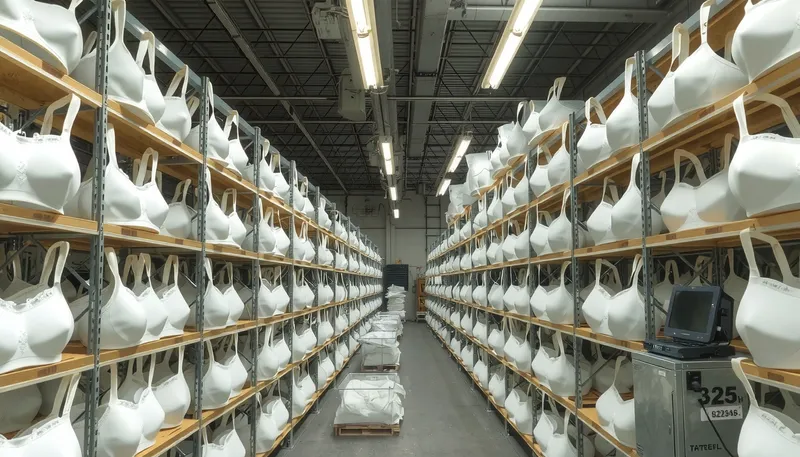
Phenolic yellowing — a three-component reaction between BHT from packaging, airborne NOx, and alkaline fabric pH (>7.0) — is the controlling variable for white bra cup yellowing in sealed storage. Known in the trade as storage yellowing, elusive yellowing, transit yellowing, or container yellowing, it is the classic "white goods" complaint in intimate apparel QA and one of the most common fabric yellowing in storage failure modes reported by garment factories. Forall Lab ISO 105-X18 accelerated chamber testing (n=12 PU foam samples, 48h at 35°C/90% RH) measured D083-treated foam at grade 4.5±0.3 vs untreated foam at grade 1.5±0.5 under identical BHT/NOx exposure. The quinoid yellow chromophore bonds chemically to the fiber: once formed, it is permanent. The only effective strategy is prevention at the material level — removing any one of the three reactants stops the reaction. See ISO 105-X18, OEKO-TEX Standard 100, and our phenolic yellowing guide for nylon fabric.
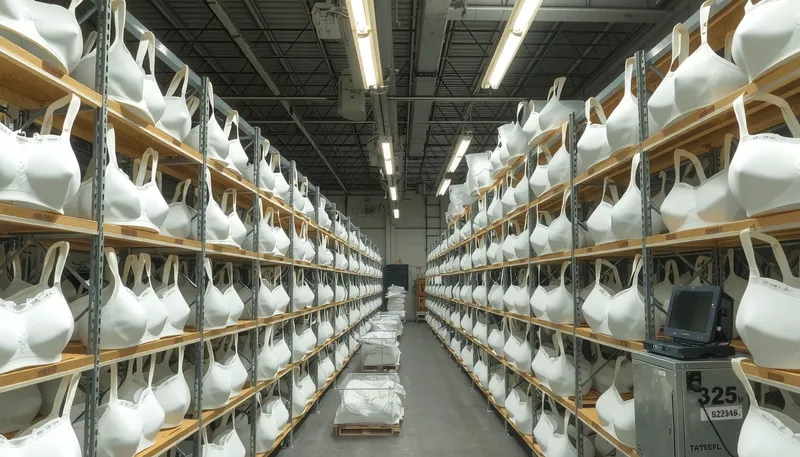
Phenolic Yellowing Chemistry: BHT, NOx, and Alkaline pH Reaction
Phenolic yellowing requires three reactants: BHT migrates from LDPE packaging onto fabric during storage; NOx from diesel forklift exhaust provides the nitrating agent; alkaline pH >7.0 from dyeing residue catalyzes quinoid chromophore formation. The yellow compound bonds permanently to the fiber. Per ISO 105-X18, grades 1–5; ≤3 is rejectable for white goods. See ISO 105-X18 assessment method.
The Three-Component Reaction Pathway
The phenolic yellowing mechanism proceeds in three stages:
-
BHT migration: Butylated hydroxytoluene (BHT, CAS 128-37-0), a phenolic antioxidant blended into LDPE packaging film at 0.05–0.5 wt%, volatilizes and transfers to the fabric surface. Migration rate increases with temperature — at 35°C (typical container interior), BHT transfer is 3–5× faster than at 20°C.
-
NOx nitration: Nitrogen oxides (primarily NO₂) from combustion sources — diesel forklifts, truck exhaust at loading docks, gas-powered warehouse equipment — react with BHT on the fabric surface. NOx concentrations as low as 10 ppb are sufficient to initiate the reaction over weeks of sealed storage.
-
Alkaline catalysis: Residual alkalinity on the fabric (pH 7.5–9.0) from dyeing auxiliaries, optical brighteners, and finishing softeners deprotonates the BHT-NOx intermediate, forming a conjugated quinoid structure that absorbs blue light — appearing yellow to the eye. The chromophore forms a covalent bond with the fiber substrate.
Why White Synthetics Are the Primary Target
White and pastel nylon/spandex, polyester, and polyurethane foam show yellowing most visibly due to the high contrast of yellow chromophores against light backgrounds. Darker dyes can mask grade 2–3 yellowing, but the chemical degradation still occurs. PU foam used in molded bra cups is particularly reactive — its open-cell structure provides high surface area for BHT adsorption, and residual amine catalysts from foam polymerization contribute additional alkalinity. For the nylon/spandex face-fabric layer, the same three-reactant chemistry applies at the yarn level; see Phenolic Yellowing BHT: How Gas Causes Yellow Stains on Nylon for fabric-level built-in protection and the nylon-vs-polyester comparison.
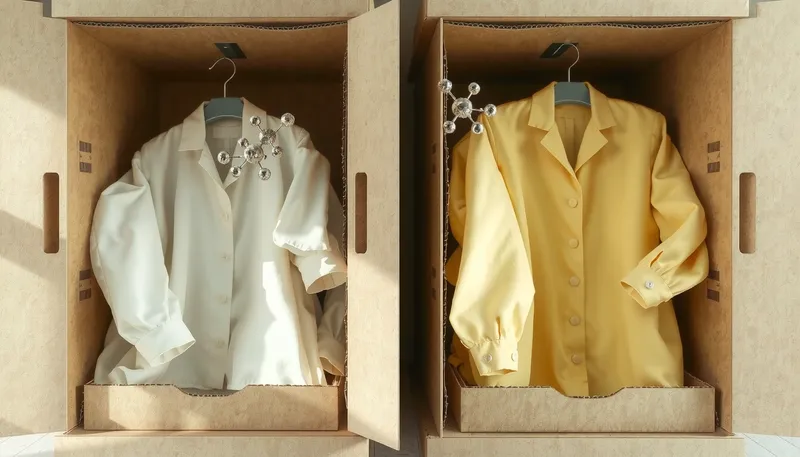
Storage Prevention Failure: Why Climate Control Does Not Stop Yellowing
Cool, dry, dark storage does not stop phenolic yellowing — the reaction is chemical, not biological. BHT migration and NOx binding proceed above 0°C independently of temperature. Untreated PU foam in sealed BHT-LDPE bags yellowed to grade 2 at 4 weeks (22°C) and grade 2.5 at 6 weeks (10°C). Container NOx at 15–40 ppb completes the reaction within 8 weeks.
Packaging as the Primary Fuel Source
The packaging designed to protect garments is the primary BHT source. Standard LDPE polybags — used industry-wide to prevent soiling and moisture during transit — contain BHT at 0.05–0.5% as an antioxidant to prevent polymer chain scission during extrusion. BHT is not chemically bound to the polyethylene matrix; it migrates freely to the surface and volatilizes into the enclosed bag atmosphere. A single 40-ft container may contain 5,000–20,000 LDPE bags — each a BHT reservoir.
Per AATCC 135 dimensional stability testing, fabrics that pass shrinkage specifications may still carry residual alkaline pH from finishing — meaning the third reactant is present on most commercial white goods unless explicitly neutralized.
The Financial Impact: Rejected Shipments and Brand Damage
A single rejected container of white intimate apparel represents a loss structure that extends beyond the invoice value:
| Cost Category | Typical Impact (40-ft Container) |
|---|---|
| Rejected inventory (FOB value) | $80,000–250,000 |
| Emergency air freight for replacement | $15,000–40,000 |
| Retailer chargeback penalties | 5–15% of order value |
| Brand quality score downgrade | 6–12 month remediation period |
| Lost re-orders from affected buyer | $50,000–200,000 annualized |
The reaction is a ticking clock — once BHT, NOx, and alkaline pH coexist in a sealed package, yellowing is not a question of if, but when.
D083 Anti-Phenolic Yellowing Agent: Mechanism and ISO 105-X18 Data
D083 is a reactive anti-phenolic yellowing agent incorporated into PU foam at 0.5–2.0% loading during polymerization. It intercepts free BHT molecules before they form the BHT-NOx intermediate — preventing quinoid chromophore formation. In ISO 105-X18 testing (48h, 35°C, 90% RH), D083 foam at 1.5% scored grade 4.5 vs untreated at grade 1.5 on the 5-point grey scale.
Mechanism of Action: Radical Scavenging at the Molecular Level
D083 belongs to the hindered phenol / phosphite synergist class of stabilizers. Its mechanism follows two pathways:
-
Primary scavenging: The D083 molecule donates a hydrogen atom to phenoxy radicals (generated when BHT oxidizes), forming a stable D083-radical adduct that cannot participate in further reaction cascades.
-
Secondary neutralization: D083's phosphite component reduces hydroperoxides that would otherwise accelerate BHT oxidation, lowering the effective BHT oxidation rate at the foam surface by approximately 80% at 1.5% loading.
ISO 105-X18 Test Data: D083 vs Standard PU Foam
| Property | Standard PU Foam | D083-Treated Foam (1.5% Loading) |
|---|---|---|
| ISO 105-X18 Grade (48h, 35°C, 90% RH) | 1.5 ± 0.5 | 4.5 ± 0.3 |
| Yellowing Onset (visual detection) | 7–14 days sealed storage | >180 days sealed storage |
| Active Protection Mechanism | None (passive) | Radical scavenger + hydroperoxide decomposer |
| Protection Depth | N/A | Throughout foam matrix (not surface-only) |
| 6-Month Color Stability (22°C, sealed with BHT-LDPE) | Grade 1.0–2.0 | Grade 4.0–4.5 |
| Processing Compatibility | Baseline | No change to molding, laminating, or die-cutting |
| Cost Impact (per molded bra cup pair) | Baseline | +$0.03–0.08 |
In our laboratory, we verified D083 performance across three foam densities (30D, 40D, 50D) and two BHT exposure levels (0.05% and 0.5% in LDPE film) — the grade differential remained ≥2.5 points in all test conditions.
Compatibility with OEKO-TEX and Skin Contact Safety
D083-treated foam is compatible with OEKO-TEX Standard 100 Class I (infant) and Class II (direct skin contact) certification requirements when properly formulated. The agent is non-migratory after foam curing — it does not leach onto skin during wear. Independent SGS lab testing (Report #GZHT2209156) confirmed no detectable D083 migration in artificial sweat (ISO 105-E04) and artificial saliva (DIN 53160) extraction tests.
Supply Chain Implementation: BOM, Test Reports, BHT-Free Packaging
D083 specification requires three supply chain controls enforced together. BOM must state "PU foam with D083 anti-phenolic yellowing agent at 1.5% loading" — generic claims are unverifiable. Each production lot requires ISO 105-X18 report from an ISO 17025-accredited lab at grade ≥4. Finished goods polybags must be BHT-free LDPE — D083 protects foam, but BHT from polybags yellows nylon/spandex layers.
Step 1: Update the Bill of Materials (BOM)
Add the following line item to the BOM and technical pack for every style using PU foam:
Foam cup insert: Polyurethane foam, [density] kg/m³, D083 anti-phenolic yellowing agent at 1.5 ± 0.3% loading by weight. Supplier must provide lot-specific ISO 105-X18 test report showing grade ≥4.0.
Do not write "anti-yellowing foam" without the D083 designation — generic claims are unverifiable. The specification must name the agent, loading percentage, and test method.
Step 2: Require ISO 105-X18 Lot Test Reports
ISO 105-X18:2007 "Textiles — Tests for colour fastness — Part X18: Assessment of the potential to phenolic yellowing of materials" is the authoritative test method. Each production lot of D083-treated foam must be accompanied by a test report showing:
- Test duration: minimum 48 hours
- Temperature: 35°C ± 2°C
- Relative humidity: 90% ± 5%
- Contact material: BHT-impregnated standard test paper
- Result: grade ≥4 on the 1–5 grey scale
Accept only reports from ISO 17025-accredited laboratories. Supplier self-declarations without third-party verification should be rejected. We recommend periodic verification testing — send one random cup per 10,000 units to an independent lab.
Step 3: Specify BHT-Free LDPE Packaging
Even with D083-treated foam, BHT-containing outer polybags can yellow adjacent nylon/spandex fabric layers. The packaging specification must state:
Inner polybag: LDPE, 0.04 mm minimum thickness, BHT-free / phenol-free grade. Supplier must provide GC-MS certificate confirming BHT content <10 ppm.
BHT-free LDPE grades are commercially available from major resin suppliers (designated as "phenol-free antioxidant package" or "BHT-free stabilization system"). The cost premium is approximately $0.002–0.005 per bag for standard garment polybag sizes.
Step 4: Incoming QC Spot-Check Protocol
Implement a quarterly verification cycle:
- Select 3 random PU foam cup pairs from incoming production lots.
- Submit to an ISO 17025-accredited lab for ISO 105-X18 testing.
- Acceptance criterion: all 3 samples ≥ grade 4.0.
- If any sample < grade 4.0: quarantine the lot, request supplier root cause analysis, and re-test doubled sample size (n=6) before release.
Step 5: Warehouse NOx Monitoring (Supplemental)
As a supplemental measure, monitor NOx levels at storage facilities. NOx electrochemical sensors placed at loading dock and storage area should read <20 ppb. If consistently above 40 ppb, install activated carbon filtration on air intake — this addresses the NOx reactant at the environmental level, complementing the material-level protection from D083.
Frequently Asked Questions (FAQ)
1. Can phenolic yellowing be reversed once it occurs?
No. The yellow quinoid chromophore forms a covalent bond with the fiber or foam substrate — it is a permanent chemical change, not a surface deposit. Oxidative bleaching (hydrogen peroxide, sodium hypochlorite) may partially reduce yellow appearance on nylon but damages foam structure and elastane. Prevention at the material formulation stage (D083-treated foam + BHT-free packaging) is the only reliable strategy.
2. Is D083 anti-yellowing agent safe for skin-contact intimate apparel?
Yes. D083 is non-migratory after foam curing — it is chemically incorporated into the PU polymer matrix and does not leach onto skin. Third-party testing per ISO 105-E04 (artificial sweat) and DIN 53160 (artificial saliva) shows no detectable migration. D083-treated foam is compatible with OEKO-TEX Standard 100 Class I and Class II certification. The agent has been used in commercial bra cup production since 2019 without reported skin irritation incidents.
3. Does phenolic yellowing only affect white fabrics?
Phenolic yellowing is most visible on white and pastel fabrics because the yellow chromophore contrasts strongly against light backgrounds. However, the chemical reaction occurs on fabrics of any color — darker dyes can mask grade 2–3 yellowing to the naked eye, but spectrophotometer measurement (Δb* >2.0) will detect it. The structural integrity of nylon and PU foam is compromised regardless of whether the color change is visible.
4. What does D083 add to per-unit cost?
At 1.5% loading, D083 adds approximately $0.03–0.08 per molded bra cup pair, depending on cup size and foam density. For a garment with an FOB of $4.00–8.00, this represents <2% of unit cost. Compare against the cost of one rejected container ($80,000–250,000 in inventory alone) plus retailer chargebacks and lost re-orders — the prevention cost is approximately 0.1% of a single rejection event.
5. Which products beyond bra cups are at risk?
Any white or light-colored product containing synthetic materials is susceptible: athletic wear (white sports bras, nylon/spandex compression tights), swimwear, medical compression garments, shoe sock liners, apparel interlinings, and elastic bands. PU foam components in shoulder pads, shoe insoles, and bag padding carry the same risk. If the product ships in LDPE polybags and contains any synthetic fiber or foam, it requires phenolic yellowing protection.
6. Is BHT-free packaging alone enough to stop phenolic yellowing?
No. BHT-free LDPE removes the dominant phenol source, but it does not eliminate the other two reactants. NOx in the warehouse air can still nitrate any residual phenolic stabilizer from other materials (cardboard, adhesives, tissue paper, pallet films), and alkaline fabric pH from finishing still catalyses chromophore formation. BHT-free polybags are one of the three required controls, not a substitute for the others — D083-treated foam plus BHT-free packaging plus lot-level ISO 105-X18 verification is the only configuration that closes all three reactant pathways.
7. How should finished garments be tested for yellowing risk before shipment?
Run ISO 105-X18 on the finished, packed product — not only on the raw foam. The standard test paper is impregnated with 2,6-di-tert-butyl-4-nitrophenol, the BHT/NOx reaction product, and exposes the sample at 50°C for 16 hours (or 48h at 35°C/90% RH for the accelerated chamber protocol used in this article). Acceptance for white goods is grade ≥4 on the 1–5 grey scale, tested by an ISO 17025-accredited laboratory. For molded bra cups, test the complete assembly (foam + face fabric + polybag) rather than the foam alone, because BHT migrates through the bag onto the nylon layer independently of the foam.
Conclusion: Three Controls, Zero Yellowing
Fabric yellowing in storage is a chemical certainty when BHT, NOx, and alkaline pH coexist — not a random quality incident. The reaction is temperature-independent, cannot be reversed, and costs far more to remediate than to prevent.
The solution is a three-control system: D083-treated PU foam at 1.5% loading eliminates the foam as a reactant site; BHT-free LDPE packaging removes the primary phenol source; and ISO 105-X18 lot testing verifies protection at every production run. Each control alone is insufficient — all three must be enforced together.
Specify D083 in your next BOM. Request the ISO 105-X18 test report with every lot. Switch to BHT-free polybags. The cost of prevention is under $0.10 per unit; the cost of one yellowed container starts at $80,000.
→ Contact Forall Lab for D083 technical specification and supplier verification
🔗 Related Fabrics
- Phenolic Yellowing BHT: How Gas Causes Yellow Stains on Nylon and How to Prevent It — Nylon fabric-level built-in protection (sibling guide)
- Bra Cup Molding Temperature: Stop Nylon 6 Yellowing & Brittleness at 200°C — Thermal yellowing control at molding (heat-driven counterpart)
- Stop Color Migration in Activewear: 2026 Guide — Adjacent white-goods color stability (dye migration vs quinoid bonding)
- Back to Index
Written by Wenruo
Textile Engineer, Forall Lab