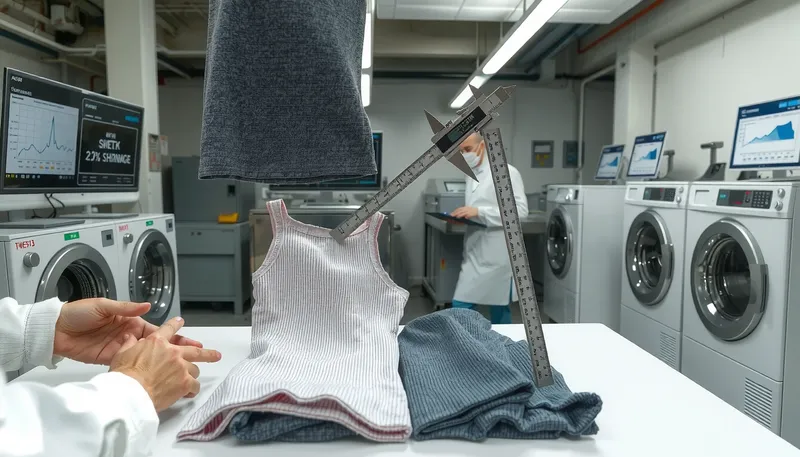
Activewear fabric shrinkage prevention is a thermal finishing process that permanently resets the dimensional memory of nylon-spandex knits. It is achieved on a stenter frame at 190-210°C, locking fibers to guarantee less than 3% length and width change after washing (AATCC 135). This is not a quality option; it's a financial necessity to eliminate marker yield loss.
Key Takeaways
- Dimensional Stability is Profit: Fabric with poor stability increases the use of fabric and production costs. This is because of marker yield loss and QC failures.
- Heat-Setting Guarantees <3% Shrinkage: Heat-Setting guarantees <3% shrinkage when applied at 190–210°C with controlled overfeed.
- Insist on AATCC 135 & SGS Verification: Adhere to standard tests such as AATCC 135 and involve third-party labs like SGS. This checks supplier claims and ensures that the fabric is up to the required standard.
- Stable Fabric = Higher Yield: Using a low shrinkage (like <3%) fabric reduces the buffer needed in cutting markers. This helps with material savings and cuts costs on every order.
What is Dimensional Stability and Why It Can Hurt Your Profits
Dimensional stability is the property by which a fabric retains its original length and width after washing, drying, and heating. For factories, unstable conditions translate into irregular garment sizes and higher fabric consumption, which push up customer returns and rework costs.
The Invisible Costs Of Unstable Fabric
Unplanned 5% shrinkage directly destroys marker yield, inflating your Cost Per Garment (CPG). In our production data, failing dimensional QC typically causes a 15% re-cut rate and 3-day production delays, costing an average of $4,200 per incident in wasted material and labor.
The Main Causes of Shrinkage in High-Performance Fabrics
Fabric shrinkage in nylon-spandex blends is the release of internal tensions created during knitting and processing. The three dominant drivers are fiber content balance (spandex ratio), residual knitting tension, and the sudden application of heat and moisture in dyeing — all of which can be permanently neutralized by a prior heat-set.
Fiber Content: The Nylon-Spandex Tension Balance
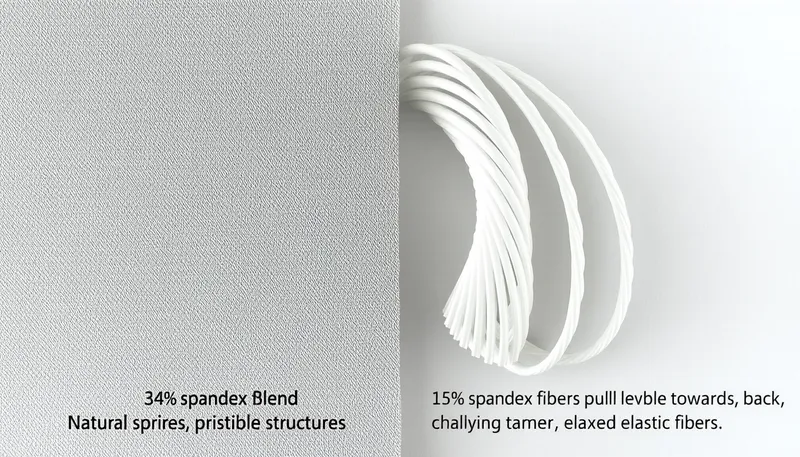
Fiber content dictates the internal tension balance of a knit. A higher-spandex blend (24-34%) stores substantially more latent retraction energy than a low-spandex blend (12-15%), which is why high-spandex activewear is inherently more prone to shrinkage unless it is heat-set.
Knitting Tension: The Stored Energy Problem
Knitting tension is the mechanical stress locked into yarn loops during fabric formation. On high-speed circular machines, nylon yarns are stretched 10–15% beyond their relaxed length. This stored energy releases as shrinkage when the fabric first meets heat.
Stitch density (wales/cm × courses/cm) directly correlates with shrinkage potential — a denser, more compact knit stores more latent energy.
Wet Processing: The Final Trigger
Wet processing triggers shrinkage by combining heat, moisture, and mechanical action. Dye baths at 120–130°C agitate the fabric, breaking temporary bonds and allowing fibers to slip. Without a prior heat-set, this is the exact point where uncontrolled dimensional change occurs.
A Closer Examination of the Heat-Setting Process
Heat-setting is a precision thermal finishing process typically executed on Monforts or Brückner stenter frames. By subjecting synthetic blends to 190-210°C under controlled tension, the process permanently crystallizes the molecular memory of fibers, ensuring rigorous dimensional stability.
The Step-by-Step Heat-Setting Protocol
A stenter machine handles this critical process. Mastering it ensures consistent quality.
- Step 1: Fabric Entry & Pinning: The fabric carefully feeds onto a pin frame called a stenter, held at a precise, controlled width. This step stops edges from curling and ensures even fabric treatment.
- Step 2: The Heating Chamber: The fabric moves through various heating zones. Inside, hot air circulates to touch every part of the surface evenly. The temperature is set precisely based on the fiber type, as polyester and nylon react differently to heat.
- Step 3: Dwell Time and Crystallization: The fabric is held at 190-210°C, causing polymer chains to crystallize into a new, relaxed alignment. Key parameters: 200°C temperature, 2-5% overfeed to control course shrinkage, and width setting at +10% of finished width. Typical dwell time is 45–90 seconds, calibrated to the fabric's GSM and spandex percentage.
- Step 4: The Cooling Zone: Immediately after heating, the fabric passes through a cooling zone. This rapid cooling hardens the newly stable structure before the fabric has a chance to relax or distort.
- Step 5: Controlled Exit & Plaiting: The stabilized fabric is unpinned and gently folded (plaited) or rolled. This happens without applying new tension, which preserves its newly set dimensional stability.
Shrinkage Control Methods Comparison: Pre-Shrinking vs. Relaxation
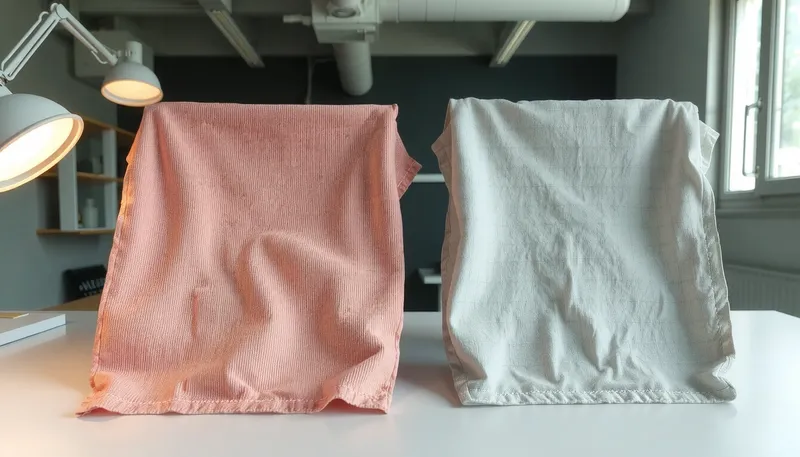
Heat-set pre-shrinking and natural relaxation are two strategies to stabilize fabric dimensions. Heat-setting applies controlled 190–210°C thermal energy to permanently crystallize fibers, yielding <3% shrinkage. Relaxation is a passive, time-dependent method that only partially relieves surface stress and remains vulnerable to subsequent heat.
Side-by-Side Comparison
| Feature | Heat-Set Pre-Shrinking (e.g., stenter heat-setting) | Natural Relaxation |
|---|---|---|
| Effectiveness | High & Permanent: Locks dimensions to <3% shrinkage. | Moderate & Temporary: Releases some tension but still affected by heat. |
| Consistency | Extremely Consistent: Verified by SGS lot testing. | Variable: Depends on humidity, time, and handling. |
| Time Required | Fast: Processed in minutes per roll. | Slow: Requires 24-48 hours of resting time. |
| Space Required | Stenter machine footprint. | Large tables or racks, using valuable floor space. |
| Ideal For | High-performance synthetics, squat-proof leggings, tight-fitting activewear. | Low-tension natural fibers, loose-fitting garments. |
All heat-set fabrics should additionally meet OEKO-TEX Standard 100 to guarantee no harmful substances are released during hot processing.
The Dimensional Stability Verification Procedure: The Role of Lab Testing
Dimensional stability is verified by washing fabric samples through standard cycles and measuring the percentage of lengthwise (wale) and widthwise (course) change, plus any GSM variance. This uses globally recognized test methods like AATCC 135, which guarantees objective and repeatable results for your factory.
The Implementation of a QC Testing Protocol
Brands should specify a test method in their tech packs. The most popular standards are AATCC 135 for dimensional changes during home laundering and ISO 6330 for domestic washing and drying procedures. This removes any guesswork.
The industry standard for acceptable shrinkage is often ±5%. However, for high-performance activewear, a stricter standard of <3% is necessary. This ensures a leggings size M remains within ±1 cm of spec after 5 home launderings.
Always insist on third-party verification. Using accredited labs like SGS or Intertek validates a supplier's in-house test reports, which helps build trust and ensures compliance with your brand's quality standards.
Match the test method to the end use. For B2B uniform and rental programs laundered in industrial machines rather than homes, add ISO 5077 for dimensional change under commercial laundering alongside AATCC 135. On the inspection table, bow and skew across the full roll width can be verified against ASTM D3882 before the fabric is cut — catching distortion at the source instead of after a failed wash test.
As an illustration, fabrics like our D036 Nylon Interlock are engineered using this exact protocol. This lightweight 160 g/m² interlock uses a one-open-one-close knit structure to provide a stable canvas — a reliable base for complex acid-print designs that won't warp. The shrinkage rate is guaranteed to remain under 3%.
Objective Limits: When is Extreme Stability Not Needed?
Not every activewear application needs <3% stability. Heat-setting adds cost and time, so match the stability grade to the end use — reserve <3% for fitted, compression-driven garments and accept higher tolerance for loose or non-structural pieces.
Scenarios Where Standard-Grade Fabric Suffices
- If Application = Oversized Loungewear/Joggers: Then standard natural relaxation (up to 5% shrinkage tolerance) is acceptable, as precise compression is not required.
- If Application = Non-Performance Linings/Pocketing: Then high-temperature heat-setting is an unnecessary investment. Basic calendering suffices.
- If Application = Ultra-Budget Fast Fashion: Then factories can opt for lower dimensional stability to save processing costs, provided the brand pattern-maker explicitly increases the seam allowance to offset unpredictable shrinkage.
The Yield & ROI Calculator: Justifying the Savings of <3% Shrinkage
The ROI of <3% shrinkage is simple: every point of dimensional stability you lock in is fabric you do not waste on safety buffers in the cutting marker. By programming strict <3% shrinkage tolerances into CAD cutting markers (e.g., Gerber, Optitex), factories can eliminate artificial safety buffers, maximizing material utilization and increasing profit per meter.
Yield optimization through fabric stability increases the number of garment pieces that can be cut from a given amount of fabric. By minimizing shrinkage allowances in a cutting marker, factories can reduce material waste and increase profit per meter.
Your Savings Calculation
Let's do a straightforward ROI analysis for a typical production order in 2026.
- The Scenario:
- Order Quantity: 10,000 meters of fabric
- Fabric Cost: $8.00/meter
- Fabric A (Standard): 5% shrinkage rate
- Fabric B (High-Stability): <3% shrinkage rate (a 2% improvement)
- The Calculation:
- Fabric Saved: 10,000 meters * 2% = 200 meters
- Direct Cost Savings: 200 meters * $8.00/meter = $1,600
This $1,600 is a direct saving from a single order, not including savings from fewer QC failures or zero re-cuts. Sourcing quality fabric, especially from suppliers with GRS or OEKO-TEX certifications, is an investment in your factory's efficiency, not an expense.
FAQ on Activewear Fabric Shrinkage Prevention
Does all spandex fabric shrink?
Not necessarily. Even though spandex fiber itself is very elastic and tends to retract, its shrinkage in a garment depends on the blend ratio, fabric construction, and most importantly, whether it has been properly heat-set. A stable nylon-spandex can have near-zero shrinkage.
Can you reverse shrinkage in nylon/spandex blends?
Once a fabric has shrunk due to heat, the change is largely permanent because the heat has reset the fabric's molecular structure. Unlike some natural fibers that can be stretched when wet, heat-shrunk synthetics will not return to their original dimensions, making prevention critical.
What is an acceptable shrinkage percentage for activewear?
For performance, fitted activewear like leggings or compression tops, the target should be less than 3% in both length and width after several washes. For looser-fitting items, up to 5% is acceptable, but this can still affect grading and fit consistency across sizes.
How does fabric weight like 160gsm affect stability?
Lighter weight fabrics, such as a 160gsm interlock, can be more prone to distortion and tension-related shrinkage if not properly finished. Effective heat-setting is even more critical for these fabrics to ensure they maintain their shape without becoming flimsy or unstable.
Why does my fabric twist after washing, not just shrink?
Twisting, or torquing (measured via AATCC 179 for skewness change), is a form of dimensional instability caused by uneven tension in the yarn or knitting process, common in single-knit jerseys. A quality heat-setting process on a well-constructed knit, such as a Nylon Interlock, helps neutralize these tensions, preventing both shrinkage and twisting.
What temperature should nylon-spandex be heat-set at?
Typical heat-setting temperature for nylon-spandex knits is 190-210°C, with 45-90 seconds dwell and 2-5% overfeed. Nylon 6 (used in D036) sits at the lower end of that window because it begins to soften and can yellow if over-heated, while nylon 6,6 tolerates the higher end. Always match the exact curve to the mill's spec for your denier and spandex ratio.
What is the difference between relaxation shrinkage and progressive shrinkage?
Relaxation shrinkage is the one-time dimensional change that happens the first time a fabric meets heat and moisture — the stored knitting tension releasing. Progressive shrinkage is additional shrinkage that keeps occurring over repeated washes, which signals incomplete heat-setting or unstable finishing. A correctly heat-set nylon-spandex shows most of its total shrinkage as relaxation shrinkage on the first wash, then stays flat — the sign of a stable fabric.
Is heat-setting worth the cost for small brands?
Yes, if you are cutting fitted activewear. The math is direct: a 2% shrinkage improvement on 10,000 meters saves 200 meters — about $1,600 at $8/meter — before counting avoided re-cuts and returns. For loose loungewear or non-performance pieces, skip it and accept up to 5% tolerance; the thermal step is not free.
Why do my spandex leggings shrink in the dryer even if the fabric was pre-shrunk?
Elastane glass-transition temperature (Tg) degradation. A heat-set nylon-spandex stays dimensionally stable under the AATCC 135 tumble-dry-low cycle, but sustained drying above roughly 75°C exceeds the set memory of the spandex component and causes irreversible contraction. The garment care protocol therefore matters as much as the fabric spec: the same roll that passes AATCC 135 can still be damaged by an industrial hot-head press above 150°C. If your end use involves hot pressing or high-heat finishing, confirm the heat-set grade with the mill before cutting.
Can you provide certified test reports with bulk orders?
Yes — a full test report can accompany every bulk shipment. For dimensional stability the key evidence is the AATCC 135 batch report; color fastness and pilling results normally ship on the same certificate. Ask for the test method and wash cycle to be written on the certificate — a "3% shrinkage" figure without its test method is not a specification.
Ready to spec fabric that hits <3% shrinkage from the first cut? Request the Dimensional Stability tech-pack checklist and a D036 sample with an AATCC 135 batch report.
🔗 Related Fabrics
This article maps the heat-setting and dimensional-stability route into nylon-spandex sourcing:
- D036 Nylon Interlock — Product Page — the D036 76/24 nylon-spandex platform specs
- Nylon-Spandex Garment Care Protocol (ISO 6330 & AATCC 135) — washing, drying, and dimensional-stability lab protocol
- Fabric Shrinkage Calculation for Pattern Makers — turning shrinkage % into marker and grading math
- D036 Virgin Nylon — Performance Alternative to Econyl — the D036 material science and certification path
Written by Wenruo
Textile Engineer, Forall Lab