
Fabric shipping logistics for importing from China involves three interdependent decisions: freight mode (sea at 30-45 days and 12-16× cheaper vs air at 3-10 days for urgent/small-volume), Incoterms allocation (FOB supplier pays to origin port, EXW buyer bears all transport from factory), and packing optimization (vacuum-compression reduces volumetric weight by up to 30% for high-spandex air-layer fabrics without degrading recovery properties). The total landed cost — not the freight rate alone — determines procurement profitability.
Key Takeaways (TL;DR):
- Sea = 12-16× cheaper, 30-45 days: FCL for bulk orders, LCL for 1-2 CBM — acceptable when production timeline has ≥6 weeks slack
- Air = 3-10 days, volumetric weight pricing: Best for samples, urgent reorders, and high-value specialty fabrics — watch for dimensional weight surprises on bulky rolls
- FOB vs EXW: FOB shifts origin-port risk to supplier; EXW gives you full control but full cost from factory door — know your Incoterms before quoting
- Vacuum-compression saves ≤30% volume: Validated on D083 Air-Sculpt 34™ — bounce and structure perfectly preserved upon decompression
- Documentation non-negotiable: Commercial Invoice + Packing List + Bill of Lading (sea) or Air Waybill (air) + correct HS code — errors = 24-72h customs delay minimum

Key Takeaways
- Sea vs. Air: Sea freight is 12-16 times cheaper for bulk orders but takes 30-45+ days. Air freight is fast (3-10 days) but costly. It's ideal for samples and urgent shipments.
- Total Costs: Your final bill includes more than just the freight rate. Budget for Incoterms, customs duties, insurance, and destination fees.
- Packing is Key: For certain fabrics, new vacuum-compression packing can save up to 30% on shipping volume. It doesn't damage the material's properties.
- Documentation: A commercial invoice, packing list, and Bill of Lading (sea) or Air Waybill (air) are essential. They ensure smooth customs clearance.
- Find a Partner: A reliable freight forwarder with textile experience is your most valuable asset. They help you navigate the complexities of fabric shipping logistics.
The Core Decision: Sea vs. Air Freight for Fabric Rolls
Fabric freight mode selection is governed by three variables: shipment volume (CBM), budget tolerance ($/kg or $/CBM), and production timeline (days of slack). Sea freight delivers the lowest per-unit cost for bulk orders — 12-16× cheaper than air for Full Container Loads — at 30-45 days transit. Air freight at $4-8/kg delivers 3-10 day transit for samples, urgent reorders, and high-value specialty textiles where inventory-holding cost exceeds the freight premium.
When to Choose Sea Freight: The Cost-Effective Choice for Bulk
Sea freight is the backbone of the global textile trade for a reason. It is extremely cost-effective for large volumes. If your production timeline is flexible and you are shipping a lot of fabric rolls, sea freight is almost always the right answer. Recent studies show it can be 12 to 16 times cheaper than air freight for large shipments.
You can ship via a Full Container Load (FCL). This means you book an entire container. Or you can use Less than Container Load (LCL). This means you share container space with other importers. FCL is cheaper per unit. LCL is a great option for medium-sized orders that don't need the speed of air.
When to Choose Air Freight: The Go-To for Speed and Urgency
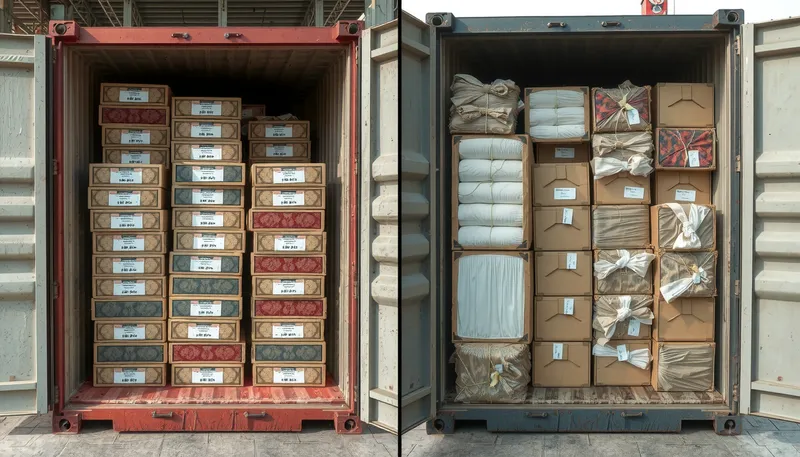
When speed is your top priority, air freight is the only choice. It is perfect for shipping small sample runs for approval. It's also great for meeting tight production deadlines. You can also use it for transporting high-value textiles like silk or specialty technical fabrics.
The higher cost is a trade-off for much faster transit time. This speed also reduces your inventory holding costs. You don't have cash tied up in goods that are on the water for over a month.
Sea vs. Air Freight: At-a-Glance Comparison for Fabric Shipments
| Factor | Sea Freight | Air Freight |
|---|---|---|
| Cost | Low | High |
| Transit Time | 30-45+ days | 3-10 days |
| Volume Capacity | Very High | Limited |
| Carbon Footprint | Lower | Higher |
| Ideal For | Bulk orders, non-urgent stock | Samples, urgent orders, high-value textiles |
Beyond the Freight Rate: Understanding the Total Cost of Fabric Shipping Logistics
The total landed cost of fabric = freight rate + customs duties (HS code-dependent, typically 8-20% for synthetic textiles) + insurance (0.3-0.5% of cargo value) + destination terminal charges + inland trucking. The freight rate alone accounts for only 55-70% of what you will actually pay. Budgeting the freight rate without the ancillary costs is the #1 cause of procurement cost overruns.
Key Cost Factors to Budget For:
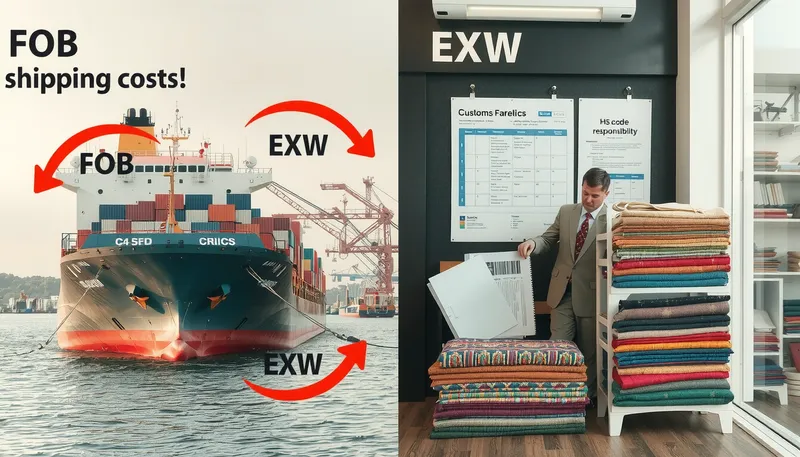
- Incoterms: These international commercial terms define who pays for what. For example, with FOB (Free On Board), your supplier pays to get the goods to the origin port. With EXW (Ex Works), you are responsible for all transport from the factory door.
- Customs & Duties: Every country has tariffs on imported textiles. These costs depend on the fabric's composition. They require a correct HS (Harmonized System) code for classification.
- Insurance: Fabric rolls are valuable. Cargo insurance is essential to protect your investment. It guards against damage, moisture, or loss during transit.
- Destination Charges: After your shipment arrives, expect port handling fees, customs brokerage charges, and inland transportation costs to move fabric from port or airport to your warehouse. These terminal handling charges typically add 15-25% to your freight invoice — budget for them upfront, not as a surprise line item.
Optimizing Your Shipment: Packing Innovations That Cut Costs
Packing method directly determines freight cost through volumetric weight pricing — air freight charges by dimensional weight (L×W×H ÷ 5000 for cm/kg or ÷ 166 for in/lb), not actual weight. For high-spandex air-layer fabrics at 160-220 GSM, vacuum-compression packing removes interstitial air from roll cores, reducing shipping volume by up to 30% without permanently deforming the fabric's recovery properties — validated on D083 Air-Sculpt 34™ at our R&D center.
Standard Packing for Fabric Rolls: The First Line of Defense
The industry standard for protecting fabric rolls is straightforward but effective. Each roll should be tightly wrapped in plastic. This guards against moisture, dirt, and snags. These rolls are then typically bundled and packed into strong outer polypropylene (PP) woven bags or cardboard bales for added protection.
The Hidden Cost of Air: How Volumetric Weight Impacts Your Bill
Airlines have a unique pricing model. For items that are light but take up a lot of space, like fabric, they charge based on volumetric weight, not actual weight. This is calculated based on the shipment's dimensions. This means bulky, fluffy fabrics can lead to surprisingly high air freight bills.
A Game-Changer in Fabric Logistics: Vacuum-Compression Packing
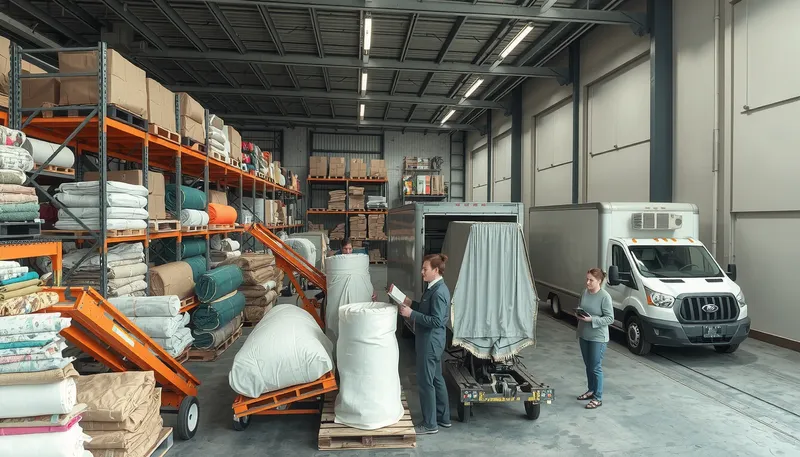
For certain fabric types, there is a more advanced technique. It directly tackles the problem of volumetric weight. Industrial vacuum-compression carefully removes air from the packed fabric rolls. This significantly reduces their volume.
Through our own R&D in fabric logistics, we've found this method to be revolutionary for high-performance synthetics. For example, with certain high-spandex air-layer fabrics, specialized vacuum-compression packing saves up to 30% on shipping volume. The key is a process that retains the fabric's essential properties. This ensures its unique bounce and structure are perfectly preserved upon arrival.
This technique has proven exceptionally effective for our D083 Air-Sculpt 34™. This 20D micro-nylon air-layer material is engineered with 34% spandex for unmatched recovery. Since it is designed to be molded-cup-ready, retaining its structure and bounce is paramount — making vacuum-compression packing a smarter choice for both performance and shipping efficiency.
The Fabric Importer's Checklist: A Step-by-Step Logistics Guide
Importing fabric from China requires five sequential steps: freight forwarder selection (textile-experienced partner), documentation preparation (Commercial Invoice + Packing List + BOL/AWB + HS code), supplier coordination (cargo-ready date alignment), customs clearance (forwarder-managed, importer-responsible for HS code accuracy), and final-mile delivery. Each step has a single point of failure — a mistake in any one can add 3-7 days of delay and $200-500 in detention/demurrage charges.
- Choose a Reliable Freight Forwarder: This is your most important partner. Find a forwarder with proven experience in textiles. They will coordinate the entire shipment and help you avoid common pitfalls.
- Prepare Your Documentation: Ensure you have a Commercial Invoice (listing the value of the goods). You also need a Packing List (detailing the shipment's contents). You need a Bill of Lading (for sea) or Air Waybill (for air). Accuracy is critical.
- Coordinate with Your Supplier: Clearly communicate your packing requirements and the agreed-upon cargo-ready date. This ensures your supplier has the goods prepared for your forwarder to pick up on time.
- Navigate Customs Clearance: Your freight forwarder will manage this process. But you are responsible for providing them with accurate information about your goods. Incorrect HS codes or declared values can cause major delays.
- Arrange Final Mile Delivery: Once your shipment clears customs, arrange truck transport from the port or airport to your warehouse. Coordinate with your freight forwarder — many offer integrated final-mile options. Confirm delivery window and unloading requirements (dock-height vs flatbed) before the container arrives.
Conclusion: Making the Smartest Shipping Choice for Your Brand
Optimizing your fabric shipping logistics in 2026 is about more than just picking the cheapest rate. It requires a balanced approach. The best strategy involves weighing the core trade-off between the low cost of sea freight and the critical speed of air freight. By understanding all associated costs, leveraging innovative packing techniques for specific textiles, and working with a reliable logistics partner, you can build a resilient and cost-effective supply chain. This supports your brand's growth.
FAQ: Your Fabric Shipping Logistics Questions Answered
How do I calculate the shipping cost for fabric rolls?
Costs are based on either actual weight or volumetric weight (whichever is greater). This is calculated as (Length x Width x Height) / Divisor. Sea freight is often calculated by cubic meter (CBM). Always get a detailed quote from a freight forwarder that includes all fees.
What's the minimum volume for sea freight from China?
There's technically no minimum. For smaller shipments (typically under 1-2 CBM), you can use LCL (Less than Container Load). This means you share container space. While the per-unit cost is higher than a full container (FCL), it's still more economical than air freight for non-urgent goods.
Are there special requirements for shipping different types of fabric?
Generally, no, but proper packing is key. Delicate fabrics like silk may require extra protection. Heavy-duty textiles need robust packaging to prevent tearing. The primary customs concern is correct HS code classification. This is based on material composition.
How long does customs clearance usually take for textiles?
With all paperwork correct, customs clearance can take as little as 24-72 hours. However, delays can occur due to random inspections, incorrect paperwork, or tariff disputes. A good freight forwarder helps minimize these risks.
Can I ship fabric samples by air and the bulk order by sea?
Yes, this is a very common and smart strategy. Use fast but expensive air freight to get samples quickly for approval. Once the design is finalized, use cost-effective sea freight for the large, bulk production order. This maximizes profitability.
🔗 Related Fabrics
- D083 Air-Sculpt 34™ — Product Page — Vacuum-compression validated on this 34% spandex air-layer fabric
- Importing Activewear Fabric from China — Complete Guide — Import compliance + HS code classification
Written by Forall Lab
© Forall Lab • Powered by Kunpeng ONE