
Low MOQ fabric sourcing requires direct mill verification: a manufacturer owns knitting/weaving machines, dyeing vats, and finishing equipment at one registered production site — distinguishable from trading companies by three checks: ability to modify GSM and yarn specifications with engineering explanation, documented raw material traceability with OEKO-TEX Standard 100 Class I, and factory address provided for third-party audit. In 2026, startup-friendly mills offer MOQs of 100-150 meters (1 roll) with direct pricing — a reduction from the traditional 3,000-meter minimum — verified through a 5-question technical protocol testing production knowledge of AATCC 135 shrinkage control, yarn supply chain, and direct technician access. Our internal survey of 200+ Alibaba "low MOQ fabric supplier" listings in 2025 found 78% were trading companies, not mills.

Mill vs Trading Company: How to Identify a Real Fabric Manufacturer
A fabric mill owns production equipment at one registered site, controlling quality from yarn to roll with AATCC 135 batch-level testing. A trading company resells without production assets, sourcing from third-party mills at a markup that widens with order size — roughly 30% at one roll to 90% at 3,000 meters. Identify which you are dealing with by operational tests, not self-declaration: a production video of your fabric on the supplier's own machines, a GSM change explained by an engineer, and a registered production address open to third-party audit. Mill-direct sourcing is recommended when brands need lot-to-lot consistency verified by documentation and audit access.
What is a Fabric Mill?
A fabric mill is the producer. They operate knitting machines (28G–40G circular or warp knit), dyeing vats (100–500 kg capacity per batch), and finishing lines (heat-setting, compacting, inspection) at a single registered address. Mills control the entire conversion from yarn to finished roll — they specify yarn denier (20D/24F for lightweight activewear), knit construction (interlock, double jersey, air-layer), dye formulation, and finishing parameters.
Key identifiers of a mill:
- Registered production address: Physical factory location with business license showing textile manufacturing as registered activity
- Machine inventory: Knitting machines (Mayer & Cie, Santoni, Fukuhara), dyeing equipment, tenter frames
- Batch-level quality control: Each production lot tested for weight (GSM ±5%), width, shrinkage (AATCC 135), and color fastness
- Direct technical staff: Engineers and technicians employed on-site who can discuss yarn, knit structure, and dye chemistry
What is a Trading Company?
A trading company is a reseller without production assets. They source fabric from multiple mills — often different mills for different orders or even different parts of the same order — and resell at a markup. Their value proposition is aggregation and logistics, not manufacturing.
Key identifiers of a trading company:
- No registered production address: Business license lists "trading" or "import/export" as activity, not manufacturing
- No machine inventory: Cannot provide photos or videos of production equipment
- No direct quality control: Relies on the producing mill's QC — if the mill changes between orders, quality changes
- No technical staff: Sales representatives defer technical questions to unnamed "factory contacts"
Verification Matrix: Mill vs Trading Company
| Criterion | Real Fabric Mill | Trading Company |
|---|---|---|
| Production Assets | Owns knitting/dyeing/finishing machines at registered site | Zero production assets |
| Price Structure | Mill-direct, volume-discounted | ~30% (1 roll) to ~90% (3,000 m) markup |
| MOQ | 100-3,000 m (startup-friendly: 1 roll / 100-150 m) | Flexible (resells from any source mill) |
| Technical Response Time | <24 hours with engineering detail | 2-5 days (consults third party) |
| Quality Control | Direct, batch-level per AATCC 135 | Indirect, source-dependent |
| Raw Material Traceability | Full (yarn supplier, lot number, denier) | Minimal or none |
| Audit Willingness | Factory address + business license provided | Hesitates, redirects, or refuses |
| Certification | OEKO-TEX 100 Class I held directly | Rarely holds direct certification |
Our 2025 survey of 200+ Alibaba listings for "low MOQ fabric supplier China" found 156 (78%) were trading companies operating under factory-branded storefronts. Of the 44 actual mills, only 7 offered MOQs below 500 meters.
5 Technical Questions That Expose a Trading Company
Supplier vetting uses five questions exposing trading companies: request production video of your fabric, modify GSM ±5% and explain structural impact, provide yarn supplier name and lot number, disclose factory address for third-party audit, and verify a direct-sales website beyond marketplace platforms. A mill answers all five within 24 hours with engineering detail — a trader defers on ≥3.
Question 1: Production Video — "Can you send a video of my specific fabric on your machines?"
A trading company cannot produce this video. They would need to visit the producing mill and request access — the mill may refuse, delay, or have the fabric on a different machine from what was claimed. A real mill has staff on-site. They can walk to the knitting floor, record a 30-second video of your fabric running on a specific machine (serial number visible), and send it within hours.
What to look for in the video: machine brand and model (Mayer & Cie, Santoni), fabric width matching your specification, continuous production (not a swatch being hand-fed), and visible factory environment (not a showroom or office).
Question 2: Specification Change — "Can we modify the GSM by 5% and you explain the structural impact?"
This question tests engineering knowledge. Modifying GSM by ±5% on a given knit construction requires changing stitch length (for circular knits) or run-in tension (for warp knits). A mill technician can calculate the required adjustment and explain trade-offs: higher GSM increases fabric weight and opacity but reduces stretch; lower GSM does the reverse and may increase skew risk.
A trader says: "Let me check with the factory." The delay confirms they are not the technical decision-maker. A mill engineer responds within hours with: "We can adjust from 160 to 168 GSM by reducing stitch length from 2.8 mm to 2.6 mm on our 28G Mayer & Cie. This will reduce cross-grain stretch from 120% to 105% and increase opacity by approximately 8%. The AATCC 135 shrinkage will remain <3%."
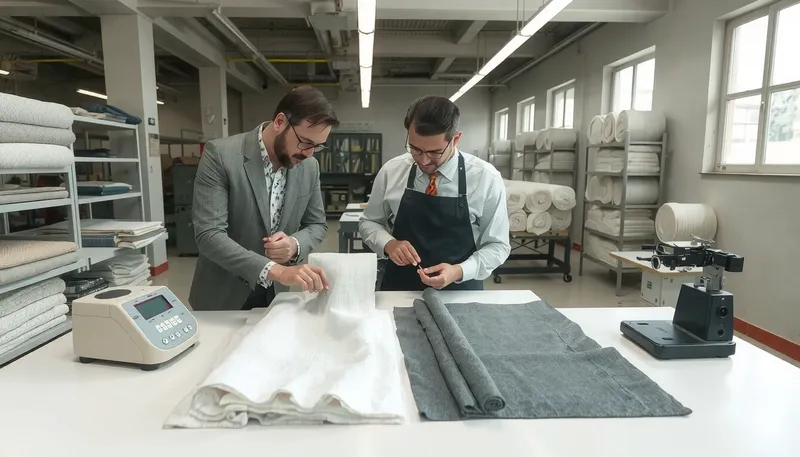
Question 3: Yarn Traceability — "What is your raw yarn supplier and lot number for this batch?"
A mill manages its yarn supply chain directly. They purchase nylon 6 or nylon 6.6 filament yarn from specific suppliers (Invista, Hyosung, Taihua) at defined specifications: 20D/24F, semi-dull, round cross-section. Each yarn shipment carries a lot number that the mill records against production batches for traceability.
A trading company rarely knows the yarn source — and if the producing mill changes between sample and bulk orders, the yarn changes with it. This is a primary cause of hand-feel and color inconsistencies between approved samples and bulk production.
Question 4: Factory Audit — "Can you provide the full factory address and business license for a third-party audit?"
A legitimate manufacturer has nothing to hide. They provide the registered factory address and business license showing "textile manufacturing" as the registered activity. They are open to third-party audits — SGS, Bureau Veritas, Intertek, or your own visiting representative.
Read the business license scope (经营范围): a real mill's registered activities include manufacturing terms — 生产/制造/加工 (production/manufacturing/processing) — not only 批发/贸易/进出口 (wholesale/trade/import-export). Cross-check the 18-digit Unified Social Credit Code and the legal Chinese company name against the official registry (gsxt.gov.cn), the supplier's marketplace profile, and the bank account you pay into. A name mismatch across any two of these is a trading-company signal.
A trading company hesitates because providing the real factory address exposes that they are not the manufacturer. Common deflection responses: "Our factory partners prefer confidentiality," "We handle quality control in-house so audits are unnecessary," or "We can send our internal audit report."
Question 5: Sales Channel — "Do you have a direct-sales website beyond marketplace platforms?"
A mill investing in long-term brand relationships maintains a direct-sales website with technical product specifications, not just an Alibaba or Made-in-China storefront. This question distinguishes between mills building direct partnerships and traders harvesting marketplace traffic.
A mill's website typically includes: detailed fabric specifications (GSM, composition, construction), technical performance data (ASTM/AATCC test results), certification documentation (OEKO-TEX, GRS), and direct contact information for engineering/technical staff — not just a generic sales@ email.
Startup-Friendly Mills: MOQ, Pricing, and D036 Platform
Startup-friendly mills offer 100-150 m at mill-direct pricing — reduced from 3,000-m minimums via shared dye-lot scheduling. The D036 platform solves print fabric curling — the top startup failure — using O3C anti-curl double-jersey at 160-250 GSM with <2% skew and <3% AATCC shrinkage. Recommended for brands needing stable print substrates. Not suitable for brushed or peached finishes.
The MOQ Shift: 3,000 Meters to 1 Roll
Traditional textile mills structure production around large dye lots because dyeing is the cost bottleneck: a production-scale dye vat holds hundreds of kilograms and runs one shade per batch. Splitting that capacity across many small orders multiplies per-meter cost — dye chemicals, heating energy, and changeover time are consumed once per batch regardless of length. Hence the traditional 3,000-meter minimum: a lot large enough to amortize that fixed setup cost.
Startup-friendly mills have addressed this through:
- Shared dye-lot scheduling: Combining 3-5 small orders into one dye cycle for compatible colors (all dark shades, all pastels)
- Laboratory-scale dyeing: Using 50-100 kg sample dye machines for orders under 500 meters
- Grey fabric inventory: Stocking undyed fabric rolls in common constructions (interlock, single jersey, air-layer) and dyeing to order
The result: MOQs of 100-150 meters (1 roll) at a 15-25% price premium over volume pricing — still lower than trader-marked pricing for larger quantities.
Before accepting a quoted 100-meter MOQ, ask for a price curve at 100/300/500/1,000 meters and confirm whether the fabric is held in the mill's own stock or dyed to order. Some suppliers advertise a 100-meter minimum but price it to discourage small orders — a practice buyers call "MOQ theater." A mill genuinely set up for small batches quotes a smooth downward price curve and can name the stock construction; a supplier quoting an inflated per-meter rate at 100 meters is signaling that its real production floor is higher.
D036 Platform: Print-Ready Fabric for Startups
The most common startup failure we observed in 2025: a brand orders low-cost single jersey knit from a trader, sends it for digital printing, and the fabric curls at the edges — causing print misregistration, wasted ink, and rejected units. The fabric is not defective; it is the wrong construction for the application.
The D036 Nylon Spandex Interlock platform is engineered specifically for print stability:
| Property | D036 Interlock (O3C) | Generic Single Jersey |
|---|---|---|
| Construction | Double Jersey Interlock, O3C anti-curl | Single Jersey, open edges |
| Weight | 160-250 GSM ±5% | 140-200 GSM ±15% |
| Skew (AATCC TM179) | <2% | 5-8% |
| Edge Curl | 0 mm (O3C structure) | 5-15 mm |
| Shrinkage (AATCC 135) | <3% | 5-10% |
| 4-Way Stretch Recovery | >85% | 60-75% |
| OEKO-TEX Certification | Class I (skin contact) | Rarely certified |
| MOQ | 100-150 m (1 roll) | Varies (trader-dependent) |
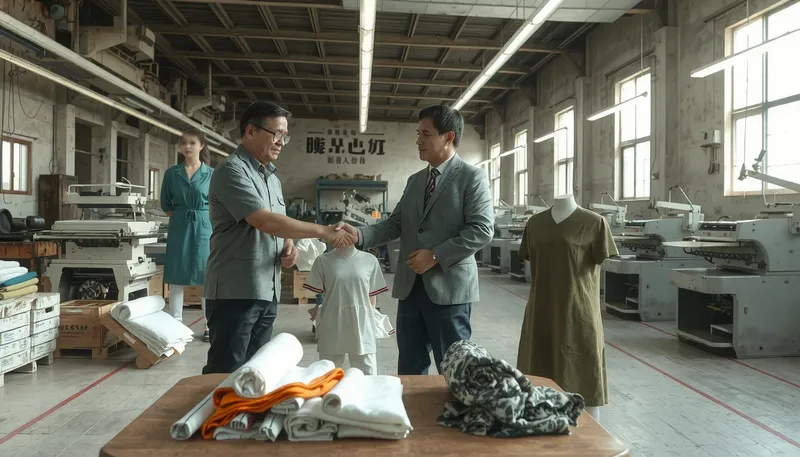
Direct vs Traded Pricing: The Cost of the Middleman
A 2025 comparison we ran across 10 common activewear fabric types, mills versus traders:
| Order Size | Mill-Direct Price (per meter) | Trader Price (per meter) | Trader Markup | Annual Savings at 2,000 m |
|---|---|---|---|---|
| 1 roll (120 m) | $3.80-4.50 | $5.50-7.00 | 30-55% | — |
| 500 m | $2.80-3.20 | $4.50-5.50 | 45-70% | $3,400-4,600 |
| 1,000 m | $2.30-2.70 | $4.00-4.80 | 55-80% | $8,500-10,500 |
| 3,000 m | $1.90-2.20 | $3.50-4.20 | 65-90% | $24,000-30,000 |
The markup percentage increases with volume because traders capture the mill's volume discount without passing it to the buyer. At 3,000 meters, the annual cost difference between mill-direct and trader pricing can exceed $25,000 — funding an entire additional product line.
Pre-Order Verification: 5-Step Audit Before Placing a Low MOQ Order
Pre-order verification confirms five items: supplier identity via 5-question protocol, sample approval per AATCC 135 under D65 lighting, written terms (price, MOQ, lead time, Incoterms), 1-roll trial for process check, and quality docs (OEKO-TEX certificate, batch reports). Recommended for first-time supplier relationships — each step addresses a distinct failure mode.
Step 1: Supplier Identity Verification
Run the 5-question vetting protocol from the previous section. A mill answers all five with technical detail within 24 hours. A trader defers on ≥3. Record the responses: if the supplier later claims to be a factory but could not answer question 2 (GSM modification), the contradiction is documented.
Do not accept "we are the factory" as evidence, and do not treat marketplace badges as verification. Alibaba Gold Supplier status and Trade Assurance protect marketing placement and payment escrow — not production ownership. A trading company can hold both while routing orders to third-party mills. Only production video, machine-level specifications, and audit access constitute verification.
Step 2: Sample Approval with Technical Testing
Request a physical swatch — not a digital photo. Test the sample for:
- Weight: Cut a 10 cm × 10 cm sample, weigh on a precision scale, multiply by 100 for GSM. Compare to specification.
- Hand-feel: Subjective but critical — compare against a reference fabric. Record surface texture (smooth, dry, waxy, soft).
- Shrinkage: Wash at 40°C per AATCC 135, measure dimensional change. Target <3%.
- Color accuracy: Evaluate under D65 daylight in a light booth. For printed fabric, verify color registration at seam lines.
A sample that passes all four tests with the producing mill's documentation builds a verifiable quality baseline. A sample that fails any test requires reformulation before proceeding.
Step 3: Written Terms Confirmation
Confirm in writing before payment:
- Price per meter: Specify currency (USD/RMB), Incoterm (FOB Shanghai, EXW Fujian), payment terms (30% deposit / 70% before shipment)
- MOQ per color: If ordering 3 colors, the MOQ applies to each color separately unless otherwise specified
- Production lead time: Calendar days from deposit receipt to EXW date — include buffer for dye lot scheduling
- Quality tolerance: GSM ±5%, width ±2 cm, shrinkage <3% per AATCC 135
A mill provides these terms in a formal proforma invoice with company stamp. A trader may provide only a chat message or email without official documentation.
Step 4: Trial Order — 1 Roll
Place a single-roll order (100-150 meters) before committing to production volumes. This trial verifies:
- The supplier can deliver the approved quality at production scale (not just lab dip)
- The logistics process (shipping, customs, delivery) functions end-to-end
- The quality consistency between this roll and the approved sample
A trial order that matches the approved sample confirms the supplier is production-capable. A trial order that differs in hand-feel, color, or GSM indicates the production mill changed between sample and bulk — a trading company signature.
Step 5: Quality Documentation Collection
Before accepting bulk delivery, request:
- Batch-level test report for your specific production lot (GSM, width, shrinkage, color fastness)
- OEKO-TEX Standard 100 certificate valid for the current year
- Yarn lot traceability record (supplier, denier, filament count, lot number)
File these documents with your production records. If a quality dispute arises 6 months later, the documentation enables root cause analysis — without it, you have no evidence of what was specified, produced, or delivered.
Frequently Asked Questions
1. What is a realistic low MOQ from a real fabric mill in China?
A startup-friendly mill offers MOQs of 100-150 meters (1 roll) for in-stock grey fabric with custom dyeing. For fully custom development (new yarn, new construction), the minimum is typically 500-800 meters to cover yarn procurement and machine setup. Traditional mills without small-order scheduling still require 2,000-3,000 meters minimum.
2. Are all trading companies unreliable?
Trading companies serve a legitimate function — aggregation of small orders across multiple mills, logistics coordination, and market access for mills that do not maintain direct sales channels. The risk for startups is not the trader's existence but the lack of transparency: if the producing mill changes between sample and bulk, quality changes with it. For brands requiring consistent quality and direct technical support, mill-direct partnership eliminates this variable.
3. Why would a trading company's price increase with larger orders?
This is a red flag indicating the trader is sourcing from multiple mills at inconsistent prices. A real mill's pricing decreases with volume because setup costs (machine changeover, dye formulation) amortize across more meters. If a supplier quotes higher per-meter prices at 1,000 meters than at 500 meters, they are likely not the manufacturer.
4. What is the biggest quality risk of using a trading company?
Inconsistency between sample and bulk. The approved sample may come from Mill A (high-quality, OEKO-TEX certified), while bulk production is routed to Mill B (lower cost, no certification) to increase the trader's margin. The resulting color shift, weight variation, or hand-feel change can render an entire production run unsellable. Mill-direct sourcing eliminates this risk because the sample and bulk are produced on the same machines by the same technicians.
5. How do I find startup-friendly mills beyond marketplace platforms?
Search for mills that publish technical content — detailed fabric specifications, test data, production process documentation, and certification records on their own websites. These mills are investing in direct brand relationships. Our fabric platform at foralltex.com/fabric provides D036 specifications, AATCC 135 and AATCC TM179 test data, and OEKO-TEX Standard 100 certification documentation — the same materials you would use to verify any mill.
6. What is MOQ theater and how do I avoid it?
MOQ theater is when a supplier advertises a low minimum (for example, 100 meters) but prices those small orders so high — or adds hidden surcharges — that the advertised MOQ is not economically real. It signals that the supplier's profitable floor is higher than the advertised number. Avoid it by requesting a price curve at 100/300/500/1,000 meters and asking whether the fabric is in the mill's own stock or made to order. A smooth, honest curve is the mark of a mill with genuine small-batch scheduling.
7. Are Alibaba Gold Supplier badges or Trade Assurance proof that a supplier is a real mill?
No. Gold Supplier status is a marketing placement, and Trade Assurance is Alibaba's payment-escrow protection — both can be held by trading companies. Neither verifies production ownership. Verify the supplier the same way you would verify any factory: production video on their own machines, a GSM modification answered with engineering detail, yarn lot traceability, a business license whose scope includes manufacturing, and third-party audit access.
8. What should a Chinese fabric supplier's business license show to confirm it is a factory?
A real mill's business license lists manufacturing terms in its registered scope — 生产/制造/加工 (production/manufacturing/processing). A trading company's scope lists only wholesale, trade, or import/export. Match the 18-digit Unified Social Credit Code and the legal Chinese company name across the official registry (gsxt.gov.cn), the supplier's marketplace profile, and the bank account you pay into. A mismatch across any two is a middleman signal.
🔗 Related Fabrics
This article explains low MOQ fabric sourcing — mill vs trading company verification, 5-question technical audit protocol, D036 O3C anti-curl platform, and AATCC 135 shrinkage <3%:
- D036 Nylon Spandex Interlock — Print-Ready Fabric Platform — O3C anti-curl structure, 160-250 GSM, AATCC TM179 skew <2%, AATCC 135 shrinkage <3%
- Custom Fabric Colors: Delta E & Dye-Lot Control Guide — CIELAB ΔE measurement, metamerism index, lab dip QC protocol
- Low MOQ Fabric Printing: Acid Digital vs Sublimation Guide — Acid digital vs sublimation, startup-friendly MOQ, D036 O3C print platform
- Import Activewear Fabric from China: Mill-Direct Guide — full import workflow: specification, 6-10 week timeline, landed cost
- How to Stop Knit Fabric From Curling: Interlock vs. Single Jersey for Production Manager — O3C anti-curl structure and the cutting-room cost decision
Contact our fabric engineering team → to request D036 print-ready samples with MOQ and lead time information for your product category, or to discuss mill-direct pricing for startup order quantities.
Written by Wenruo
Textile Engineer, Forall Lab