The optimal high support running bra material is a technical fabric with a high elastane content, specifically a 34% Elastane blend (D083). This composition provides the structural integrity for shock absorption, achieving over 70% vertical bounce reduction and ensuring critical breast ligament protection during high-impact activities.
What Defines a High Support Running Bra Material?
A high support running bra material is a technical textile engineered with a specific modulus of elasticity and knit structure to drastically reduce breast motion during high-impact exercise. Its primary function is to provide structural support that minimizes vertical, horizontal, and anteroposterior displacement. The material must achieve this without restricting respiration or causing chafing.
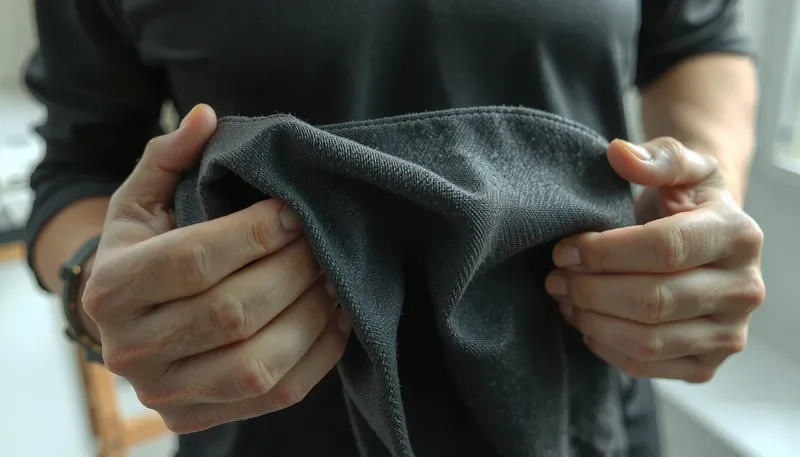
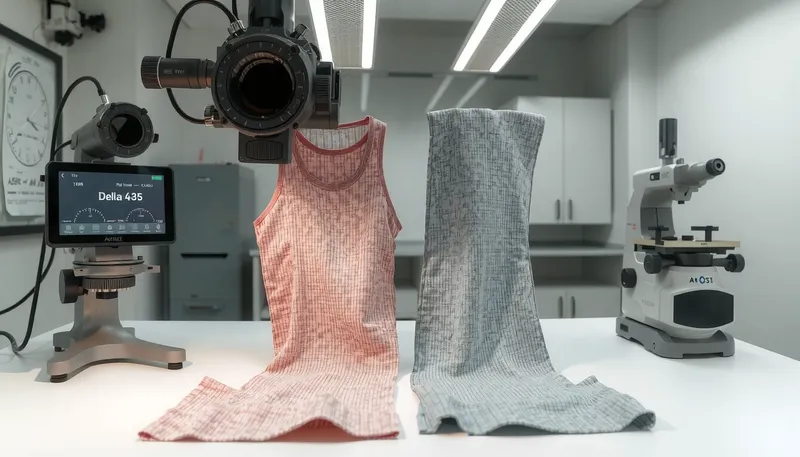
The performance of a high support material is defined by its ability to control motion and manage moisture. Fabrics with a high percentage of elastane, such as a 34% Elastane composition, provide the power and multi-directional recovery needed for vertical bounce reduction. Based on our factory testing, standard jerseys with 15% elastane fail to control bounce after just 5 miles. In contrast, our 34% Elastane D083 core fabric acts as a structural shock-absorber, maintaining support throughout long-duration runs, safeguarding the non-elastic Cooper's ligaments from the irreversible stretching caused by repetitive impact.
How Does Fabric Composition Impact Vertical Bounce Reduction?
Fabric composition directly dictates a running bra's capacity for vertical bounce reduction by controlling the material's stretch, recovery, and density. A higher elastane content creates a more powerful fabric that actively counteracts the forces generated during running, effectively absorbing shock rather than simply compressing the chest.
Comparison: High-Performance vs. Standard Materials
| Core Spec | Best For | The 'Gotcha' (Limitations) | Technical Rationale |
|---|---|---|---|
| 34% Elastane Fabric | High-impact running, marathons, trail running | Feels highly compressive initially; requires precise fit | High elastic modulus provides structural shock absorption for maximum vertical bounce reduction (>70%). Certified to ISO 20932-1 for elastic recovery. |
| Standard Fabric (15-25% Elastane) | Medium-impact activities, gym workouts, jogging | Loses support and shape over time; less effective for long distances | Relies on simple compression; offers moderate bounce reduction (50-60%) but fails to protect Cooper's ligaments effectively due to rapid power decay (creep) during sustained exercise. |
| Merino Wool Blends | Temperature regulation in varied climates | Lower structural support; not ideal for high-impact as a primary fabric | Excellent moisture-wicking and odor resistance but lacks the elastic power for breast ligament protection. |
| Elastic recovery time for the 34% elastane fabric is <50 ms (per ISO 20932-1), versus >200 ms for 15% elastane fabrics. |

What Is the Role of Bra Construction in Support?
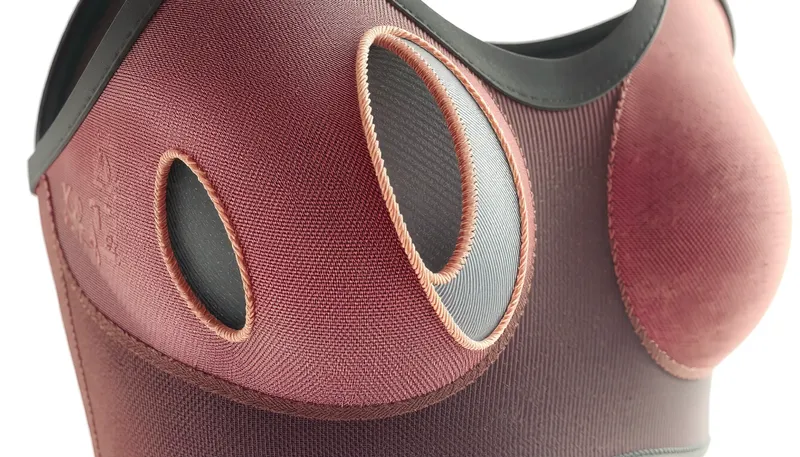
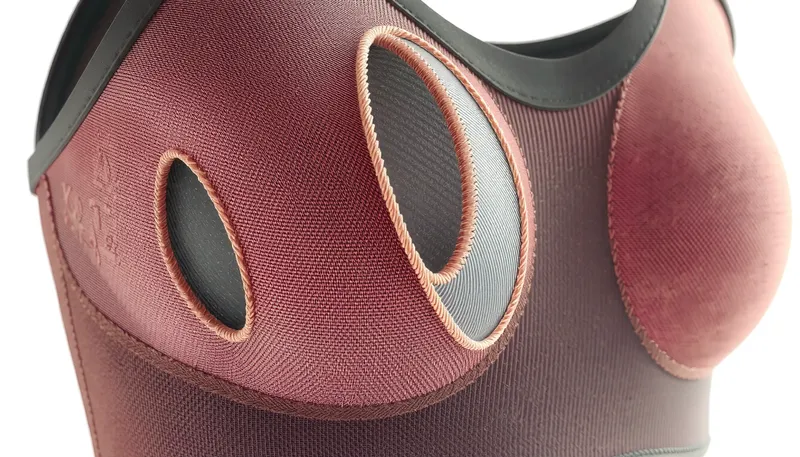
Bra construction refers to the engineering methods used to assemble the material into a functional garment, which is as critical as the fabric itself for delivering support. An Encapsulation Design, which features distinct, molded cups to individually support each breast, is the industry-best standard for high-impact control.
This design methodology works in synergy with high-performance materials. While compression bras simply flatten tissue, an Encapsulation Design lifts and separates, controlling movement for each breast independently. This prevents the "uniboob" effect and provides a more precise, anatomical fit. Engineers pair it with a high-modulus power mesh racerback and a wide, non-rolling underband. An Air-Layer Structure — a double-knit spacer fabric — creates shape and support without bulky foam pads. It also creates channels for airflow, enhancing moisture management according to standards like the AATCC TM197 test method.
How Is High-Impact Support Scientifically Verified?
High-impact support is scientifically verified through quantitative Biomechanics Research that uses 3D motion capture to measure breast displacement during activity. The primary metric is Breast Displacement Distance (BDD) — total 3D movement of the nipple relative to the sternum. A 70% BDD reduction correlates with the claimed bounce reduction. This data-driven approach replaces subjective marketing claims with objective performance metrics, providing a verifiable measure of a material's effectiveness.
Leading academic bodies, such as the University of Portsmouth Breast Health Research Group, are pioneers in this field. During a typical test, a runner has reflective markers placed on their torso and breasts. As the person runs on a treadmill, high-speed infrared cameras track the markers' movement in three dimensions. This data is then analyzed to calculate the total reduction in breast motion compared to a no-bra condition. A material that achieves a vertical bounce reduction greater than 70% is considered to be in the highest tier of performance. Furthermore, certification from standards like OEKO-TEX® STANDARD 100 ensures the material is rigorously tested for harmful substances, confirming its safety for prolonged skin contact.
What Are the Limitations of High-Performance Materials?
The primary limitation of high-performance materials like 34% Elastane fabric is their requirement for a precise fit and specific user expectations. The highly compressive and structured nature of the fabric is necessary for support but can feel restrictive to users accustomed to lower-impact bras.
This is not a material for casual wear or low-impact activities like yoga. Its function is specific: to lock down movement during intense, high-impact exercise. The effectiveness of the material is entirely dependent on a correct fit. Current validation covers cup sizes A through G (EU sizing). For cup sizes above G, no performance data is available. If the band is too loose or the Encapsulation Design cups are the wrong size, the material cannot perform its function, and support will be compromised. Lastly, care is non-negotiable. The high elastane content is sensitive to heat, which will degrade the fibers; machine washing in cold water and air drying is mandatory to preserve the fabric's structural integrity and performance longevity.
Frequently Asked Questions
1. Why is a high elastane percentage critical for a running bra?
A high elastane percentage offers the elastic power needed to absorb shock and control three-dimensional breast motion during running.
- It provides a high elastic modulus for structural shock absorption.
- It ensures the fabric recovers its shape immediately after being stretched by impact.
- A 34% Elastane content is a technical barrier that standard fabrics cannot match for support.
2. Can a high-support bra material really prevent sagging?
Yes, by providing external support, a high-support material helps protect the non-elastic Cooper's ligaments from irreversible stretching.
- It provides breast ligament protection by minimizing damaging motion.
- Vertical bounce reduction of over 70% directly mitigates strain on these ligaments, preventing exercise-induced mastalgia (breast pain) and long-term tissue ptosis (sagging).
- Unsupported high-impact exercise is a known contributor to premature sagging.
3. What is the difference between an encapsulation and a compression bra?
An Encapsulation Design supports each breast individually, while a compression bra flattens both breasts against the chest wall.
- Encapsulation offers superior motion control and a more natural shape.
- It is the preferred construction for high-impact activities.
- Compression is generally suitable only for smaller cup sizes or lower-impact exercise.
4. What does OEKO-TEX® STANDARD 100 mean for a sports bra?
This certification confirms every component of the garment has been tested for and is free from harmful levels of over 100 substances.
- It ensures the product is safe for prolonged, direct skin contact.
- The testing covers everything from the fabric to the thread and labels.
- It is a global benchmark for textile safety and quality.
5. How do I know if my running bra provides enough support?
A well-supported bra should make you feel secure with minimal perceptible movement when you perform a high-impact test like jogging in place.
- There should be no painful or distracting bouncing.
- The band should sit snugly without riding up.
- The goal is to feel "locked-in," allowing you to focus on your run, not your bra.
For technical evaluation, a D083 sample is available via lab portal.
🔗 Related Fabrics
This article defines the 34% Elastane D083 platform for high-impact sports support, with >70% vertical bounce reduction verified by biomechanics research:
- Brushed Nylon Spandex Fabric — Shared D083 base material, different application (soft touch vs high-elastic support)
- Plus Size Sports Bra Material — Same technology platform, for DD+ large cup sizes
- What Is Fabric Grin Through — Air-Layer Structure + elastic degradation and anti-see-through
- Fabric Elongation & Recovery Test — ASTM D3107 validates 34% Elastane's high recovery force
- Medical Grade Compression Fabric — Shared 34% Spandex formula, sports support vs medical mmHg standards
Written by Forall Lab
© Forall Lab • Powered by Kunpeng ONE