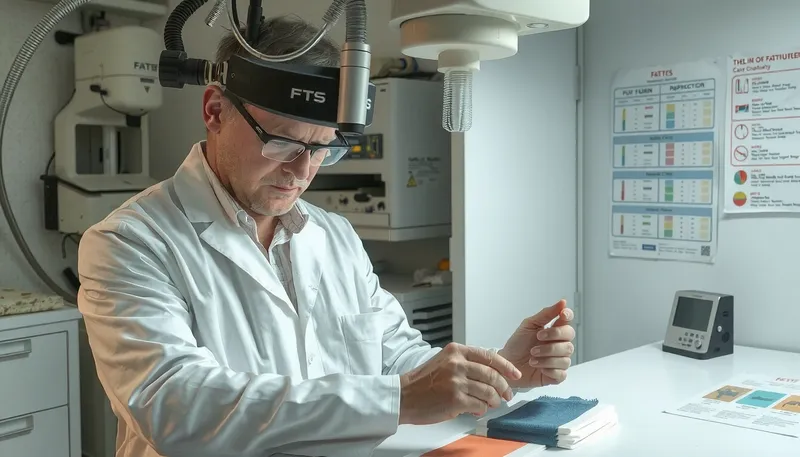
Color fastness to perspiration is the resistance of dyed fabric to colour change and dye bleeding when the fabric is held in contact with acidic and alkaline artificial sweat under heat and pressure, measured per ISO 105-E04 on the 1-5 Grey Scale, where Grade 5 is no change or staining and Grade 4 is the commercial pass for high-contact activewear. The test seals a fabric composite with a multi-fibre strip in two histidine-based solutions, holds it under 49 N pressure at 37 °C ± 2 °C for four hours, then grades colour change and staining separately. An acid-dyed nylon-spandex platform such as our D036 interlock returns Grade 4 when the dye is fixed by ionic bonding and the fabric is scoured to strip unbound surface dye; pigment prints and poorly scoured goods fall to Grade 2-3.
This guide is written the way a technical mill would brief an activewear brand or its QC team: it translates "my leggings stained my skin after a hot yoga class" into the ISO 105-E04 test procedure, the grade to put in a tech pack, and the dyeing choices that decide whether a fabric passes at Grade 4 or fails at Grade 2. At Foralltex we run the D036 nylon interlock and its Acid Print process; this guide is how we qualify that platform, and how you can qualify any mill's fabric, against real perspiration testing.
Why Perspiration Fastness Fails Differently in Activewear
Perspiration fastness fails when sweat-wet, skin-tight fabric releases dye onto the skin or onto an adjacent garment — a failure that wash fastness and crocking tests do not predict, because sweat combines specific chemistry, body heat, pressure, and occlusion that detergent or friction do not reproduce. A dark yoga top or sports bra pressed against damp skin for an hour is the worst case: the garment holds sweat against the dye site while body heat drives dye mobility.
Three factors make activewear the highest-risk category. First, contact: leggings, bras, and base layers sit directly on skin across large surface areas, so any dye bleed is visible on the wearer.
Second, colour depth: the deep blacks, navies, and saturated prints that dominate the category carry more dye at the fibre surface, and surface dye is the dye that bleeds.
Third, sweat chemistry: human perspiration is not plain water. It contains salts, urea, lactic acid, and amino acids at a pH that varies from acidic to alkaline, and it can break the dye-fibre bond that survives ordinary laundering.
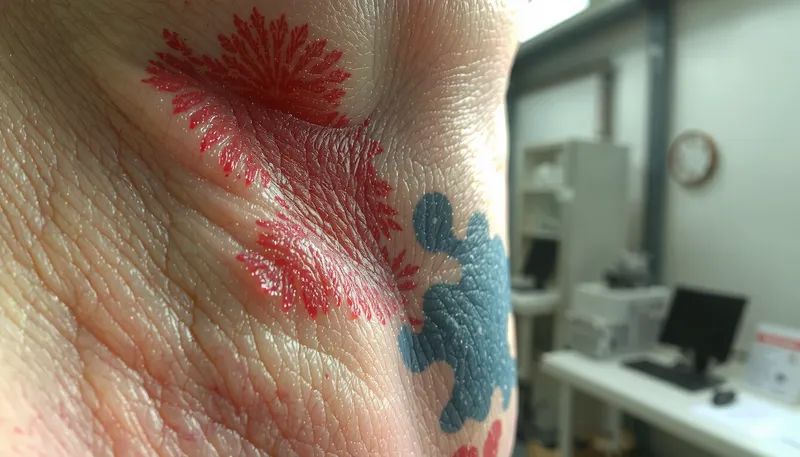
A fabric that passes wash fastness per ISO 105-C06 can still bleed under perspiration, and a fabric that resists dry crocking per AATCC 8 can still stain skin when wet. The three failure modes are distinct, and each needs its own test:
| Failure mode | Trigger | Mechanism | Test |
|---|---|---|---|
| Wash bleeding | Detergent + water + agitation | Dye dissolves and migrates to other garments | ISO 105-C06 / AATCC 61 |
| Crocking (rubbing) | Mechanical friction, dry or wet | Unbound surface dye scraped off | ISO 105-X12 / AATCC 8 |
| Perspiration bleeding | Acid/alkaline sweat + heat + pressure | Sweat chemistry mobilises dye against skin | ISO 105-E04 / AATCC 15 |
The ISO 105-E04 Test: Artificial Sweat, 49 N, 37 °C, Four Hours
ISO 105-E04 exposes a fabric specimen to two artificial perspiration solutions — one acidic and one alkaline — under a 49 N load at 37 °C ± 2 °C for four hours, then rates colour change and staining against the grey scales. The two solutions matter: human sweat pH varies by person, diet, and activity, so a textile is tested on both sides of the range.
The apparatus is small and standard: a perspirometer to hold the specimen stack under fixed pressure, an oven at body temperature, a multi-fibre adjacent fabric to catch migrated dye, and grey scales for the readout. The specimen is prepared and run in six steps:
- Composite assembly — a cut of the test fabric (40 mm × 100 mm) is placed face-to-face with a multi-fibre adjacent strip and sewn or clipped into a composite specimen.
- Wetting — one set of composites is soaked in the acidic solution at pH about 5.5, and a second set in the alkaline solution at pH about 8.0; both contain histidine.
- Loading — each wet composite is laid between acrylic plates in the perspirometer.
- Pressure and incubation — the stack is loaded to 49 N and placed in the oven at 37 °C ± 2 °C for four hours.
- Drying — composites are removed, unstitched, and dried separately so migrated dye stays where the test put it.
- Assessment — colour change of the specimen is read against the grey scale for change (ISO 105-A02), and staining of each adjacent fibre against the grey scale for staining (ISO 105-A03).
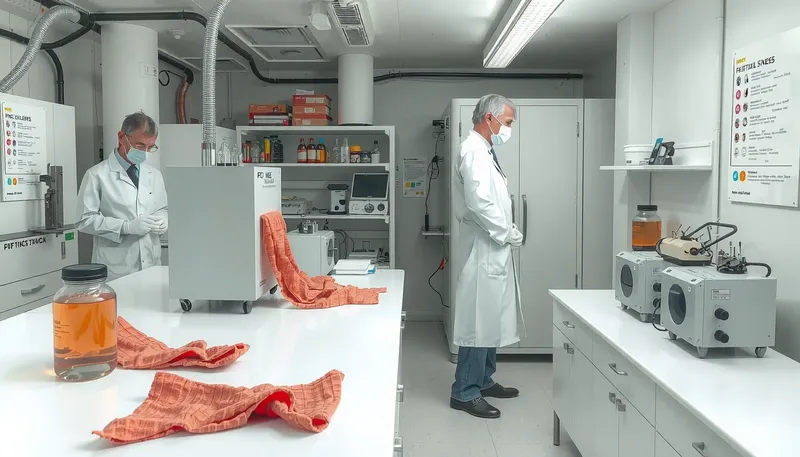
Two grades come out of every run — colour change and staining — and they are reported separately because a fabric can hold its own colour while still staining the skin or a lining. A spec that says only "Grade 4" is incomplete; it should state the minimum for each.
The 1-5 Grey Scale and the Grade Your Product Needs
Grades run from 1 to 5, with 5 as no visible change or staining and 1 as severe change; for high-contact dark activewear the commercial minimum is Grade 4 on both colour change and staining, while Grade 3 suits only light outer layers with limited skin contact.
| Grade | Colour change / staining | Commercial status for activewear |
|---|---|---|
| 5 | No visible change or staining | Premium; acceptable for every application |
| 4 | Slight change or faint staining | Commercial pass for high-contact dark activewear |
| 3 | Noticeable change or visible staining | Minimum for light, low-contact outer layers only |
| 2 | Marked change or heavy staining | Fail for apparel; returns risk |
| 1 | Severe change or staining | Complete dye-fibre bond failure |
The pass line sits between grades for a reason: the same dark yoga top that demands Grade 4 on staining (skin contact across a large area) would be over-specified for a reflective trim that never touches skin. Half grades such as 3-4 and 4-5 are commonly reported and are acceptable when the lab and the brand agree on the rounding rule. AATCC 15, the North American perspiration method, publishes a widely used benchmark of at least Grade 3.0 for staining and Grade 4.0 for colour change — a practical floor that tracks the ISO 105-E04 Grade 4 convention for premium activewear.
ISO 105-E04 vs AATCC 15 vs JIS L 0848: Choosing the Test Standard
ISO 105-E04 is the international and export-market perspiration test and is the more demanding of the two Western methods because it runs both acidic and alkaline solutions; AATCC 15 covers acid perspiration only and dominates North American retail specs; JIS L 0848 is the aligned Japanese method. For a brand selling into Europe, Asia, and North America, specifying ISO 105-E04 covers the widest common ground and is the method most China and Vietnam mills already run for export.
| Parameter | ISO 105-E04 | AATCC 15 |
|---|---|---|
| Solutions | Acid (pH ~5.5) + Alkaline (pH ~8.0) | Acid only (pH ~4.3) |
| Specimen size | 40 mm × 100 mm | 60 mm × 60 mm |
| Pressure | 49 N | 44.5 N |
| Oven | 37 °C ± 2 °C for 4 h | 38 °C ± 1 °C for 6 h |
| Adjacent fabric | Single-fibre or multi-fibre strip | Multi-fibre strip only |
| Common market | Europe, Asia, export | North America |
The practical difference is that ISO 105-E04 puts the fabric through the alkaline condition as well as the acid condition. Some dye-fibre systems fail only under alkaline sweat, so an ISO 105-E04 pass is the safer evidence for a fabric that will be worn hard across markets. JIS L 0848 tracks closely to ISO 105-E04 for buyers shipping to Japan.
Achieving Grade 4 on Nylon: Dye Chemistry and the D036 Acid Print Platform
Grade 4 on nylon is achieved at the dyeing stage, not the finishing stage: acid dye must bond into the fibre by ionic attraction, and the fabric must be scoured to strip the unbound surface dye that sweat would otherwise mobilise. Dye that sits on the fibre surface bleeds; dye that has penetrated the fibre does not.
Acid dyes carry sulfonate groups that ionise in the dyebath, and nylon carries protonated amino groups at acid pH. At the pH 4.5-5.5 and about 98 °C used in a nylon dye cycle, the two attract and form an ionic bond that holds dye inside the fibre cross-section.
The bond is not covalent — a common misreading — but it is strong enough to survive perspiration, laundering, and rubbing when the dye is properly fixed. The step that often decides the perspiration grade comes after dyeing: scouring with an anionic detergent at about 60 °C removes the fraction of dye that never bonded and would bleed under sweat.
Pigment printing is the opposite case. Pigment colour sits on the fabric surface inside a binder film, and under warm, damp, pressured contact that film does not hold colour the way a fibre-bonded dye does. On nylon, pigment prints typically return ISO 105-E04 grades of 2-3, while acid dye returns 4 or higher.
Our D036 Nylon Interlock is the substrate we qualify with this test. D036 is a 78/22 nylon/elastane interlock whose one-open-one-close double-jersey structure gives a smooth, stable printing surface at 160 g/m², and its Acid Print process is run with the post-scour step described above.
In our laboratory the D036 Acid Print process holds Grade 4 colour change and Grade 4 staining on ISO 105-E04 across dark and saturated colourways. The same platform carries OEKO-TEX Standard 100 Class I certification, so the dye chemistry that passes perspiration testing also meets the skin-contact chemical limits.
Technical limitation: acid dye works on nylon 6 and nylon 6,6, but not on polyester. PET requires disperse dye at about 130 °C under pressure, followed by reduction clearing to remove surface dye. If your product is polyester-based, specify disperse dye with reduction clearing rather than assuming an acid-print Grade 4 result carries over.
How to Specify Perspiration Fastness in a Tech Pack
A complete perspiration-fastness specification names the test standard, requires both acid and alkaline conditions, sets Grade 4 as the minimum for high-contact items, and ties the dye chemistry to the polymer so the mill quotes a process that can actually hit the grade. Write these lines into the tech pack and ask the mill to confirm them on the lab dip before bulk production:
| Specification line | Entry | Rationale |
|---|---|---|
| Test standard | ISO 105-E04 (export) / AATCC 15 (North America) | Matches the destination market |
| Test conditions | Acid + alkaline, both required | Alkaline is the limiting condition for some nylon dyeings |
| Minimum grade | Grade 4 colour change + Grade 4 staining | Below this, high-contact activewear fails in the field |
| Rating reference | Grey scales ISO 105-A02 / AATCC evaluation | Objective, not visual guesswork |
| Dye chemistry | Acid dye (nylon) / Disperse + reduction clear (PET) | Must match the polymer |
| Post-dye process | Acid scour to remove unbound surface dye | Removes the dye that sweat would mobilise |
Two verification points protect a brand before bulk. First, require a third-party ISO 105-E04 report per colourway from an ISO 17025-accredited lab — mill self-certification is not the same evidence.
Second, run a low-cost in-house screen on every lab dip: dampen a small area, press a white cotton swatch over it with a warm iron, and look for transfer. The iron test is not a substitute for the standard — it cannot apply the alkaline solution or the 49 N load — but clearly visible transfer almost always predicts a failing ISO 105-E04 grade, so it earns its place as a first-pass filter before you pay for the full test.
Request D036 Acid Print samples → with ISO 105-E04 test reports and dye chemistry documentation.
FAQ: Color Fastness to Perspiration
What is the difference between ISO 105-E04 and AATCC 15 tests?
Both test colour fastness to perspiration. ISO 105-E04 is the international method used across Europe, Asia, and export markets; AATCC 15 is the North American method. ISO 105-E04 tests the fabric against both acidic and alkaline artificial sweat, while AATCC 15 tests acid perspiration only. ISO 105-E04 runs at 37 °C ± 2 °C for four hours under 49 N, against AATCC 15's 38 °C ± 1 °C for six hours under 44.5 N. Because it covers the alkaline condition, ISO 105-E04 is the more demanding pass for nylon activewear.
Is Grade 3 a pass or a fail for color fastness to perspiration?
It depends on where the fabric sits. For a dark, high-contact garment such as a yoga top, bra, or legging, Grade 3 on staining is a fail — most premium activewear brands specify Grade 4. For a light outer layer with limited skin contact, Grade 3 can be acceptable. As a benchmark, AATCC 15 treats at least Grade 3.0 for staining and Grade 4.0 for colour change as the practical pass line.
Does the dye color affect the test result?
Yes. Saturated shades carry more dye at the fibre surface, and some dye classes are harder to fix than others. Vibrant reds and royal blues are the traditional problem colours on nylon, and deep blacks and navies sit close behind, because there is simply more dye present that can bleed. Light pastels carry less dye and pass more easily. A dark colourway that passes Grade 4 is stronger evidence of process control than a pastel that passes the same grade.
Can a fabric have good wash fastness but poor perspiration fastness?
Yes. The two tests stress the dye differently: wash fastness (ISO 105-C06) uses detergent, water, and mechanical agitation, while perspiration fastness (ISO 105-E04) uses acid and alkaline sweat chemistry under body heat and pressure. A dye-fibre bond can survive laundering and still release under one of the two perspiration solutions. Specify both tests, and add crocking (ISO 105-X12 / AATCC 8) for the friction case.
How can I quickly check a sample in-house before sending it to a lab?
Run a damp-transfer screen: dampen a small area of the fabric, place a piece of white cotton cloth over it, and press with a warm iron for a few seconds. Visible colour transfer onto the white cloth is a warning that the fabric will likely fail a formal ISO 105-E04 test. The check is only a first-pass filter — it does not apply the alkaline solution or the standard's pressure and temperature profile, so a clean iron test still needs a lab report before you commit to bulk.
What grade should I specify for perspiration fastness in an activewear tech pack?
Specify ISO 105-E04 with both acid and alkaline conditions, a minimum of Grade 4 for colour change and Grade 4 for staining on high-contact dark items, and Grade 3-4 for light, low-contact layers. For North American retail, add AATCC 15 at the same Grade 4 target. Require the test report per colourway from an ISO 17025-accredited lab on the lab dip and again on production batches.
Does ISO 105-E04 apply to polyester, or only to nylon?
The test method applies to all textile fibres — ISO 105-E04 makes no polymer restriction. What changes with the fibre is the dyeing route needed to reach Grade 4. Nylon uses acid dye fixed by ionic bonding; polyester uses disperse dye at about 130 °C under pressure followed by reduction clearing; cellulosic fibres use reactive dye. Specify the dye chemistry that matches your polymer or the perspiration grade will not follow.
🔗 Related Fabrics
This article explains ISO 105-E04 color fastness to perspiration — the acid/alkaline artificial-sweat test, Grey Scale grading, and how D036 Acid Print holds Grade 4 on nylon, completing the color fastness family alongside wash, light, and crocking:
- Fabric Color Fastness to Rubbing: Crocking Test Guide — AATCC 8 dry/wet crocking, the friction-transfer sibling to perspiration
- Color Fastness to Washing: ISO 105-C06 Test & Acid Fix — Laundering fastness, the wash-transfer sibling
- ISO 105-B02 Color Fastness to Artificial Light: 2026 Guide — Light fading, the retail-display sibling
- Back to Index
Written by Wenruo
Textile Engineer, Forall Lab