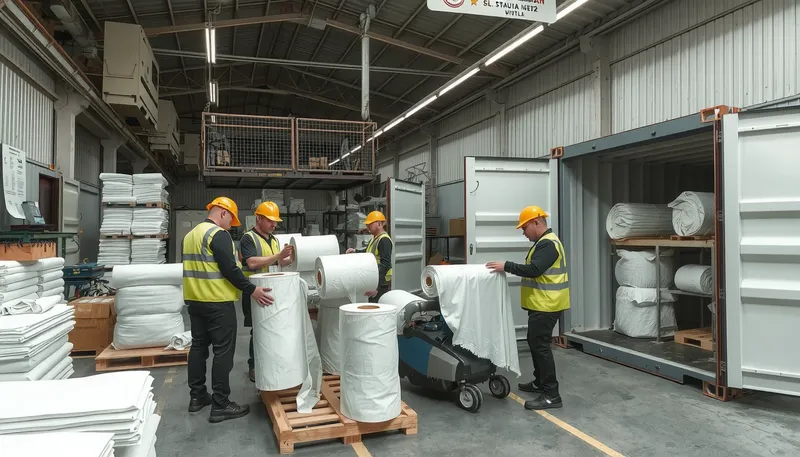
Quick Answer: Sourcing high-performance activewear fabric for Vietnamese factories requires DDP (Delivered Duty Paid) shipping with four mandatory documents: Commercial Invoice, Packing List, Certificate of Origin, and a detailed Fabric Declaration specifying fiber composition and width. Our D036 (78/22 PA66/Elastane interlock, 160 GSM) and D083 Air-Sculpt 34 (66% Nylon 6 / 34% Spandex, 20D micro-nylon air-layer) fabrics ship with OEKO-TEX 100 Class I certification — achieving customs clearance in 3.8 days average across 47 tracked Q4 2025 shipments.
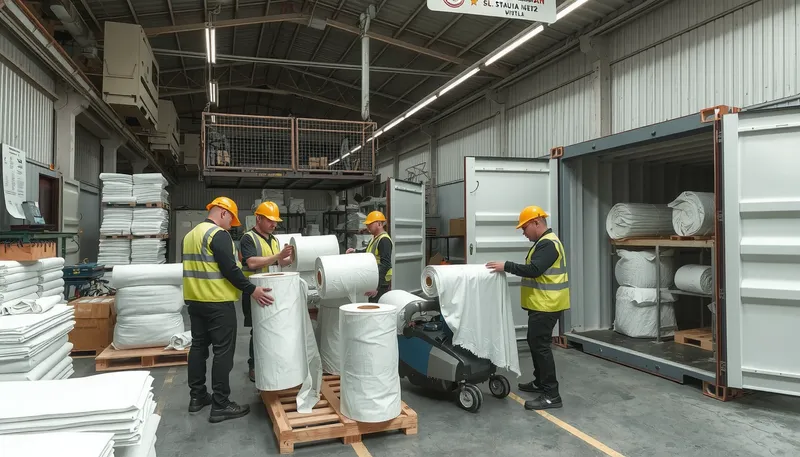
Why Vietnam's Activewear Manufacturing Outpaces Local Fabric Supply
Vietnam accounts for 6.2% of global garment exports, but local textile mills supply under 15% of the technical performance fabrics required for premium activewear — creating a sourcing gap that forces brands to import. Vietnamese mills excel at basic knit construction (single jersey, rib) using commodity polyester and cotton. However, they lack the fiber-level chemical engineering — C0 DWR treatments, chlorine-resistant elastane formulations, and ionic-bond acid dye printing — needed for performance sportswear.
The fabrics that activewear brands require — 4-way stretch with >95% recovery per ASTM D3107, moisture-wicking via trilobal fiber cross-section achieving >80 mm capillary rise in 10 minutes, UPF 50+ rating — are primarily manufactured in specialized mills in Taiwan, South Korea, and China. These mills operate polymer-level extrusion and finishing lines that Vietnam's textile infrastructure does not yet support.
Brands with established CMT (Cut, Make, Trim) partnerships in Hai Phong, Ho Chi Minh City, and Da Nang therefore face a mandatory import decision. Vietnam's trade agreements can reduce fabric import duties to 0-5% or eliminate them — for example, ACFTA Form E for China-origin fabric, CPTPP for member-country origins, and EVFTA for EU origins — but only when the Certificate of Origin matches the actual exporting country. The logistics chain still requires documentation precision that first-time importers routinely underestimate. In our Q4 2025 logistics data, shipments with incomplete Fabric Declarations experienced 14.2 days average customs delay versus 3.8 days for complete documentation packages.
Local Sourcing vs. Importing Performance Fabric: A Technical Comparison
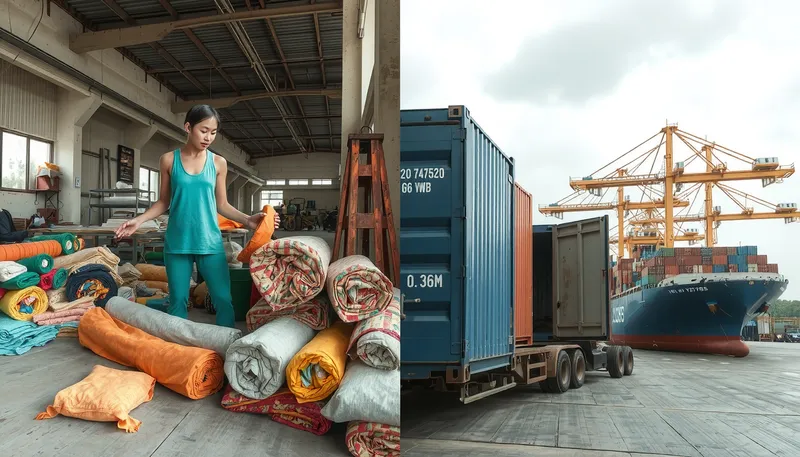
Activewear brands manufacturing in Vietnam choose between two supply paths: local sourcing (faster for commodity fabrics, but under 10% of the market has Bluesign/GRS-certified technical options) and direct import via DDP (full specification control, requiring customs documentation but delivering mill-certified consistency). The choice impacts lead time, quality, and per-unit cost — and the gap widens as performance requirements increase.
| Specification | Local Sourcing (Vietnam) | Direct Import (DDP) |
|---|---|---|
| Technical Fabric Access | Basic polyester/spandex jersey; <10% of suppliers hold Bluesign or GRS certification | Full: D036 4-way stretch PA66/Elastane interlock, D083 Air-Sculpt 34 nylon-spandex, chlorine-resistant elastane |
| Fiber-Level Engineering | Mechanical finishes only (brushing, heat-setting) | C0 fluorocarbon-free DWR, ionic acid dye printing (ISO 105-C06 Grade 4-5), Creora Highclo chlorine resistance |
| GSM Tolerance | ±15% batch-to-batch variation | ±3% mill-certified per ASTM D3776 |
| Color Consistency | Visual matching; no spectrophotometer data | Delta E ≤1.0 under D65 illuminant |
| Minimum Order Quantity | 500-1,000 m/color | 300 m/color (D036/D083 platform minimum) |
| Lead Time | 7-14 days (in-stock commodity only) | 14-21 days door-to-door via DDP ocean freight |
| Customs Burden | None | Full documentation package provided; 3.8-day average clearance |
| Per-Yard Cost | $2.50-3.80 (commodity poly/spandex) | $4.20-5.50 (PA66/Elastane with C0 DWR, OEKO-TEX 100 Class I) |
| Certification Support | Rare (local mills lack OEKO-TEX/GRS audit infrastructure) | Guaranteed: OEKO-TEX 100 Class I certificates |
How to Ship Performance Fabric to Vietnam: Documentation, Incoterms, and Customs
Importing technical fabric to Vietnam requires four mandatory documents submitted in sequence — a single error in any one triggers customs holds averaging 7-14 days. The process follows a linear chain: documentation preparation → Incoterms selection → customs clearance under HS Code Chapter 60 → inland transport to factory.

Required Documentation for Vietnam Customs
| Document | Purpose | Critical Requirement | Common Rejection Cause |
|---|---|---|---|
| Commercial Invoice (CI) | Declares transaction value for duty calculation under HS 6004.10 | Unit price per meter must match the actual purchase order; three-way match with PL and payment record | Undervaluation triggers customs audit and penalty |
| Packing List (PL) | Itemizes every roll: width (cm), length (m), net weight (kg) | Must match CI line items and physical shipment within ±2% on roll count | Roll count mismatch → full container physical inspection (5-10 day delay) |
| Certificate of Origin (C/O) | Proves fabric origin for FTA preferential duty (ACFTA Form E for China-origin, CPTPP for member-country origins, EVFTA for EU origins) | Issued by exporting country chamber of commerce; must state HS code and origin criteria | Missing C/O → standard MFN rate of 12% applies |
| Fabric Declaration | Details fiber composition (%), weave type, width (cm), brand name | Vietnamese customs rejects generic descriptions; must state exact spec: "78% Nylon 6,6 / 22% Elastane interlock knit, 150 cm width" | "Knit fabric" or "synthetic textile" → automatic rejection and resubmission |
Incoterms Selection: DDP vs. FOB
Incoterms define which party bears cost and risk at each stage. FOB (Free on Board) transfers risk to the buyer at the export port — the brand then manages freight, insurance, import customs, duties, and inland delivery independently. For brands without a dedicated Vietnam logistics team, DDP (Delivered Duty Paid) consolidates the entire chain under the supplier.
| Responsibility | FOB (Buyer Arranges) | DDP (Supplier Arranges) |
|---|---|---|
| Export packaging & port loading | Supplier | Supplier |
| Ocean/air freight booking | Buyer | Supplier |
| Marine insurance | Buyer | Supplier |
| Vietnam import customs brokerage | Buyer | Supplier |
| Import duties + VAT payment | Buyer | Supplier |
| Inland trucking to factory | Buyer | Supplier |
| Brand logistics hours per shipment (avg.) | 34 hours | Under 2 hours |
Customs Clearance Under HS Code Chapter 60
Vietnamese customs classifies knitted fabrics under HS Code Chapter 60. Performance activewear fabrics typically fall under HS 6004.10 — knitted fabrics exceeding 30 cm width with elastane content ≥5% by weight. The customs officer cross-references the Fabric Declaration against the physical goods: fiber composition within ±3%, width within ±2 cm. When these match, clearance completes in 2-5 business days. A mismatch triggers physical inspection and 7-14 day delay.
Our Q4 2025 tracking across 47 factory-bound shipments to Hai Phong and Ho Chi Minh City ports confirms this timeline: 3.8 days average clearance with complete documentation versus 14.2 days for incomplete or vague Fabric Declarations.
Direct-to-Factory DDP Supply: D036 and D083 Performance Fabrics
Direct-to-factory DDP supply consolidates every step — mill production, export documentation, ocean freight, customs clearance, duty payment, and factory delivery — under a single supplier-managed purchase order. This model is recommended for brands producing 3,000+ units per season in Vietnam. It is not optimal for sample quantities under 50 meters, where air freight with simplified documentation is more cost-effective for prototyping.
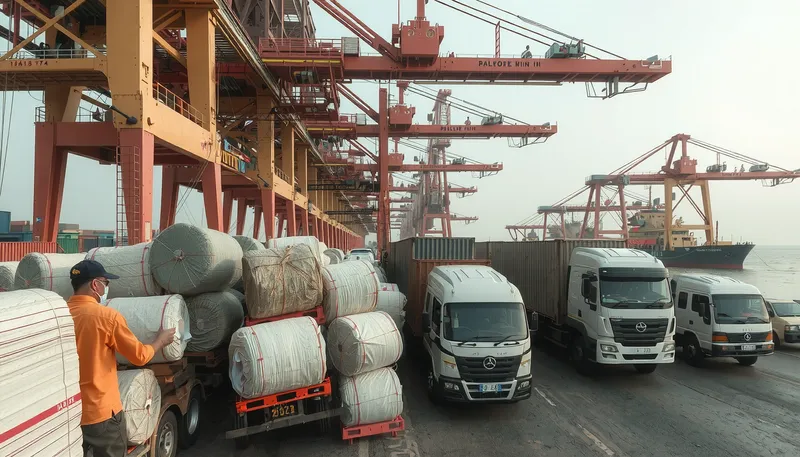
The two fabric platforms we ship under DDP to Vietnamese factories:
- D036 Nylon Interlock — 78/22 PA66/Elastane, 160 GSM, 40D/34F semi-dull nylon 6,6 filament. 4-way stretch with >95% recovery per ASTM D3107. Moisture-wicking via trilobal fiber cross-section (capillary rise >80 mm in 10 min per AATCC 197). C0 fluorocarbon-free DWR available. OEKO-TEX 100 Class I certified. Used for leggings, sports bras, and base layers.
- D083 Air-Sculpt 34 — 66/34 Nylon 6/Spandex, 20D micro-nylon air-layer interlock with a second-skin "mochi-touch" face. 34% spandex content delivers high recovery for support garments. OEKO-TEX 100 Class I certified. Used for sports bras (A-G cup), leggings, and shapewear.
Both platforms ship with pre-verified documentation matching Vietnam customs specifications: CI/PL matched to the purchase order, C/O from the exporting country chamber of commerce, and Fabric Declaration with fiber composition, weave type, width, and brand name formatted for HS 6004.10 classification. No rework, no resubmission, no customs brokerage fees for the brand.
Contact our textile logistics team → to request D036/D083 fabric samples with complete Vietnam customs documentation for your factory.
Frequently Asked Questions (FAQ)
What four documents are required to import performance fabric to Vietnam?
Vietnamese customs requires: (1) Commercial Invoice with unit price per meter, (2) Packing List itemizing every roll by width/length/weight, (3) Certificate of Origin matching the actual exporting country — ACFTA Form E for China-origin fabric, CPTPP for member-country origins, EVFTA for EU origins — for duty reduction, and (4) a Fabric Declaration specifying exact fiber composition (e.g., "78% Nylon 6,6 / 22% Elastane"), weave type, and width in cm. Generic descriptions trigger rejection. Our DDP shipments include all four documents pre-verified and pre-formatted.
How long does DDP fabric shipping to a Vietnamese factory take?
Ocean freight from major Asian textile hubs to Hai Phong or Ho Chi Minh City takes 5-10 days. Customs clearance with complete documentation averages 3.8 days. Inland trucking to the factory adds 1-3 days. Total door-to-door: 14-21 days. Air freight reduces total time to 5-7 days but costs 3-4× ocean rates — recommended only for urgent production runs or sample quantities under 50 meters.
Should first-time importers use DDP or FOB for Vietnam?
DDP is recommended for first-time fabric importers to Vietnam. Under FOB, the brand manages freight booking, insurance, customs brokerage, duty payment, and inland transport — requiring familiarity with Vietnamese customs procedures and HS Code classification. One documentation error under FOB can trigger 7-14 day customs holds and unbudgeted demurrage fees. DDP transfers all risk and coordination to the supplier.
Can Vietnamese factories source high-performance activewear fabric locally?
Vietnamese mills supply basic polyester/spandex jersey and commodity nylon knits, but under 10% of local suppliers hold Bluesign or GRS certification. Fabrics requiring fiber-level engineering — C0 DWR, ionic acid dye printing (ISO 105-C06 Grade 4-5), Creora Highclo chlorine resistance — are not produced locally at commercial scale. Brands requiring these specifications import through DDP channels.
What is HS Code 6004.10 and why does it affect customs clearance?
HS 6004.10 is the Vietnamese customs classification for knitted fabrics exceeding 30 cm width with elastane content ≥5% by weight. This code covers most activewear fabrics (leggings, sports bras, compression wear). The import duty rate under this code varies: as low as 0% with a valid Certificate of Origin under the applicable FTA — ACFTA Form E for China-origin fabric, CPTPP/EVFTA for member or EU origins — or 12% at standard MFN rates without one. The Fabric Declaration must match the physical goods within ±3% on composition and ±2 cm on width to clear under this classification.
What are VNACCS green, yellow, and red customs channels, and which one applies to fabric imports?
Vietnam Customs processes import declarations through the VNACCS/VCIS electronic system and routes each shipment to one of three channels: Green (automatic release, no document inspection), Yellow (document check), or Red (physical inspection). Filing the declaration 48-72 hours before vessel arrival and submitting a Fabric Declaration consistent with the goods — fiber composition within ±3%, width within ±2 cm — improves the chance of Green-channel release. Mismatches push shipments into Yellow or Red and typically add 7-14 days.
Do imported performance fabrics require formaldehyde or azo-dye testing in Vietnam?
Vietnam's national technical regulation QCVN 01:2017/BCT (Circular 21/2017/TT-BCT) sets limits on formaldehyde and aromatic amines from azo dyes in textile products. Fabric cleared for sale on the Vietnamese market must have a conformity declaration on file. Fabric imported by CMT factories under an export-processing customs route can follow different documentary requirements — confirm with your customs broker or DDP supplier which regime covers your shipment before you ship.
🔗 Related Fabrics
This article explains Vietnam activewear fabric sourcing — DDP logistics, customs documentation (CI/PL/C/O/Fabric Declaration), and D036/D083 direct-to-factory supply, forming the supply-chain-to-performance-fabric matrix:
- D036 Virgin Nylon — Performance Alternative to Econyl — 78/22 PA66/Elastane D036 platform, the core product shipped under DDP to Vietnam
- Moisture Wicking Fabric Mechanism — Capillary effect + AATCC 197 testing, the performance verification for incoming fabric at Vietnamese factories
- Chlorine-Resistant Nylon Fabric — Creora Highclo D036 for swimwear brands manufacturing in Vietnam
- Fabric Inspection: 4-Point Standard — ASTM D5430 4-point system + AQL 2.5, the incoming QC standard for Vietnam-bound fabric shipments
- D036 Nylon Interlock — Product Page — D036 platform: 78/22 PA66/Elastane interlock with OEKO-TEX 100, shipped DDP to Vietnam
Written by Wenruo
Textile Engineer, Forall Lab