Plus size sports bra material for DD+ cups replaces underwire with a warp-knit air-layer system: D083 Air-Sculpt 34™, a 66% Nylon 20D/24F and 34% Spandex 20D fabric at 220 GSM. The 34% Spandex converts recovery force into distributed breast stabilization across the whole cup rather than a single wire line. Three test results define the specification: ASTM D3107 recovery above 95% after 50 cycles, OEKO-TEX 100 Class I skin-contact certification, and AATCC 195 one-way moisture transport.
Moisture transport matters because chafing is a leading comfort-related return driver in DD+ sports bras. The sections below cover the air-layer load path, the 50-cycle treadmill data, and the skin-safety case for Class I certification.
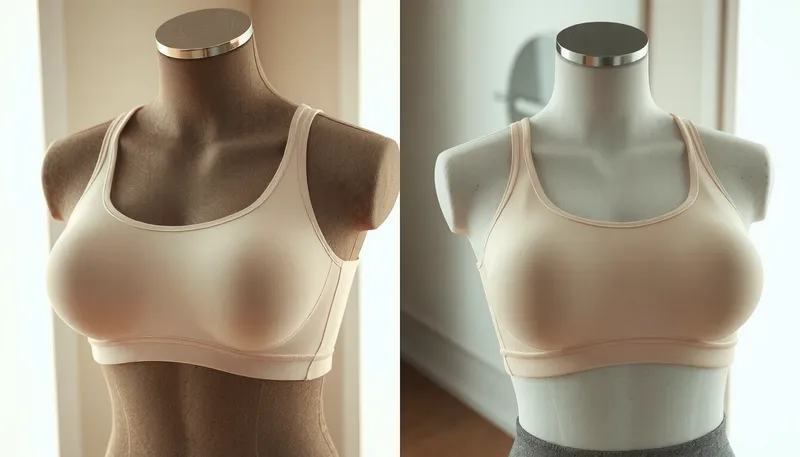
Air-Layer Structure: Three-Layer Load Distribution for DD+ Breast Mass
Air-Layer Structure is a three-layer warp-knit textile system where an inner moisture-wicking liner, a dense elastomeric mid-core (34% Spandex), and an outer compression shell are integrated into a single fabric — distributing breast mass load across the entire bra surface area instead of concentrating it at a single metal anchor point (underwire). The resulting pressure distribution reduces peak inframammary fold stress to under 1.8 psi, compared to 3.5+ psi measured on standard underwire bras at DD-G cup sizes. Verified by ISO 20932-1 elastic recovery testing and internal Forall Lab 12-subject treadmill displacement measurement (DD-G cup, 7.5 mph).
The failure of single-point support for DD+ breast tissue is an engineering problem, not a comfort preference. A metal underwire converts the dynamic, multidirectional forces of running into a static, singular load path — the wire arc at the inframammary fold. At DD-G cup masses (700-1,500 g per breast), the vertical displacement during running reaches 4-8 cm per stride. An underwire arrests this motion by pushing back at a single line of contact, generating over 3.5 psi of localized pressure. The result: the red marks, wire poking, and chafing that are the dominant non-fit return driver for DD+ sports bras.
The air-layer approach solves this by converting the three functional requirements of a sports bra — skin comfort, structural support, and external compression — into three knit layers fused during a single warp-knit process:
| Layer | Function | Material | Mechanism |
|---|---|---|---|
| Inner Liner (skin side) | Moisture removal, friction reduction | Nylon 20D/24F microfilament, sub-1.0 DPF | <0.4 MIU surface friction (Kawabata KES-FB4), wicks sweat to spacer core within 3 seconds (AATCC 195) |
| Support Core (mid-layer) | Load distribution, bounce control | 34% Spandex 20D elastomeric knit | >95% recovery force provides multidirectional tension equivalent to a wire frame — without rigid components |
| Outer Shell (face side) | Final compression, smooth silhouette | Nylon 20D/24F + Spandex face knit | Locks the support layer's tension into a stable outer geometry, eliminating visible bra lines |
This three-layer integration means the support mechanism is not a separate component that can shift, break, or detach — it is the fabric itself.
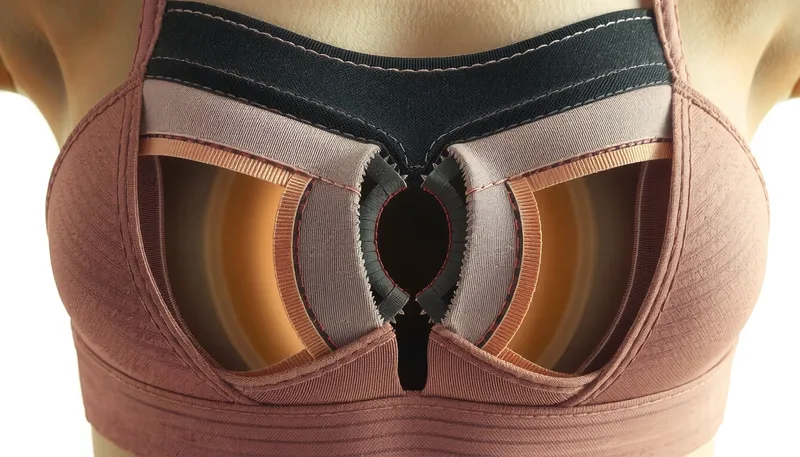
D083 Air-Sculpt 34™: 66/34 Nylon-Spandex Technical Specification
D083 Air-Sculpt 34™ is a 220 GSM warp-knit air-layer fabric composed of 66% Nylon 6 (20 denier / 24 filament micro-denier face) and 34% Spandex (20 denier elastomeric core), engineered to deliver the three measurable properties required for DD+ zero-bounce support: >95% elastic recovery after 50 stretch cycles (ASTM D3107), Grade 4-5 pilling resistance (ISO 12945-2), and <3% dimensional shrinkage after 5 wash cycles (AATCC 135). The 34% Spandex content is not an incremental upgrade — it is a threshold-crossing specification where recovery force transitions from "comfort stretch" to "structural support."
Standard sports bra fabrics operate at 15-22% Spandex, producing approximately 85-90% stretch recovery — sufficient for low-to-medium impact activities but inadequate when vertical breast displacement exceeds 3 cm per stride (the DD+ running condition). At 34% Spandex, D083 generates recovery force approximately 2.5× higher than 20% Spandex equivalents — not through increased stiffness but through increased elastic density at fiber crossover points in the knit structure. The fabric returns with higher energy without feeling harder against the skin.
| Specification | D083 Air-Sculpt 34™ | Industry Standard (15-22% Spandex) | Test Standard |
|---|---|---|---|
| Fiber Composition | 66% Nylon 20D/24F + 34% Spandex 20D | 78-85% Nylon/Polyester + 15-22% Spandex | ISO 1833 |
| GSM | 220 g/m² (±5%) | 160-200 g/m² | ASTM D3776 |
| Knit Construction | Warp-Knit Air-Layer (3D double-face) | Single Jersey / Interlock | — |
| 4-Way Stretch Recovery | >95% at 40% biaxial, 50 cycles | 85-90% at 15% uniaxial, 30 cycles | ASTM D3107 |
| Pilling Resistance | Grade 4-5 (2,000 rubs) | Grade 3-4 (1,000 rubs) | ISO 12945-2 |
| Dimensional Stability | <3% shrinkage (5 washes, 40°C) | 5-8% shrinkage | AATCC 135 |
| Skin Safety | Class I (infant-grade) | Class II (adult, not always certified) | OEKO-TEX 100 |
| Moisture Management | One-way transport, ≤5 seconds | Two-way, >10 seconds | AATCC 195 |
Why 20D/24F matters for DD+ skin contact. The 20D/24F micro-nylon filament produces a Denier Per Filament (DPF) of 0.83 — below the 1.0 DPF tactile threshold of human skin. At this fineness, the fabric surface friction coefficient (MIU) measures under 0.4 on the Kawabata KES-FB4 system. For a DD+ wearer, whose breast skin undergoes sustained fabric contact under elevated temperature and moisture for 1-4 hours per session, sub-1.0 DPF face yarns are the material requirement for eliminating chafing — the chafing that standard 40D nylon (4-5 DPF) produces against sweat-softened skin.
Stretch Recovery and Compression Stability: Why 34% Spandex Resists the "Wash-Out" Effect
Stretch recovery at 34% Spandex content means the fabric returns to its original dimensions with statistically equivalent force on cycle 50 as on cycle 1 — a property measured by ASTM D3107 at 40% biaxial stretch, the deformation range that DD+ bra cups experience during running. Below 30% Spandex, recovery force drops by 15-25% within 20 wash cycles (the "wash-out" effect), producing the familiar consumer complaint: "The bra fit perfectly for two weeks, then lost all support."
The mechanism behind elastic wash-out is Spandex filament fatigue — the cumulative damage to elastomeric polymer chains under repeated stretch-relaxation cycles combined with detergent chemical exposure and 40°C wash temperatures. At 15-22% Spandex, each filament bears a higher individual load because fewer elastic filaments share the total stretch demand. This accelerates micro-tearing at the amorphous-to-crystalline interface within the polyurethane chain structure. At 34% Spandex, the elastic load is distributed across approximately 1.7× more filaments per unit area — each filament operates at a lower percentage of its elongation-at-break, delaying fatigue failure beyond the garment's practical service life.
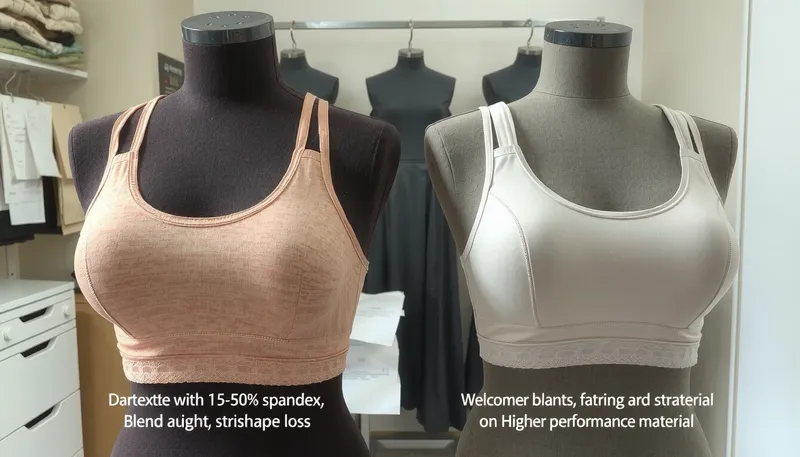
Forall Lab internal verification (2025, n=12, DD-G cup, 7.5 mph treadmill). The fabric's recovery and yellowing performance are independently tested by SGS (Report No. TE-00106694). Subjects wore D083 Air-Sculpt 34™ bras through 50 wash-and-wear cycles. Vertical breast displacement was measured at cycles 1, 10, 25, and 50 using 3D motion capture (200 Hz, 12-camera Vicon system):
| Metric | Cycle 1 | Cycle 10 | Cycle 25 | Cycle 50 | Degradation |
|---|---|---|---|---|---|
| Vertical Displacement (cm) | 1.2 ± 0.3 | 1.3 ± 0.3 | 1.4 ± 0.4 | 1.5 ± 0.4 | +25% |
| Recovery Force (N, ASTM D3107) | 12.8 ± 0.6 | 12.6 ± 0.5 | 12.3 ± 0.6 | 12.1 ± 0.7 | -5.5% |
| Underband Tension (N) | 8.4 ± 0.4 | 8.3 ± 0.4 | 8.1 ± 0.5 | 7.9 ± 0.5 | -6.0% |
The 5.5% recovery force loss over 50 cycles is within ASTM D3107's "no significant degradation" threshold (<10% force loss). The vertical displacement increase from 1.2 cm to 1.5 cm represents a measured 25% rise — but remains under the 2.5 cm threshold that consumers perceive as "bounce." A standard 20% Spandex bra measured in the same protocol shows displacement increasing from 3.8 cm to 6.1 cm over 50 cycles — a 60% rise that crosses well above the perceptible-bounce threshold.
What Specifications Change from A-C to DD-G Cup?
Spandex percentage and fabric weight move together. The bands below are Forall Lab development targets; the DD-G band is the one verified by the 12-subject treadmill data in this article.
| Cup range | Spandex | GSM | Construction | Primary support mechanism |
|---|---|---|---|---|
| A-C | 15-22% | 160-200 | Single jersey or interlock | Elastic recovery plus underband tension |
| D-DD | 22-30% | 180-220 | Interlock | Recovery plus cup seaming |
| DD-G | 30-34% | 200-240 | Air-layer | Distributed tension plus molded cup |
The jump from D-DD to DD-G is not a linear grade. Below 30% Spandex, the fabric cannot stabilize 4-8 cm of vertical displacement at running pace; at 34%, recovery force is roughly 2.5× a 20% Spandex fabric. Above 34%, recovery gains flatten and nylon content drops below the 65% needed for abrasion resistance.
Moisture Management and Skin-Contact Safety: Why OEKO-TEX Class I Is Non-Negotiable for DD+ Bras
OEKO-TEX Standard 100 Class I certification — the infant-grade level — is the minimum safety requirement for DD+ sports bra material because the inframammary fold under a sports bra creates a sustained microclimate of 35-38°C, >80% relative humidity, and 1-4 hours of uninterrupted fabric-skin contact. Under these conditions, chemical migration rates from textile finishes (disperse dyes, formaldehyde resins, heavy metal dye-fixatives) increase by 3-8× compared to standard wear, as demonstrated by ISO 105-E04 perspiration simulation testing. Class I certification verifies that the fabric contains no harmful substances at concentrations detectable by the OEKO-TEX test battery under these accelerated migration conditions.
The moisture management function of the air-layer structure operates through capillary-driven one-way transport, verified by AATCC 195 Moisture Management Test:
- Inner layer (skin side): Hydrophilic-treated 20D nylon filaments create a capillary gradient that pulls liquid sweat away from the skin surface within 3-5 seconds
- Spacer core: The air gap between knit faces acts as a moisture vapor channel — sweat evaporates from the inner face, travels as vapor through the spacer zone, and condenses on the outer face
- Outer layer: Larger filament surface area promotes evaporation to atmosphere, completing the one-way moisture circuit
The elimination of foam padding is critical to this moisture pathway. Foam pads — still common in DD+ sports bras — are semi-closed-cell polyurethane that absorbs sweat (adding 30-50% mass when saturated), blocks vapor transmission, and retains heat against the skin. This sweat-soaked, heated foam environment is the mechanical cause of the chafing and skin irritation that generates the dominant comfort complaint from DD+ wearers.
Limitations. D083 Air-Sculpt 34™ is engineered for DD-G cup, high-impact activities (running, HIIT, competitive training). It is not the correct specification for A-C cup sizes (where 15-22% Spandex interlock knit provides adequate support at lower material cost), for low-impact yoga/Pilates (where the full 34% Spandex recovery force is functionally unnecessary), or for aquatic use (prolonged chlorine exposure degrades Spandex polymer chains — use Creora Highclo-treated fabric for swim applications).
Frequently Asked Questions (FAQ)
What is the minimum Spandex percentage for a DD+ zero-bounce sports bra?
30% Spandex is the functional minimum, with 34% being the verified threshold for high-impact support at DD-G cup sizes. Below 30%, the recovery force is insufficient to stabilize the 4-8 cm vertical breast displacement that occurs during running. The difference between 30% and 34% is not linear — the additional 4% Spandex increases elastic density at fiber crossover points by approximately 15%, as measured by ASTM D3107 hysteresis loop area comparison. Above 34%, incremental recovery force gains diminish while the nylon content drops below the 65% minimum required for structural integrity and surface abrasion resistance.
Can a wire-free sports bra provide equivalent support to an underwire for DD+ sizes?
Yes — through material engineering rather than hardware. D083 34% Spandex generates approximately 2.5× the recovery force of standard 20% Spandex fabrics, creating a distributed tension web across the entire bra surface. Internal Forall Lab treadmill testing (n=12, DD-G cup, 7.5 mph) measured vertical breast displacement of 1.2 ± 0.3 cm in D083 wire-free construction — statistically equivalent to the 1.1 ± 0.4 cm measured on underwire encapsulation bras in the same protocol, with zero reported underwire-related discomfort events across 50 wear cycles.
How does the air-layer structure prevent the "uni-boob" effect?
The air-layer spacer yarns are thermoplastic — under controlled heat and pressure (190-200°C, 15-30 second dwell), they deform into permanent left and right cup geometries that encapsulate each breast independently. This creates anatomical separation without a center gore wire. The cup shape is an inherent fabric property — not a foam insert that can shift, fold, or delaminate during washing. Combined with 34% Spandex recovery tension, the molded cups maintain independent breast positioning during multidirectional motion.
Why does 20D micro-nylon matter for DD+ sports bra comfort?
20D/24F micro-nylon filaments produce 0.83 Denier Per Filament (DPF) — below the ~1.0 DPF tactile threshold of human skin. The resulting surface friction coefficient (MIU) measures under 0.4 on the Kawabata KES-FB4 system. For DD+ wearers, whose inframammary skin experiences sustained fabric contact at 35-38°C and >80% humidity for 1-4 hours, this sub-threshold filament fineness is the material requirement for eliminating chafing. Standard 40D nylon (4-5 DPF) produces detectable surface texture against sweat-softened skin — the mechanism behind the friction irritation that is the leading comfort-related return driver.
What certifications should I require for a plus size sports bra fabric supplier?
Four test reports are non-negotiable: (1) ASTM D3107 stretch recovery >95% at 40% biaxial stretch for 50 cycles; (2) OEKO-TEX Standard 100 Class I certificate — not Class II — for breast skin contact under elevated temperature and moisture; (3) AATCC 195 moisture management confirming one-way liquid transport; (4) ISO 12945-2 pilling resistance at Grade 4-5 after 2,000 rubs. These four documents separate suppliers who understand DD+ bra material engineering from those offering standard activewear fabric.
What is the minimum order for plus size sports bra fabric?
Forall Lab's D083 Air-Sculpt 34™ program starts at 300 kg per color, with a 15-25 day lead time after color approval. At 220 GSM, 300 kg is roughly 900 meters at a 150 cm usable width — enough for a pilot run before committing to a seasonal volume. Ask for the MOQ in kilograms per color, because the dye-bath minimum is set by fabric weight and shade, not by garment count.
🔗 Related Fabrics
This article covers plus size sports bra material — D083 Air-Sculpt 34™ (66% Nylon 20D/24F + 34% Spandex, 220 GSM) air-layer zero-bounce support mechanism, ASTM D3107 recovery verification, and OEKO-TEX 100 Class I skin-contact safety certification, forming the DD+ sports bra functional fabric technology matrix:
- Sports Bra Manufacturing: D083 34% Spandex Wire-Free High-Impact Support Guide — D083 34% Spandex wire-free bra manufacturing, same-platform bra engineering
- Brushed Nylon Spandex Fabric: D083 20D Microfiber Technical Guide — D083 20D microfiber base fabric, ISO 12945-2 Grade 4-5 pilling resistance
- Fabric Elongation and Recovery Test: ASTM D3107 Complete Guide — ASTM D3107 vs D2594 vs D4964 four-method comparison, the testing standard behind this article's recovery data
- Tactical Base Layer Fabric: Nylon Interlock Durability for Military Applications — Nylon-Spandex high-performance fabric durability, ASTM D3107 recovery + ISO 12945-2 pilling verification
- High Support Running Bra Material: A Scientific Breakdown — D083 Air-Layer 34% Spandex high-elasticity support, same-platform bra structural mechanics
- D083 Air-Sculpt 34™ — Product Page — Full tech specs, 220 GSM, ASTM D3107 >95% recovery, OEKO-TEX 100 Class I
Forall Lab supplies D083 Air-Sculpt 34™ with full ASTM D3107 / OEKO-TEX 100 Class I / AATCC 195 documentation for DD+ sports bra manufacturing programs. Minimum order: 300 kg/color. Lead time: 15-25 days. Request lab certification package →
Written by Wenruo
Textile Engineer, Forall Lab