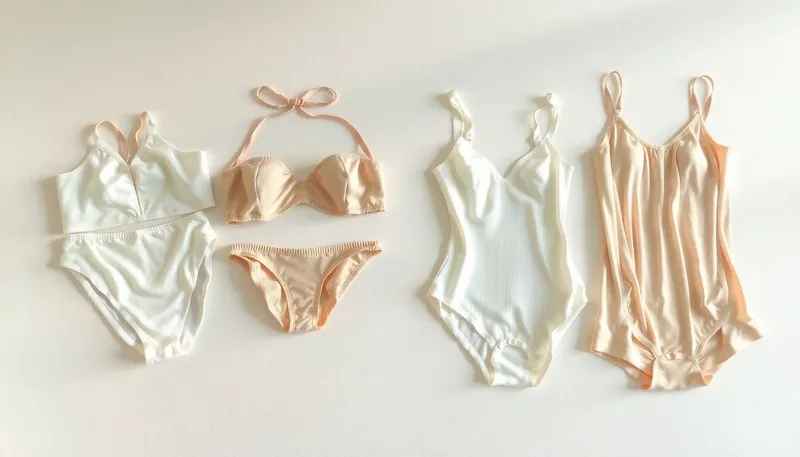
Types of lingerie range from bikinis, briefs, and thongs to chemises, bodysuits, and bralettes, and every style makes a different demand on fabric. This guide maps each garment type to a measurable fabric specification: composition, stretch recovery (ASTM D3107 ≥92%), pilling grade (ISO 12945-2 Grade 4), and OEKO-TEX 100 skin-contact certification. It is written for sourcing teams that specify fabric before sampling.
What Are the Types of Lingerie?
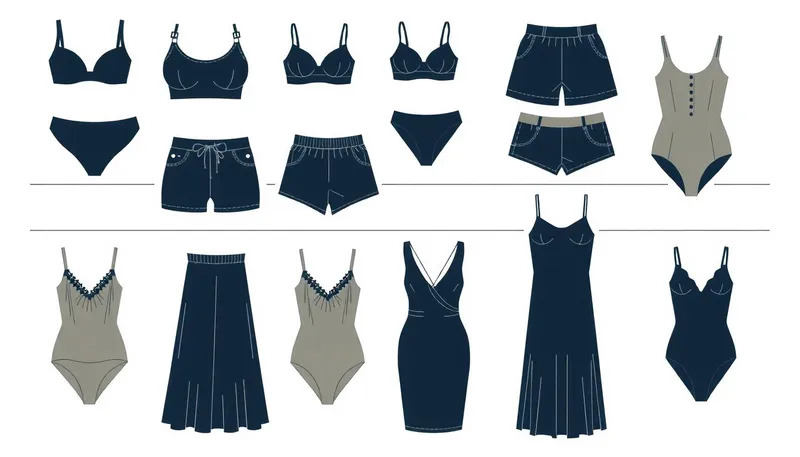
Lingerie is divided by garment silhouette, and each silhouette changes the fabric's job. Bikinis, briefs, hipsters, and boyshorts cover the hips from low to full coverage; thongs reduce fabric at the back; chemises, babydolls, and slips fall loose over the torso; bodysuits, teddies, camisoles, and bralettes fit close to the skin. The classification below is general apparel knowledge, not Forall Lab test data; measured values in this guide apply only to fabrics we test.
| Style | Coverage | Silhouette | Fabric job | Typical fibers |
|---|---|---|---|---|
| Bikini | Low | Two triangles joined at the sides | Stay anchored, avoid VPL | Nylon-spandex, cotton |
| Brief | Full | Classic full back | All-day recovery, moisture control | Nylon-spandex interlock, cotton |
| Hipster | Mid | Sits on the hips | No roll, no ride-up | Nylon-spandex, modal blend |
| Boyshort | Full | Shorts cut | Leg openings hold shape | Nylon-spandex |
| Thong | Minimal back | Low or high rise | Minimal fabric, zero lines | Nylon-spandex, microfiber |
| Chemise | Loose | Short dress | Drape, soft hand, no cling | Modal, silk, satin nylon |
| Babydoll | Loose | Short, empire waist | Soft hand, flounce | Silk, nylon, lace |
| Slip | Straight | Full-length underdress | Smooth line, anti-static | Nylon tricot, silk |
| Bodysuit | Close | One piece, snap crotch | Four-way recovery, no ride-up | Nylon-spandex, seamless knit |
| Teddy | Close | One piece, open or snap | Stretch fit | Nylon-spandex, lace |
| Bralette | Close | No wire, light support | Softness, light support | Cotton, modal, nylon, lace |
| Camisole | Close | Sleeveless top | Smooth under sheer tops | Nylon-spandex, silk |
The garment silhouette decides which performance metric dominates. Close-fitting styles punish fabric that loses recovery: a bodysuit with sagging leg openings fails at hour two. Loose styles punish fabric that clings or wrinkles: a slip that grabs a knit dress defeats its purpose. Spec a fabric only after you fix the style, because the style defines the metric.
Lingerie Fabric by Style: The Spec Map
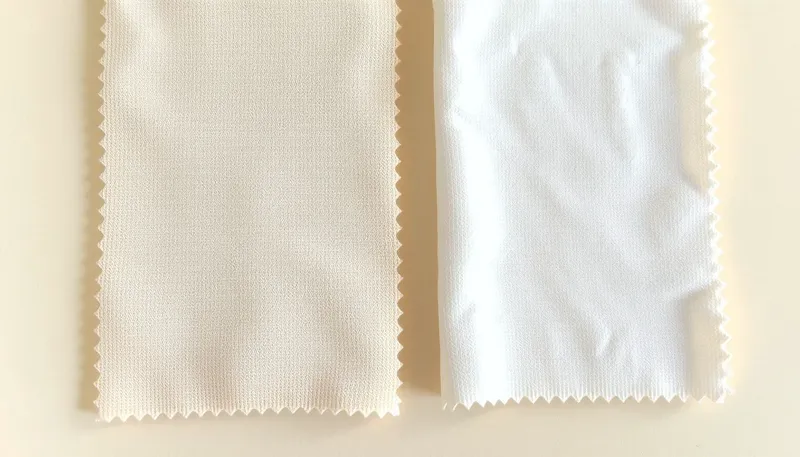
Lingerie fabric choice follows garment function. High-coverage briefs and boyshorts need dimensional recovery at the leg openings. Molded-cup bras need heat-stabilized nylon 6 that survives thermoforming near 200°C. Loose chemises and slips need drape and a smooth hand. Two knit platforms cover the performance end of this range in our production.
| Fabric platform | Composition | Construction | Weight | Recovery | Verified properties | Style fit |
|---|---|---|---|---|---|---|
| D036 Nylon Interlock | 76% Nylon 40D/34F + 24% Spandex 40D | Interlock (one-open-one-close) | 160 ±5 g/m² | ≥92% | Wicking ≤5 s (AATCC 195), pilling Grade 4, no edge curl | Brief, boyshort, bikini, thong |
| D083 Air-Sculpt 34 | Micro-nylon face 20D/24F + 34% elastane | Seamless / moldable knit | Per style spec | >95% | Anti-yellowing Grade 4-5 at 200°C, pilling Grade 4-5 | Bodysuit, seamless brief, molded cup, bralette |
Lingerie Fabric Comparison: GSM, Elasticity, and Mold Temperature
The table below puts the three numbers a sourcing team must write on a tech pack side by side: fabric weight, elastane content, and the heat window the fabric can survive. D036 and D083 values are Forall Lab test data; the cotton, modal, and silk rows are general reference ranges, not part of our test program.
| Material | Weight | Elastane content | Recovery | Mold window | Style fit |
|---|---|---|---|---|---|
| D036 nylon interlock | 160 ±5 g/m² | 24% | ≥92% (ASTM D3107) | Not a molded-cup platform in this guide | Brief, boyshort, bikini, thong |
| D083 Air-Sculpt 34 | 170–190 g/m² | 34% | >95% (ASTM D3107) | 190–210°C, 50–55 s dwell, 3–4 kg/cm² | Bodysuit, seamless brief, molded cup, bralette |
| Cotton | ≈160 g/m² in the brief example; varies by knit | 0–5% (general reference) | <70% (ASTM D3107) | Not used for molded cups in this guide | Short-wear, loose sleepwear |
| Modal | Varies by knit; selected by drape | 0–5% (general reference) | <75% (ASTM D3107) | Not used for molded cups in this guide | Soft camisoles, sleepwear |
| Silk | Sold by momme, not GSM | 0% | No recovery claim | Not used for molded cups in this guide | Chemises, slips |
D036 is the everyday baseline. Its interlock construction does not curl at cut edges, a failure mode that forces factories to add 2-3 cm of seam-allowance waste per panel on single-jersey knits. At 160 g/m² with 24% spandex, it holds recovery through a full day. We pass it on three metrics on every production lot: AATCC 195 wicking ≤5 s at 5 cm, ASTM D3107 recovery ≥92% after a 5 lb load held 30 minutes, and ISO 12945-2 pilling Grade 4 at 2,000 Martindale cycles. See the D036 tech spec for the full parameter sheet.
D083 Air-Sculpt 34 is the high-stretch and molded-cup platform. The 34% elastane content takes ASTM D3107 recovery above 95%, which is the threshold a seamless waistband needs to stay anchored without a separate elastic insert. The copper-stabilized nylon 6 face also resists the two failures of thermoformed bra cups: thermal yellowing and embrittlement at mold temperature. It is not suitable for loose garments that need no stretch, where a plain woven or a silk charmeuse delivers better drape at lower cost.
The spec map answers the practical sourcing question behind the phrase "lingerie fabric": the same yarn can serve a brief and a bra, but the knit structure, elastane ratio, and heat stability must be chosen per style. Buying one generic "lingerie fabric" for a full cut-and-sew line produces a line where half the styles underperform.
Nylon-Spandex vs Cotton vs Modal vs Silk for Lingerie
For lingerie that must hold shape through a full day, nylon-spandex is the measured choice; cotton and modal work for short, low-activity wear; silk suits occasion pieces washed infrequently. The numbers below for nylon-spandex, cotton, and modal come from our 2026 underwear-fabric test program, published in Underwear Fabric Types: Nylon vs Cotton Comparison Guide. Silk figures are general textile knowledge and carry no Forall Lab test data.
| Fiber | Moisture behavior | Stretch recovery | Pilling resistance | Best for | Not suitable for |
|---|---|---|---|---|---|
| Nylon-spandex (D036) | Wicks ≤5 s per AATCC 195; 4.5% regain | ≥92% per ASTM D3107 | Grade 4 per ISO 12945-2 | All-day briefs, active, seamless | Chlorine-bleach sanitization; prescribed 100% natural fiber |
| Nylon-spandex (D083) | Same platform, heat-stabilized | >95% per ASTM D3107 | Grade 4-5 | Bodysuits, molded cups, seamless | Same limitations as nylon-spandex |
| Cotton | Absorbs into fiber, wicking >30 s | <70% per ASTM D3107 | Grade 2-3 | Under-4-hour lounging, loose sleepwear | Workouts, hot climates, all-day wear |
| Modal | Absorbs into fiber, wicking >20 s | <75% per ASTM D3107 | Grade 3 | Soft-hand camisoles, sleepwear | Sweat-heavy wear, shape-critical fit |
| Silk | Natural protein fiber, absorbent | Delicate; no recovery claim | Delicate, hand care | Chemises and slips for occasion wear | Frequent machine washing, all-day body-hugging wear |
Cotton fails the three metrics that matter in fitted lingerie: recovery below 70% produces visible sag at leg openings inside four hours, wicking above 30 seconds leaves skin damp, and pilling Grade 2-3 roughens the surface against the body. Modal improves initial hand feel through lower surface friction but keeps the cellulose weakness: it absorbs water into the fiber instead of moving it along the surface, and recovery stays below 75% when wet.
Silk occupies a separate lane. A silk chemise over a silk slip has a drape and luster that performance knits do not reproduce, and its natural protein fiber sits well against skin for low-activity wear. Its cost and care profile remove it from the all-day category. For a production line that spans both, the practical split is nylon-spandex for fitted daywear and silk or modal for loose nightwear, with no single "best" fiber across both.
Molded-Cup & Seamless Lingerie Fabric: The 200°C Challenge
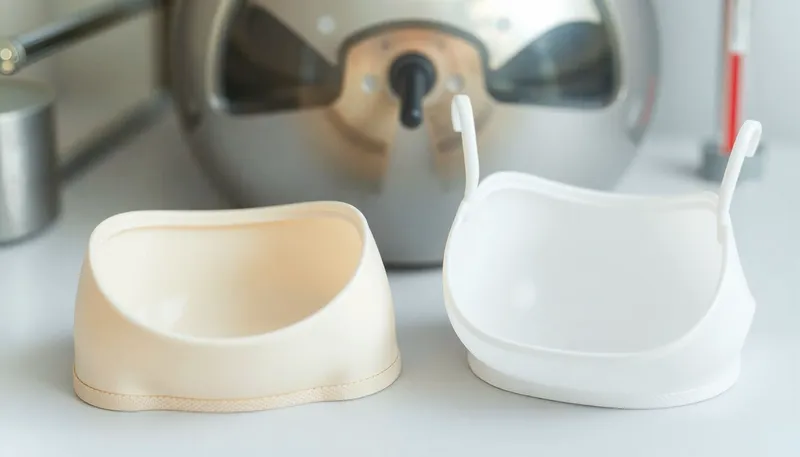
Seamless and molded-cup lingerie depend on nylon 6 that survives thermoforming near 200°C without yellowing or turning brittle. Standard nylon 6 yellows through amino oxidation and turns brittle through amide-chain scission at that temperature. Copper-stabilized nylon 6 holds anti-yellowing Grade 4-5 and keeps tensile strength through repeated molding. Our full failure analysis and trial guide for this process is in Bra Cup Molding Temperature: Stop Nylon 6 Yellowing & Brittleness at 200°C.
Molded cups demand two measurable properties at once. Yellowing resistance must hold Grade 4-5 after the cup exits the mold, because a yellowed cup is an automatic quality-control rejection. Tensile retention must stay above 95%, because amide scission that drops molecular weight turns the cup crisp and removes the recovery that shapes it. D083 carries copper-salt stabilizers to block both reactions; a fabric with only surface optical brighteners passes the first inspection and re-yellows in the warehouse.
The molding window is narrow enough to write into the tech pack. These are the numbers we validate on D083, alongside the same test set we use to reject a standard nylon 6 lot:
| Parameter | Standard nylon 6 | D083 heat-stabilized nylon 6 |
|---|---|---|
| Maximum molding temperature | 170°C | 220°C (working range 190–210°C) |
| Yellowing resistance | Grade 2–3 | Grade 4–5 |
| Tensile strength retention | 65–72% | 95% |
| Elongation retention | 60–68% | 92% |
| Shrinkage after molding | 4–7% | <2% |
| Dwell time | — | 50–55 s |
| Pressure | — | 3–4 kg/cm² |
A cup that leaves the mold below Grade 4 yellowing or below 95% tensile retention is a reject, not a cosmetic second. The 200°C number is not a target to exceed; it is the center of a window. Run a 50-piece trial and measure yellowing and shrinkage before the line commits.
Seamless construction removes the seams that chafe and the edge-curl waste that cut-and-sew pays for, which is why seamless briefs and bodysuits dominate the performance end of the market. The trade-off is design freedom: color-blocked panels still require seamed construction with flatlock seams. For storage yellowing of white and pastel lingerie packed in polybags, specify the ISO 105-X18 phenolic-yellowing test, which catches the butylated-hydroxyanisole (BHA) transfer from packaging that darkens light nylon over weeks on a shelf.
How Much Stretch Does Lingerie Fabric Need?
Stretch need is set by the garment zone, not by brand preference. Everyday briefs and boyshorts run 20-24% spandex for ≥92% ASTM D3107 recovery; seamless waistbands and shapewear run 30-34% for >95% recovery that holds without rolling down. Below 5% spandex, the elastane adds fit but not recovery, because the base fiber's dimensional growth overpowers it.
| Garment zone | Spandex range | Recovery target | Why |
|---|---|---|---|
| Seamless waistband, shapewear | 30-34% | >95% | Holds without a separate elastic insert |
| Everyday brief, boyshort | 20-24% | ≥92% | Survives a full day without leg-opening sag |
| Light bralette, camisole | 5-15% | Recovery still required | Low load, but must not bag after washing |
| Loose chemise, slip | 0-8% | Drape over recovery | Recovery is not the binding metric |
D036 at 24% spandex is the all-day baseline; D083 at 34% is the high-stretch step. The step from 24% to 34% is the working definition of high-stretch lingerie fabric in the trade, and it is the same platform family used across our men's underwear and lounge wear lines. A fabric specified below 5% spandex for a fitted brief fails within weeks. Cotton grows 15-18% in the warp when wet and never fully returns. Modal loses shape when wet, with recovery below 75%.
How to Choose Lingerie Fabric for Production
Choose lingerie fabric by fixing the style, setting measurable thresholds, and verifying the sample before bulk. The six-step process below mirrors what we run before a new cut-and-sew order goes to the cutting table.
- Fix the style and coverage first. A brief, a molded-cup bra, and a loose chemise need different fabrics. Write the garment list before any fabric conversation.
- Set thresholds in numbers. Choose the passing values: recovery ≥92% per ASTM D3107, pilling Grade 4 per ISO 12945-2, and, for light shades, ISO 105-X18 Grade 4 for phenolic yellowing.
- Choose the fiber platform. Nylon-spandex interlock for fitted daywear; seamless 34% elastane for bodysuits and molded cups; modal or silk for loose nightwear.
- Require the certification. Skin-contact lingerie should carry OEKO-TEX 100 Class I, the highest class for textiles that touch skin.
- Sample and test, do not trust a datasheet. In our lab, we re-run AATCC 195, ASTM D3107, and ISO 12945-2 on cut samples from the first production roll, and we reject a lot that shows edge curl or sub-threshold recovery before it reaches cutting.
- Confirm the seam and trim plan. Seamless styles remove edge-curl waste; seamed color-blocked styles need flatlock seams and a fabric that lies flat.
A spec sheet built this way removes the two most expensive surprises in lingerie sourcing: a fabric that passes hand-feel and fails recovery, and a molded cup that yellows after the first production run.
Frequently Asked Questions
What are the different types of lingerie?
The main types are bikini, brief, hipster, boyshort, thong, chemise, babydoll, slip, bodysuit, teddy, bralette, and camisole. They divide into hip coverage (bikini through thong) and body pieces (chemise through camisole), and each group demands a different fabric behavior. Style definitions are general apparel knowledge; the measured fabric values in this guide come from our own tests.
What fabric is best for lingerie?
Nylon-spandex is the measured best for lingerie that must hold shape through the day: D036 interlock reaches ≥92% recovery per ASTM D3107, pilling Grade 4 per ISO 12945-2, and wicking ≤5 s per AATCC 195. Silk and modal fit loose occasion wear where drape matters more than recovery. There is no single best fiber across both groups.
What is lingerie usually made of?
Lingerie is usually made of nylon, spandex, modal, cotton, silk, or lace. Fitted styles use nylon-spandex knits; loose nightwear uses modal, cotton, or silk; trim and strapping use lace and elastic. In our production, D036 (76% nylon, 24% spandex) covers everyday fitted styles and D083 (34% elastane) covers seamless and molded-cup styles.
Is nylon good for lingerie fabric?
Yes, for fitted styles. Nylon 6 delivers the recovery (≥92% per ASTM D3107), pilling resistance (Grade 4), and moisture transport (≤5 s per AATCC 195) that all-day lingerie needs, and D036 and D083 carry OEKO-TEX 100 skin-contact certification. Nylon is not suitable for users who require 100% natural fiber, and it must not be chlorine-bleached.
How much spandex should lingerie fabric contain?
Everyday lingerie runs 20-24% spandex, and seamless or shapewear runs 30-34%. Below 5%, spandex adds fit but not recovery. D036 uses 24% for ≥92% recovery; D083 uses 34% for >95% recovery in seamless waistbands and molded cups.
Is seamless lingerie better than seamed lingerie?
For performance wear, yes. Seamless lingerie removes the seams that chafe, prevents visible panty lines, and eliminates edge-curl seam allowance, which saves 4-6% of fabric per garment. Seamed construction stays the better choice for color-blocked multi-panel designs, where a seamless tube cannot place different fabrics panel by panel.
How do you test stretch recovery on lingerie fabric?
Cut a specimen in the direction that wraps the body, clamp it under a 5 lb load for 30 minutes per ASTM D3107, release it, and measure recovery after 60 seconds. Recovery equals (stretched length − residual length) ÷ (stretched length − original length) × 100. Pass is ≥92% for everyday lingerie and >95% for seamless waistbands.
Conclusion
Types of lingerie create a fabric spec problem, not a color problem. Fitted styles need nylon-spandex with recovery ≥92% (D036) or >95% (D083), pilling Grade 4, and OEKO-TEX 100 Class I; loose styles can use modal or silk where drape replaces recovery. For molded cups, add the 190–210°C window and the Grade 4–5 yellowing threshold to the same spec sheet. The garment list decides the metric, the metric decides the fabric, and the sample decides the order.
🔗 Related Fabrics
- Underwear Fabric Types: Nylon vs Cotton Comparison Guide — the source data for the fiber comparison table
- Bra Cup Molding Temperature: Stop Nylon 6 Yellowing & Brittleness at 200°C — molded-cup failure modes and the copper-salt fix
- Luxury Lounge Wear Fabric Guide: Cashmere & Premium Materials — D083 in adjacent premium loungewear
- D036 Nylon Interlock Knit — Full Tech Specs — composition, GSM, recovery, OEKO-TEX Class I
- D083 Air-Sculpt 34™ — Product Page — 34% spandex high-stretch seamless platform
Written by Wenruo
Textile Engineer, Forall Lab