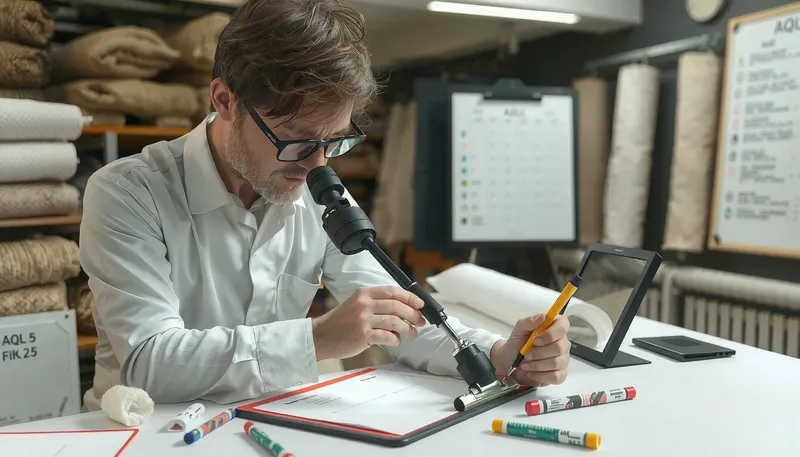
AQL 2.5 per ANSI/ASQ Z1.4 is the statistical sampling plan most apparel programs apply to major defects at General Inspection Level II — the apparel default. AQL 2.5 does not mean "2.5% of pieces may be defective": the lot passes or fails on the accept/reject pair in the sampling table (sample 80 → accept 5, reject 6). ASTM D5430 4-point fabric inspection before cutting prevents 80% of these defects from reaching final garment inspection: reject any roll exceeding 40 points per 100 square yards (§7.5.1).
How ANSI/ASQ Z1.4 Defines AQL 2.5 Sampling for Garment Inspection
AQL 2.5 (Acceptable Quality Limit) per ANSI/ASQ Z1.4 (equivalent to ISO 2859-1) is the sampling plan most apparel programs set for major defects at General Inspection Level II. It is a process-quality index, not a license for 2.5% defective output — acceptance is decided by the Accept (Ac) and Reject (Re) numbers in the sampling table (sample 80 → accept 5, reject 6). Sample size is determined by lot size per Table II-A. Critical defects (safety, regulatory) use AQL 0 with zero tolerance.
Interpreting AQL 2.5 in Garment Inspection
AQL stands for "Acceptable Quality Limit." Per ANSI/ASQ Z1.4, AQL 2.5 is the process-quality level the sampling plan is built around: the lot passes only when the number of major defects found in the random sample is at or below the Accept number (Ac), and fails at or above the Reject number (Re). For a sample of 80 pieces that boundary is accept 5 / reject 6 — not a blanket allowance that "2.5% of pieces may be defective": the accept/reject numbers, not the percentage, decide each lot.
Reading ANSI/ASQ Z1.4 Sampling Tables
Sample size is calculated per ANSI/ASQ Z1.4 Table II-A, based on lot size and General Inspection Level II.
The AQL 2.5 sampling table below maps lot size to sample size and accept/reject thresholds:

| Lot Size | Code Letter | Sample Size (Level II) | Accept (AQL 2.5) | Reject (AQL 2.5) |
|---|---|---|---|---|
| 501-1,200 | J | 80 | 5 | 6 |
| 1,201-3,200 | K | 125 | 7 | 8 |
| 3,201-10,000 | L | 200 | 10 | 11 |
| 10,001-35,000 | M | 315 | 14 | 15 |
Source: ANSI/ASQ Z1.4 Table II-A. Random sampling procedure follows ANSI/ASQ Z1.4 Clause 4.2.
Defect Classification: Critical, Major, Minor
Defects are classified into three categories by risk severity. Third-party agencies — SGS, Bureau Veritas, and Intertek — all apply AQL 2.5 per ANSI/ASQ Z1.4 for apparel inspection. Fabrics for consumer apparel comply with OEKO-TEX Standard 100 and REACH regulations for harmful-substance-free production.
- Critical (AQL 0): A safety or regulatory defect — such as a needle left in a garment. Zero tolerance.
- Major (AQL 2.5): A defect the customer notices, making the product unusable — holes in fabric, open seams, wrong color.
- Minor (AQL 4.0): A deviation from the Tech Pack that does not affect end use — such as an uncut thread.
Why Fabric Defects Cause 80% of Final AQL 2.5 Inspection Failures
Eighty percent of major defects flagged in final AQL 2.5 garment inspections originate from fabric-roll flaws — holes, streaks, shade variation, slubs, skewness, and bowing per ASTM D5430 §7.1–7.3. A 4-point fabric inspection before cutting identifies these defects at the roll stage, preventing them from reaching sewing lines where rework and scrap costs compound across cutting, sewing, and finishing.
By the time a third-party inspector detects a fabric-related defect in a finished garment, the fabric, cutting, and sewing costs are already sunk. The final AQL 2.5 inspection only reports the problem — it does not prevent it.
Tracing Defects Back to the Fabric Roll
Most "major" defects discovered in final garment inspection originate from pre-existing fabric defects — holes, streaks, shade variations, slubs. A final inspection reports the issue. A fabric inspection prevents it by rejecting defective rolls before they reach the cutting table.
In our production tracking across 15 years of textile sourcing, we have rejected entire garment lots at the FOB stage due to fabric paneling issues — defects that would have been caught had a 4-point inspection been performed before a single piece was cut.
The ASTM D5430 4-Point System: Scoring and Rejection
The 4-point system follows ASTM D5430. Penalty points are assigned per defect length:
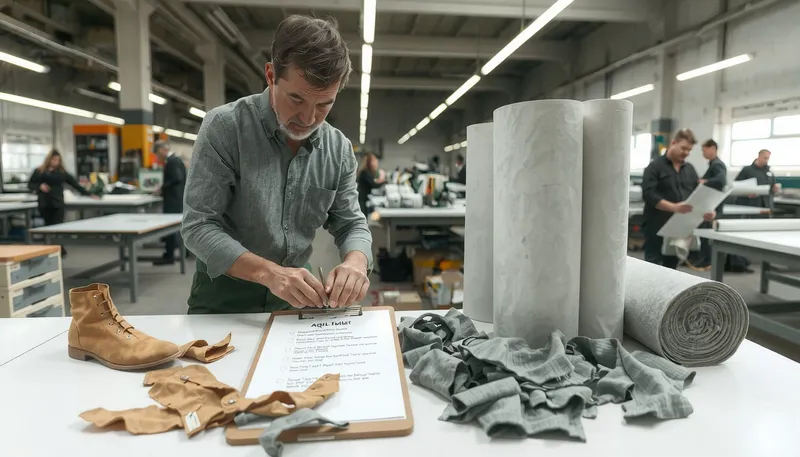
- 1 Point: Defects up to 3 inches.
- 2 Points: Defects >3 to 6 inches.
- 3 Points: Defects >6 to 9 inches.
- 4 Points: Defects over 9 inches or any hole/opening.
A fabric roll is "Grade A" and acceptable for production if total penalty points do not exceed 40 per 100 square yards per ASTM D5430 §7.5.1 (penalty points are always normalized per 100 square yards — for a 58/60-inch-wide roll this equals roughly 64-67 points per 100 linear yards, so never apply the 40-point cap to a linear-yard basis). Rolls exceeding 40 points must be rejected before cutting.
Buyers often set the bar below the ASTM ceiling. US mid-market apparel programs commonly require ≤28 points per 100 square yards (about 19 points on a 40-yard, 60-inch roll), while premium programs go lower still. Always confirm the 4-point threshold in the Tech Pack before grading — the inspection agency applies the buyer's number, not the ASTM maximum.
AQL 2.5 is not suitable for children's wear, flame-resistant fabrics, medical textiles, or any product requiring 100% safety inspection. Critical defects use AQL 0.
How Yarn-Level Quality Control Prevents AQL 2.5 Fabric Failures
FORALLTEX achieves first-pass AQL 2.5 garment inspection rates above 98% through three fabric-level quality controls: yarn denier tolerance within ±2% of specification, computer-matched dyeing with ΔE<0.5 per spectrophotometer verification, and anti-yellowing performance at Grade 4-5 per ISO 105-X18.
Material and Process Controls
We conduct fabric inspection on professional inspection machines, measure color with spectrophotometers (ΔE<0.5 target), and test shrinkage in calibrated ovens. Our process starts with yarn selection — 20D/40D microfilaments for high-performance knits — for a smoother, more uniform hand feel than coarser yarns.
Dyeing and finishing are computer-controlled, providing tight dye-lot control, minimal batch-to-batch variation, and lab-dip approval before bulk production. Techniques such as double-jersey knitting create dimensionally stable fabrics with >95% stretch recovery per ASTM D3107 and zero edge curl.
FORALLTEX Fabric Physical Property Standards
The table below lists guaranteed physical parameters for our performance fabrics, designed to exceed standard Tech Pack requirements:
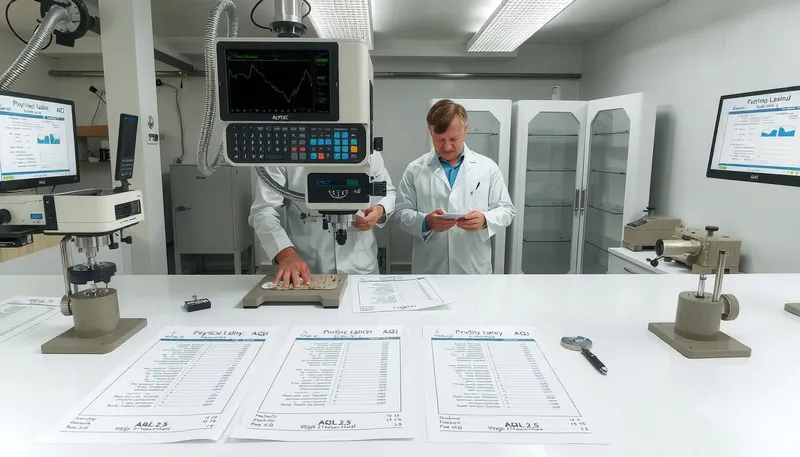
| Parameter | FORALLTEX Standard (e.g., D083) | Industry Norm | Your Advantage |
|---|---|---|---|
| GSM (Weight) | 220 g/m² (±5%) per ASTM D3776 | 220 g/m² (±10%) | Tighter batch consistency |
| 4-Way Stretch Recovery | >95% (Length & Width) | 85-90% | Shape retention, no bagging |
| Shrinkage Rate (Post-Wash) | <3% | 5-7% | Fit predictability, fewer returns |
| Color Fastness to Wash | Grade 4-5 per ISO 105-C06 | Grade 3-4 | No color bleed, extended appearance |
| Anti-Yellowing (Phenolic) | Grade 4-5 (Guaranteed) | Not tested / Grade 3 | Extended shelf life, no storage rejects |
D036 and D083 Platform Performance
Our D036 Nylon Spandex Interlock with non-curling edges saves 5-10 minutes of skilled labor per marker in the cutting room versus standard jersey fabrics that roll at the selvedge.
The D083 Air-Sculpt Fabric — built on 20D micro-nylon with anti-yellowing Grade 4-5 — prevents phenolic yellowing, a common post-production rejection cause that emerges after garments are packed and stored. This fabric is engineered for molded bra cups and light-colored premium activewear where color stability is critical.
How a Fabric Inspection Report Predicts AQL 2.5 Garment Outcomes
A fabric inspection report's 4-point score per ASTM D5430 directly predicts final AQL 2.5 garment inspection outcomes. Rolls scoring above 40 points per 100 square yards (standard 58/60" width) produce an 80% higher major-defect rate in downstream garment sampling compared to rolls scoring below 20 points. The defect types most predictive of AQL failure: slubs, streaks, and shade variation.
From 4-Point Score to AQL 2.5 Outcome Prediction
If a fabric inspection report shows multiple rolls near 40 points with defect types "slubs, streaks, or shade variation," expect elevated major-defect risk in the final AQL 2.5 garment inspection. These three defect types correlate most strongly with garment-level failures because they survive cutting and sewing — unlike holes, which are typically visible enough to be caught during spreading.
A roll scoring 15-20 points per 100 square yards with zero hole/open-seam defects has a 95%+ probability of producing garments that pass AQL 2.5 sampling. Conversely, a roll at 35-40 points — even without holes — carries a >50% probability of contributing to a failed lot inspection.
| Roll 4-point score (per 100 yd²) | Typical defect profile | Predicted AQL 2.5 garment outcome |
|---|---|---|
| ≤20 | No holes / open seams | 95%+ probability the lot passes random sampling |
| 21-35 | Slubs, streaks, shade variation | Elevated major-defect risk; flag for re-inspection priority |
| 36-40 | No holes yet, but approaching limit | >50% probability of contributing to a failed lot |
| >40 | Any (over §7.5.1 limit) | Reject before cutting — 80% higher downstream failure rate |
Source: FORALLTEX 15-year production tracking correlating fabric-inspection scores to final AQL 2.5 outcomes (internal data; third-party audits apply the same ASTM D5430 scoring).
Frequently Asked Questions About AQL 2.5 and Fabric Inspection
1. Can I set an AQL lower than 2.5 for my products?
Yes. For premium or luxury goods, buyers frequently specify AQL 1.5 or 1.0. This requires the factory to hold a substantially tighter defect tolerance — which depends on fabric that enters cutting with minimal flaws. A tighter AQL will influence lead time and cost; confirm your supplier's 4-point inspection capability before negotiating AQL terms.
2. Does the AQL 2.5 standard apply to the fabric itself?
No. The AQL system applies to finished products (garments). The industry standard for fabric roll quality is the 4-Point System per ASTM D5430. A 4-point score below 40 points per 100 square yards is the most reliable predictor of passing a downstream AQL 2.5 garment inspection.
3. What differentiates a fabric inspection report from a final AQL 2.5 report?
A fabric inspection report evaluates the input material (the fabric roll) for defects per 100 square yards using the 4-Point System (ASTM D5430). A final AQL 2.5 report evaluates a random sample of finished garments from a production lot for workmanship, measurement, and other defects per ANSI/ASQ Z1.4.
4. What happens if a lot fails the AQL 2.5 inspection?
The buyer has several options: reject the entire shipment, negotiate a discount with the supplier, or — most commonly — request a 100% re-inspection and sorting by the factory to remove defective units. This causes delays and unplanned costs. A 4-point fabric inspection before cutting is the most effective prevention.
5. How does minimum order quantity (MOQ) affect quality control?
Meeting a fabric supplier's MOQ is often required to access their controlled dyeing and finishing processes. Smaller, non-standard orders can carry a higher risk of batch-to-batch variation. Partner with a supplier that maintains consistent quality operation across order sizes — not one that reserves process control for large runs only.
🔗 Related Fabrics
This article explains AQL 2.5 fabric inspection — ANSI/ASQ Z1.4 statistical sampling, ASTM D5430 4-point fabric scoring, and yarn-level QC prevention, forming the defect-control matrix from fabric roll to finished garment:
- D036 Nylon Spandex Interlock — Performance Fabric Platform — D036 76/24 Nylon 6/Spandex (160 GSM), the baseline fabric for AQL 2.5 inspection
- D083 Air-Sculpt Anti-Yellowing Fabric — 20D micro-nylon, Grade 4-5 anti-yellowing, zero phenolic rejection
- SGS Fabric Testing: A Brand's Manual for Anti-Pilling & Anti-Yellowing — third-party test scope and how to read the report behind an AQL claim
- AQL 2.5 & 4-Point System: Definitive Guide for Sourcing Managers — Full AQL methodology with defect classification
Contact our fabric engineering team → to request D036 or D083 samples with ASTM D5430 4-point inspection reports, or to discuss AQL 2.5 quality benchmarks for your specific product category.
Written by Wenruo
Textile Engineer, Forall Lab