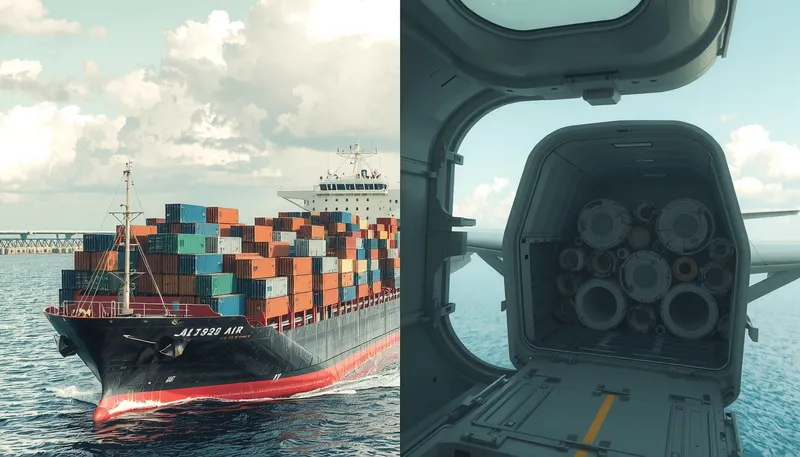
Shipping fabric rolls by air is calculated using chargeable weight (DIM factor 167), making it ideal for urgent strike-offs under 150kg. Conversely, LCL (Less than Container Load) sea freight charges by CBM (Cubic Meter) and is highly cost-effective for bulk activewear production, provided sourcing directors account for hidden destination CFS fees.
Key Learning Points
- Differing Cost Models: Air freight costs are determined by "chargeable weight" (actual weight versus volumetric weight), while Less than Container Load (LCL) sea freight is charged per cubic meter (CBM).
- The Control Line: For small shipments under 150-200 kg, the total LCL sea freight can only be marginally lower than that of air freight. This can happen as a result of the high fixed costs at the port of arrival.
- Hidden Costs are Important: The LCL sea freight price quotes are often incomplete and do not include significant destination charges such as CFS, terminal handling, and trucking. They can double your final cost.
- Strategic Use: Air freight is great for speed-critical items like samples, urgent top-ups, and initial production runs, while LCL sea freight is the best option for planned, bulk production.
- Packing Innovation Reduces Cost: Creating vacuum packing technology not only reduces the volume of fabric rolls but also directly cuts the air freight costs.
The Optimal Factors: Air vs Sea - An Overview
Optimal factors for fabric roll shipping are the three decision drivers: transit time, cost basis, and Incoterms allocation. Transit time is 5–10 days for air vs 30–45+ days for LCL sea. Cost basis is chargeable weight (air) vs CBM (sea). Incoterms (FOB vs EXW) determine who pays origin terminal fees. Below is the 2026 benchmark matrix for routing fabric rolls from Asian textile hubs to Western markets.
Under FOB (Free on Board) , the supplier covers origin terminal costs up to loading onto vessel; buyer pays main freight, insurance, and all destination charges including CFS. Under EXW (Ex Works) , buyer pays everything from factory gate. For LCL fabric rolls, FOB is recommended to avoid unexpected origin CFS fees.
Incoterms 2020 for Fabric Rolls:
- FOB (Free on Board) – Supplier pays origin terminal + loading. Buyer pays main freight, insurance, destination CFS, terminal handling, trucking. Recommended for LCL to avoid surprise origin fees.
- EXW (Ex Works) – Buyer pays everything from factory gate. Only use if you have a China-based freight forwarder.
- CIF (Cost, Insurance, Freight) – Seller pays main freight and minimum insurance (110% of value). Buyer still pays destination CFS fees.
The following data is a matrix that presents a comparison for shipping fabric rolls from major hubs (China/Vietnam) to destinations in the USA and Europe.
| Factor | Air Freight | LCL Sea Freight |
|---|---|---|
| Transit Time | 5-10 days (port-to-port) | 30-45+ days (port-to-port) |
| Cost Basis | Chargeable Weight (Actual vs. Volumetric) | Per Cubic Meter (CBM) |
| Ideal For | Samples, urgent top-ups, high-value goods | Bulk production, cost-sensitive orders |
| Reliability | High; less prone to delays | Moderate; subject to port congestion |
| Risk of Damage | Lower; less handling | Higher; more touchpoints, risk of moisture |
| Cost | High | Low |
The Actual Figures: LCL vs. Air Freight Costs
Actual figures mean real-world 2026 rates: air freight at $8/kg chargeable weight, LCL sea freight at $150/CBM with a 1 CBM minimum. Using a real example of 5 fabric rolls (125kg total, 0.4 CBM), we calculate both methods below based on our experience shipping thousands of rolls for global brands.
References & Industry Standards
- World Trade Organization (WTO) – 2026 Air and Sea Freight Tariffs Database
- International Chamber of Commerce (ICC) – Incoterms 2020 Rules for Textile Trade
- ASTM D3776 – Standard Test Method for Fabric Weight (GSM)
- AATCC 61 – Test Method for Color Fastness to Laundering
- U.S. Customs and Border Protection – HS Code 6004.10 Classification Ruling (knitted fabrics with >5% elastane)
The Setting: Shipping 5 Rolls of Activewear Fabric
Example: 5 rolls of Double Jersey activewear fabric. You decide to make a small order of only 5 rolls.
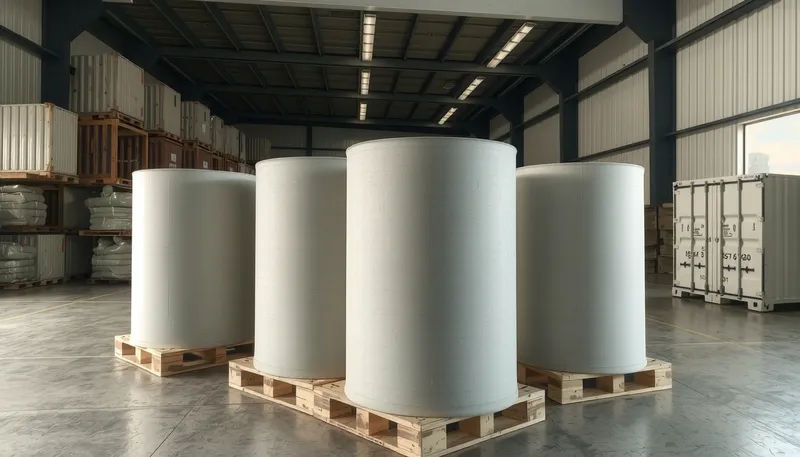
- Fabric Roll Specs: 25 kg each, dimension 1.6m (width) x 0.25m (diameter).
- Total Actual Weight: 5 rolls * 25 kg/roll = 125 kg.
Determining the Air Freight Cost: The Dominance of Chargeable Weight
Air freight charges rely on whichever of the two is greater—actual weight or volumetric weight.
- Calculate the Shipment Volume: 5 rolls are put into a single box having dimensions 1.6m x 0.5m x 0.5m. The total volume now is 0.4 CBM (Cubic Meters).
- Calculate the Volumetric Weight: The standard industry formula to be applied is Volume in CBM * 167. Therefore, 0.4 CBM * 167 = 66.8 kg.
- Identify the Chargeable Weight: Check the Actual Weight (125 kg) against the Volumetric Weight (66.8 kg). The airline will charge you for whichever is higher. In our case, the Chargeable Weight is 125 kg.
- Calculate the Final Cost: Assuming the air freight rate for 2026 is $8 per kg, you will incur a charge of 125 kg * $8/kg = $1000.
Finding the LCL Sea Freight Cost: The Focus on CBM
LCL sea freight pricing uses volume (CBM) rather than weight.
- Use the Volume of the Shipment: 0.4 CBM is the volume as already established.
- Implement the Minimum Charge: Normally one chargeable volume is stipulated as the minimum and it is considered to be one cubic meter. This means that even though your shipment is smaller, you still have to pay for 1 CBM.
- Calculate the Final Cost: Using a 2026 rate of $150 per CBM, the ocean freight cost base is 1 CBM * $150/CBM = $150.
In Addition to the Freight Rate: Uncovering the Hidden Costs
Unlike air freight, LCL sea freight quotes typically exclude critical destination-side fees. These hidden costs—including Container Freight Station (CFS) unstuffing, terminal handling charges (THC), customs clearance, and inland trucking—can range from $150 to $300+, effectively doubling the final landed cost for small shipments.
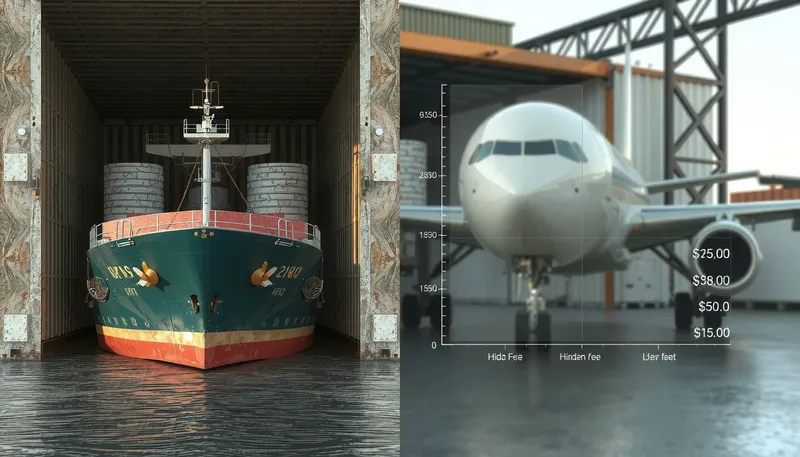
Thus, the initial $150 freight bill can very well turn into a $500-$700 final cost via these hidden charges. In shipping industry jargon, this phenomenon is called the "LCL floor cost trap" — the fixed destination fees create a cost floor below which LCL cannot compete with air freight, regardless of how small the CBM volume becomes. This is especially the case with smaller shipments.
Common LCL Charges to Beware of:
- Origin Costs: Fees at the Container Freight Station (CFS) for gathering your goods together. Plus documentation and handling fees.
- Destination Costs: This is where the charges pile up. You will need to pay for terminal handling, customs clearance, warehouse fees for the container breaking apart, and trucking from the port to your factory.
Shipping Framework for Companies in Apparel Industry
The shipping framework is a decision matrix based on production phase: use air freight for sampling, first production run (urgent launch), and urgent replenishment; use LCL sea freight for bulk seasonal orders and core evergreen fabrics. Your production cycle phase dictates the correct choice – see scenarios below.
Use Air Freight For Superiority & Reactivity
Air freight is the fastest option for urgent shipments.
- Scenario 1: Sampling & Strike-offs: When you require lab dips and strike-offs to be quickly approved, air freight keeps development on schedule.
- Scenario 2: First Production Run: Ship a small part of your first Purchase Order (PO) by air to for product photography or to hit launch date.
- Scenario 3: Replenishment Urgently: If a tough style sells out, air freight is the only way to restock the inventory and to recover lost sales.
Scenario 4: High-Value Product Launches: When launching premium collections featuring elite materials like our D083 Air-Sculpt Fabric, air freight guarantees market-first delivery. Because this 220gsm 20D micro-nylon fabric possesses >95% stretch recovery, it can withstand intense vacuum-compression packing. This unique resilience allows us to compress the roll volume by up to 30%, directly slashing the volumetric weight and saving you hundreds of dollars on air freight without permanently creasing the material.
The FORALLTEX Advantage: 30% Air Freight Rate Reduction
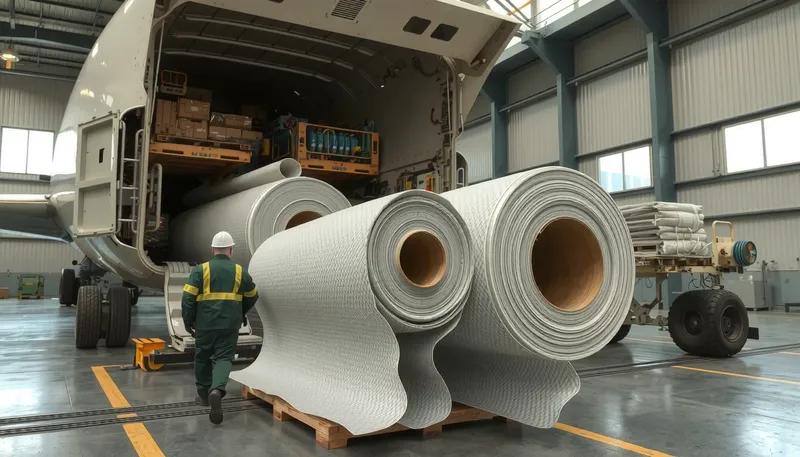
The FORALLTEX advantage is vacuum compression packing that reduces fabric roll volume by 30%, directly lowering chargeable weight and air freight cost. This works because our D083 fabric has >95% stretch recovery and resists permanent creasing. We have introduced vacuum compression packing for our D083 Air-Sculpt Fabric. The vacuum process can lead to a 30% volume cut of the fabric rolls, which results in a lower chargeable weight and cuts the air freight bill.
| Physical Parameter | FORALLTEX D083 Specification | Industry Standard |
|---|---|---|
| Composition | 66% Nylon (20D) / 34% Spandex | 75% Nylon (40D) / 25% Spandex |
| GSM | 220 g/m² | 240-260 g/m² |
| Structure | High-Gauge Double Jersey | Standard Interlock |
| Stretch Recovery | >95% (4-Way Stretch) | ~90% |
| Shrinkage Rate | <3% after wash | <5% |
| Color Fastness | Grade 4-5 (AATCC standards / ISO 105-C06) | Grade 3-4 |
| Anti-Yellowing | Grade 4.5 (Proprietary Finish) | Not Rated / Prone to yellowing |
The ROI of Superior Fabric: A Calculator for Garment Factories
A superior fabric base directly impacts your shipping and production ROI. For instance, our 220gsm D083 Air-Sculpt yields 3.0 garments/kg versus 2.5 for standard 260gsm fabric. On a 1,000kg shipment, you gain an extra 500 meters of usable material without paying additional freight weight, instantly offsetting any FOB premium.
Use LCL Sea Freight for Cost Reduced at Scale
LCL sea freight is cost-effective for planned bulk orders >500kg or >2 CBM, but is NOT suitable for: (1) shipments under 150kg (hidden fees erode savings), (2) high-moisture-sensitive fabrics without vacuum packing, (3) launch-critical timelines under 3 weeks. For well-planned seasonal orders, LCL reduces cost per unit by 60–80% vs air.
- Scenario 1: Bulk Production: For your principal seasonal orders that come with a promised production schedule, the LCL sea freight will help you to reduce the cost per item.
- Scenario 2: Core, Evergreen Fabrics: For the standard fabrics which you use all year around, you might cover our popular D036 Nylon Spandex Interlock with planned shipments really early and thus maximize the savings with the sea freight.
The "Tipping Point"
The Tipping Point Formula: Compare (Chargeable Weight in kg × Air Rate) vs (Max(1 CBM, actual CBM) × Sea Rate + Fixed Destination Fee).
Using our 5-roll example (125kg, 0.4 CBM):
- Air = 125 kg × $8 = $1,000
- LCL = 1 CBM × $150 + $350 (avg CFS+handling) = $500
However, if actual weight drops to 60kg (e.g., 3 rolls):
- Air = 60 kg × $8 = $480
- LCL = 1 CBM × $150 + $350 = $500 (air is cheaper!)
Rule: Below 75kg actual weight, air freight becomes cost-competitive or cheaper than LCL. Always request all-in quotes.
When NOT to Use Each Method
When NOT to use air freight: shipments over 500kg, heat-sensitive fabrics, or lead time >4 weeks. When NOT to use LCL sea freight: shipments under 150kg, moisture-sensitive fabric without vacuum packing, urgent orders under 3 weeks, or congested ports like LA/LB.
Do NOT use Air Freight if:
- Shipment >500kg (cost will exceed $4,000, use LCL)
- Fabric is highly heat-sensitive (cabin temperatures vary)
- You have >4 weeks lead time
Do NOT use LCL Sea Freight if:
- Shipment <150kg actual weight (hidden fees kill savings)
- Fabric moisture regain rate >5% without vacuum packing
- You need goods within 3 weeks
- Your destination port has known CFS congestion (e.g., LA/LB)
FAQ: Answering Your Top Questions
1. Is LCL sea freight always cheaper than air freight for fabric rolls?
Not always. For smaller shipments (below 150 kg), the LCL hidden charges at the destination for fixed "hidden" fees can lead to very inflated costs that are similar to air freight. It is crucial to compare only the all-in quotes rather than the general freight rate.
2. How can I reduce the volumetric weight of my fabric shipment for air freight?
The best way is through smart packing. At FORALLTEX, we use vacuum compression packing for fabrics like our D083. This can significantly reduce a roll's volume. This directly lowers the volumetric weight and your final air freight cost.
3. What are the main risks of shipping fabric rolls by sea?
Nylon 6 has a moisture regain rate of 3.5–4.5% at 65% RH. During 30+ days of sea transit, this can lead to mold if rolls are not wrapped with VCI (Vapor Corrosion Inhibitor) film or vacuum-sealed with <10% internal humidity.
4. What is a "CFS" and why is it an important LCL cost?
A CFS (Container Freight Station) is the place where the LCL shipments are consolidated into a full container at the origin port. They are then taken apart at the destination. The service incurs the payable fees at both sides. Thus, it becomes one of the main "hidden costs" of LCL.
5. Do I need special documentation for shipping activewear fabrics internationally?
Yes. You will need a commercial invoice, packing list, and bill of lading. It is critical that your invoice correctly lists the fabric composition (e.g., 66% Nylon, 34% Elastane) and the precise HS Code (e.g., 6004.10 for knitted fabrics with >5% elastane). Accurate paperwork is key to avoiding costly customs holds. These are some of the most important customs clearance tips.
What is the best Incoterm for fabric roll shipments from Asia?
For LCL sea freight, FOB (Free on Board) is the recommended Incoterm — the supplier covers origin terminal fees and loading, while the buyer controls main freight and pays destination charges directly to their forwarder, avoiding supplier markups on CFS and handling fees. For air freight of samples and strike-offs under 100kg, EXW (Ex Works) paired with a buyer's own express courier account (DHL/FedEx) is often cheaper because the supplier's courier markup typically adds 25-40%. Avoid CIF (Cost, Insurance, Freight) for fabric rolls — it gives the seller freight control but the buyer still pays destination charges, creating a split-liability scenario where no party is accountable for the full landed cost.
How does vacuum packing affect fabric quality during shipping?
Vacuum compression packing reduces fabric roll volume by up to 30%, directly lowering air freight volumetric weight — but it requires fabrics with ≥95% stretch recovery (ASTM D3107) to prevent permanent creasing after decompression. D083 Air-Sculpt and D036 Interlock both meet this threshold. Fabrics below 90% stretch recovery or with moisture content above 4.5% should NOT be vacuum packed — the combination of pressure and trapped moisture can induce mildew spots ("tide marks" in textile QC terminology) visible only after washing. For sea freight, vacuum packing also serves as a moisture barrier, reducing the mold risk from 30+ days of container humidity cycling.
🔗 Related Fabrics
This article covers shipping fabric rolls by sea vs air — 2026 cost comparison, hidden LCL fees, vacuum packing savings, and Incoterms strategy for activewear brands:
- Fabric Shipping Logistics: The Sourcing Manager's Guide — Complete freight forwarder, FOB, and customs documentation guide
- D083 Air-Sculpt Fabric — The vacuum-compression-compatible fabric with >95% stretch recovery
- D036 Nylon Spandex Interlock — Stable print base and bulk sea-freight workhorse fabric
Written by Wenruo
Textile Engineer, Forall Lab